Complete Beginner's Guide to Peptide Research

Introduction#
Peptides are among the most rapidly growing areas of biomedical research, but the field can be overwhelming for newcomers. With over 80 peptides in active research or clinical use, a constantly evolving regulatory landscape, and evidence quality that varies dramatically between compounds, knowing where to start — and how to evaluate what you read — is essential.
This guide provides a comprehensive foundation for understanding peptide research. It covers the basic science of what peptides are and how they work, the major categories of peptide therapeutics, how to evaluate evidence quality, and the regulatory framework that governs peptide availability. For a deeper dive into the science, see our Learn section, particularly What Are Peptides and How Peptides Work.
What Are Peptides?#
Peptides are short chains of amino acids — the same building blocks that make up proteins. The distinction between a peptide and a protein is primarily one of size: peptides typically contain 2-50 amino acids, while proteins contain 50 or more. However, this boundary is not rigid, and some molecules classified as peptides exceed 50 amino acids.
Key characteristics of peptides:
- Built from amino acids — the same 20 standard amino acids used in all proteins
- Linked by peptide bonds — covalent bonds between the carboxyl group of one amino acid and the amino group of the next
- Biologically active — many peptides function as hormones, neurotransmitters, growth factors, or signaling molecules
- Naturally occurring or synthetic — the body produces thousands of endogenous peptides; synthetic peptides are designed to mimic, modify, or improve upon natural ones
Why Peptides Matter#
Peptides occupy a unique pharmaceutical space between small-molecule drugs (like aspirin or metformin) and large biologic therapies (like monoclonal antibodies):
- More specific than small molecules — peptides typically bind to specific receptors with high selectivity, reducing off-target effects
- More accessible than biologics — peptides are simpler to manufacture than antibodies and can often be synthesized chemically
- Naturally integrated — because the body already uses peptides for signaling, exogenous peptides can interact with existing biological pathways
Major Peptide Categories#
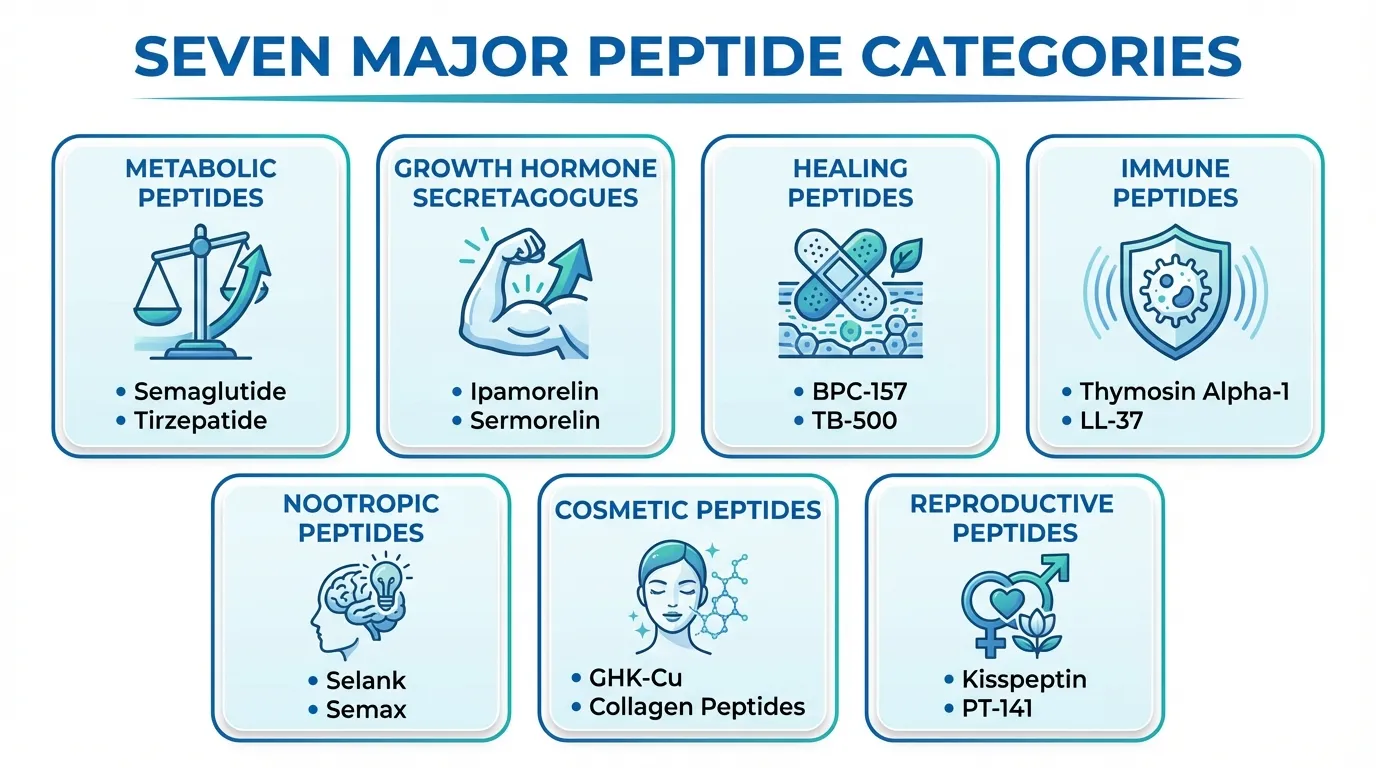
Peptides span a wide range of therapeutic categories. Understanding these categories helps organize the field and set appropriate expectations for each compound. For a detailed breakdown, see Understanding Peptide Categories.
Metabolic Peptides#
These target energy metabolism, appetite regulation, and body composition. Semaglutide and tirzepatide are the most prominent examples — both are FDA-approved for weight management and type 2 diabetes. This category has the strongest clinical evidence base.
Learn more: Weight Loss Peptides and Triple Agonists
Growth Hormone Secretagogues#
Peptides like ipamorelin, sermorelin, and CJC-1295 stimulate the body's own growth hormone release. They are studied for body composition, recovery, and age-related GH decline.
Learn more: Growth Hormone Secretagogues Compared
Healing Peptides#
BPC-157 and TB-500 are studied for tissue repair, including tendon, ligament, and muscle healing. This category has extensive preclinical data but very limited human clinical evidence.
Learn more: Best Healing Peptides, Peptides for Joint Pain
Immune Peptides#
Compounds like thymosin alpha-1, LL-37, and KPV modulate immune function. Thymosin alpha-1 is approved in 35+ countries outside the US.
Learn more: Top Immune-Boosting Peptides
Nootropic Peptides#
Selank, semax, and cerebrolysin are studied for cognitive enhancement and neuroprotection.
Learn more: Best Nootropic Peptides
Cosmetic Peptides#
GHK-Cu, SNAP-8, and collagen peptides are used in skincare formulations for anti-aging and skin rejuvenation.
Learn more: Peptides for Skin Health
Reproductive Peptides#
Kisspeptin, HCG, and PT-141 play roles in reproductive health, fertility, and sexual function.
Learn more: Reproductive Health Peptides
How to Evaluate Peptide Evidence#
One of the most important skills for anyone exploring peptide research is the ability to evaluate evidence quality. Not all peptide evidence is created equal, and understanding the hierarchy of evidence prevents both over-enthusiasm and undue skepticism.
The Evidence Hierarchy#
From weakest to strongest:
- In vitro studies (cell cultures) — show that a peptide has a biological effect in isolated cells. Important for understanding mechanisms but does not predict whole-organism effects
- Animal studies — demonstrate effects in living organisms, including dosing, pharmacokinetics, and safety. However, animal results frequently do not translate to humans
- Phase 1 clinical trials — small human studies focused on safety and basic pharmacokinetics, not efficacy
- Phase 2 clinical trials — moderate-sized studies evaluating efficacy and dose-response in targeted patient populations
- Phase 3 clinical trials — large, randomized, controlled studies that provide definitive efficacy and safety data
- FDA approval / post-market surveillance — regulatory validation based on comprehensive review, followed by real-world safety monitoring
Red Flags in Peptide Claims#
When evaluating peptide information, watch for these warning signs:
- Animal study results presented as if they apply to humans — "BPC-157 heals tendons" when the data is from rat models
- Single-study conclusions — extraordinary claims based on a single study, particularly if unreplicated
- Single research group — evidence concentrated in publications from one laboratory without independent replication
- Dosing extrapolation — animal study doses applied directly to humans without appropriate scaling (use the HED Calculator for proper translation)
- Missing regulatory context — failing to mention that a compound is not approved, is investigational, or has been banned from compounding
For a comprehensive guide on reading research, see Reading Research.
Understanding Peptide Regulation#
The regulatory landscape for peptides is complex and actively evolving. Understanding where a peptide falls in the regulatory framework is essential context for evaluating its evidence and availability.
FDA-Approved Peptides#
These have completed the full regulatory process including Phase 3 clinical trials. Examples include semaglutide (Ozempic/Wegovy), tirzepatide (Mounjaro/Zepbound), and PT-141 (Vyleesi). These can be prescribed by physicians for their approved indications.
Investigational Peptides#
Compounds in active clinical trials that have not yet received approval. Retatrutide and survodutide are current examples. Available only through clinical trial enrollment.
Compounded Peptides#
Peptides that compounding pharmacies can legally prepare under certain conditions. The FDA's 2024 Category 1/2/3 framework significantly restricted this landscape:
- Category 1 — allowed for compounding (no safety concerns identified)
- Category 2 — banned from compounding (safety concerns or other issues)
- Category 3 — under evaluation
Several popular research peptides (BPC-157, thymosin alpha-1, GHK-Cu injectable) were placed in Category 2. For details, see Peptides Under FDA Scrutiny.
Research Chemicals#
Peptides sold as "research chemicals" or "for research purposes only" occupy a gray area. They are not regulated as drugs or supplements and are not intended for human use, though they are widely available.
How Peptides Are Administered#
Different peptides require different administration routes, each with distinct advantages and limitations:
Subcutaneous Injection#
The most common route for research peptides. A small needle delivers the peptide into the fatty tissue beneath the skin. Most peptides come as lyophilized (freeze-dried) powder that must be reconstituted with bacteriostatic water before injection. For reconstitution guidance, see How to Reconstitute Peptides.
Intramuscular Injection#
Some peptides (particularly depot formulations like triptorelin) are injected into muscle tissue for slower absorption.
Oral Administration#
Most peptides are degraded by digestive enzymes, making oral delivery challenging. Exceptions include semaglutide (Rybelsus, which uses an absorption enhancer), KPV (which uses the PepT1 intestinal transporter), and glutathione (though with limited bioavailability).
Intranasal#
Selank and semax are commonly administered intranasally, allowing peptides to reach brain tissue through the nasal mucosa and potentially bypass the blood-brain barrier.
Topical#
GHK-Cu and other cosmetic peptides are applied to the skin. Topical delivery is limited by the skin's barrier function, and most peptides penetrate poorly without special formulations.
Essential Tools for Beginners#
This site provides several tools to help evaluate and understand peptide research:
- Dosing Calculator — weight-based peptide dose calculations
- HED Calculator — translate animal study doses to human-equivalent doses
- GLP-1 Saturation Calculator — model steady-state plasma levels for metabolic peptides
- Half-Life Comparison Chart — compare elimination times across 27+ peptides
- Stack Checker — evaluate known interactions between peptide combinations
Where to Go Next#
Based on your interests, here are recommended starting points:
If you are interested in weight management: Start with Semaglutide and Tirzepatide — the best-studied metabolic peptides with FDA approval.
If you are interested in healing and recovery: Read the Best Healing Peptides guide and individual profiles for BPC-157 and TB-500.
If you are interested in cognitive enhancement: See the Best Nootropic Peptides guide covering selank, semax, and cerebrolysin.
If you are interested in anti-aging: Review Mitochondrial Peptides and Longevity and Best Anti-Aging Peptides.
If you want to understand the science more deeply: Work through the Learn section, starting with What Are Peptides.
Conclusion#
Peptide research is a rapidly evolving field with compounds ranging from FDA-approved medications to early-stage preclinical molecules. The key to navigating this landscape is understanding the evidence hierarchy — distinguishing between established clinical data and preclinical promise — and maintaining appropriate context about regulatory status and evidence limitations.
The most productive approach for beginners is to start with well-characterized compounds, learn to evaluate evidence critically, and build understanding gradually. The tools and educational resources on this site are designed to support that journey.
For comprehensive safety information, see the Safety page. For help evaluating specific peptides, browse the Peptide Directory.
Related Peptide Profiles#
Learn more about the peptides discussed in this article:
- BPC-157 Overview and Research Guide
- BPC-157 Dosing Protocols
- BPC-157 Side Effects and Safety
- Semaglutide Overview and Research Guide
- Semaglutide Dosing Protocols
- Semaglutide Side Effects and Safety
- Ipamorelin Overview and Research Guide
- Ipamorelin Dosing Protocols
- Ipamorelin Side Effects and Safety
- GHK-Cu Overview and Research Guide
- GHK-Cu Dosing Protocols
- GHK-Cu Side Effects and Safety

Frequently Asked Questions About Complete Beginner's Guide to Peptide Research
What does this article cover?
Introduction to peptides — what they are, how they work, major categories, evidence evaluation, and tools for understanding the research. This guide is for educational purposes only and does not constitute medical advice.
Which peptides are discussed in this article?
This article covers BPC-157, Semaglutide, Ipamorelin, GHK-Cu. Key context: BPC-157 (Widely discussed healing peptide that illustrates the gap between preclinical promise and clinica...); Semaglutide (FDA-approved GLP-1 agonist that represents the gold standard for evidence-based peptide therapeutics); Ipamorelin (Selective GH secretagogue commonly used as an introductory example of research-stage peptides). Each peptide is discussed based on available research evidence.
Who is this guide written for?
This guide is written for researchers and individuals seeking an evidence-based overview of the topic covered in "Complete Beginner's Guide to Peptide Research." It summarizes available research data without making treatment recommendations. Always consult a healthcare provider for medical decisions.
What are the key takeaways from this article?
The main findings covered in this article include: Widely discussed healing peptide that illustrates the gap between preclinical promise and clinica.... FDA-approved GLP-1 agonist that represents the gold standard for evidence-based peptide therapeutics. Selective GH secretagogue commonly used as an introductory example of research-stage peptides. These takeaways are based on the research data available at the time of publication.
What is BPC-157 and why is it significant?
BPC-157 is a peptide discussed in this article because: Widely discussed healing peptide that illustrates the gap between preclinical promise and clinical validation. For a complete profile of BPC-157, see the dedicated peptide page on this site.
Continue reading this research review
Free access to the complete analysis with citations and evidence ratings.
150+ peptide profiles · 30+ comparisons · 18 research tools
Medical Disclaimer
This website is for educational and informational purposes only. The information provided is not intended to diagnose, treat, cure, or prevent any disease. Always consult with a qualified healthcare professional before using any peptide or supplement.
Join 2,000+ researchers getting biweekly updates
Enjoyed this article?
The Research Briefing delivers deep-dives like this biweekly — plus new study breakdowns, safety updates, and tool announcements.
Free forever. No spam. Unsubscribe in one click.
Where to Find These Peptides
Continue Exploring
Peptide Profiles
Keep Reading
Most Popular Therapeutic Peptides in 2026: 15 Ranked by Research Interest
The 15 most popular therapeutic peptides in 2026, ranked by clinical trial activity, search interest, and research community adoption. From semaglutide to BPC-157.

How to Choose Your First Peptide: A Decision Framework by Goal
A comprehensive decision framework to help beginners identify the right peptide for their goals. Maps 10 health categories to specific peptide recommendations with evidence levels, administration routes, and regulatory context.

How Long Do Peptides Take to Work? Timelines by Category
How long peptides take to work: timelines for GLP-1 agonists, healing peptides, GH secretagogues, and factors influencing onset.
You Might Also Like
Related content you may find interesting