13 Best Anti-Aging Peptides (2026): Ranked by Clinical Evidence

Introduction#
Anti-aging peptide research sits at the intersection of geroscience, molecular biology, and regenerative medicine. Unlike cosmetic anti-aging products, the peptides reviewed here are being studied for their effects on fundamental aging mechanisms: telomere shortening, cellular senescence, mitochondrial dysfunction, immunosenescence, and more.
This comprehensive 2026 guide covers 13 peptides organized by the cellular aging pathway they target, from telomere modulation and senolytic clearance to mitochondrial protection, autophagy enhancement, immunosenescence reversal, neuroprotection, and skin rejuvenation. For a deeper dive into the cellular mechanisms, see Peptides for Cellular Longevity. Learn how these peptides map to the Hallmarks of Aging framework.
Important note: None of these peptides are FDA-approved for anti-aging indications. SS-31 (elamipretide) is the most clinically advanced but is investigational. Several others are in FDA Category 2 (banned from compounding). This article is for educational and research purposes only.
Telomere Modulation#
Telomeres -- the protective caps on chromosome ends -- shorten with each cell division. When telomeres become critically short, cells enter senescence or apoptosis. Telomere-targeted peptides aim to maintain or restore telomere length.
Epitalon#
Evidence Level: Preclinical | FDA Status: Category 2
Epitalon (Ala-Glu-Asp-Gly) is the most-studied peptide for telomerase activation. In vitro studies reported that epitalon increases telomerase activity in human fibroblasts and CD8+ T cells, with cells exceeding their Hayflick limit by approximately 10 passages. A 2025 study confirmed telomere-lengthening effects across multiple human cell lines. Animal studies showed a 12-13% lifespan increase in SHR mice.
Limitations: Research dominated by a single group (Khavinson Institute). No clinical trials. Independent replication is limited. For a detailed analysis of bioregulator peptide evidence, see our Epitalon & Bioregulator Evidence Guide.
Senolytic Clearance#
Senescent cells accumulate with age and secrete inflammatory factors (SASP) that damage surrounding tissue. Senolytic peptides selectively eliminate these cells.
FOXO4-DRI#
Evidence Level: Preclinical | FDA Status: Not approved
FOXO4-DRI disrupts the FOXO4-p53 nuclear interaction in senescent cells, releasing p53 to trigger apoptosis selectively. In naturally aged mice, it restored fitness, fur density, and renal function (Baar et al., Cell 2017). Recent studies have expanded applications to chondrocyte rejuvenation (2021), age-related testosterone restoration (2020), and keloid fibroblast clearance (2025).
Limitations: No human trials. Large peptide with pharmacokinetic challenges. Long-term effects of senescent cell clearance in humans unknown.
Mitochondrial Protection#
Mitochondrial dysfunction is a central hallmark of aging. Multiple peptides target mitochondrial function through different mechanisms.
SS-31 (Elamipretide)#
Evidence Level: Phase 2/3 clinical trials | FDA Status: Investigational
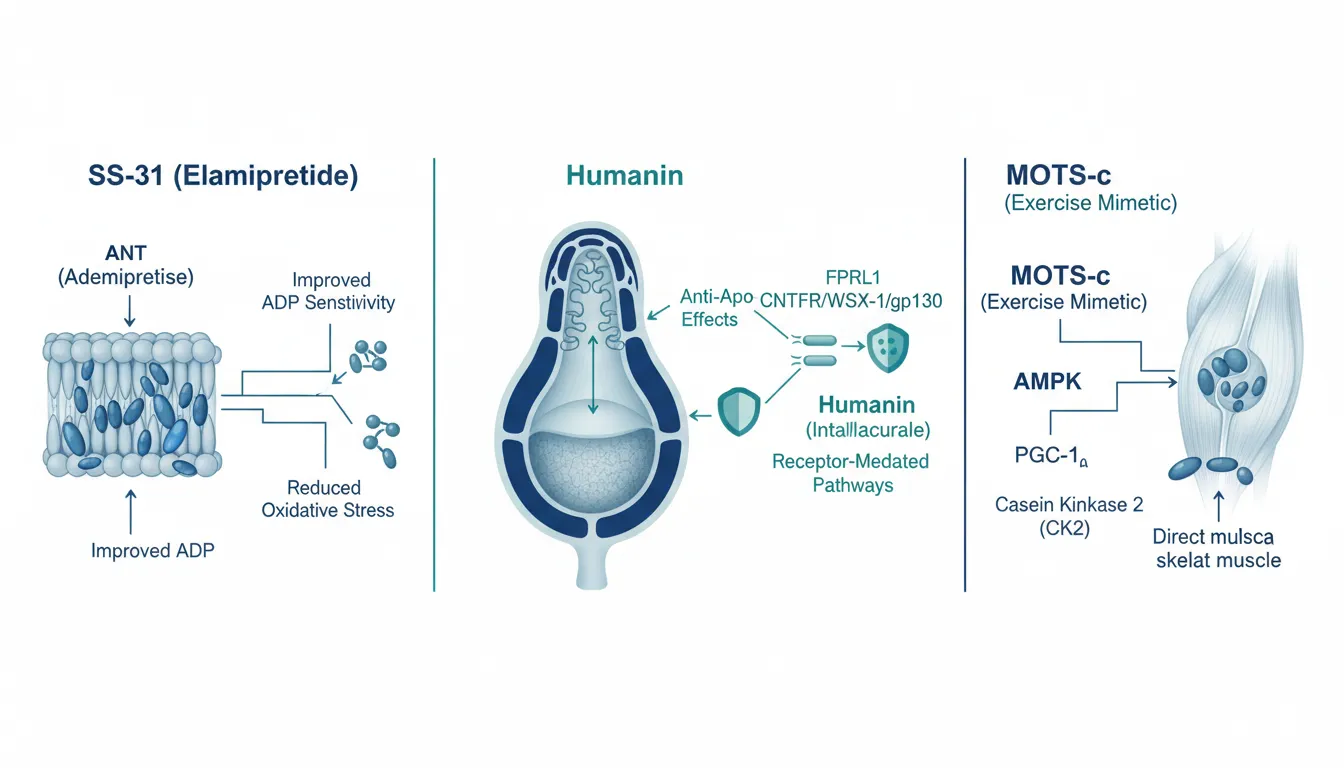
SS-31 concentrates 1,000-5,000 fold in the inner mitochondrial membrane, where it improves ADP sensitivity through the adenine nucleotide translocator (ANT) and reduces oxidative stress. It is the most clinically advanced anti-aging peptide, with Phase 2/3 trials for Barth syndrome, primary mitochondrial myopathy, heart failure, and age-related mitochondrial dysfunction.
A 2019 study showed SS-31 reverses age-related redox stress and improves exercise tolerance in aged mice. A 2025 review provided updated assessment of its therapeutic mechanisms.
Limitations: FDA rejected the Barth syndrome NDA in 2021 on efficacy grounds. Regulatory path uncertain despite ongoing trials.
Humanin#
Evidence Level: Preclinical with translational data | FDA Status: Not approved
Humanin is a 24-amino-acid mitochondrial-derived peptide (MDP) encoded in mtDNA. Endogenous levels decline with age, correlating with disease risk. Humanin protects neurons against amyloid-beta toxicity, improves insulin sensitivity, reduces myocardial infarct size, and acts through both intracellular anti-apoptotic and extracellular receptor-mediated (FPRL1, CNTFR/WSX-1/gp130) pathways.
Limitations: No clinical trials for aging. Complex mechanism not fully elucidated. Synthetic analogs (HNG) developed for improved pharmacology remain preclinical.
MOTS-c#
Evidence Level: Preclinical | FDA Status: Category 2; WADA prohibited
MOTS-c is a 16-amino-acid MDP that functions as an exercise mimetic. Skeletal muscle MOTS-c levels increase nearly 12-fold during exercise. Exogenous MOTS-c doubled running capacity in mice and reversed age-related physical decline by activating the AMPK/PGC-1alpha pathway and directly binding casein kinase 2 (CK2) in skeletal muscle.
Limitations: No human clinical trials. Exercise-mimetic effects may not translate to already-active humans. See Mitochondrial Peptides: The Next Frontier in Longevity for detailed coverage.
Autophagy Enhancement#
Autophagy -- cellular self-cleaning -- declines with age, leading to accumulation of damaged proteins and organelles. Enhanced autophagy is strongly linked to longevity across species.
Tat-Beclin-1#
Evidence Level: Preclinical with lifespan data | FDA Status: Not approved
Tat-Beclin-1 induces autophagy by disrupting the inhibitory beclin 1-BCL2 interaction. Mice engineered with a constitutive disruption of this interaction showed increased basal autophagy, improved healthspan, and extended lifespan (Fernandez et al., Nature 2018). Serum beclin-1 levels above 1.5 ng/mL are associated with a 3.4-fold increased odds of being a healthy centenarian. Tat-Beclin-1 also reduces viral mortality and polyglutamine aggregate accumulation.
Limitations: No human trials. Excessive autophagy could damage healthy tissue. Complex roles in cancer (both tumor-suppressive and promoting).
Anti-Glycation and Cellular Defense#
Glycation -- the non-enzymatic binding of sugars to proteins -- accelerates with age and contributes to tissue damage, particularly in long-lived proteins like collagen.
Carnosine#
Evidence Level: Human data for beta-alanine/carnosine supplementation | FDA Status: Supplement ingredient
Carnosine (beta-alanyl-L-histidine) is an endogenous dipeptide with anti-glycation, antioxidant, anti-senescence, and pH-buffering properties. Muscle carnosine levels decline with age. As an anti-glycation agent, carnosine scavenges reactive carbonyl species that form advanced glycation end products (AGEs) implicated in aging of skin, vasculature, and other tissues.
Carnosine has also shown anti-senescence effects in cell culture, extending the replicative lifespan of human fibroblasts, and acts as a metal chelator and reactive oxygen species scavenger.
Limitations: Orally administered carnosine is rapidly hydrolyzed by serum carnosinase. Beta-alanine supplementation increases muscle carnosine. Anti-aging effects in humans are extrapolated from biochemical data rather than aging-specific clinical trials. See Peptides for Physical Performance for exercise applications.
Longevity Factors#
Some endogenous proteins with powerful effects on lifespan and healthspan decline with age. Peptide approaches aim to supplement or restore these factors.
Klotho Peptides#
Evidence Level: Primate data | FDA Status: Not approved
Klotho peptides are derived from alpha-klotho, a transmembrane protein whose loss causes accelerated aging and whose overexpression extends lifespan in mice. Human klotho levels decline from around age 40. A landmark study showed a single low-dose klotho injection enhanced memory in aged nonhuman primates (Nature Aging, 2023). A 2025 meta-analysis of 6,645 subjects confirmed the positive correlation between klotho levels and cognitive function. Klotho enhances cognition through GluN2B-dependent NMDA receptor signaling and modifies APOE-associated Alzheimer's risk.
Limitations: Klotho is a large protein (~130 kDa). Peptide delivery is challenging. Klotho Neurosciences developing gene therapy approaches. No peptide-form clinical trials.
Vilon#
Evidence Level: Preclinical | FDA Status: Not approved
Vilon (Lys-Glu) is a synthetic dipeptide from the Khavinson bioregulation program targeting thymic involution -- the progressive shrinkage of the thymus that drives immunosenescence. Studies report thymic tissue regeneration and T-cell subpopulation restoration in aged animal models.
Limitations: Research from a single group with limited independent replication. The dipeptide gene regulation mechanism lacks robust validation by international standards.
Thymosin Alpha-1#
Evidence Level: Extensive clinical data (11,000+ subjects) | FDA Status: Category 2; approved in 35+ countries
Thymosin Alpha-1 is primarily an immune peptide, but it directly addresses immunosenescence -- the age-related decline in immune function that is a hallmark of biological aging. A 2024 comprehensive review of 30+ clinical trials involving over 11,000 human subjects confirmed its role as a well-tolerated immune modulator 1. Thymosin Alpha-1 restores T-cell function, which declines significantly with age, contributing to increased infection susceptibility, reduced vaccine efficacy, chronic inflammation ("inflammaging"), and impaired wound healing.
Limitations: Despite being one of the most clinically validated peptides on this list, Thymosin Alpha-1 was banned from US compounding in 2024 (FDA Category 2). Its anti-aging applications are secondary to its primary immune-modulating effects.
Neuroprotection#
Neurodegeneration is a major component of aging. The following peptide targets brain aging through pineal gland regulation and neuroprotective mechanisms.
Pinealon#
Evidence Level: Preclinical only | FDA Status: Not approved
Pinealon (Glu-Asp-Arg) is a tripeptide bioregulator studied primarily for its effects on pineal gland function and neuroprotection. The peptide is proposed to regulate melatonin synthesis by the pineal gland and to have neuroprotective effects in aging models. Pinealon belongs to the same Khavinson bioregulation program as Epitalon and Vilon.
Limitations: Very limited evidence base, with few studies available in peer-reviewed English-language journals. Research is dominated by a single group. Claims about anti-aging effects should be treated with significant caution.
Skin Aging#
While the peptides above target systemic aging, several peptides specifically address skin aging through distinct mechanisms.
GHK-Cu#
Evidence Level: Extensive in vitro; limited clinical | FDA Status: Category 2
GHK-Cu is a naturally occurring tripeptide-copper complex that declines with age (200 ng/mL at age 20 to 80 ng/mL by age 60). The 2015 gene expression study showed GHK modulates 4,000+ human genes involved in collagen synthesis, antioxidant defense, DNA repair, and anti-inflammatory pathways. GHK-Cu stimulates collagen I and III production, promotes wound healing, and has been shown to improve skin thickness, elasticity, and firmness in topical applications.
Limitations: Gap between gene expression data and measurable clinical anti-aging outcomes. Most evidence is in vitro. Topical formulations are widely available commercially but systemic anti-aging applications are less studied.
SNAP-8#
Evidence Level: In vitro and clinical cosmetic studies | FDA Status: Cosmetic ingredient
SNAP-8 (acetyl octapeptide-3) inhibits SNARE complex formation at the neuromuscular junction, reducing muscle contraction intensity. This is mechanistically similar to botulinum toxin but much milder, targeting expression lines and wrinkles through topical application rather than injection.
Clinical cosmetic studies report wrinkle depth reduction of up to 63% after 28 days of topical application at 10% concentration. SNAP-8 is widely used in cosmetic formulations and represents the most commercially established anti-aging peptide.
Limitations: Effects are cosmetic rather than systemic. Does not address underlying cellular aging. Primarily studied by cosmetics manufacturers with potential bias.
Evidence Comparison#
| Peptide | Aging Pathway | Evidence Level | Human Data | FDA Status |
|---|---|---|---|---|
| Epitalon | Telomere modulation | Preclinical | None | Category 2 |
| FOXO4-DRI | Senolytic clearance | Preclinical | None | Not approved |
| SS-31 | Mitochondrial protection | Phase 2/3 | Clinical trials | Investigational |
| Humanin | Mitochondrial protection | Preclinical+ | Observational | Not approved |
| MOTS-c | Mitochondrial / exercise | Preclinical | Observational | Category 2 |
| Tat-Beclin-1 | Autophagy enhancement | Preclinical (lifespan) | Biomarker only | Not approved |
| Carnosine | Anti-glycation / defense | Human (beta-alanine) | Supplement trials | Supplement |
| Klotho | Longevity factor | Primate data | Epidemiological | Not approved |
| Vilon | Immunosenescence | Preclinical | None | Not approved |
| GHK-Cu | Skin / gene modulation | In vitro + clinical | Topical studies | Category 2 |
| SNAP-8 | Skin expression lines | Clinical cosmetic | Cosmetic trials | Cosmetic ingredient |
| Thymosin Alpha-1 | Immunosenescence | Extensive clinical | 11,000+ subjects | Category 2 |
| Pinealon | Neuroprotection / pineal | Very limited | None | Not approved |
What Has Changed Since 2025#
Several developments have shifted the anti-aging peptide landscape in 2025-2026:
-
Klotho primate data -- The 2023 Nature Aging publication showing cognitive enhancement in aged nonhuman primates moved klotho from a theoretical longevity target to a near-translational candidate, with gene therapy approaches now in development.
-
FOXO4-DRI expansion -- New applications in keloid treatment (Communications Biology, 2025) and continued validation across tissue types strengthen the senolytic peptide concept.
-
Autophagy-longevity link -- Growing centenarian biomarker data linking beclin-1 levels to exceptional longevity provides human validation for the Tat-Beclin-1 mechanism.
-
Myostatin-aging intersection -- Anti-myostatin antibodies like bimagrumab are addressing sarcopenia (age-related muscle loss) through a body composition approach. See Next-Generation Myostatin Inhibitors.
-
FDA Category 2 impact -- The 2024 ban on compounding for epitalon, GHK-Cu, MOTS-c, and thymosin alpha-1 has significantly restricted access to several anti-aging peptides in the US.
Conclusion#
The anti-aging peptide landscape in 2026 spans from well-validated clinical candidates (SS-31, Thymosin Alpha-1) to early-stage research compounds (vilon, pinealon), with each targeting distinct cellular aging mechanisms. The most scientifically compelling developments are in three areas: klotho's primate cognition data, the expanding senolytic evidence for FOXO4-DRI, and the robust genetic validation of autophagy-longevity connections underlying Tat-Beclin-1's mechanism.
No single peptide addresses all aging mechanisms, and the field increasingly recognizes that rational combinations targeting multiple aging hallmarks may ultimately be more effective than single-target approaches. The critical bottleneck remains translating preclinical promise into rigorously validated human anti-aging interventions.
For related reading, see Peptides for Cellular Longevity, Mitochondrial Peptides: The Next Frontier in Longevity, and the Peptide Finder Quiz for personalized peptide recommendations.
References#
Related Peptide Profiles#
Learn more about the peptides discussed in this article:
- Epitalon Overview and Research Guide
- Epitalon Dosing Protocols
- Epitalon Side Effects and Safety
- FOXO4-DRI Overview and Research Guide
- FOXO4-DRI Dosing Protocols
- FOXO4-DRI Side Effects and Safety
- Humanin Overview and Research Guide
- Humanin Dosing Protocols
- Humanin Side Effects and Safety
- Carnosine Overview and Research Guide
- Carnosine Dosing Protocols
- Carnosine Side Effects and Safety
- Klotho Peptides Overview and Research Guide
- Klotho Peptides Dosing Protocols
- Klotho Peptides Side Effects and Safety
- Tat-Beclin-1 Overview and Research Guide
- Tat-Beclin-1 Dosing Protocols
- Tat-Beclin-1 Side Effects and Safety
- Vilon Overview and Research Guide
- Vilon Dosing Protocols
- Vilon Side Effects and Safety
- SS-31 Overview and Research Guide
- SS-31 Dosing Protocols
- SS-31 Side Effects and Safety
- MOTS-c Overview and Research Guide
- MOTS-c Dosing Protocols
- MOTS-c Side Effects and Safety
- GHK-Cu Overview and Research Guide
- GHK-Cu Dosing Protocols
- GHK-Cu Side Effects and Safety
- SNAP-8 Overview and Research Guide
- SNAP-8 Dosing Protocols
- SNAP-8 Side Effects and Safety
- Thymosin Alpha-1 Overview and Research Guide
- Thymosin Alpha-1 Dosing Protocols
- Thymosin Alpha-1 Side Effects and Safety
- Pinealon Overview and Research Guide
- Pinealon Dosing Protocols
- Pinealon Side Effects and Safety
Footnotes#
-
Comprehensive Review of Safety and Efficacy of Thymosin Alpha 1 in Human Clinical Trials. PMID: 38308608. 2024. ↩

Frequently Asked Questions About 13 Best Anti-Aging Peptides (2026): Ranked by Clinical Evidence
What does this article cover?
Comprehensive guide to 13 anti-aging peptides grouped by mechanism — telomere modulation, senolytic clearance, mitochondrial protection, autophagy induction, immunosenescence, neuroprotection, and skin rejuvenation — with evidence levels and research status. This guide is for educational purposes only and does not constitute medical advice.
Which peptides are discussed in this article?
This article covers Epitalon, FOXO4-DRI, Humanin, Carnosine, Klotho Peptides, Tat-Beclin-1, Vilon, SS-31, MOTS-c, GHK-Cu, SNAP-8, Thymosin Alpha-1, and Pinealon. Key context: Epitalon (Tetrapeptide studied for telomerase activation and telomere elongation in human somatic cells); FOXO4-DRI (Senolytic peptide that selectively eliminates senescent cells by disrupting the FOXO4-p53 interaction); SS-31 (Most clinically advanced mitochondrial peptide in Phase 2/3 trials). Each peptide is discussed based on available research evidence.
Who is this guide written for?
This guide is written for researchers and individuals seeking an evidence-based overview of the topic covered in "Best Anti-Aging Peptides in 2026: Complete Research Guide." It summarizes available research data without making treatment recommendations. Always consult a healthcare provider for medical decisions.
What are the key takeaways from this article?
The main findings covered in this article include: Tetrapeptide studied for telomerase activation and telomere elongation in human somatic cells. Senolytic peptide that selectively eliminates senescent cells by disrupting the FOXO4-p53 interac.... Mitochondrial-derived peptide with cytoprotective effects that decline with age, linked to neurop.... These takeaways are based on the research data available at the time of publication.
What is Epitalon and why is it significant?
Epitalon is a peptide discussed in this article because: Tetrapeptide studied for telomerase activation and telomere elongation in human somatic cells. For a complete profile of Epitalon, see the dedicated peptide page on this site.
Continue reading this research review
Free access to the complete analysis with citations and evidence ratings.
150+ peptide profiles · 30+ comparisons · 18 research tools
Medical Disclaimer
This website is for educational and informational purposes only. The information provided is not intended to diagnose, treat, cure, or prevent any disease. Always consult with a qualified healthcare professional before using any peptide or supplement.
Join 2,000+ researchers getting biweekly updates
Enjoyed this article?
The Research Briefing delivers deep-dives like this biweekly — plus new study breakdowns, safety updates, and tool announcements.
Free forever. No spam. Unsubscribe in one click.
Where to Find These Peptides
Continue Exploring
Peptide Profiles
Keep Reading

The Hallmarks of Aging: Which Peptides Target Which?
Definitive mapping of the 12 hallmarks of aging to specific peptide interventions including Epitalon, FOXO4-DRI, SS-31, MOTS-c, and NAD+.

Anti-Aging Peptides by Mechanism: Senolytics, Telomeres, Mitochondria, and Hormones
Research review of anti-aging peptides organized by mechanism of action including senolytic peptides (FOXO4-DRI), telomere peptides (epitalon), mitochondrial peptides (SS-31, MOTS-c), tissue remodelers (GHK-Cu), and bioregulators (pinealon, thymalin). Evidence quality assessment for each approach.

Peptides for Cellular Longevity: From Telomeres to Senescence
A guide to peptides targeting cellular aging mechanisms — senolytic peptides (FOXO4-DRI), telomere modulators (Epitalon), autophagy inducers (Tat-Beclin-1), mitochondrial protectors (Humanin), and longevity factors (Klotho, Vilon).
You Might Also Like
Related content you may find interesting