How to Reconstitute Peptides: A Step-by-Step Guide to Peptide Preparation

Introduction#
Reconstitution is the process of adding a liquid solvent to a lyophilized (freeze-dried) peptide powder to create an injectable solution. Most research peptides are supplied as lyophilized powders because the dry form is significantly more stable during shipping and long-term storage than a liquid solution. Before a lyophilized peptide can be used in a research protocol, it must be properly reconstituted.
While the basic process is straightforward -- add solvent to powder, swirl gently, refrigerate -- the details matter. Incorrect reconstitution can degrade the peptide, introduce contamination, or produce inaccurate concentrations that compromise research results. This guide covers every step of the process: understanding the starting materials, calculating concentrations, performing the reconstitution, and storing the finished solution.
This information is provided for educational and research purposes. For pharmaceutical peptide products like semaglutide (Ozempic, Wegovy) and HCG, always follow the manufacturer's specific instructions included with the product.
What Is Lyophilization?#
Lyophilization, or freeze-drying, is a dehydration process that removes water from a peptide solution by freezing it and then reducing the surrounding pressure to allow the frozen water to sublimate directly from solid ice to vapor. The result is a dry, porous cake or powder that retains the peptide's molecular structure.
Lyophilized peptides offer several advantages over liquid formulations:
- Stability: Dry peptides are far more resistant to degradation from heat, oxidation, and hydrolysis
- Shelf life: Properly stored lyophilized peptides can remain stable for months to years at -20 degrees C
- Shipping: Powder is more resilient during transit than liquid formulations
- Flexibility: Researchers can reconstitute to their desired concentration
The lyophilized cake should appear as a white to off-white powder or puck at the bottom of the vial. If the powder appears discolored, wet, or has visible contamination, do not use it.
Materials Needed#
Before beginning reconstitution, gather all required materials:
Essential Materials#
| Item | Purpose | Notes |
|---|---|---|
| Lyophilized peptide vial | Contains the peptide to be reconstituted | Verify the peptide identity and quantity (mg) on the label |
| Bacteriostatic water (BAC water) | Solvent for reconstitution | Contains 0.9% benzyl alcohol as a preservative; standard for multi-use vials |
| Insulin syringes (1 mL / 100 units) | For measuring and adding solvent, and for drawing doses | Use separate syringes for reconstitution and dosing |
| Alcohol swabs | Sterilize vial tops before piercing | 70% isopropyl alcohol pads |
Optional Materials#
| Item | Purpose | Notes |
|---|---|---|
| Sterile water for injection | Alternative solvent | No preservative; use within 24 hours of reconstitution |
| 0.9% sodium chloride (normal saline) | Alternative solvent for some peptides | May be preferred for certain peptide formulations |
| Sterile gloves | Contamination prevention | Recommended for aseptic technique |
| Sharps container | Safe syringe disposal | Required for proper needle disposal |
Choosing the Right Solvent#
Bacteriostatic water is the standard reconstitution solvent for most research peptides. The 0.9% benzyl alcohol preservative inhibits bacterial growth, allowing multi-dose use over several weeks. This is the recommended choice for peptides that will be used over multiple days or weeks.
Sterile water for injection contains no preservative and should be used when benzyl alcohol sensitivity is a concern or when the entire vial will be used in a single session. Without preservative, any unused solution should be discarded within 24 hours.
Normal saline (0.9% NaCl) is occasionally specified for certain peptides. Check the peptide's specific documentation for solvent recommendations.
Some pharmaceutical peptide products come with their own supplied diluent. HCG, for example, is often supplied with a specific diluent that should be used instead of generic bacteriostatic water. Always use the manufacturer-supplied diluent when one is provided.
Calculating Concentration#
Before reconstituting, determine what concentration you want to achieve. This determines how much solvent to add.
The Basic Formula#
Concentration = Peptide amount (mcg) / Solvent volume (mL)
Or rearranged to find the volume needed:
Solvent volume (mL) = Peptide amount (mcg) / Desired concentration (mcg/mL)
Common Reconstitution Examples#
Example 1: BPC-157 (5 mg vial)
Target dose: 250 mcg per injection. Want each 0.1 mL (10 units on insulin syringe) to deliver 250 mcg.
- Desired concentration: 250 mcg / 0.1 mL = 2,500 mcg/mL = 2.5 mg/mL
- Solvent needed: 5,000 mcg / 2,500 mcg/mL = 2.0 mL of bacteriostatic water
- Result: Add 2.0 mL BAC water. Each 10 units on an insulin syringe = 250 mcg.
Example 2: Ipamorelin (5 mg vial)
Target dose: 200 mcg per injection. Want each 0.1 mL to deliver 200 mcg.
- Desired concentration: 200 mcg / 0.1 mL = 2,000 mcg/mL = 2.0 mg/mL
- Solvent needed: 5,000 mcg / 2,000 mcg/mL = 2.5 mL of bacteriostatic water
- Result: Add 2.5 mL BAC water. Each 10 units on an insulin syringe = 200 mcg.
Example 3: Sermorelin (2 mg vial)
Target dose: 100 mcg per injection. Want each 0.05 mL (5 units) to deliver 100 mcg.
- Desired concentration: 100 mcg / 0.05 mL = 2,000 mcg/mL = 2.0 mg/mL
- Solvent needed: 2,000 mcg / 2,000 mcg/mL = 1.0 mL of bacteriostatic water
- Result: Add 1.0 mL BAC water. Each 5 units on an insulin syringe = 100 mcg.
Quick Reference Table#
| Vial Size | BAC Water Added | Concentration | 10 units (0.1 mL) delivers |
|---|---|---|---|
| 5 mg | 1.0 mL | 5.0 mg/mL | 500 mcg |
| 5 mg | 2.0 mL | 2.5 mg/mL | 250 mcg |
| 5 mg | 2.5 mL | 2.0 mg/mL | 200 mcg |
| 5 mg | 5.0 mL | 1.0 mg/mL | 100 mcg |
| 10 mg | 2.0 mL | 5.0 mg/mL | 500 mcg |
| 10 mg | 5.0 mL | 2.0 mg/mL | 200 mcg |
| 2 mg | 1.0 mL | 2.0 mg/mL | 200 mcg |
| 2 mg | 2.0 mL | 1.0 mg/mL | 100 mcg |
For more precise calculations including body-weight-based dosing, use our dosing calculator.
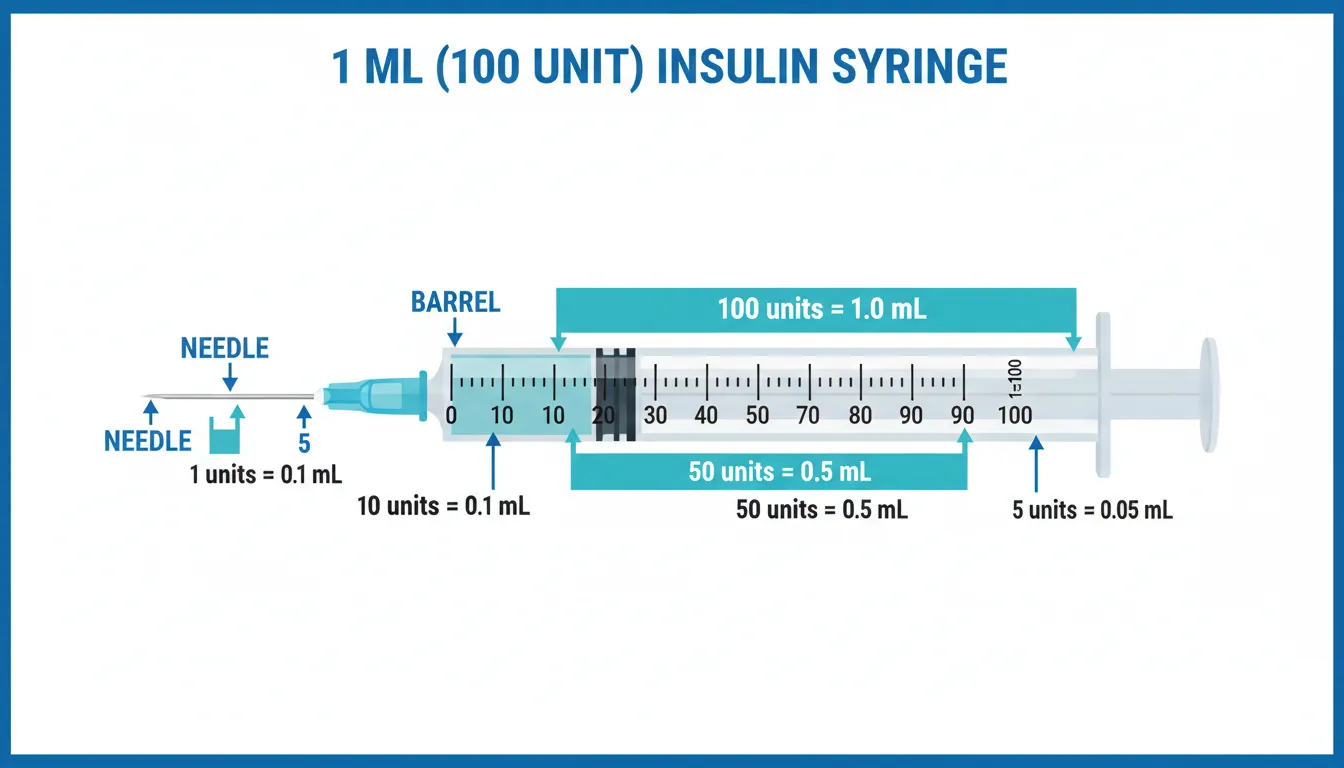
Understanding Insulin Syringe Markings#
A standard 1 mL insulin syringe is marked in "units" from 0 to 100:
- 100 units = 1.0 mL
- 50 units = 0.5 mL
- 10 units = 0.1 mL
- 5 units = 0.05 mL
- 1 unit = 0.01 mL
When calculating your dose volume, express it in both mL and insulin syringe units to avoid measurement errors. For very small doses (under 5 units), consider reconstituting with less water to increase the concentration and make measurement more practical.
Step-by-Step Reconstitution Process#
Step 1: Prepare Your Workspace#
- Clean your work surface with 70% isopropyl alcohol or a suitable disinfectant
- Wash hands thoroughly or wear sterile gloves
- Gather all materials before starting
- Ensure the peptide vial has been at room temperature for 5-10 minutes if previously frozen (to reduce condensation on the vial interior)
Step 2: Inspect the Peptide Vial#
- Verify the label matches the intended peptide and quantity
- Check the expiration date if present
- Inspect the lyophilized powder through the vial -- it should be white to off-white
- Do not use if the powder appears discolored, liquefied, or the vial seal is compromised
Step 3: Sterilize Vial Tops#
- Wipe the rubber stopper of the peptide vial with an alcohol swab
- Wipe the rubber stopper of the bacteriostatic water vial with an alcohol swab
- Allow alcohol to air dry for a few seconds before piercing
Step 4: Draw the Bacteriostatic Water#
- Attach a new, sterile needle to the syringe (or use a pre-attached insulin syringe)
- Draw the calculated volume of bacteriostatic water into the syringe
- Remove any air bubbles by tapping the syringe and pushing excess air out
Step 5: Add Solvent to the Peptide Vial#
This is the most critical step. Peptides are fragile molecules that can be damaged by agitation:
- Insert the needle through the rubber stopper of the peptide vial at a slight angle
- Direct the stream of water against the inside wall of the vial, not directly onto the lyophilized powder. This is essential -- a direct stream onto the powder can damage the peptide through shear forces
- Depress the plunger slowly and steadily. Add the water in a controlled stream, allowing it to run down the vial wall and contact the powder gently from the side
- Do not inject rapidly or forcefully. The water should flow slowly and make contact with the powder gradually
Step 6: Allow the Peptide to Dissolve#
- Do not shake the vial. Vigorous shaking can denature (unfold and damage) the peptide through mechanical stress and foam formation
- Gently swirl the vial by rolling it between your palms or tilting it in slow circles
- If the peptide does not dissolve immediately, leave the vial in the refrigerator for 15-30 minutes. Many peptides will dissolve fully on their own with gentle swirling and time
- The solution should be clear and colorless when fully dissolved. If it remains cloudy or contains visible particles after 30 minutes of gentle swirling, the peptide may have degraded or may have solubility issues in the chosen solvent
Step 7: Label the Vial#
After reconstitution, label the vial with:
- Peptide name
- Concentration (mg/mL or mcg per unit)
- Date of reconstitution
- Solvent used
- Storage temperature
This prevents confusion, especially when multiple peptides are being used in a research setting.
Storage Guidelines#
Proper storage is critical for maintaining peptide integrity after reconstitution.
Lyophilized (Unreconstituted) Peptides#
| Storage Condition | Temperature | Expected Stability |
|---|---|---|
| Long-term storage | -20 degrees C (freezer) | Months to years depending on peptide |
| Short-term storage | 2-8 degrees C (refrigerator) | Weeks to months |
| Room temperature | 15-25 degrees C | Days to weeks (not recommended for extended periods) |
Reconstituted Peptides#
| Solvent Used | Storage Temperature | Maximum Duration |
|---|---|---|
| Bacteriostatic water | 2-8 degrees C (refrigerator) | 3-4 weeks |
| Sterile water (no preservative) | 2-8 degrees C (refrigerator) | 24 hours |
| Normal saline | 2-8 degrees C (refrigerator) | 1-2 weeks |
General Storage Rules#
- Refrigerate immediately after reconstitution. Do not leave reconstituted peptides at room temperature for extended periods.
- Protect from light. Many peptides are photosensitive. Store vials in a dark location or wrap in foil.
- Do not freeze reconstituted solutions. Freezing and thawing can damage the peptide through ice crystal formation and denaturation. This applies to the reconstituted liquid only -- lyophilized powder can be stored frozen.
- Minimize needle punctures. Each time a needle is inserted through the stopper, it introduces a small contamination risk. Use a consistent technique and avoid unnecessary piercing.
- Discard if cloudy. If a previously clear solution becomes cloudy, develops particles, or changes color, the peptide may have degraded. Do not use it.
Common Mistakes to Avoid#
Mistake 1: Injecting Water Directly onto the Powder#
Spraying bacteriostatic water directly onto the lyophilized cake can damage the peptide through shear forces. Always aim the stream at the vial wall and let the water trickle down to the powder.
Mistake 2: Shaking the Vial#
Vigorous shaking creates foam and subjects the peptide to mechanical stress that can cause denaturation. Proteins and peptides are sensitive to the air-liquid interfaces created during shaking. Always swirl gently or roll between palms.
Mistake 3: Using the Wrong Solvent Volume#
Adding too little solvent creates an overly concentrated solution that may cause injection site irritation. Adding too much creates a dilute solution that requires drawing larger volumes, reducing dose accuracy. Calculate the correct volume before reconstituting.
Mistake 4: Storing at the Wrong Temperature#
Leaving reconstituted peptides at room temperature accelerates degradation. Freezing reconstituted peptides damages them through ice crystal formation. Always refrigerate at 2-8 degrees C.
Mistake 5: Reusing Syringes#
Each syringe should be used once. Reusing syringes compromises sterility and can introduce bacteria into the peptide vial, especially when puncturing the stopper multiple times with the same needle.
Mistake 6: Ignoring Expiration After Reconstitution#
Once reconstituted in bacteriostatic water, most peptides should be used within 3-4 weeks. Reconstituted peptides degrade faster than lyophilized forms. Mark the reconstitution date on each vial and discard solutions that exceed the recommended timeframe.
Mistake 7: Not Accounting for Dead Volume#
Insulin syringes retain a small amount of liquid (dead volume) in the hub and needle. For very small doses, this can represent a significant percentage of the intended volume. Low dead volume syringes are available and recommended for doses under 10 units (0.1 mL).
Peptide-Specific Considerations#
Different peptides may have specific reconstitution requirements. Always check the peptide-specific dosing page for individual recommendations.
Peptides Stable in Standard BAC Water#
Most research peptides reconstitute well in bacteriostatic water at neutral pH:
- BPC-157 -- notably stable across a wide pH range, including gastric acid
- Ipamorelin -- standard BAC water reconstitution
- Sermorelin -- standard BAC water reconstitution
- GHRP-2 and GHRP-6 -- standard BAC water reconstitution
- CJC-1295 variants -- standard BAC water reconstitution
Peptides Requiring Special Attention#
- Methionine-containing peptides (e.g., Semax) are susceptible to oxidation. Minimize exposure to air and UV light during and after reconstitution.
- Large peptides and proteins (e.g., HGH, follistatin) may require gentler handling and longer dissolving times. Never shake these vials.
- Copper-containing peptides (GHK-Cu) are typically used topically and do not require reconstitution for topical application. For injectable research formulations, follow specific protocols.
Pre-Mixed Pharmaceutical Peptides#
Some FDA-approved peptide products come pre-mixed and do not require reconstitution:
- Semaglutide injection pens (Ozempic, Wegovy) -- supplied as ready-to-use solutions in pre-filled pens
- Tirzepatide injection pens (Mounjaro, Zepbound) -- supplied as ready-to-use solutions in pre-filled pens
- Semax intranasal solution -- supplied as 0.1% or 1% ready-to-use nasal drops (Russian pharmaceutical product)
For pharmaceutical products, always follow the manufacturer's instructions provided with the product. Do not attempt to reconstitute or modify pre-filled injection pens.
Reconstitution Math: Worked Examples#
How to Calculate Your Dose in Syringe Units#
Once you know the concentration, use this formula to find how many units to draw:
Units to draw = (Desired dose in mcg / Concentration in mcg/mL) x 100
Example: You want 300 mcg of BPC-157 from a 5 mg vial reconstituted with 2.0 mL BAC water.
- Concentration = 5,000 mcg / 2.0 mL = 2,500 mcg/mL
- Volume needed = 300 mcg / 2,500 mcg/mL = 0.12 mL
- Syringe units = 0.12 mL x 100 = 12 units
Draw 12 units on the insulin syringe.
How Many Doses Per Vial#
Doses per vial = Total peptide amount (mcg) / Dose per injection (mcg)
Example: A 5 mg (5,000 mcg) vial of ipamorelin with a dose of 200 mcg per injection.
- Doses per vial = 5,000 mcg / 200 mcg = 25 doses
At once daily dosing, this vial will last 25 days. At twice daily dosing, approximately 12 days. Factor in a small amount of waste from dead volume when estimating practical yield.
Frequently Asked Questions#
Can I use regular water instead of bacteriostatic water?#
No. Tap water, distilled water, and other non-sterile water sources contain bacteria and contaminants that will contaminate the peptide solution and create serious infection risk. Only use bacteriostatic water, sterile water for injection, or normal saline.
How do I know if my reconstituted peptide has gone bad?#
A properly reconstituted peptide solution should be clear and colorless. Signs of degradation include cloudiness, visible particles or floaters, discoloration (yellow or brown tint), or unusual odor. If any of these are present, discard the solution.
Can I travel with reconstituted peptides?#
Reconstituted peptides must remain refrigerated. For short trips, an insulated cooler with ice packs can maintain appropriate temperature for several hours. For longer travel, lyophilized (unreconstituted) peptides are more practical as they are stable at room temperature for short periods and do not require cold chain.
What if the peptide does not dissolve?#
Most peptides dissolve within a few minutes of gentle swirling. If the powder does not dissolve after 30 minutes:
- Leave the vial in the refrigerator for 1-2 hours, swirling gently every 15-20 minutes
- Check that you used the correct solvent
- The peptide may have degraded during shipping or storage
- Some peptides have lower solubility and may benefit from slight warming (no higher than room temperature) or use of a different solvent such as dilute acetic acid (specific to certain peptides)
Can I reconstitute a vial, use some, and freeze the rest?#
Do not freeze reconstituted peptide solutions. If you need to preserve the peptide long-term, keep the lyophilized powder frozen and only reconstitute what you will use within 3-4 weeks.
Conclusion#
Proper reconstitution is a fundamental skill for peptide research. The process itself is simple -- add bacteriostatic water to the vial wall, swirl gently, refrigerate -- but attention to detail at each step ensures the peptide retains its biological activity and the solution remains sterile.
The key principles to remember are: use the correct solvent (bacteriostatic water for multi-use), calculate your concentration before adding solvent, never shake the vial, always direct the water stream against the vial wall rather than onto the powder, refrigerate immediately after reconstitution, and discard the solution within 3-4 weeks (or 24 hours if using sterile water without preservative).
For peptide-specific reconstitution details and dosing information, visit our peptide directory and select the dosing page for your specific compound. Our dosing calculator can also help with concentration and volume calculations.
Related Peptide Profiles#
Learn more about the peptides discussed in this article:
- BPC-157 Overview and Research Guide
- BPC-157 Dosing Protocols
- BPC-157 Side Effects and Safety
- Ipamorelin Overview and Research Guide
- Ipamorelin Dosing Protocols
- Ipamorelin Side Effects and Safety
- Semaglutide Overview and Research Guide
- Semaglutide Dosing Protocols
- Semaglutide Side Effects and Safety
- HCG Overview and Research Guide
- HCG Dosing Protocols
- HCG Side Effects and Safety
- Sermorelin Overview and Research Guide
- Sermorelin Dosing Protocols
- Sermorelin Side Effects and Safety

Frequently Asked Questions About How to Reconstitute Peptides: A Step-by-Step Guide to Peptide Preparation
What does this article cover?
Learn how to reconstitute lyophilized peptides safely. Step-by-step guide covering bacteriostatic water, concentration calculations, storage, and common mistakes to avoid. This guide is for educational purposes only and does not constitute medical advice.
Which peptides are discussed in this article?
This article covers BPC-157, Ipamorelin, Semaglutide, HCG, Sermorelin. Key context: BPC-157 (Commonly reconstituted peptide used as a practical example for reconstitution calculations and st...); Ipamorelin (Growth hormone secretagogue frequently reconstituted for research protocols, illustrating standar...); Semaglutide (Example of a pre-mixed pharmaceutical peptide that does not require reconstitution, contrasting w...). Each peptide is discussed based on available research evidence.
Who is this guide written for?
This guide is written for researchers and individuals seeking an evidence-based overview of the topic covered in "How to Reconstitute Peptides: A Step-by-Step Guide to Peptide Preparation." It summarizes available research data without making treatment recommendations. Always consult a healthcare provider for medical decisions.
What are the key takeaways from this article?
The main findings covered in this article include: Commonly reconstituted peptide used as a practical example for reconstitution calculations and st.... Growth hormone secretagogue frequently reconstituted for research protocols, illustrating standar.... Example of a pre-mixed pharmaceutical peptide that does not require reconstitution, contrasting w.... These takeaways are based on the research data available at the time of publication.
What is BPC-157 and why is it significant?
BPC-157 is a peptide discussed in this article because: Commonly reconstituted peptide used as a practical example for reconstitution calculations and storage guidelines. For a complete profile of BPC-157, see the dedicated peptide page on this site.
Continue reading this research review
Free access to the complete analysis with citations and evidence ratings.
150+ peptide profiles · 30+ comparisons · 18 research tools
Medical Disclaimer
This website is for educational and informational purposes only. The information provided is not intended to diagnose, treat, cure, or prevent any disease. Always consult with a qualified healthcare professional before using any peptide or supplement.
Join 2,000+ researchers getting biweekly updates
Enjoyed this article?
The Research Briefing delivers deep-dives like this biweekly — plus new study breakdowns, safety updates, and tool announcements.
Free forever. No spam. Unsubscribe in one click.
Where to Find These Peptides
Continue Exploring
Peptide Profiles
Keep Reading

Understanding Peptide Dosing: Units, Conversions, and Calculations
Peptide dosing guide: units, conversions, and calculations. Learn mcg-to-mg conversions, syringe units, and common dosing errors.
Understanding Peptide Side Effects: A Comprehensive Safety Guide
A thorough, evidence-based guide to peptide side effects by category — covering GLP-1 agonists, GH secretagogues, tissue repair peptides, and melanocortins — with serious risk flags, drug interactions, monitoring recommendations, and guidance on when to stop.
Peptide Stacking Safety: Synergies, Interactions, and Protocol Design
A safety-focused guide to combining peptides — covering known synergistic combinations, contraindicated pairings, timing and administration principles, recommended bloodwork monitoring, and red flags to watch for during stacked protocols.
You Might Also Like
Related content you may find interesting