How Long Do Peptides Take to Work? Timelines by Category

Introduction#
"How long will it take to see results?" is one of the most common questions about peptide use. The honest answer is: it depends entirely on which peptide, what outcome you are measuring, and individual biological variation.
Some peptides produce measurable effects within hours (growth hormone secretagogues cause an acute GH pulse shortly after administration). Others require weeks or months of consistent use before meaningful changes become apparent (weight loss peptides, anti-aging peptides). And for many research peptides, the timeline data simply does not exist because adequate human studies have not been conducted.
This guide provides realistic timeline expectations for major peptide categories, based on clinical trial data where available and biological plausibility where it is not.
Factors That Influence Onset of Action#
Before looking at specific peptides, several general factors affect how quickly any peptide produces noticeable effects:
Half-life and dosing frequency: Peptides with longer half-lives (like semaglutide at approximately 7 days) take longer to reach steady-state concentrations but maintain more consistent blood levels. Short half-life peptides (like ipamorelin at approximately 2 hours) produce acute effects quickly but require frequent dosing for sustained impact.
Dose titration: Many peptides are started at a low dose and gradually increased. This means full effects are not expected until the target dose is reached, which can take weeks.
Mechanism of action: Peptides that work through direct receptor activation (e.g., GH release) produce faster effects than those that work through gene expression changes (e.g., GHK-Cu stimulating collagen synthesis) or tissue remodeling.
Individual variation: Age, body composition, genetics, diet, sleep quality, stress levels, and overall health status all influence how quickly an individual responds to a peptide.
Measurement method: Some effects are subjectively noticeable (better sleep, reduced appetite) while others require objective measurement (body composition scans, blood work). Objective endpoints often reveal changes before they become subjectively apparent.
For a comparison of peptide half-lives, see our half-life comparison tool.
GLP-1 Receptor Agonists#
Semaglutide#
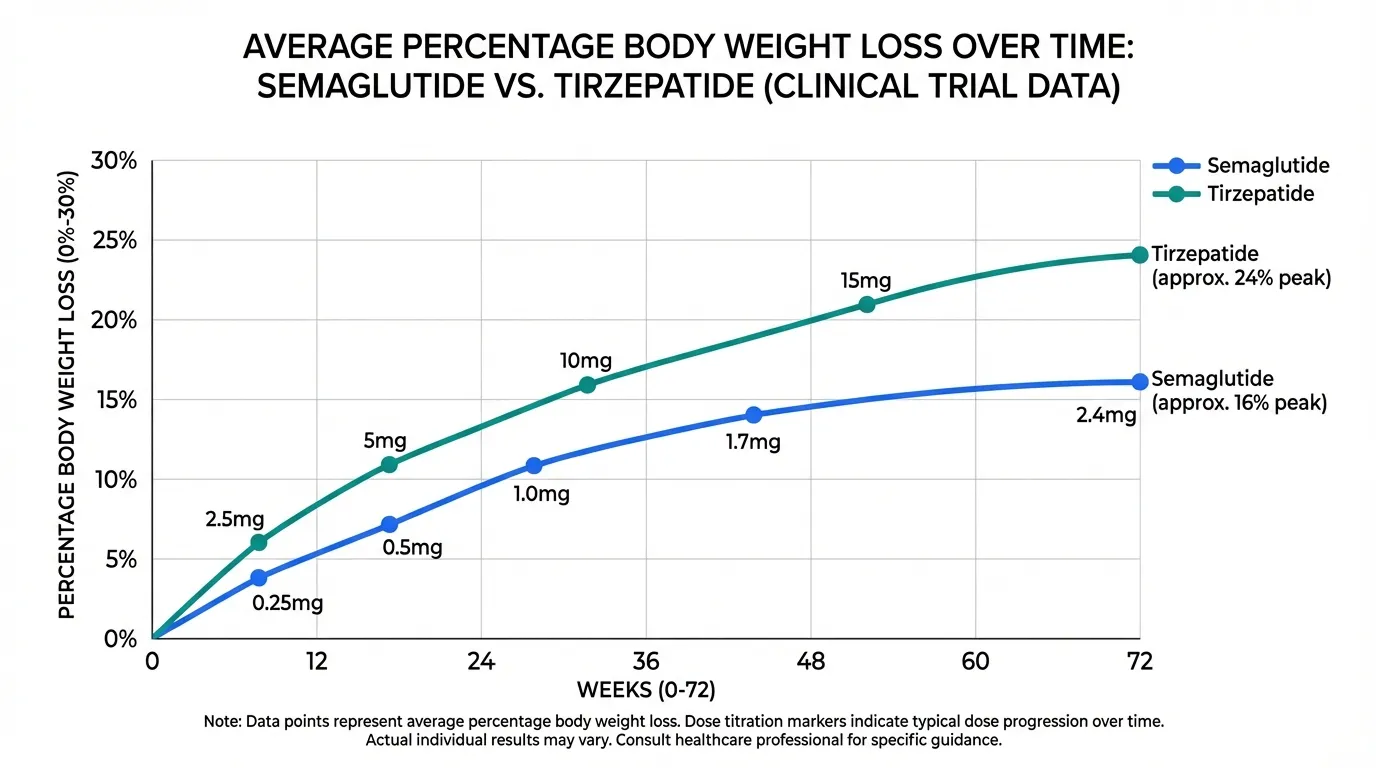
Semaglutide has the most detailed clinical timeline data of any peptide, thanks to the large STEP and SUSTAIN clinical trial programs.
| Timepoint | Expected Effects |
|---|---|
| Week 1-4 (0.25 mg) | Reduced appetite, possible mild nausea. Minimal weight change. |
| Week 5-8 (0.5 mg) | Appetite suppression more pronounced. Weight loss begins (1-3% body weight). |
| Week 9-16 (1.0-1.7 mg) | Steady weight loss of approximately 1-2% body weight per month. GI side effects typically improving. |
| Week 17-28 (2.4 mg) | Continued weight loss. Body composition changes becoming visually apparent. |
| Week 28-68 | Peak weight loss in clinical trials averaged 15-17% of body weight by week 68 at the 2.4 mg dose. |
Key insight: Semaglutide's effects are progressive and cumulative. Most of the weight loss occurs during the first 40-52 weeks, after which weight typically stabilizes.
Tirzepatide#
Tirzepatide follows a similar trajectory, with the SURMOUNT trials showing:
| Timepoint | Expected Effects |
|---|---|
| Week 1-4 (2.5 mg) | Reduced appetite, possible nausea. |
| Week 5-16 (5-10 mg titration) | Progressive appetite suppression and weight loss. |
| Week 17-72 (5-15 mg maintenance) | Peak weight loss of 20-26% body weight at highest dose in clinical trials. |
Tirzepatide demonstrated greater maximum weight loss than semaglutide in the head-to-head SURMOUNT trials, though the timeline to plateau was similar.
Growth Hormone Secretagogues#
Acute vs. Long-Term Effects#
Growth hormone secretagogues like ipamorelin and sermorelin have two distinct timelines:
Acute effects (hours): A single injection of ipamorelin produces a measurable growth hormone pulse within 15-30 minutes, peaking at approximately 30-60 minutes and returning to baseline within 2-3 hours.
Long-term effects (weeks to months): The body composition and recovery effects attributed to elevated GH levels develop gradually:
| Timepoint | Commonly Reported Effects |
|---|---|
| Week 1-2 | Improved sleep quality (frequently reported as the earliest noticeable effect) |
| Week 2-4 | Improved recovery from exercise, subtle skin quality changes |
| Week 4-8 | More noticeable recovery benefits, potential fat loss beginning |
| Week 8-16 | Body composition changes (fat loss, lean mass improvement) becoming more apparent |
| Month 4-6 | More significant body composition and skin quality changes |
Note: These timelines are based on anecdotal reports and the known biology of growth hormone. Controlled clinical trial data for most GH secretagogues at these specific endpoints is limited.
Healing Peptides#
BPC-157#
BPC-157 timeline data comes primarily from animal studies, where improvements in tendon, ligament, muscle, and gut tissue healing are typically observed within:
| Animal Study Timepoint | Observed Effects |
|---|---|
| Day 3-7 | Initial improvements in wound healing markers in some models |
| Day 7-14 | Significant improvements in tissue repair in most healing models |
| Day 14-28 | Near-complete healing in some models (compared to controls still healing) |
For human users (based on anecdotal reports only):
| Timepoint | Commonly Reported |
|---|---|
| Week 1-2 | Reduced pain or discomfort at injury site |
| Week 2-4 | Improved function and mobility |
| Week 4-8 | More substantial recovery |
Important: These human timelines are anecdotal. BPC-157 has not been studied in controlled human trials for healing outcomes, so these timeframes should be viewed with appropriate skepticism.
TB-500#
TB-500 is similarly based primarily on preclinical and anecdotal data. Thymosin beta-4 (the parent compound) accelerated wound healing by nearly a month in a Phase 2 trial, with differences becoming apparent within the first few weeks of treatment.
Anecdotal reports suggest a timeline similar to BPC-157, with initial improvements in soft tissue discomfort within 1-3 weeks and more substantial recovery over 4-8 weeks.
Skin and Anti-Aging Peptides#
GHK-Cu (Topical)#
GHK-Cu works through gene expression changes and collagen synthesis, which are inherently slow processes:
| Timepoint | Expected Effects |
|---|---|
| Week 2-4 | Subtle improvement in skin texture and hydration |
| Week 4-8 | More noticeable skin firmness and reduced fine lines |
| Week 8-12 | Meaningful improvements in skin quality visible in comparison photos |
| Month 3-6 | Peak effects with consistent daily use |
Collagen synthesis and remodeling take weeks to months. Expecting visible skin changes in the first week of GHK-Cu use is not realistic based on the biology of collagen turnover.
Melanotan Peptides#
Melanotan-2 has a somewhat faster timeline for its primary effect (tanning):
- Day 1-3: Possible facial flushing, nausea (side effects may precede desired effects)
- Week 1-2: Initial darkening of moles, subtle skin tone changes
- Week 2-4: Progressive tanning with UV exposure
- Week 4+: Full tanning effect with maintenance dosing
Immune and Neuroprotective Peptides#
These categories have less precise timeline data for human use:
Thymosin Alpha-1 (based on clinical use in infection and cancer settings): Immune marker improvements have been documented within 1-2 weeks of treatment initiation. Functional immune benefits are typically assessed over 4-12 week treatment courses.
Nootropic peptides (Selank, Semax -- based on Russian pharmaceutical data): Anxiolytic and cognitive effects have been reported within 1-2 weeks of intranasal administration, though study designs and assessment methods vary.
Timeline Summary Table#
| Peptide Category | First Noticeable Effects | Meaningful Results | Peak Effects |
|---|---|---|---|
| GLP-1 agonists (weight loss) | 1-4 weeks (appetite) | 3-6 months (weight) | 12-18 months |
| GH secretagogues (body composition) | 1-2 weeks (sleep) | 2-4 months (body comp) | 4-6 months |
| Healing peptides (BPC-157, TB-500) | 1-3 weeks (pain relief) | 4-8 weeks (functional) | 8-12 weeks |
| Skin peptides (GHK-Cu topical) | 2-4 weeks (texture) | 8-12 weeks (visible) | 3-6 months |
| Tanning peptides (Melanotan) | 1-2 weeks | 2-4 weeks | 4-8 weeks |
| Immune peptides (TA-1) | 1-2 weeks (markers) | 4-12 weeks (functional) | Protocol-dependent |
Managing Expectations#
Why Patience Matters#
Biological processes take time. Tissue healing involves cellular migration, proliferation, and remodeling. Body composition changes require cumulative energy balance shifts. Collagen synthesis and turnover occur over weeks, not days.
Expecting dramatic results within days of starting a peptide is unrealistic for virtually all categories. The peptides that show the fastest effects (GH pulse from secretagogues, appetite reduction from GLP-1 agonists) are those with direct, acute receptor-mediated mechanisms.
When Lack of Results May Indicate a Problem#
If you see no effects after a reasonable timeframe, consider:
- Peptide quality: Degraded or counterfeit peptides will not produce expected effects. Review our quality guide.
- Dosing errors: Incorrect concentration calculations or measurement mistakes. Review our dosing guide.
- Storage issues: Improperly stored peptides may have lost potency. Review our storage guide.
- Individual variation: Not everyone responds to every peptide. Genetic and metabolic differences play a role.
- Unrealistic expectations: Some expected "effects" are based on marketing claims rather than clinical evidence.
Key Takeaways#
-
Different peptides work on vastly different timelines. GH secretagogues produce acute hormone pulses within minutes; body composition changes take months.
-
GLP-1 agonists have the best-documented timelines. Clinical trials provide detailed week-by-week data on appetite, weight, and metabolic changes.
-
Healing peptide timelines are mostly anecdotal in humans. Animal study timelines provide guidance, but human responses may differ.
-
Skin and anti-aging peptides require the most patience. Collagen synthesis is a slow process -- expect meaningful skin changes only after 8-12 weeks of consistent use.
-
Dose titration delays full effects. For peptides that require gradual dose increases, peak effects only begin after the target dose is reached.
-
Quality, dosing accuracy, and proper storage all affect whether a peptide produces expected effects within expected timelines. Rule out these factors before concluding a peptide is not working.
Related Peptide Profiles#
Learn more about the peptides discussed in this article:
- BPC-157 Overview and Research Guide
- BPC-157 Dosing Protocols
- BPC-157 Side Effects and Safety
- Semaglutide Overview and Research Guide
- Semaglutide Dosing Protocols
- Semaglutide Side Effects and Safety
- Tirzepatide Overview and Research Guide
- Tirzepatide Dosing Protocols
- Tirzepatide Side Effects and Safety
- Ipamorelin Overview and Research Guide
- Ipamorelin Dosing Protocols
- Ipamorelin Side Effects and Safety
- GHK-Cu Overview and Research Guide
- GHK-Cu Dosing Protocols
- GHK-Cu Side Effects and Safety
- TB-500 Overview and Research Guide
- TB-500 Dosing Protocols
- TB-500 Side Effects and Safety

Frequently Asked Questions About How Long Do Peptides Take to Work? Timelines by Category
What does this article cover?
How long peptides take to work: timelines for GLP-1 agonists, healing peptides, GH secretagogues, and factors influencing onset. This guide is for educational purposes only and does not constitute medical advice.
Which peptides are discussed in this article?
This article covers BPC-157, Semaglutide, Tirzepatide, Ipamorelin, GHK-Cu, TB-500. Key context: BPC-157 (Healing peptide with reported onset of effects within 1-2 weeks in animal studies and anecdotal h...); Semaglutide (GLP-1 agonist with well-documented clinical timeline from dose titration through peak weight loss...); Tirzepatide (Dual agonist with similar clinical timeline to semaglutide, showing progressive effects over the ...). Each peptide is discussed based on available research evidence.
Who is this guide written for?
This guide is written for researchers and individuals seeking an evidence-based overview of the topic covered in "How Long Do Peptides Take to Work? Timelines by Category." It summarizes available research data without making treatment recommendations. Always consult a healthcare provider for medical decisions.
What are the key takeaways from this article?
The main findings covered in this article include: Healing peptide with reported onset of effects within 1-2 weeks in animal studies and anecdotal h.... GLP-1 agonist with well-documented clinical timeline from dose titration through peak weight loss.... Dual agonist with similar clinical timeline to semaglutide, showing progressive effects over the .... These takeaways are based on the research data available at the time of publication.
What is BPC-157 and why is it significant?
BPC-157 is a peptide discussed in this article because: Healing peptide with reported onset of effects within 1-2 weeks in animal studies and anecdotal human reports. For a complete profile of BPC-157, see the dedicated peptide page on this site.
Continue reading this research review
Free access to the complete analysis with citations and evidence ratings.
150+ peptide profiles · 30+ comparisons · 18 research tools
Medical Disclaimer
This website is for educational and informational purposes only. The information provided is not intended to diagnose, treat, cure, or prevent any disease. Always consult with a qualified healthcare professional before using any peptide or supplement.
Join 2,000+ researchers getting biweekly updates
Enjoyed this article?
The Research Briefing delivers deep-dives like this biweekly — plus new study breakdowns, safety updates, and tool announcements.
Free forever. No spam. Unsubscribe in one click.
Where to Find These Peptides
Continue Exploring
Peptide Profiles
Keep Reading
Most Popular Therapeutic Peptides in 2026: 15 Ranked by Research Interest
The 15 most popular therapeutic peptides in 2026, ranked by clinical trial activity, search interest, and research community adoption. From semaglutide to BPC-157.

Subcutaneous vs Intramuscular Peptide Injection: What Research Shows
Subcutaneous vs intramuscular peptide injection compared. Covers absorption, technique, site selection, and preferred routes by peptide.

How Much Does Peptide Therapy Cost? A 2026 Price Guide
Comprehensive overview of peptide therapy costs in 2026 covering FDA-approved medications, compounded peptides, and research peptides. Includes cost-per-month estimates for common protocols, insurance considerations, and cost-saving strategies.
You Might Also Like
Related content you may find interesting