Best Nootropic Peptides for Cognitive Enhancement: 2026 Guide

Introduction#
Nootropic peptides represent a distinct class of cognitive enhancers that work through neurotrophic, synaptic, and neuroprotective mechanisms rather than the receptor-agonist approaches of traditional nootropics (racetams, modafinil). While most conventional cognitive enhancers modulate neurotransmitter activity acutely, peptide nootropics often promote structural brain changes -- new synapse formation, dendritic spine growth, and neuronal survival -- that may produce more durable effects.
This 2026 guide covers 9 peptides organized by their primary cognitive mechanism: BDNF-mediated neurotrophic support, synaptogenesis, neuroprotection, and anxiolytic/sleep/mood pathways. Several compounds have regulatory approval outside the US (semax, selank, cerebrolysin), while others remain preclinical research tools.
Compounds profiled include semax, selank, cerebrolysin, pinealon, dihexa, PE-22-28, davunetide, humanin, and DSIP.
Important note: None of these peptides are FDA-approved for cognitive enhancement. Semax, selank, and cerebrolysin are approved in other countries for neurological indications. This article is for educational and research purposes only.
BDNF Upregulation and Neurotrophic Support#
Brain-derived neurotrophic factor (BDNF) is the primary neurotrophin supporting synaptic plasticity, learning, and memory. Low BDNF levels are associated with cognitive decline, depression, and neurodegeneration. These peptides upregulate BDNF and related neurotrophic factors.
Semax -- ACTH Fragment with Neurotrophic Effects#
Evidence Level: Approved in Russia | FDA Status: Not FDA-approved
Semax (Met-Glu-His-Phe-Pro-Gly-Pro) is a synthetic heptapeptide derived from the ACTH(4-7) fragment with a C-terminal Pro-Gly-Pro extension that prevents enzymatic degradation. It is approved in Russia for treatment of stroke, cognitive disorders, and optic nerve disease, with decades of clinical use.
Cognitive mechanisms:
- Upregulates BDNF and NGF expression in hippocampal and cortical neurons, providing the neurotrophic support essential for memory consolidation
- Modulates dopaminergic and serotoninergic neurotransmitter systems, influencing attention, motivation, and cognitive flexibility
- Demonstrated neuroprotective effects in ischemic stroke models, preserving neuronal viability in the penumbral zone
- Does not affect adrenal cortex function despite its ACTH origin -- the Pro-Gly-Pro extension eliminates melanocortin receptor activation
Clinical context: Semax has the longest clinical track record among peptide nootropics, with Russian registration for stroke recovery and cognitive impairment. Typical intranasal dosing is 0.1% solution (200-600 mcg/day). While Russian clinical data are extensive, they have not been widely replicated in Western trial frameworks, limiting international regulatory acceptance.
Strength: Most clinically validated peptide nootropic with real-world patient use data.
Pinealon -- Bioregulatory Tripeptide#
Evidence Level: Preclinical | FDA Status: Not approved
Pinealon (Glu-Asp-Arg) is a synthetic tripeptide from the Khavinson bioregulation research program, studied for neuroprotective effects and modulation of gene expression related to neuronal function and pineal gland activity.
Cognitive mechanisms:
- Investigated for epigenetic modulation of genes involved in neuroprotection and neuronal survival
- Short tripeptide sequence enables potential oral bioavailability, unlike most peptide therapeutics
- Explored for circadian rhythm regulation through pineal gland support -- circadian disruption significantly impairs cognition
- Studied for anti-senescence effects in neural tissue culture models
Limitations: Research is dominated by the Khavinson Institute with limited independent replication. The proposed mechanism of dipeptide gene regulation through direct DNA binding lacks robust validation by international standards. No clinical trials have been conducted.
Synaptogenesis and Structural Plasticity#
These peptides promote the formation of new synaptic connections, dendritic spine growth, or structural remodeling of neural circuits -- mechanisms that may produce more durable cognitive enhancement than acute neurotransmitter modulation.
Dihexa -- HGF/c-Met Synaptogenic Peptide#
Evidence Level: Preclinical | FDA Status: Not approved
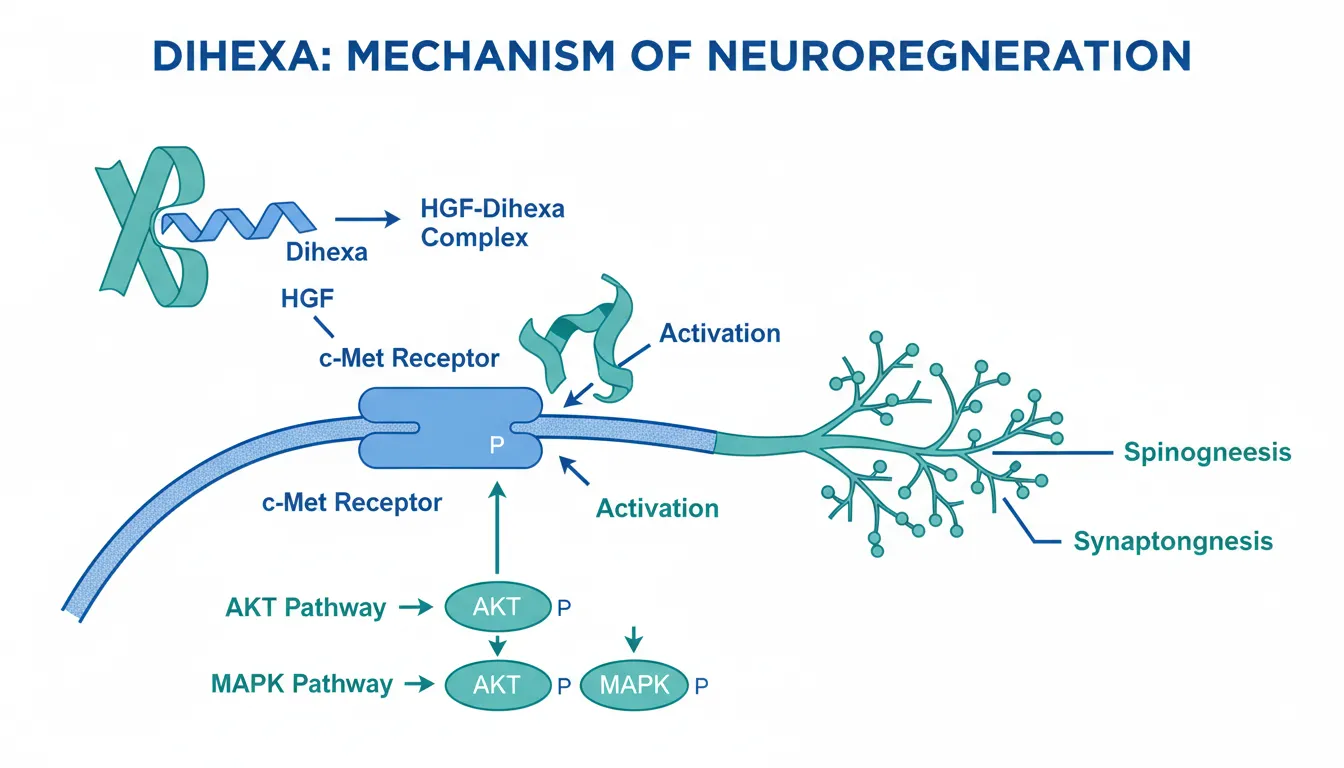
Dihexa (PNB-0408) is a small oligopeptide derived from angiotensin IV, developed at Washington State University. It is one of the most potent synaptogenic compounds identified in preclinical research, active at picomolar concentrations.
Cognitive mechanisms:
- Binds hepatocyte growth factor (HGF) with high affinity and potentiates HGF/c-Met receptor signaling
- Promotes synaptogenesis (new synapse formation) and spinogenesis (new dendritic spine growth) -- the structural substrates of learning and memory
- In preclinical models, dihexa enhanced cognitive performance in aged rats and reversed scopolamine-induced memory deficits when administered orally
- Crosses the blood-brain barrier with approximately 38% oral bioavailability, unusual for a peptide
Critical caveat: A key 2014 publication from the Bhatt group supporting dihexa's cognitive effects was retracted due to data integrity concerns. The original discovery work by Harding, Wright, and colleagues at Washington State University remains published, but the retraction significantly undermines the evidence base. HGF/c-Met signaling also has oncogenic potential, raising serious long-term safety questions.
Bottom line: Scientifically fascinating mechanism but weakened by a data integrity issue and unaddressed cancer risk. No human studies.
Cerebrolysin -- Multi-Peptide Neurotrophic Preparation#
Evidence Level: Approved in 40+ countries | FDA Status: Not FDA-approved
Cerebrolysin is not a single peptide but a standardized mixture of low-molecular-weight neuropeptides and free amino acids derived from porcine brain tissue. It is approved in over 40 countries for stroke, traumatic brain injury (TBI), and Alzheimer's disease dementia.
Cognitive mechanisms:
- Contains peptide fragments with neurotrophic factor-like activity mimicking BDNF, NGF, and GDNF signaling
- Promotes neurogenesis and synaptogenesis in the hippocampus, the brain region most critical for memory formation
- Demonstrated neuroprotective and neurorestorative properties -- it both protects neurons during acute injury and supports recovery afterward
- Phase 4 clinical trials in Alzheimer's disease show improved cognitive scores (ADAS-Cog) and global clinical impression
Clinical evidence: Cerebrolysin has the broadest international regulatory approval of any peptide nootropic. A Cochrane review and multiple meta-analyses have evaluated its efficacy in stroke and Alzheimer's disease, with mixed but generally positive results. The CASTA and CARS trials (800+ patients combined) demonstrated safety and some cognitive benefit in acute ischemic stroke.
Limitation: As a complex biological mixture, cerebrolysin's exact active components are not fully characterized. This complicates regulatory acceptance in the US and EU, where single-entity therapeutics are preferred. Administered as IV infusion or deep IM injection, typically 10-30 mL/day in clinical protocols.
PE-22-28 -- TREK-1 Channel Blocker with Neurogenic Properties#
Evidence Level: Preclinical | FDA Status: Not approved
PE-22-28 is a synthetic 7-amino acid peptide derived from spadin that potently blocks TREK-1 two-pore domain potassium channels (IC50 0.12 nM). While primarily studied as an antidepressant, its neurogenic properties are directly relevant to cognition.
Cognitive mechanisms:
- TREK-1 blockade increases neuronal excitability in hippocampal circuits, enhancing synaptic transmission relevant to memory encoding
- Promotes hippocampal neurogenesis after only 4 days of treatment in rodent models -- adult neurogenesis is strongly linked to pattern separation and spatial memory
- 300-500x more potent than parent compound spadin at inhibiting TREK-1, with improved metabolic stability
- Antidepressant effects in forced swimming test and novelty suppressed feeding test comparable to SSRIs but with faster onset
Cognitive relevance: Depression is one of the most common causes of cognitive impairment ("pseudodementia"). PE-22-28's rapid neurogenic and antidepressant effects address the mood-cognition connection that conventional antidepressants take weeks to influence. TREK-1 knockout mice also show enhanced memory, supporting a direct cognitive role for this channel.
Limitation: Entirely preclinical. No human pharmacokinetic, safety, or efficacy data. The TREK-1 channel is expressed throughout the body, raising questions about systemic effects beyond the brain.
Neuroprotection and Neuronal Survival#
These peptides protect existing neurons from damage rather than primarily building new connections. In the context of cognitive aging and neurodegeneration, preserving functional neurons is as important as promoting new growth.
Davunetide -- Microtubule Stabilizer#
Evidence Level: Phase 2/3 (mixed results) | FDA Status: Not approved
Davunetide (NAP, AL-108) is an eight-amino-acid peptide (NAPVSIPQ) derived from activity-dependent neuroprotective protein (ADNP). It stabilizes microtubules -- the structural highways for intraneuronal transport -- which are disrupted in tauopathies and other neurodegenerative conditions.
Cognitive mechanisms:
- Stabilizes microtubules and protects against tau hyperphosphorylation, the pathological process that disrupts neuronal transport in Alzheimer's disease and related dementias
- Intranasal delivery provides direct CNS access without injection, a significant practical advantage
- Well-tolerated in multiple clinical trials with a favorable safety profile
- ADNP mutations cause ADNP syndrome (Helsmoortel-Van der Aa syndrome), a neurodevelopmental disorder, establishing the biological pathway's relevance to cognition
Clinical setback: The Phase 2/3 trial in progressive supranuclear palsy (PSP) failed to meet its primary endpoint (Boxer et al., Lancet Neurology 2014). The original developer Allon Therapeutics became insolvent. However, ExoNavis licensed the compound in 2021 and initiated a Phase 3 trial for ADNP syndrome in 2024, giving davunetide a second chance in a population where the mechanism is directly relevant to the disease genotype.
Lesson: Davunetide illustrates a common pattern in neuroprotective drug development -- a compound may fail in a broad neurodegenerative population but succeed in a genetically defined subgroup where the specific mechanism is causally relevant.
Humanin -- Mitochondrial-Derived Neuroprotector#
Evidence Level: Preclinical with translational data | FDA Status: Not approved
Humanin is a 24-amino-acid mitochondrial-derived peptide discovered in surviving neurons from Alzheimer's disease brains -- its name reflects its identification as a factor that kept human neurons alive against amyloid-beta toxicity.
Cognitive mechanisms:
- Protects neurons against amyloid-beta (Abeta) toxicity at nanomolar concentrations through both intracellular anti-apoptotic mechanisms (Bax inhibition) and extracellular receptor-mediated signaling
- Activates AKT and STAT3 through the tripartite CNTFR/WSX-1/gp130 receptor complex and binds FPRL1 for anti-inflammatory signaling
- Circulating humanin levels decline with age, correlating with cognitive decline and Alzheimer's disease risk
- The 1,000-fold more potent analog S14G-humanin (HNG) has been extensively characterized in preclinical neuroprotection studies
- Cross-talks with insulin/IGF-1 signaling, linking metabolic health to neuroprotection
Translational evidence: Large epidemiological studies show associations between circulating humanin levels and cognitive outcomes. Humanin levels are lower in Alzheimer's disease patients compared to cognitively normal controls. While this is correlational, it provides human-relevant evidence that most preclinical peptide nootropics lack.
Limitation: No human interventional studies. The relationship between circulating humanin and brain humanin (which is produced locally in mitochondria) is not well understood. Systemic administration may not adequately replicate the protective effects of locally-produced endogenous humanin.
Anxiolytic, Sleep, and Mood Pathways#
Anxiety, mood disturbances, and poor sleep are among the most common causes of perceived cognitive impairment. These peptides address cognition indirectly by reducing the anxious or under-rested state that impairs attention, working memory, and executive function.
Selank -- Anxiolytic Nootropic#
Evidence Level: Approved in Russia | FDA Status: Not FDA-approved
Selank (Thr-Lys-Pro-Arg-Pro-Gly-Pro) is derived from tuftsin, an endogenous immunomodulatory peptide, with the same Pro-Gly-Pro stabilization used in semax. It is approved in Russia as an anxiolytic and nootropic, administered intranasally.
Cognitive mechanisms:
- Modulates GABAergic signaling without binding GABA-A receptors directly, producing anxiolysis without the sedation, tolerance, or dependence associated with benzodiazepines
- Influences serotonergic neurotransmission, contributing to mood stabilization and reduced anxiety-mediated cognitive interference
- Upregulates BDNF expression, providing neurotrophic support alongside anxiolytic effects
- Retains immunomodulatory properties from parent compound tuftsin, with potential neuroimmune benefits
Cognitive relevance: Selank's primary cognitive benefit is indirect -- by reducing anxiety without sedation, it removes a major barrier to optimal cognitive performance. Unlike benzodiazepines (which impair memory and attention), selank's non-sedating anxiolysis allows improved cognitive function in anxious states. Russian clinical data report improvements in both anxiety scores and cognitive test performance.
Limitation: Like semax, selank's clinical evidence comes predominantly from Russian studies that have not been independently replicated in Western regulatory frameworks. Intranasal bioavailability and brain penetration data are limited.
DSIP -- Delta Sleep-Inducing Peptide#
Evidence Level: Preclinical with limited clinical data | FDA Status: Not approved
DSIP is a naturally occurring nonapeptide first isolated from rabbit brain in 1977. While its name suggests a primary sleep role, research has revealed a broader profile covering stress modulation, endocrine regulation, and indirect cognitive support through improved sleep architecture.
Cognitive mechanisms:
- Modulates sleep architecture by promoting delta-wave (slow-wave) sleep -- the sleep stage most strongly associated with memory consolidation, synaptic downscaling, and glymphatic clearance of metabolic waste
- Stress-buffering effects on the hypothalamic-pituitary-adrenal (HPA) axis, reducing cortisol responses to stressors (chronic cortisol elevation is associated with hippocampal atrophy and cognitive decline)
- Demonstrates antioxidant properties in preclinical models, potentially protecting neurons from oxidative damage
- Because sleep quality is a major determinant of next-day cognitive performance, DSIP's influence on sleep architecture provides an indirect but meaningful pathway to cognitive optimization
Limitation: DSIP is not FDA-approved and has never undergone formal clinical development. Its instability in solution (rapid degradation at room temperature) is a practical research challenge, and the original characterization of DSIP as a direct sleep-inducer has been debated -- more recent literature frames its effects as sleep-wake cycle modulation rather than hypnotic induction.
Evidence Comparison#
| Peptide | Primary Mechanism | Evidence Level | Human Data | Regulatory Status |
|---|---|---|---|---|
| Semax | BDNF/NGF upregulation | Approved (Russia) | Clinical use (Russia) | Russian registration |
| Pinealon | Bioregulatory/epigenetic | Preclinical | None | Not approved |
| Dihexa | HGF/c-Met synaptogenesis | Preclinical | None | Not approved |
| Cerebrolysin | Multi-neurotrophic | Approved (40+ countries) | Phase 4 trials | 40+ country approvals |
| PE-22-28 | TREK-1 blockade / neurogenesis | Preclinical | None | Not approved |
| Davunetide | Microtubule stabilization | Phase 2/3 | Clinical trials | Investigational |
| Humanin | Mitochondrial neuroprotection | Preclinical+ | Epidemiological | Not approved |
| Selank | GABA/serotonin / anxiolytic | Approved (Russia) | Clinical use (Russia) | Russian registration |
| DSIP | Delta sleep / HPA modulation | Preclinical | Limited | Not approved |
Mechanism Group Summary#
The 9 nootropic peptides target cognition through four complementary layers:
-
Neurotrophic support (semax, pinealon): Upregulate BDNF and other growth factors that sustain synaptic plasticity and neuronal health. Semax has the strongest clinical validation in this group.
-
Synaptogenesis and structural plasticity (dihexa, cerebrolysin, PE-22-28): Promote formation of new synapses, dendritic spines, or neurons. Cerebrolysin has the broadest regulatory approval; dihexa has the most potent preclinical data but carries data integrity and safety concerns.
-
Neuroprotection (davunetide, humanin): Protect existing neurons from damage and degeneration. Humanin has the strongest translational evidence linking declining levels to cognitive decline; davunetide has the most clinical trial experience despite mixed results.
-
Anxiolytic, sleep, and mood optimization (selank, DSIP): Remove anxiety- and sleep-mediated cognitive impairment. Selank provides non-sedating anxiolysis through a non-GABAergic mechanism; DSIP modulates slow-wave sleep architecture and HPA-axis stress reactivity, both of which shape next-day cognitive performance.
What Has Changed Since 2025#
Several developments have shifted the nootropic peptide landscape:
-
Dihexa retraction impact -- The 2014 Bhatt publication retraction has increased scrutiny on dihexa's evidence base, though the original WSU discovery research remains intact. Researchers should exercise particular caution with this compound.
-
Davunetide revival -- ExoNavis's Phase 3 trial for ADNP syndrome represents a precision medicine approach, targeting the compound to a genetically defined population where the mechanism is directly disease-relevant.
-
Humanin as biomarker -- Growing epidemiological data linking humanin levels to cognitive outcomes in aging populations strengthens the case for humanin-based interventions, even though clinical trials have not yet begun.
-
Klotho cognition data -- While not covered in this nootropic-focused guide, the 2023 Nature Aging publication showing klotho injection enhanced memory in aged primates has expanded the cognitive peptide landscape. See Best Anti-Aging Peptides in 2026 for klotho coverage.
Conclusion#
The nootropic peptide landscape in 2026 offers a mechanistically diverse set of compounds targeting cognition through structural, neurotrophic, neuroprotective, and anxiolytic pathways. Cerebrolysin and semax have the strongest clinical backing with regulatory approvals in multiple countries, making them the most validated options for research contexts where clinical evidence is prioritized.
For researchers interested in novel mechanisms, PE-22-28's TREK-1 neurogenesis pathway and humanin's mitochondrial neuroprotection represent the most scientifically compelling emerging targets. Dihexa's HGF/c-Met mechanism remains fascinating but carries data integrity and oncogenic risk concerns that warrant caution.
The critical gap across the field remains translation: most nootropic peptides lack the rigorous, double-blind, placebo-controlled trials in cognitively normal humans that would establish true nootropic efficacy. The compounds with regulatory approval (semax, selank, cerebrolysin) were approved for disease states (stroke, anxiety, neurodegeneration), not cognitive enhancement in healthy populations.
For related reading, see Peptides for Cellular Longevity, Best Anti-Aging Peptides in 2026, and the Peptide Finder Quiz for personalized recommendations.
Related Peptide Profiles#
Learn more about the peptides discussed in this article:
- Dihexa Overview and Research Guide
- Dihexa Dosing Protocols
- Dihexa Side Effects and Safety
- Semax Overview and Research Guide
- Semax Dosing Protocols
- Semax Side Effects and Safety
- Selank Overview and Research Guide
- Selank Dosing Protocols
- Selank Side Effects and Safety
- Cerebrolysin Overview and Research Guide
- Cerebrolysin Dosing Protocols
- Cerebrolysin Side Effects and Safety
- PE-22-28 Overview and Research Guide
- PE-22-28 Dosing Protocols
- PE-22-28 Side Effects and Safety
- Davunetide Overview and Research Guide
- Davunetide Dosing Protocols
- Davunetide Side Effects and Safety
- Pinealon Overview and Research Guide
- Pinealon Dosing Protocols
- Pinealon Side Effects and Safety
- Humanin Overview and Research Guide
- Humanin Dosing Protocols
- Humanin Side Effects and Safety
- DSIP Overview and Research Guide
- DSIP Dosing Protocols
- DSIP Side Effects and Safety

Frequently Asked Questions About Best Nootropic Peptides for Cognitive Enhancement: 2026 Guide
What does this article cover?
Comprehensive 2026 guide to 9 nootropic peptides for cognitive enhancement — dihexa, semax, selank, cerebrolysin, PE-22-28, davunetide, pinealon, humanin, and DSIP — grouped by mechanism including BDNF upregulation, synaptogenesis, neuroprotection, and anxiolytic/sleep pathways. This guide is for educational purposes only and does not constitute medical advice.
Which peptides are discussed in this article?
This article covers Dihexa, Semax, Selank, Cerebrolysin, PE-22-28, Davunetide, Pinealon, Humanin. Key context: Dihexa (Angiotensin IV-derived peptide that potentiates HGF/c-Met signaling to promote synaptogenesis and...); Semax (ACTH(4-7) analog approved in Russia for stroke and cognitive disorders, with potent BDNF and NGF ...); Selank (Tuftsin-derived anxiolytic peptide approved in Russia that modulates GABA, serotonin, and BDNF sy...). Each peptide is discussed based on available research evidence.
Who is this guide written for?
This guide is written for researchers and individuals seeking an evidence-based overview of the topic covered in "Best Nootropic Peptides for Cognitive Enhancement: 2026 Guide." It summarizes available research data without making treatment recommendations. Always consult a healthcare provider for medical decisions.
What are the key takeaways from this article?
The main findings covered in this article include: Angiotensin IV-derived peptide that potentiates HGF/c-Met signaling to promote synaptogenesis and.... ACTH(4-7) analog approved in Russia for stroke and cognitive disorders, with potent BDNF and NGF .... Tuftsin-derived anxiolytic peptide approved in Russia that modulates GABA, serotonin, and BDNF sy.... These takeaways are based on the research data available at the time of publication.
What is Dihexa and why is it significant?
Dihexa is a peptide discussed in this article because: Angiotensin IV-derived peptide that potentiates HGF/c-Met signaling to promote synaptogenesis and spinogenesis at picomolar concentrations. For a complete profile of Dihexa, see the dedicated peptide page on this site.
Continue reading this research review
Free access to the complete analysis with citations and evidence ratings.
150+ peptide profiles · 30+ comparisons · 18 research tools
Medical Disclaimer
This website is for educational and informational purposes only. The information provided is not intended to diagnose, treat, cure, or prevent any disease. Always consult with a qualified healthcare professional before using any peptide or supplement.
Join 2,000+ researchers getting biweekly updates
Enjoyed this article?
The Research Briefing delivers deep-dives like this biweekly — plus new study breakdowns, safety updates, and tool announcements.
Free forever. No spam. Unsubscribe in one click.
Where to Find These Peptides
Continue Exploring
Peptide Profiles
Keep Reading

Nootropic Peptide Stacks: What Research Says About Combining Cognitive Peptides
Evidence-based review of nootropic peptide stacking, including Semax+Selank combinations, BDNF upregulation stacks, and neuroprotective synergies.

Peptide Therapy for Brain Health: Neuroprotection, Cognition, and Recovery
Comprehensive guide to peptides for brain health covering neurotrophic factors, neuroprotective agents, anxiolytics, and experimental cognitive enhancers. Includes cerebrolysin, semax, selank, BPC-157, dihexa, pinealon, SS-31, and rapastinel.

Peptides for Brain Injury and Neuroprotection: TBI, Stroke, and Neurodegeneration Research
Research review of neuroprotective peptides for TBI, stroke, and neurodegeneration, including Semax, Davunetide, BPC-157, and Dihexa.
You Might Also Like
Related content you may find interesting