Mitochondrial Peptides: The Next Frontier in Longevity

Introduction#
Mitochondria have long been recognized as the powerhouses of the cell, generating the ATP that fuels virtually every biological process. But in recent years, a paradigm shift has occurred: mitochondria are now understood to be signaling organelles that produce their own peptide hormones. These mitochondrial-derived peptides (MDPs) represent a previously unknown class of endogenous signaling molecules with profound implications for aging, metabolism, and cellular resilience.
The discovery that the mitochondrial genome encodes functional peptides — not just the proteins involved in oxidative phosphorylation — has opened an entirely new frontier in longevity research. Compounds like MOTS-c emerge from the mitochondrial DNA itself, while synthetic peptides like SS-31 are designed to target mitochondria from the outside. Together with peptides that influence mitochondrial-related processes like telomere maintenance (epitalon), these compounds represent some of the most scientifically fascinating developments in the peptide field.
The Mitochondrial Theory of Aging#
To understand why mitochondrial peptides matter for longevity, it helps to review the mitochondrial theory of aging. This framework proposes that accumulated mitochondrial dysfunction is a primary driver of the aging process through several mechanisms:
- Oxidative stress — mitochondria are both the primary producers and primary targets of reactive oxygen species (ROS), leading to a progressive cycle of damage
- Bioenergetic decline — reduced ATP production capacity with age impairs cellular function across all tissues
- mtDNA mutations — the mitochondrial genome lacks the robust repair mechanisms of nuclear DNA, accumulating mutations over time
- Altered signaling — age-related changes in mitochondrial retrograde signaling affect nuclear gene expression, immune function, and metabolic regulation
Peptides that can protect, restore, or compensate for mitochondrial dysfunction therefore have direct theoretical relevance to the aging process.
1. MOTS-c (Mitochondrial Open Reading Frame of the 12S rRNA-c)#
Evidence Level: Preclinical with early clinical data Primary Mechanism: AMPK activation; metabolic regulation; exercise mimetic FDA Status: Not approved; investigational
MOTS-c is a 16-amino-acid peptide encoded by the mitochondrial 12S rRNA gene. Discovered in 2015, it was one of the first identified mitochondrial-derived peptides and has been described as an "exercise mimetic" due to its ability to activate metabolic pathways normally triggered by physical activity.
Research Findings#
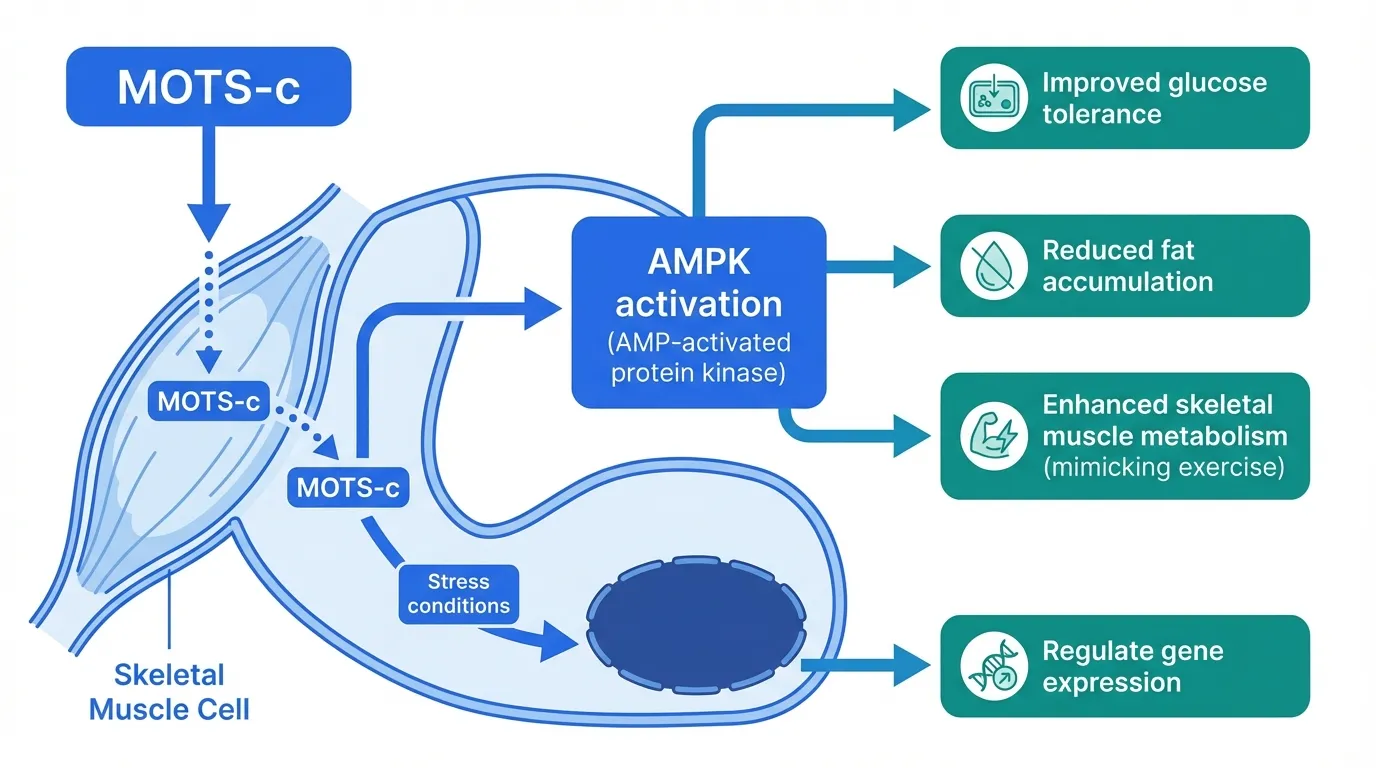
MOTS-c's primary mechanism involves activation of the AMPK (AMP-activated protein kinase) pathway — the same cellular energy sensor activated by exercise and caloric restriction. Key research findings include:
- Metabolic regulation — MOTS-c administration in mice prevented age-related insulin resistance, improved glucose tolerance, and reduced fat accumulation
- Exercise mimicry — MOTS-c activates skeletal muscle metabolism through AMPK-dependent pathways, mimicking some of the metabolic benefits of exercise
- Nuclear translocation — MOTS-c can translocate from the cytoplasm to the nucleus under stress conditions, directly regulating gene expression related to cellular stress response
- Age-related decline — circulating MOTS-c levels decrease with age, suggesting that declining MOTS-c may contribute to metabolic dysfunction in aging
A 2018 study demonstrated that MOTS-c improved physical performance and metabolic function in aging mice, with effects comparable to exercise training. This has generated significant interest in MOTS-c as a potential intervention for age-related metabolic decline.
Important Considerations#
MOTS-c research is primarily preclinical, with limited human pharmacokinetic and pharmacodynamic data. The peptide's stability, optimal dosing, and long-term safety in humans have not been established. While the "exercise mimetic" framing is compelling, it oversimplifies the complex relationship between MOTS-c and metabolic regulation. No clinical trials for longevity or anti-aging indications have been completed.
2. SS-31 (Elamipretide)#
Evidence Level: Phase 3 clinical trials; FDA-approved for Barth syndrome (2025) Primary Mechanism: Cardiolipin stabilization; inner mitochondrial membrane protection FDA Status: Approved for Barth syndrome
SS-31, also known as elamipretide (brand name Elamipretide), is a synthetic tetrapeptide that selectively concentrates in the inner mitochondrial membrane. It represents the most clinically advanced mitochondrial-targeted peptide and a milestone achievement: the first FDA-approved therapy specifically designed to target mitochondrial dysfunction.
Research Findings#
SS-31's mechanism is distinct from other compounds in this guide. It binds to cardiolipin, a phospholipid unique to the inner mitochondrial membrane that is essential for the structural organization and function of the electron transport chain. Key findings include:
- Cardiolipin stabilization — SS-31 prevents the peroxidation and redistribution of cardiolipin that occurs with aging and mitochondrial stress
- Electron transport chain optimization — by maintaining cardiolipin structure, SS-31 preserves the efficiency of oxidative phosphorylation and reduces electron leak (a source of ROS)
- Barth syndrome — Phase 3 clinical trials demonstrated clinically meaningful improvements in cardiac function and exercise capacity in patients with this rare mitochondrial cardiomyopathy, leading to FDA approval in 2025
- Heart failure — Phase 2 trials in non-Barth heart failure showed improvements in left ventricular volumes, though Phase 3 results were mixed
- Age-related mitochondrial decline — preclinical studies show SS-31 reverses age-related mitochondrial dysfunction in heart, skeletal muscle, and kidney tissue
Longevity Implications#
SS-31 is the strongest proof-of-concept that targeting mitochondrial dysfunction can produce clinical benefits. While its current approval is for a rare disease, the underlying mechanism — protecting the mitochondrial membrane from age-related damage — has broad theoretical relevance to aging. Research is actively exploring SS-31 for age-related conditions including heart failure, kidney disease, and skeletal muscle decline.
Important Considerations#
SS-31 is available only as a prescription medication for Barth syndrome. Its application to general anti-aging or longevity remains investigational. The mixed Phase 3 heart failure results suggest that the relationship between mitochondrial membrane protection and clinical outcomes is more complex than initially hypothesized.
3. Epitalon (Epithalon)#
Evidence Level: Limited clinical data; primarily Russian/Eastern European research Primary Mechanism: Telomerase activation; pineal gland regulation; melatonin modulation FDA Status: Not approved; not FDA-evaluated
Epitalon is a synthetic tetrapeptide (Ala-Glu-Asp-Gly) developed by Professor Vladimir Khavinson at the St. Petersburg Institute of Bioregulation and Gerontology. While not a mitochondrial-derived peptide, epitalon targets a process intimately connected to cellular aging: telomere maintenance.
Research Findings#
Epitalon's proposed anti-aging mechanism centers on telomerase activation:
- Telomerase activation — in vitro studies have shown that epitalon activates telomerase, the enzyme that extends telomeres (the protective caps on chromosome ends)
- Telomere elongation — cell culture studies demonstrated elongation of telomeres in human fetal fibroblasts and other cell types following epitalon treatment
- Pineal gland effects — epitalon is proposed to stimulate melatonin production by the pineal gland, potentially restoring the age-related decline in melatonin synthesis
- Animal lifespan studies — studies in mice and rats reported increased lifespan with chronic epitalon administration, though these studies had methodological limitations
The Khavinson research group has also reported long-term observational studies in elderly human subjects showing improved biomarkers of aging, reduced mortality, and improved organ function following epitalon treatment combined with other bioregulator peptides. However, these studies lacked proper randomization and blinding.
Important Considerations#
Epitalon's evidence base is heavily concentrated in publications from a single research group. The telomerase activation data, while intriguing, raises theoretical concerns — telomerase activation in the wrong cellular context could promote cancer growth, as telomerase reactivation is a hallmark of most cancers. The long-term safety of chronic telomerase activation has not been studied in controlled human trials.
The bioregulator peptide framework (proposing that short peptides regulate gene expression by interacting with DNA) has limited acceptance in the broader international scientific community. Independent replication of epitalon's key findings by non-affiliated research groups would significantly strengthen the evidence base.
How These Peptides Compare#
| Feature | MOTS-c | SS-31 | Epitalon |
|---|---|---|---|
| Origin | Mitochondrial genome | Synthetic (designed) | Synthetic bioregulator |
| Target | AMPK pathway/metabolism | Inner mitochondrial membrane | Telomerase/pineal gland |
| Evidence Level | Preclinical + early clinical | FDA-approved (Barth syndrome) | Limited clinical |
| Primary Aging Mechanism | Metabolic decline | Mitochondrial membrane damage | Telomere shortening |
| FDA Status | Not approved | Approved | Not evaluated |
| Administration | SC injection | SC injection | SC injection |
| International Evidence | Primarily US/Asian research | US/international | Primarily Russian |
The Broader Longevity Peptide Landscape#
Beyond these three compounds, several other peptides and peptide-related compounds are being studied in the context of aging:
- Humanin — another mitochondrial-derived peptide with cytoprotective effects, studied for neuroprotection and metabolic regulation
- SHLP1-6 — a family of small humanin-like peptides from the mitochondrial 16S rRNA gene, with diverse metabolic and cytoprotective effects
- FOXO4-DRI — a senolytic peptide that selectively kills senescent cells by disrupting the FOXO4-p53 interaction (see the FOXO4-DRI profile)
- GHK-Cu — while primarily studied for skin and tissue repair, GHK-Cu's gene expression data shows modulation of genes involved in oxidative stress response and cellular aging
The longevity peptide space is rapidly expanding as researchers discover new endogenous peptides and develop synthetic compounds targeting specific aging mechanisms.
Conclusion#
Mitochondrial peptides represent one of the most exciting frontiers in longevity research. The discovery that mitochondria produce their own signaling peptides (MOTS-c) has fundamentally changed our understanding of mitochondrial biology. The FDA approval of SS-31 for Barth syndrome validates the therapeutic principle of targeting mitochondrial dysfunction. And epitalon, while requiring more rigorous validation, raises compelling questions about the potential for peptide-mediated telomere maintenance.
The evidence continuum in this space ranges from SS-31's FDA approval to MOTS-c's preclinical promise to epitalon's intriguing but inadequately validated claims. Researchers interested in longevity peptides should evaluate each compound on its own evidence merits while maintaining enthusiasm for the broader scientific potential of this emerging field.
For tools to help evaluate peptide research, visit the HED Calculator for translating animal study doses, and the Safety page for risk assessment guidance.
Related Peptide Profiles#
Learn more about the peptides discussed in this article:

Frequently Asked Questions About Mitochondrial Peptides: The Next Frontier in Longevity
What does this article cover?
Mitochondrial peptides MOTS-c, SS-31, and Epitalon reviewed for their roles in cellular energy, aging, and longevity research. This research review is for educational purposes only and does not constitute medical advice.
Which peptides are discussed in this article?
This article covers MOTS-c, SS-31, Epitalon. Key context: MOTS-c (Mitochondrial-derived peptide that regulates metabolic homeostasis and exercise mimetic effects); SS-31 (Synthetic mitochondrial-targeted peptide FDA-approved for Barth syndrome in 2025); Epitalon (Synthetic tetrapeptide studied for telomerase activation and pineal gland function in aging). Each peptide is discussed based on available research evidence.
What level of evidence does this research review cover?
This research review examines published preclinical and clinical studies related to the peptides discussed. Evidence quality varies between peptides and indications. The article distinguishes between FDA-approved uses and investigational applications where applicable.
What are the key takeaways from this article?
The main findings covered in this article include: Mitochondrial-derived peptide that regulates metabolic homeostasis and exercise mimetic effects. Synthetic mitochondrial-targeted peptide FDA-approved for Barth syndrome in 2025. Synthetic tetrapeptide studied for telomerase activation and pineal gland function in aging. These takeaways are based on the research data available at the time of publication.
What is MOTS-c and why is it significant?
MOTS-c is a peptide discussed in this article because: Mitochondrial-derived peptide that regulates metabolic homeostasis and exercise mimetic effects. For a complete profile of MOTS-c, see the dedicated peptide page on this site.
Continue reading this research review
Free access to the complete analysis with citations and evidence ratings.
150+ peptide profiles · 30+ comparisons · 18 research tools
Medical Disclaimer
This website is for educational and informational purposes only. The information provided is not intended to diagnose, treat, cure, or prevent any disease. Always consult with a qualified healthcare professional before using any peptide or supplement.
Join 2,000+ researchers getting biweekly updates
Enjoyed this article?
The Research Briefing delivers deep-dives like this biweekly — plus new study breakdowns, safety updates, and tool announcements.
Free forever. No spam. Unsubscribe in one click.
Where to Find These Peptides
Continue Exploring
Peptide Profiles
Keep Reading

Anti-Aging Peptides by Mechanism: Senolytics, Telomeres, Mitochondria, and Hormones
Research review of anti-aging peptides organized by mechanism of action including senolytic peptides (FOXO4-DRI), telomere peptides (epitalon), mitochondrial peptides (SS-31, MOTS-c), tissue remodelers (GHK-Cu), and bioregulators (pinealon, thymalin). Evidence quality assessment for each approach.

13 Best Anti-Aging Peptides (2026): Ranked by Clinical Evidence
From senolytic FOXO4-DRI to mitochondrial SS-31, we ranked 13 anti-aging peptides by clinical trial evidence across 6 mechanisms. See which have human data vs. animal-only studies.

The Hallmarks of Aging: Which Peptides Target Which?
Definitive mapping of the 12 hallmarks of aging to specific peptide interventions including Epitalon, FOXO4-DRI, SS-31, MOTS-c, and NAD+.
You Might Also Like
Related content you may find interesting