Reproductive Health Peptides: A Research Roundup

Introduction#
Reproductive health represents one of the most established clinical applications of peptide therapeutics. Unlike many peptide research areas where evidence is primarily preclinical, several reproductive peptides have extensive clinical trial data and FDA approval for specific indications. The hypothalamic-pituitary-gonadal (HPG) axis — the hormonal cascade that controls reproductive function — is regulated at every level by peptide hormones, making it a natural target for peptide-based interventions.
This research roundup examines six peptides with significant roles in reproductive health, ranging from the endogenous signaling peptide kisspeptin to FDA-approved therapeutics like HCG and PT-141. The evidence base spans from early clinical research to decades of established clinical use.
Important note: Reproductive peptide therapies require medical supervision. Self-administration of hormonal peptides can disrupt the HPG axis and potentially impair rather than improve reproductive function.
The HPG Axis: A Peptide-Driven System#
Understanding reproductive peptides requires a brief overview of the HPG axis:
- Hypothalamus — releases GnRH (gonadotropin-releasing hormone) in a pulsatile pattern, regulated by kisspeptin neurons
- Anterior pituitary — responds to GnRH by releasing LH (luteinizing hormone) and FSH (follicle-stimulating hormone)
- Gonads — LH and FSH stimulate sex steroid production (estrogen, progesterone, testosterone) and gametogenesis (egg and sperm development)
- Feedback loops — sex steroids feed back to the hypothalamus and pituitary to regulate the system
Each peptide in this guide acts at a specific level of this cascade, and understanding the level of action is essential for understanding both therapeutic effects and potential disruption.
1. Kisspeptin#
Evidence Level: Clinical research for reproductive applications Primary Mechanism: GnRH pulse generator activation; upstream regulator of the entire HPG axis FDA Status: Investigational; not approved
Kisspeptin is a hypothalamic neuropeptide that was identified in 2003 as the critical upstream signal that initiates puberty and maintains reproductive function. Kisspeptin neurons in the hypothalamus directly stimulate GnRH neurons, making kisspeptin the master switch of the reproductive hormone cascade.
Research Findings#
Kisspeptin research has advanced rapidly from discovery to clinical studies:
- IVF oocyte maturation — kisspeptin-54 has been studied as an alternative trigger for final oocyte maturation in IVF, replacing HCG. A key advantage is the significantly lower risk of ovarian hyperstimulation syndrome (OHSS), a potentially dangerous complication of standard IVF protocols
- Hypothalamic amenorrhea — kisspeptin administration has been shown to restore pulsatile LH secretion in women with hypothalamic amenorrhea, a condition characterized by absent menstrual periods due to suppressed GnRH pulsatility
- Male reproductive function — kisspeptin stimulates testosterone production through the HPG axis and has been studied for male hypogonadism without the testicular atrophy risk associated with exogenous testosterone
- Diagnostic applications — kisspeptin challenge tests are being evaluated as diagnostic tools for pubertal disorders and hypothalamic dysfunction
Important Considerations#
Kisspeptin's effects are highly dependent on the existing hormonal milieu. Responses differ between men and women, vary across the menstrual cycle, and are influenced by body composition and metabolic status. The peptide has a very short half-life (approximately 28 minutes for kisspeptin-54), which has implications for dosing protocols. No kisspeptin-based therapeutic has received regulatory approval. For kisspeptin's role in women's health, see Peptides for Women.
2. Gonadorelin#
Evidence Level: FDA-approved for diagnostic use; established clinical data Primary Mechanism: Direct GnRH receptor agonist on pituitary gonadotrophs FDA Status: Approved (Factrel) for diagnostic evaluation of pituitary function
Gonadorelin is the synthetic form of endogenous GnRH (gonadotropin-releasing hormone), the 10-amino-acid peptide that directly stimulates the anterior pituitary to release LH and FSH. It is one of the most well-characterized peptides in reproductive endocrinology.
Research Findings#
Gonadorelin has both diagnostic and therapeutic applications:
- Pituitary function testing — the gonadorelin stimulation test is a standard diagnostic tool for evaluating pituitary gonadotropin reserve. An adequate LH/FSH response confirms pituitary function, while a blunted response suggests pituitary dysfunction
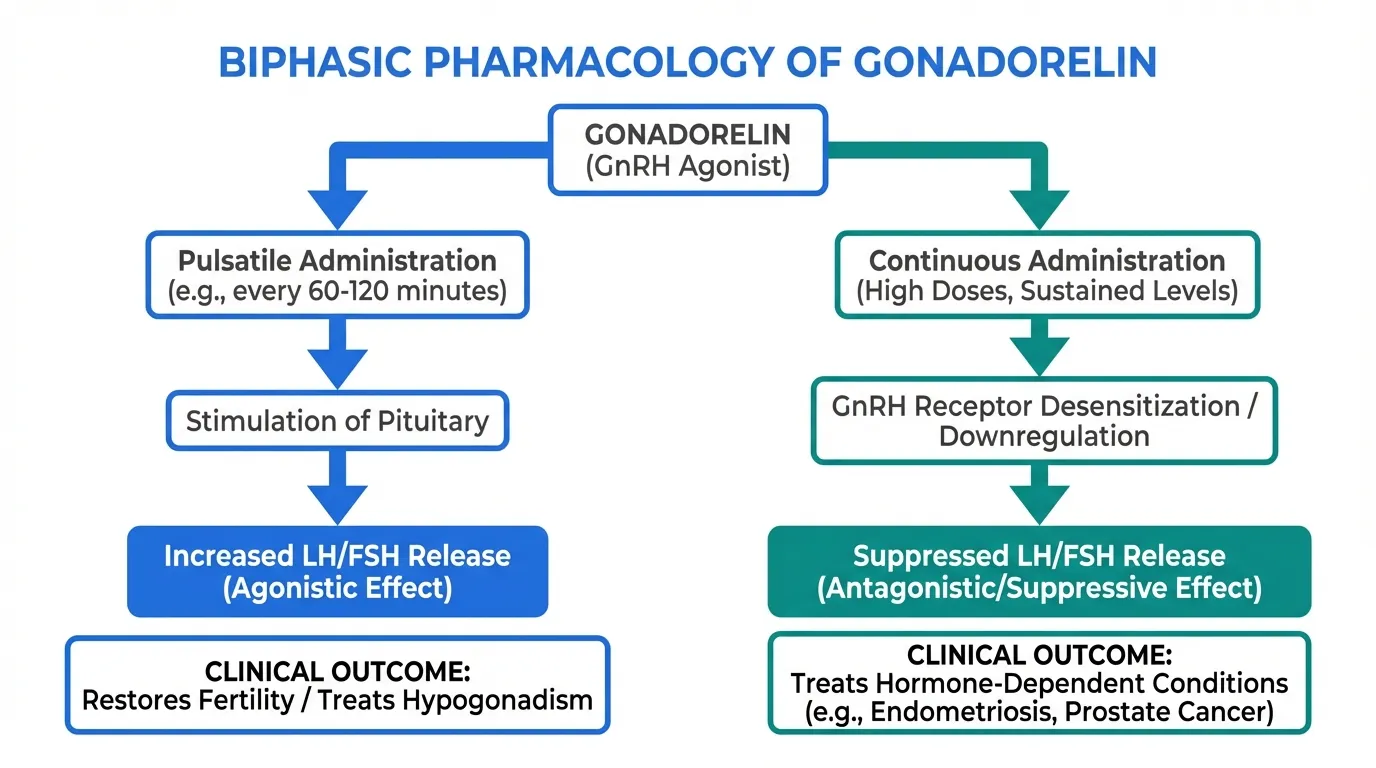
- Pulsatile GnRH therapy — when administered in a pulsatile pattern (mimicking natural hypothalamic GnRH secretion), gonadorelin can restore ovulation in women with hypothalamic amenorrhea. This approach uses portable infusion pumps to deliver GnRH pulses every 60-120 minutes
- Male fertility — pulsatile gonadorelin has been used to stimulate spermatogenesis in men with hypothalamic hypogonadism (Kallmann syndrome)
- HPG axis maintenance — some protocols explore gonadorelin for maintaining HPG axis function during conditions that would otherwise suppress it
Important Considerations#
The route and pattern of gonadorelin administration dramatically affect its clinical outcome. Pulsatile administration stimulates gonadotropin release (agonistic), while continuous administration paradoxically suppresses gonadotropins (the same principle exploited by GnRH agonists like triptorelin and leuprolide). This biphasic pharmacology means that improper dosing protocols could produce the opposite of the intended effect.
3. HCG (Human Chorionic Gonadotropin)#
Evidence Level: Decades of clinical use; FDA-approved for multiple indications Primary Mechanism: LH receptor agonist (structural and functional similarity to LH) FDA Status: Approved for ovulation induction, hypogonadism, cryptorchidism
HCG is a glycoprotein hormone naturally produced by the placenta during pregnancy. Its alpha subunit is identical to LH, FSH, and TSH, while the beta subunit provides LH receptor specificity. HCG has a much longer half-life than LH (approximately 24-36 hours vs. 20 minutes), making it pharmacologically practical for clinical use.
Research Findings#
HCG has the longest and most extensive clinical track record of any peptide in this guide:
- Ovulation induction — HCG is the standard trigger for final oocyte maturation in IVF and other assisted reproduction protocols, mimicking the natural LH surge that triggers ovulation
- Luteal phase support — HCG supplementation supports the corpus luteum during early pregnancy, maintaining progesterone production until the placenta takes over
- Male hypogonadism — HCG stimulates Leydig cells to produce testosterone without suppressing spermatogenesis (unlike exogenous testosterone, which suppresses the HPG axis)
- Cryptorchidism — HCG is used to promote testicular descent in prepubertal boys with undescended testes
- Fertility preservation — in men using testosterone replacement therapy who wish to maintain fertility, HCG can sustain intratesticular testosterone and spermatogenesis
Important Considerations#
HCG was significantly affected by the 2020 CARES Act, which reclassified it as a biologic rather than a drug, removing it from compounding pharmacy availability. This substantially increased cost and reduced access. From a safety perspective, HCG carries the risk of ovarian hyperstimulation syndrome in women and can elevate estrogen through aromatization in men. HCG should only be used under medical supervision with appropriate monitoring.
4. HMG (Human Menopausal Gonadotropin)#
Evidence Level: Decades of clinical use; FDA-approved Primary Mechanism: Combined FSH and LH activity for gonadal stimulation FDA Status: Approved (Menopur, Repronex) for controlled ovarian stimulation
HMG is a gonadotropin preparation derived from the urine of postmenopausal women, containing both FSH and LH activity in approximately equal proportions. It has been a cornerstone of fertility treatment since its introduction in the 1960s.
Research Findings#
HMG is primarily used in controlled ovarian stimulation (COS) for assisted reproduction:
- IVF protocols — HMG is widely used to stimulate multiple follicle development in preparation for egg retrieval. Compared to recombinant FSH alone, some studies suggest HMG may produce better embryo quality due to the LH component
- Ovulation induction — in anovulatory women (particularly with PCOS or hypothalamic amenorrhea), HMG can stimulate follicular development when clomiphene citrate alone is insufficient
- Male fertility — combined with HCG, HMG is used to stimulate spermatogenesis in men with hypogonadotropic hypogonadism
- LH supplementation — the LH activity in HMG is particularly valuable for women with very low endogenous LH, such as those with hypothalamic amenorrhea
Important Considerations#
HMG carries a significant risk of ovarian hyperstimulation syndrome and multiple pregnancy. Its use requires careful monitoring with serial ultrasound and estradiol measurements. The development of recombinant FSH (follitropin alfa/beta) and recombinant LH (lutropin alfa) has provided more purified alternatives, though HMG remains widely used due to its established track record and some evidence suggesting comparable or superior outcomes.
5. Triptorelin#
Evidence Level: FDA-approved; extensive clinical data Primary Mechanism: GnRH agonist with initial stimulation followed by sustained suppression FDA Status: Approved (Trelstar, Triptodur) for prostate cancer, central precocious puberty
Triptorelin is a synthetic GnRH agonist — a modified form of GnRH that is more potent and resistant to enzymatic degradation than the native peptide. Like all GnRH agonists, triptorelin initially stimulates the pituitary (the "flare" effect) before producing sustained suppression of gonadotropins through receptor downregulation.
Research Findings#
Triptorelin has diverse applications across reproductive health and oncology:
- Fertility preservation during chemotherapy — the PROMISE-GIM6 trial demonstrated that triptorelin administration during chemotherapy reduced the rate of premature ovarian failure in premenopausal breast cancer patients, preserving future fertility potential
- Endometriosis — GnRH agonist suppression with triptorelin reduces endometriotic lesion activity and provides pain relief by creating a temporary hypoestrogenic state
- IVF protocols — triptorelin is used in long GnRH agonist protocols to prevent premature LH surges during controlled ovarian stimulation. The initial flare can also be strategically used in "flare" or "micro-dose flare" protocols for poor responders
- Prostate cancer — triptorelin is FDA-approved for androgen deprivation therapy, suppressing testosterone to castrate levels
- Central precocious puberty — triptorelin suppresses premature puberty, preserving adult height potential and allowing age-appropriate psychological development
Important Considerations#
GnRH agonists produce profound hormonal suppression with significant side effects — menopausal symptoms in women (hot flashes, bone loss, mood changes) and androgen deprivation symptoms in men. The initial flare effect can transiently worsen hormone-dependent conditions. Long-term use requires monitoring for bone density loss. These are prescription medications that require careful medical management.
6. PT-141 (Bremelanotide)#
Evidence Level: FDA-approved for HSDD in premenopausal women Primary Mechanism: Melanocortin-4 receptor (MC4R) agonist; central nervous system mechanism of action FDA Status: Approved (Vyleesi) for hypoactive sexual desire disorder in premenopausal women
PT-141, marketed as bremelanotide (brand name Vyleesi), is a synthetic cyclic heptapeptide that acts on melanocortin receptors in the central nervous system to modulate sexual desire. It is the only FDA-approved peptide for sexual dysfunction and represents a unique mechanism compared to other sexual health therapies.
Research Findings#
PT-141's development and clinical program is distinctive in the reproductive peptide space:
- HSDD in women — Phase 3 clinical trials (RECONNECT studies) demonstrated statistically significant improvements in sexual desire and reduction in distress related to low sexual desire in premenopausal women
- Central mechanism — unlike PDE5 inhibitors (sildenafil, tadalafil) that act peripherally on blood flow, PT-141 acts centrally on MC4R receptors in the hypothalamus and limbic system, affecting the neurological pathways that underlie desire rather than arousal mechanics
- Male erectile dysfunction — early clinical studies showed efficacy for erectile dysfunction, including in men who did not respond to PDE5 inhibitors, though development focused on the female indication
- On-demand dosing — PT-141 is administered as a subcutaneous injection at least 45 minutes before anticipated sexual activity, as needed (not daily)
Important Considerations#
PT-141's side effects include nausea (40% in clinical trials), flushing, headache, and transient increases in blood pressure. The nausea can be significant enough to limit tolerability. PT-141 is not approved for use in men, in postmenopausal women, or for erectile dysfunction. Its relationship to Melanotan-2 (from which it was derived) means it shares melanocortin receptor activity, but PT-141 is more selective and does not produce significant tanning effects. See also Peptides for Sexual Health.
How These Peptides Compare#
| Feature | Kisspeptin | Gonadorelin | HCG | HMG | Triptorelin | PT-141 |
|---|---|---|---|---|---|---|
| Level of Action | Hypothalamus | Pituitary | Gonad (LH receptor) | Gonad (FSH + LH) | Pituitary (suppression) | CNS (MC4R) |
| FDA Status | Investigational | Approved (diagnostic) | Approved | Approved | Approved | Approved (HSDD) |
| Primary Use | Research / IVF | Pituitary testing | Fertility / hypogonadism | Ovarian stimulation | Suppression therapy | Sexual desire |
| Half-Life | ~28 min | ~4 min | 24-36 hours | Variable | ~8 hours (depot: weeks) | ~2.5 hours |
| Administration | SC injection | IV/SC injection | SC/IM injection | SC/IM injection | IM injection (depot) | SC injection |
| OHSS Risk | Very low | None | Significant | Significant | None (suppressive) | None |
The Broader Reproductive Peptide Landscape#
Beyond these six compounds, several other peptides interact with reproductive health:
- Oxytocin — established roles in labor, lactation, and bonding (see Peptides for Women)
- GnRH antagonists (cetrorelix, ganirelix) — produce immediate GnRH suppression without the flare effect of agonists, widely used in IVF
- Recombinant gonadotropins (follitropin alfa, lutropin alfa) — purified single-hormone alternatives to HMG
- Kisspeptin analogs — longer-acting kisspeptin derivatives are in development for improved clinical utility
Conclusion#
Reproductive health peptides represent one of the most clinically validated areas of peptide therapeutics. HCG, HMG, triptorelin, and PT-141 all carry FDA approval for specific indications, while gonadorelin has established diagnostic use and kisspeptin is in active clinical development.
The key principle across reproductive peptides is that the HPG axis is a finely tuned feedback system. Peptides that modulate this axis — whether stimulating, suppressing, or resetting it — require precise dosing, appropriate timing, and medical monitoring to achieve therapeutic goals without causing unintended disruption.
For dose calculations and further research tools, visit the Dosing Calculator and HED Calculator. For important safety information, see the Safety page.
Related Peptide Profiles#
Learn more about the peptides discussed in this article:
- Kisspeptin Overview and Research Guide
- Kisspeptin Dosing Protocols
- Kisspeptin Side Effects and Safety
- Gonadorelin Overview and Research Guide
- Gonadorelin Dosing Protocols
- Gonadorelin Side Effects and Safety
- HCG Overview and Research Guide
- HCG Dosing Protocols
- HCG Side Effects and Safety
- HMG Overview and Research Guide
- HMG Dosing Protocols
- HMG Side Effects and Safety
- Triptorelin Overview and Research Guide
- Triptorelin Dosing Protocols
- Triptorelin Side Effects and Safety
- PT-141 Overview and Research Guide
- PT-141 Dosing Protocols
- PT-141 Side Effects and Safety

Frequently Asked Questions About Reproductive Health Peptides: A Research Roundup
What does this article cover?
Peptides for reproductive health — kisspeptin, gonadorelin, HCG, HMG, triptorelin, and PT-141 — with evidence levels and clinical status. This research review is for educational purposes only and does not constitute medical advice.
Which peptides are discussed in this article?
This article covers Kisspeptin, Gonadorelin, HCG, HMG, Triptorelin, PT-141. Key context: Kisspeptin (Hypothalamic neuropeptide that triggers GnRH release, studied for IVF protocols and hypothalamic ...); Gonadorelin (Synthetic GnRH used diagnostically and therapeutically to evaluate and stimulate pituitary gonado...); HCG (FDA-approved glycoprotein hormone used for ovulation induction and luteal support in fertility tr...). Each peptide is discussed based on available research evidence.
What level of evidence does this research review cover?
This research review examines published preclinical and clinical studies related to the peptides discussed. Evidence quality varies between peptides and indications. The article distinguishes between FDA-approved uses and investigational applications where applicable.
What are the key takeaways from this article?
The main findings covered in this article include: Hypothalamic neuropeptide that triggers GnRH release, studied for IVF protocols and hypothalamic .... Synthetic GnRH used diagnostically and therapeutically to evaluate and stimulate pituitary gonado.... FDA-approved glycoprotein hormone used for ovulation induction and luteal support in fertility tr.... These takeaways are based on the research data available at the time of publication.
What is Kisspeptin and why is it significant?
Kisspeptin is a peptide discussed in this article because: Hypothalamic neuropeptide that triggers GnRH release, studied for IVF protocols and hypothalamic amenorrhea. For a complete profile of Kisspeptin, see the dedicated peptide page on this site.
Continue reading this research review
Free access to the complete analysis with citations and evidence ratings.
150+ peptide profiles · 30+ comparisons · 18 research tools
Medical Disclaimer
This website is for educational and informational purposes only. The information provided is not intended to diagnose, treat, cure, or prevent any disease. Always consult with a qualified healthcare professional before using any peptide or supplement.
Join 2,000+ researchers getting biweekly updates
Enjoyed this article?
The Research Briefing delivers deep-dives like this biweekly — plus new study breakdowns, safety updates, and tool announcements.
Free forever. No spam. Unsubscribe in one click.
Where to Find These Peptides
Continue Exploring
Peptide Profiles
Keep Reading

Kisspeptin and Fertility Peptides: Research on Reproductive Hormone Regulation
Review of kisspeptin, gonadorelin, HCG, HMG, triptorelin, and MVT-602 in fertility medicine covering reproductive hormone regulation and clinical data.

Peptides for Men's Sexual Health: PT-141, Kisspeptin, and Emerging Options
Guide to peptides researched for male sexual health including PT-141, kisspeptin, gonadorelin, HCG, alprostadil, and oxytocin with evidence levels.

What Peptides Are FDA Approved? The Complete List (2026)
Complete list of FDA-approved peptide drugs with brand names, indications, and approval dates. Includes Foundayo (orforglipron), Wegovy HD, and the RFK Jr. Category 1 reclassification of 14 peptides.
You Might Also Like
Related content you may find interesting