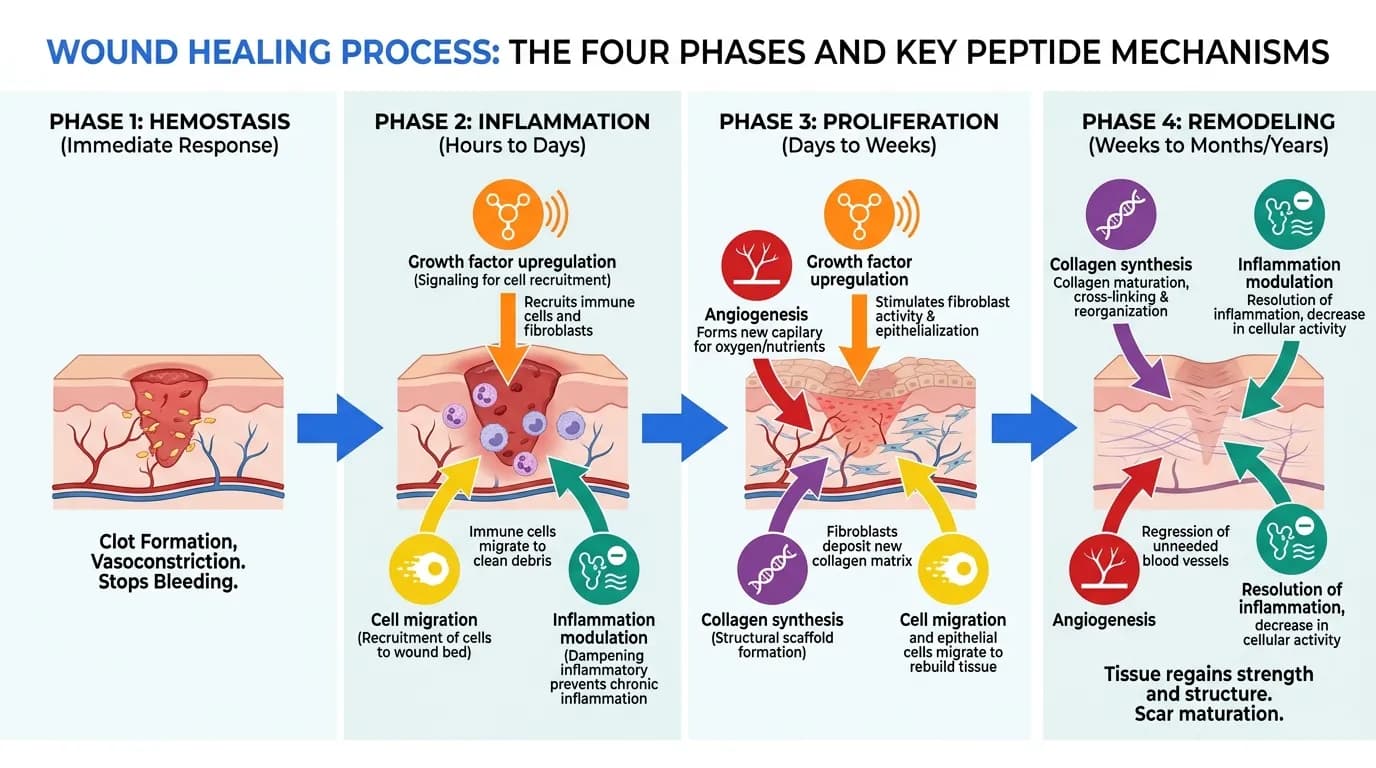
TB500 is a synthetic peptide corresponding to the full-length sequence of Thymosin Beta-4 (Tβ4), a 43-amino acid protein that is one of the most abundant intracellular peptides in mammalian cells. Thymosin Beta-4 was originally isolated from calf thymus tissue and belongs to a family of 15 highly conserved beta-thymosins found across vertebrate species. The peptide is encoded by the TMSB4X gene in humans and is expressed in virtually every cell type, with particularly high concentrations found in platelets, macrophages, and polymorphonuclear leukocytes.
The primary intracellular function of Thymosin Beta-4 is the sequestration of monomeric actin (G-actin), which prevents spontaneous polymerization into filamentous actin (F-actin). This actin-buffering capacity is essential for the regulation of the cytoskeleton, which in turn governs cell shape, motility, and division. Within cells, Thymosin Beta-4 maintains a large reservoir of unpolymerized actin that can be rapidly mobilized when the cell needs to migrate, divide, or change shape in response to extracellular signals.
Beyond its intracellular role, Thymosin Beta-4 has potent extracellular biological activities. When released from damaged cells or secreted by platelets at sites of injury, it acts as a paracrine signaling molecule that promotes wound healing, angiogenesis, and anti-inflammatory responses. These properties have made TB500 a subject of considerable scientific and clinical interest, with phase II clinical trials investigating its use in dermal wound healing, corneal injury repair, and cardiac protection after myocardial infarction.
The most well-characterized function of Thymosin Beta-4 is its role as the principal actin-sequestering protein in eukaryotic cells. In resting cells, approximately 50% of total actin exists in the monomeric G-actin form, and Thymosin Beta-4 binds to most of this pool in a 1:1 stoichiometric complex. The Tβ4-actin binding involves a central LKKTET motif (residues 17-22) that is essential for this interaction and is highly conserved across species.
When a cell receives a migration or proliferation signal, signaling pathways trigger the release of G-actin from the Tβ4 complex, allowing profilin to facilitate actin polymerization at the leading edge of the cell. This controlled release of actin monomers is critical for directional cell migration, a process fundamental to wound healing, immune cell trafficking, and tissue repair.
TB500 promotes the migration of multiple cell types critical to tissue repair, including endothelial cells, keratinocytes, and cardiac progenitor cells. In wound healing models, topical or systemic administration of Thymosin Beta-4 increased keratinocyte migration 2- to 3-fold over controls in Boyden chamber assays (Goldstein AL et al., Expert Opin Biol Ther 2012; PMID 22074294)1. The pro-migratory effect is mediated through activation of integrin-linked kinase (ILK), which in turn activates the Akt/protein kinase B survival pathway1.
The angiogenic properties of Thymosin Beta-4 are established. The peptide promotes endothelial cell differentiation, tubule formation, and sprouting angiogenesis in both in vitro and in vivo models1. The actin-binding domain (residues 17-23, the LKKTETQ sequence) has been identified as the minimal active site required for angiogenic activity, and this region alone can stimulate endothelial cell migration and coronary vasculogenesis1.
Thymosin Beta-4 exerts anti-inflammatory effects through multiple mechanisms. It inhibits TNF-alpha-stimulated NF-kB binding activity through its interaction with PINCH-1 and ILK signaling partners, independently of its actin-sequestering function. In corneal injury models, Thymosin Beta-4 treatment reduced polymorphonuclear leukocyte infiltration and decreased mRNA transcript levels of interleukin-1 beta, MIP-1alpha, MIP-2, and MCP-1 by several fold compared to controls.
The peptide also demonstrates significant anti-fibrotic properties. In dermal wound models, Thymosin Beta-4 reduces the number of myofibroblasts in healing wounds, which results in decreased scar formation. This anti-fibrotic effect has been observed in cardiac tissue as well, where Tβ4 treatment reduced fibrosis following myocardial infarction in animal models.
Thymosin Beta-4 has demonstrated remarkable cardioprotective properties in preclinical models. The seminal work by Bock-Marquette and colleagues demonstrated that Tβ4 activates integrin-linked kinase (ILK) in cardiomyocytes, promoting Akt-mediated cell survival after ischemic injury. In mouse models of coronary artery ligation, systemic administration of Tβ4 resulted in upregulation of ILK and Akt phosphorylation in the heart, enhanced early myocyte survival, and significantly improved cardiac function.
Additionally, Thymosin Beta-4 has been shown to reactivate embryonic epicardial progenitor cells in the adult heart, stimulating them to differentiate into cardiomyocytes and coronary vessel cells. This regenerative capacity represents a novel mechanism for cardiac repair that is distinct from conventional stem cell therapies.
The wound-healing properties of Thymosin Beta-4 have been studied extensively in both animal models and human clinical trials. In the foundational 1999 study by Malinda and colleagues (PMID 10469335 [animal model])2, topical or intraperitoneal administration of Tβ4 increased re-epithelialization by 42% over saline controls at 4 days and by 61% at 7 days post-wounding in a rat full-thickness wound model2. Treated wounds also showed increased collagen deposition, enhanced angiogenesis, and accelerated wound contraction2.
These preclinical findings were advanced into phase II clinical trials for venous stasis ulcers (NCT00832091) and pressure ulcers, where Thymosin Beta-4 treatment accelerated healing by nearly one month in responders (Treadwell T et al., 2012; PMID 23050815)3. The peptide demonstrated efficacy across multiple wound types, including diabetic wounds, aged-animal wounds, and steroid-impaired healing models3.
Thymosin Beta-4 has shown particular promise in ophthalmic applications. Studies by Sosne and colleagues demonstrated that topical Tβ4 accelerated corneal re-epithelialization, decreased inflammation, and reduced polymorphonuclear leukocyte infiltration after alkali injury in mouse models. The formulation RGN-259 (0.1% Tβ4 ophthalmic solution) was developed by RegeneRx Biopharmaceuticals and advanced through clinical trials.
In a randomized, double-blind phase II trial (NCT01387347), RGN-259 demonstrated a 35.1% reduction in ocular discomfort and a 59.1% reduction in total corneal fluorescein staining compared to vehicle control. In a compassionate-use study of neurotrophic keratopathy patients, complete healing was observed in four of six patients by 28 days, with the remaining two healing by days 55 and 60. A phase III trial confirmed these results in neurotrophic keratopathy (Sosne G et al., 2023; PMID 36613994)4.
The cardioprotective effects of Thymosin Beta-4 have been studied in multiple preclinical models of myocardial infarction. Following coronary artery ligation in mice, systemic Tβ4 administration improved left ventricular function, reduced infarct size, and decreased cardiac fibrosis (Goldstein AL et al. 2012 [review of animal models]; PMID 22074294)1. These effects were mediated through ILK-Akt survival signaling and mobilization of epicardial progenitor cells1.
Clinical translation of these findings has been slower, with early-phase human studies focusing on safety and tolerability. A first-in-human Phase I trial in healthy Chinese volunteers reported no dose-limiting toxicities or serious adverse events (Wang X et al., 2021; PMID 34346165)5. Earlier Allan-led work reported tolerability at IV doses up to 1260 mg with no dose-limiting toxicities.
Following intravenous administration in healthy volunteers, Thymosin Beta-4 exhibited dose-proportional pharmacokinetics across the tested range of 42 to 1260 mg (Wang X et al., 2021; PMID 34346165)5. The half-life increased with increasing dose, suggesting non-linear elimination kinetics at higher concentrations5. Tβ4 is naturally present in serum at concentrations of approximately 12-18 ng/mL in healthy individuals, and endogenous levels increase at sites of injury due to platelet degranulation and cellular release.
The peptide is metabolized by cellular peptidases, with the N-terminal tetrapeptide Ac-SDKP being a notable bioactive metabolite. Ac-SDKP is produced through the action of meprin-alpha and is degraded by angiotensin-converting enzyme (ACE). This metabolite has its own anti-fibrotic and anti-inflammatory properties, and its levels are elevated during ACE inhibitor therapy.
The current evidence base for TB500, while more advanced than many research peptides, still has significant gaps:
- Phase III clinical trials for dermal and cardiac applications have not been completed
- Human pharmacokinetic data beyond single-dose and 14-day studies is limited
- The optimal route of administration (intravenous, subcutaneous, topical) for different indications remains under investigation
- Long-term safety data from controlled human studies is not yet available
- The relationship between TB500 (full-length synthetic Tβ4) and the shorter TB-500 fragment (Ac-LKKTETQ, residues 17-23) requires further clarification in terms of comparative efficacy
- Drug interaction studies in humans have not been conducted
- The potential impact on tumor growth and cancer progression requires thorough evaluation, given Tβ4's promotion of angiogenesis and cell migration
Thymosin beta4 accelerates wound healing, published in Journal of Investigative Dermatology (Malinda KM et al., 1999; PMID: 10469335):
- The study demonstrated increase of 42% in re epithelialization at 4 days over saline controls
- The study demonstrated increase of 61% in re epithelialization at 7 days
- The study showed foundational study demonstrating that topical or intraperitoneal Tβ4 increased re epithelialization by 42% at day 4 and 61% at day 7 in a rat full thickness wound model. Increased collagen deposition, angiogenesis, and keratinocyte migration.