Top Immune-Boosting Peptides: Research Overview

Introduction#
The immune system is one of the most actively researched targets for peptide-based interventions. Immune-modulating peptides work through diverse mechanisms — from enhancing T-cell maturation and promoting antimicrobial defense to reducing inflammatory cascades and supporting antioxidant pathways that protect immune cells.
Unlike broad-spectrum immunosuppressants or stimulants, many immune peptides act as immunomodulators, meaning they help regulate immune function rather than simply boosting or suppressing it. This distinction is important: an effective immune peptide ideally enhances the body's response to pathogens while preventing the overactivation that leads to chronic inflammation and autoimmune pathology.
This guide examines five peptides with the most substantial research profiles in immune modulation. The evidence ranges from extensive clinical data (Thymosin Alpha-1, with 11,000+ human subjects studied) to entirely preclinical (KPV). Understanding where each peptide falls on this evidence spectrum is critical for accurate evaluation.
1. Thymosin Alpha-1#
Evidence Level: Extensive clinical data; approved in 35+ countries Primary Mechanism: T-cell maturation, dendritic cell activation, Toll-like receptor signaling Research Status: FDA Category 2 (banned from US compounding); approved internationally as Zadaxin
Thymosin Alpha-1 is a 28-amino-acid peptide originally isolated from thymic tissue. It is the most clinically validated immune peptide currently known, with regulatory approval in over 35 countries for indications including chronic hepatitis B, hepatitis C, and as an immunotherapy adjuvant.
Research Findings#
A comprehensive 2024 review examined data from more than 30 clinical trials involving over 11,000 human subjects. The review confirmed Thymosin Alpha-1's consistent immunomodulatory effects across diverse clinical populations, including patients with viral hepatitis, immunodeficiencies, cancer, and severe infections.
Thymosin Alpha-1's mechanism centers on the activation of Toll-like receptors (TLR2, TLR9) in dendritic cells, which enhances both innate and adaptive immune responses. It promotes T-cell maturation in the thymus, increases the activity of natural killer (NK) cells, and modulates cytokine production to balance pro-inflammatory and anti-inflammatory signaling.
During the COVID-19 pandemic, Thymosin Alpha-1 was studied as an adjunct therapy in critically ill patients. Several observational studies and small clinical trials reported improved lymphocyte counts and reduced mortality in severe cases, though large randomized controlled trials were limited.
Regulatory Note#
Despite its extensive international clinical use and favorable safety profile, Thymosin Alpha-1 was placed in FDA Category 2 in 2024. The FDA classified it as a biological product, which excludes it from the compounding framework. This decision is currently being challenged by several medical organizations. For more on this regulatory situation, see 5 Peptides Under FDA Scrutiny.
2. Thymalin#
Evidence Level: Limited clinical data; primarily Russian/Eastern European research Primary Mechanism: Thymic bioregulator; immune system restoration Research Status: Not FDA-approved; available as a research compound
Thymalin is a synthetic dipeptide (Glu-Trp) classified as a bioregulator peptide developed at the St. Petersburg Institute of Bioregulation and Gerontology. Like Thymosin Alpha-1, it targets the thymic arm of the immune system, but through a different mechanism — the bioregulator approach proposes that short peptides modulate gene expression in specific tissues.
Research Findings#
Thymalin's research profile includes long-term observational studies conducted primarily by the Khavinson research group. One notable study followed elderly subjects over a 6-year period and reported that thymalin administration was associated with improvements in immune function biomarkers and reduced mortality rates. However, these studies had methodological limitations including lack of proper randomization and blinding.
In vitro studies suggest thymalin influences gene expression in thymic cells, potentially supporting thymic regeneration — a process that declines significantly with aging (thymic involution). The theoretical framework proposes that restoring thymic function could improve overall immune competence in elderly populations.
Thymalin has also been studied in combination with epitalon (a pineal bioregulator peptide), with some studies reporting synergistic effects on immune function and longevity markers. However, these combination studies share the methodological limitations of the single-compound research.
Important Considerations#
The evidence for thymalin comes predominantly from a single research group, and the studies have not been replicated by independent investigators. The bioregulator peptide framework has limited acceptance in the broader international research community. Researchers should treat thymalin as an early-stage compound with intriguing but unvalidated data.
3. LL-37#
Evidence Level: Extensive in vitro and preclinical data; limited clinical data Primary Mechanism: Antimicrobial peptide; innate immune defense Research Status: Not FDA-approved; investigational
LL-37 is the only human cathelicidin — a class of antimicrobial peptides that form a critical component of the innate immune system. It is a 37-amino-acid peptide produced by neutrophils, macrophages, epithelial cells, and other immune cells in response to infection.
Research Findings#
LL-37 has broad-spectrum antimicrobial activity against bacteria (including antibiotic-resistant strains like MRSA), viruses, and fungi. In vitro studies have demonstrated direct killing of pathogens through membrane disruption, as well as indirect immune effects including chemotaxis of immune cells, modulation of inflammatory responses, and promotion of wound healing.
A particularly significant area of research concerns LL-37's activity against biofilms — structured bacterial communities that are notoriously resistant to conventional antibiotics. Studies have shown that LL-37 can disrupt biofilm formation and kill bacteria within established biofilms, a property that has generated interest for potential applications in chronic infections.
Beyond direct antimicrobial effects, LL-37 modulates the immune response by serving as a signaling molecule. It activates formyl peptide receptor-like 1 (FPRL1) on immune cells, promoting neutrophil and monocyte recruitment to infection sites. It also influences dendritic cell maturation and T-cell polarization.
Important Considerations#
Despite extensive mechanistic data, LL-37's clinical translation has been challenging. The peptide is susceptible to proteolytic degradation, has potential cytotoxicity at higher concentrations, and its systemic delivery raises pharmacokinetic challenges. Most clinical applications being explored involve topical or localized delivery rather than systemic administration.
4. KPV#
Evidence Level: Preclinical (animal studies and in vitro) Primary Mechanism: Anti-inflammatory via NF-kappaB inhibition; gut immune modulation Research Status: Not FDA-approved; no human clinical trials
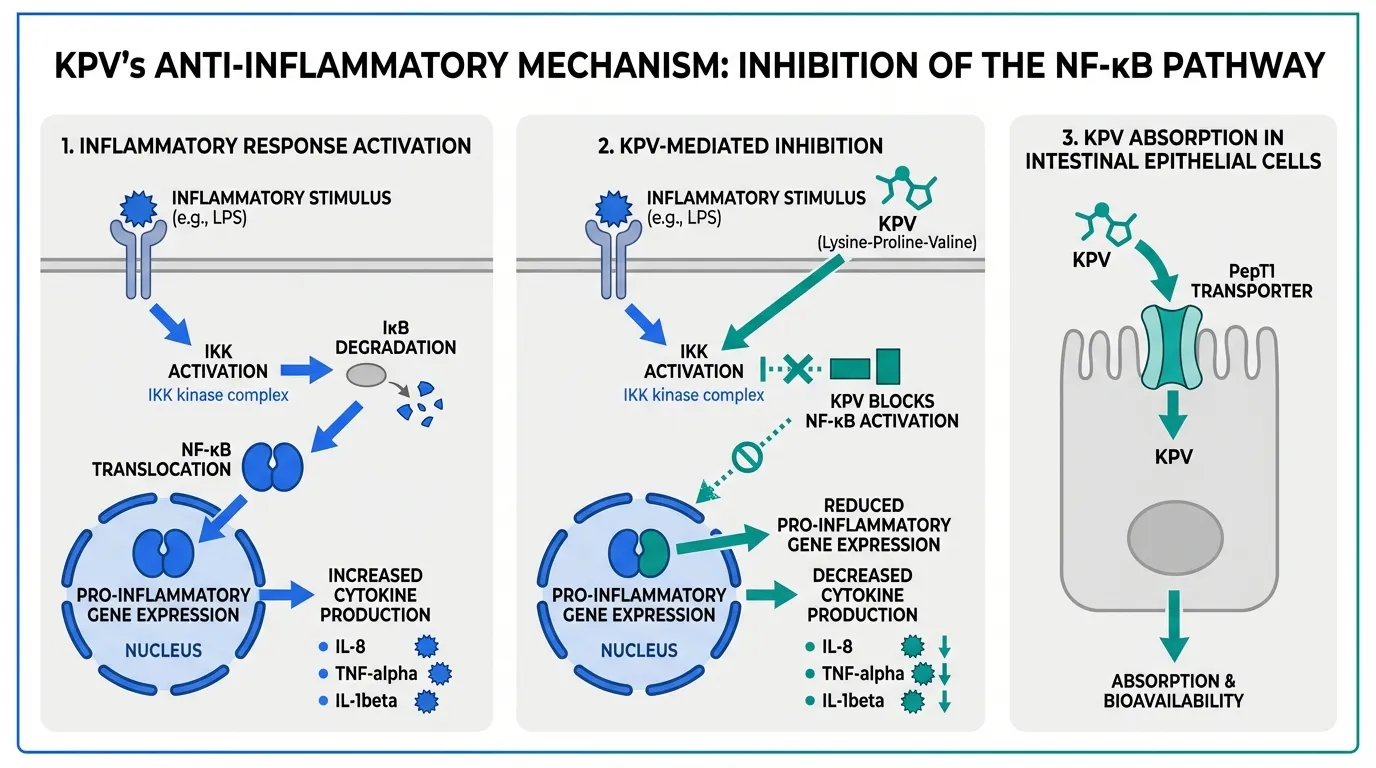
KPV is a tripeptide (Lys-Pro-Val) derived from the C-terminal end of alpha-melanocyte-stimulating hormone (alpha-MSH). While alpha-MSH has well-characterized anti-inflammatory properties, KPV retains these properties in a much smaller, more stable molecule — and with potentially greater potency.
Research Findings#
KPV's primary mechanism is inhibition of the NF-kappaB signaling pathway, a master regulator of inflammatory gene expression. Studies have demonstrated dose-dependent suppression of NF-kappaB activation and downstream reduction of pro-inflammatory cytokines including IL-8, TNF-alpha, and IL-1beta.
The most notable research area for KPV is gut immunity. Studies in murine models of inflammatory bowel disease (IBD) have shown that oral KPV reduces colitis severity in both DSS-induced and TNBS-induced models. Remarkably, KPV was absorbed through the PepT1 transporter in intestinal epithelial cells — an unusual property for a peptide that enables oral bioavailability.
Research also demonstrated that KPV exhibits stronger anti-inflammatory effects than the full alpha-MSH peptide from which it is derived, suggesting that the tripeptide contains the minimal active sequence for anti-inflammatory activity.
Important Considerations#
All KPV research is preclinical. No human clinical trials have been conducted or registered. While the IBD model data is promising, the gap between murine colitis models and human IBD is substantial. Claims about KPV's efficacy in humans remain speculative until clinical data emerges.
5. Glutathione#
Evidence Level: Extensive human data (as a natural metabolite); limited peptide supplementation trial data Primary Mechanism: Master antioxidant; immune cell protection; detoxification Research Status: Available as a supplement; not FDA-approved for immune indications
Glutathione is a tripeptide (Glu-Cys-Gly) that functions as the body's primary intracellular antioxidant. While technically a peptide, glutathione occupies a unique position because it is an endogenous molecule present in virtually every cell. The immune system is particularly dependent on glutathione for proper function.
Research Findings#
The connection between glutathione and immune function is well-established in the biochemical literature. Glutathione is essential for:
- T-cell proliferation and function — lymphocytes require adequate glutathione levels for activation, proliferation, and cytotoxic activity
- NK cell activity — natural killer cell function is directly correlated with intracellular glutathione levels
- Macrophage function — phagocytic activity and antigen presentation are glutathione-dependent
- Redox signaling — glutathione-mediated redox balance regulates NF-kappaB and other immune transcription factors
Glutathione levels decline with aging, chronic disease, and oxidative stress — conditions associated with impaired immune function. Research suggests that glutathione depletion contributes to immune senescence, the age-related decline in immune competence.
Supplementation studies have explored various forms including oral glutathione, liposomal glutathione, IV glutathione, and glutathione precursors (N-acetylcysteine). The evidence for oral supplementation improving systemic glutathione levels has been mixed, with some studies showing increases in blood glutathione and others finding minimal effect due to digestive degradation.
Important Considerations#
While the biochemistry linking glutathione to immune function is robust, the clinical evidence for glutathione supplementation specifically boosting immune outcomes is less definitive. The challenge lies in efficiently raising intracellular glutathione levels through exogenous administration. NAC (N-acetylcysteine), a glutathione precursor, has stronger clinical evidence for raising glutathione levels than direct glutathione supplementation.
Comparison Summary#
| Peptide | Evidence Level | Primary Immune Effect | Administration | Approved | FDA Status |
|---|---|---|---|---|---|
| Thymosin Alpha-1 | Extensive clinical | Adaptive immunity (T-cells, DCs) | SC injection | 35+ countries | Category 2 banned |
| Thymalin | Limited clinical | Thymic restoration | SC injection/oral | Russia (limited) | Not evaluated |
| LL-37 | Extensive preclinical | Innate immunity (antimicrobial) | Topical/local | No | Not evaluated |
| KPV | Preclinical only | Anti-inflammatory (gut) | Oral/SC injection | No | Not evaluated |
| Glutathione | Mixed clinical | Antioxidant/immune cell support | Oral/IV/topical | As supplement | GRAS (supplement) |
Key Distinctions#
These five peptides target fundamentally different aspects of the immune system:
Thymosin Alpha-1 enhances the adaptive immune system by promoting T-cell development and dendritic cell function. It is best suited for research on immune deficiency, viral infections, and immunosenescence.
Thymalin targets thymic function specifically, with potential applications in reversing age-related thymic involution. Its evidence base is weaker but its theoretical framework is compelling.
LL-37 operates in the innate immune system as a direct antimicrobial agent. It is most relevant for research on bacterial infections, biofilms, and antimicrobial resistance.
KPV is an anti-inflammatory peptide with specific relevance to mucosal immunity and gut health. Its NF-kappaB inhibition may have broad anti-inflammatory applications beyond the gut.
Glutathione supports immune function indirectly through antioxidant defense and redox regulation. It is the most broadly relevant compound on this list but also the hardest to target through supplementation.
Conclusion#
Immune-modulating peptides offer diverse approaches to supporting and regulating immune function. The evidence spectrum ranges from Thymosin Alpha-1's extensive clinical validation in over 11,000 human subjects to KPV's entirely preclinical record. Researchers should evaluate each peptide within its specific evidence context and avoid extrapolating preclinical findings to human outcomes.
The regulatory landscape adds another layer of complexity. Thymosin Alpha-1 — the most clinically validated immune peptide — is now restricted from US compounding despite international approval. This regulatory paradox underscores the importance of understanding both the science and the regulatory framework when evaluating immune peptides.
For researchers exploring immune peptide protocols, the Dosing Calculator can assist with weight-based calculations, and the Safety page provides important guidance on quality considerations and risk evaluation.
Related Peptide Profiles#
Learn more about the peptides discussed in this article:
- Thymosin Alpha-1 Overview and Research Guide
- Thymosin Alpha-1 Dosing Protocols
- Thymosin Alpha-1 Side Effects and Safety
- Thymalin Overview and Research Guide
- Thymalin Dosing Protocols
- Thymalin Side Effects and Safety
- LL-37 Overview and Research Guide
- LL-37 Dosing Protocols
- LL-37 Side Effects and Safety
- KPV Overview and Research Guide
- KPV Dosing Protocols
- KPV Side Effects and Safety
- Glutathione Overview and Research Guide
- Glutathione Dosing Protocols
- Glutathione Side Effects and Safety

Frequently Asked Questions About Top Immune-Boosting Peptides: Research Overview
What does this article cover?
Top immune-boosting peptides including Thymosin Alpha-1, Thymalin, LL-37, KPV, and Glutathione — evidence levels and mechanisms reviewed. This guide is for educational purposes only and does not constitute medical advice.
Which peptides are discussed in this article?
This article covers Thymosin Alpha-1, Thymalin, LL-37, KPV, Glutathione. Key context: Thymosin Alpha-1 (Most clinically validated immune peptide with 11,000+ human subjects and 35+ country approvals); Thymalin (Thymic bioregulator peptide studied for immune restoration in aging and immunodeficient populations); LL-37 (Human cathelicidin antimicrobial peptide with broad-spectrum activity against bacteria, viruses, ...). Each peptide is discussed based on available research evidence.
Who is this guide written for?
This guide is written for researchers and individuals seeking an evidence-based overview of the topic covered in "Top Immune-Boosting Peptides: Research Overview." It summarizes available research data without making treatment recommendations. Always consult a healthcare provider for medical decisions.
What are the key takeaways from this article?
The main findings covered in this article include: Most clinically validated immune peptide with 11,000+ human subjects and 35+ country approvals. Thymic bioregulator peptide studied for immune restoration in aging and immunodeficient populations. Human cathelicidin antimicrobial peptide with broad-spectrum activity against bacteria, viruses, .... These takeaways are based on the research data available at the time of publication.
What is Thymosin Alpha-1 and why is it significant?
Thymosin Alpha-1 is a peptide discussed in this article because: Most clinically validated immune peptide with 11,000+ human subjects and 35+ country approvals. For a complete profile of Thymosin Alpha-1, see the dedicated peptide page on this site.
Continue reading this research review
Free access to the complete analysis with citations and evidence ratings.
150+ peptide profiles · 30+ comparisons · 18 research tools
Medical Disclaimer
This website is for educational and informational purposes only. The information provided is not intended to diagnose, treat, cure, or prevent any disease. Always consult with a qualified healthcare professional before using any peptide or supplement.
Join 2,000+ researchers getting biweekly updates
Enjoyed this article?
The Research Briefing delivers deep-dives like this biweekly — plus new study breakdowns, safety updates, and tool announcements.
Free forever. No spam. Unsubscribe in one click.
Where to Find These Peptides
Continue Exploring
Peptide Profiles
Keep Reading

Immune-Modulating Peptides: Thymosin Alpha-1, KPV, LL-37, and Beyond
Comprehensive research review of immune-modulating peptides including thymosin alpha-1, KPV, LL-37, thymalin, VIP, and glutathione. Clinical evidence, mechanisms of immune regulation, and implications for autoimmune and inflammatory conditions.

Antimicrobial Peptides: LL-37 and KPV in Infection and Inflammation Research
LL-37 and KPV antimicrobial peptide research reviewed — mechanisms of action, infection defense, gut immunity, and anti-inflammatory pathways.

Can Peptides Help with Inflammation? A Research-Based Guide
Anti-inflammatory peptides — KPV, BPC-157, LL-37, thymosin alpha-1, VIP, and glutathione — with mechanisms and clinical evidence.
You Might Also Like
Related content you may find interesting