5 Peptides Under FDA Scrutiny: What You Need to Know

Introduction#
The regulatory landscape for research peptides in the United States shifted dramatically in 2024 when the FDA finalized its categorization framework for substances used in compounding pharmacies. Several peptides that had been widely available through compounding pharmacies for years were placed in Category 2 — meaning they are now prohibited from being compounded for human use.
This article examines five peptides that are currently under FDA scrutiny or have been directly affected by recent regulatory actions. For each, we cover the current legal status, the FDA's stated rationale, the existing evidence base, and what these changes mean for the research community.
Understanding the regulatory framework is essential for anyone involved in peptide research. The FDA's categorization system, its implications, and the ongoing legal challenges represent one of the most significant shifts in the peptide space in decades.
The FDA Categorization Framework#
Before examining individual peptides, it helps to understand the regulatory structure the FDA uses for compounding substances.
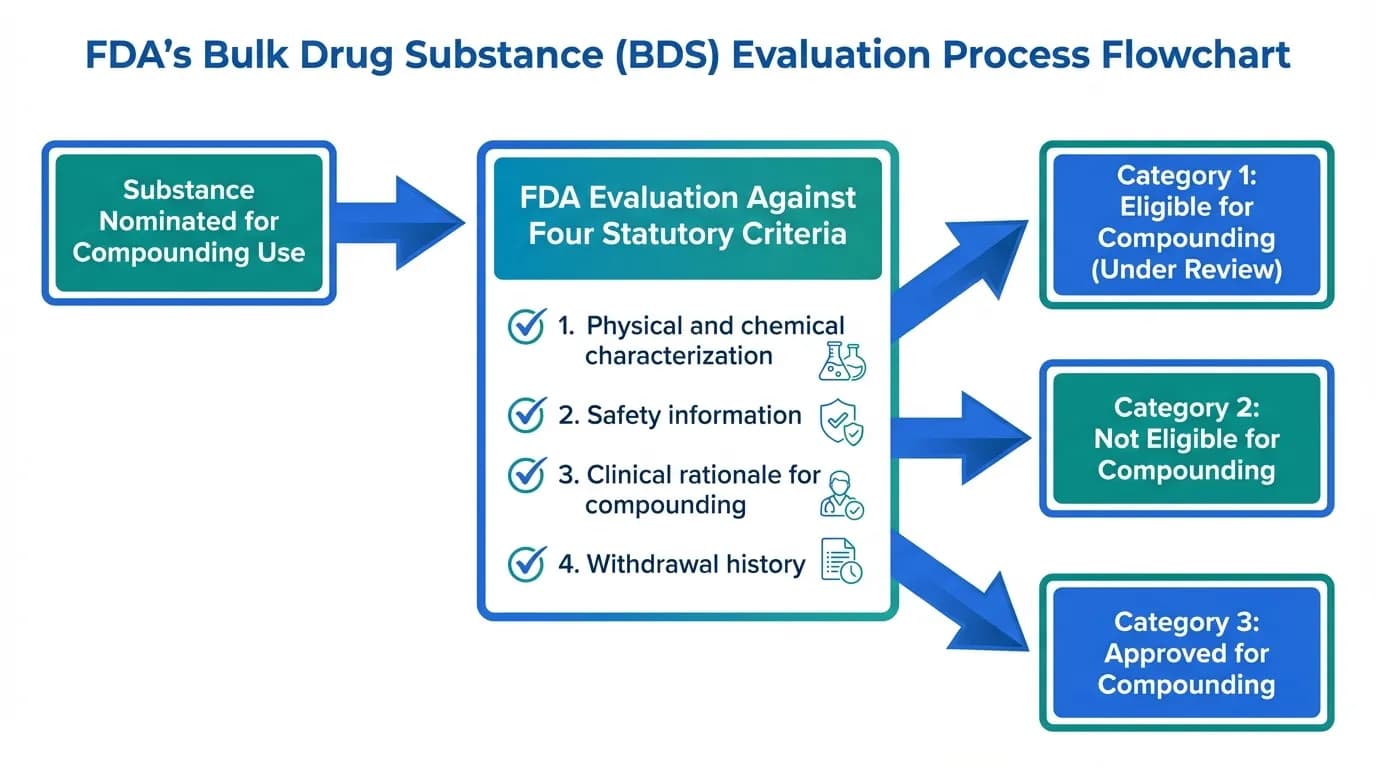
The FDA evaluates substances nominated for use in compounding under Section 503B of the Federal Food, Drug, and Cosmetic Act. Substances are sorted into three categories:
- Category 1: Approved for compounding after evaluation
- Category 2: Not approved for compounding; safety or efficacy concerns identified
- Category 3: Under evaluation; more data needed
Category 2 placement effectively bans a substance from being compounded by 503A (traditional) and 503B (outsourcing facility) pharmacies. This does not affect FDA-approved versions of these drugs (if any exist) or legitimate research use, but it eliminates the compounding pathway that had been the primary access route for many peptides.
1. BPC-157 (Body Protection Compound)#
Current Status: FDA Category 2 — banned from compounding (2024) Previous Availability: Widely available through compounding pharmacies FDA Rationale: Insufficient safety data for human use; no approved drug product to reference
BPC-157 is arguably the most well-known peptide affected by the FDA's Category 2 designation. A 15-amino-acid peptide derived from human gastric juice proteins, BPC-157 had become one of the most popular research peptides available through compounding pharmacies, used primarily for its tissue repair properties observed in extensive preclinical research.
The Evidence Situation#
BPC-157 has been studied in over 100 preclinical (animal) studies spanning tendon, ligament, muscle, bone, gut, and skin tissue repair. The breadth and consistency of the animal data is unusual for a peptide of this type. However, the human clinical evidence is extremely limited — published data includes a pilot safety study with just 2 subjects and a small intra-articular injection study with 12 patients.
The FDA's position centers on this gap: despite extensive animal research, the lack of completed human clinical trials means there is insufficient data to confirm that BPC-157 is safe for human compounding. The agency cited the absence of an approved drug product as a reference standard and the limited characterization of the compound's safety profile in humans.
Industry Response#
The Category 2 designation has been controversial. Advocates point to BPC-157's extensive preclinical safety record and the small but positive human data as evidence of a favorable risk profile. Critics counter that the regulatory standard for compounding substances requires more rigorous human data than currently exists. Several organizations have filed comments with the FDA challenging the Category 2 placement.
2. Thymosin Alpha-1#
Current Status: FDA Category 2 — banned from compounding (2024) Previous Availability: Available through compounding pharmacies; prescribed by longevity and integrative medicine practitioners FDA Rationale: Classified as a biological product, not eligible for compounding under current framework
Thymosin Alpha-1 represents perhaps the most paradoxical case in the FDA's categorization decisions. This 28-amino-acid immune-modulating peptide is approved in over 35 countries under the brand name Zadaxin for indications including hepatitis B, hepatitis C, and as an immunotherapy adjunct. It has been studied in over 11,000 human subjects across more than 30 clinical trials.
The Evidence Situation#
Unlike BPC-157, Thymosin Alpha-1 has an extensive human clinical record. Its safety and efficacy data in viral hepatitis, immunodeficiency, and vaccine adjuvant applications have been sufficient for regulatory approval in countries across Asia, Europe, and South America. A comprehensive 2024 review covering the full breadth of clinical evidence confirmed its favorable safety profile across diverse patient populations.
The FDA's Position#
The FDA's restriction of Thymosin Alpha-1 rests on a technical regulatory argument rather than a safety concern. The agency classified Thymosin Alpha-1 as a biological product (rather than a drug), which places it outside the compounding framework established under Section 503B. Under the Biologics Price Competition and Innovation Act, biological products have different regulatory pathways that do not include compounding exemptions.
Why This Is Controversial#
The Category 2 designation of Thymosin Alpha-1 has generated significant criticism from clinicians and researchers for several reasons:
- It is approved in 35+ countries with extensive safety data
- Over 11,000 human subjects have been studied in clinical trials
- The FDA's objection is regulatory/classificatory, not based on safety signals
- No FDA-approved version exists in the US, leaving no alternative access pathway
Several medical organizations have formally challenged this decision, arguing that the biologics classification is overly broad when applied to a well-characterized synthetic peptide.
3. AOD-9604#
Current Status: FDA Category 2 — banned from compounding (2024) Previous Availability: Available through compounding pharmacies; used in weight management and joint health protocols FDA Rationale: Insufficient evidence of safety; no FDA-approved drug product
AOD-9604 is a modified fragment (amino acids 177-191) of human growth hormone, originally developed for its lipolytic (fat-reducing) properties without the growth-promoting effects of full-length HGH. It occupies an interesting regulatory position because it has received approval in Australia from the Therapeutic Goods Administration (TGA) as a complementary medicine for osteoarthritis.
The Evidence Situation#
AOD-9604's clinical data is mixed. Early clinical trials demonstrated safety but showed disappointing efficacy results for weight loss — the Phase 2b trial for obesity did not meet its primary endpoint. However, subsequent research has explored alternative applications, particularly in joint health, where Australian regulatory approval was obtained.
The peptide has been studied in approximately 1,500 human subjects across completed clinical trials, primarily focused on obesity. While these trials established a reasonable safety profile, the lack of demonstrated efficacy for the primary indication (weight loss) weakened its regulatory position.
The Regulatory Paradox#
AOD-9604 illustrates the complexity of international regulatory divergence. A peptide that is approved by one country's regulatory agency (Australia's TGA) is banned from compounding in another (US FDA). This creates confusion for researchers and clinicians working across jurisdictions. The FDA has not commented specifically on the Australian approval, maintaining its position based on the US regulatory framework.
4. CJC-1295 DAC#
Current Status: Under increased regulatory scrutiny; compounding availability restricted Previous Availability: Widely available through compounding and research chemical channels FDA Rationale: Safety concerns related to sustained non-pulsatile GH elevation; no approved drug product
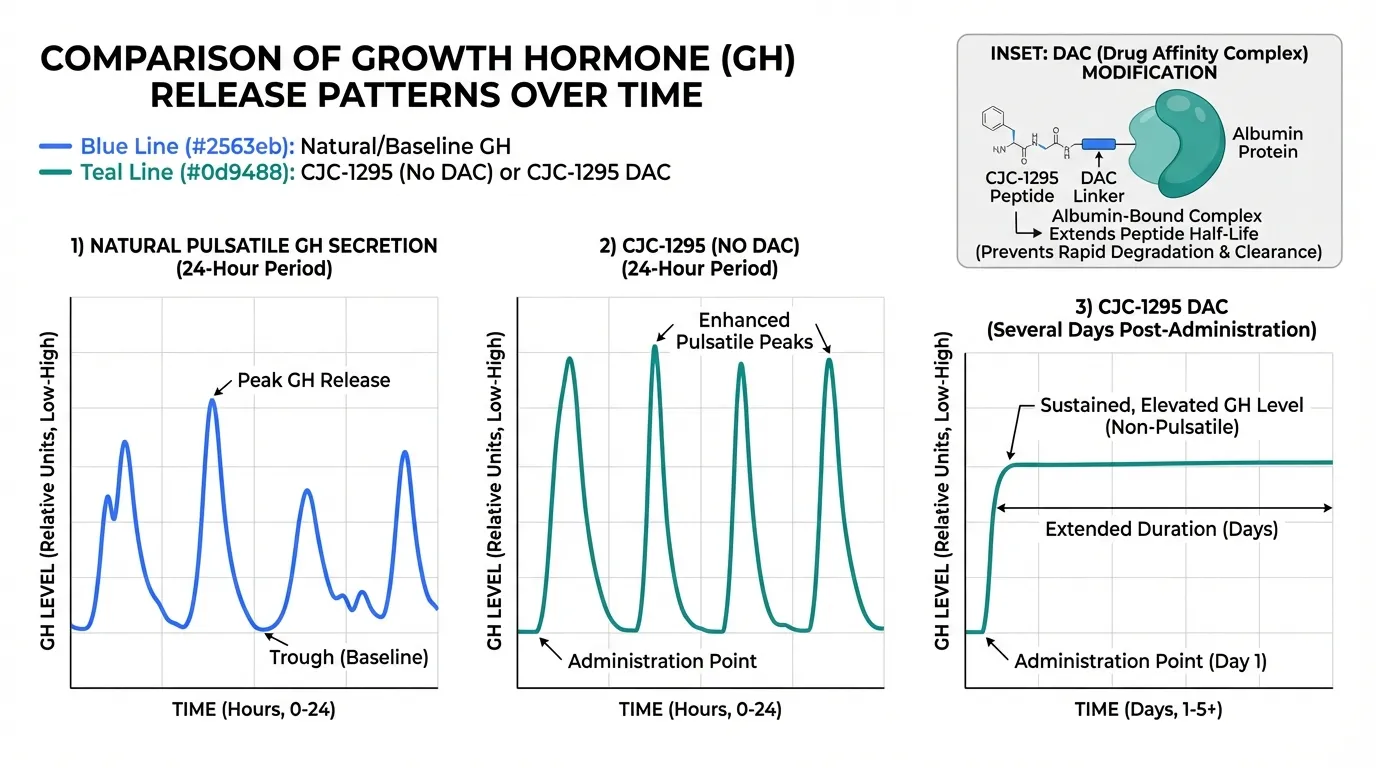
CJC-1295 DAC is a GHRH analog modified with a Drug Affinity Complex (DAC) that binds to albumin, extending its half-life to approximately 6-8 days. This creates sustained growth hormone elevation — a pharmacological profile that has drawn particular FDA attention.
The Regulatory Concern#
The FDA's concern with CJC-1295 DAC centers on its sustained, non-pulsatile stimulation of growth hormone release. Natural GH secretion follows a pulsatile pattern with clear peaks and troughs. The DAC modification eliminates this pulsatility, producing continuously elevated GH levels for days after each injection.
This profile raises theoretical concerns about:
- Potential for elevated IGF-1 levels beyond physiological ranges
- Unknown long-term effects of sustained non-pulsatile GH stimulation
- Risk of side effects associated with chronically elevated GH (insulin resistance, fluid retention, joint pain)
- A reported death during a clinical trial (though the causal relationship has been debated in the literature)
How It Differs from CJC-1295 (No DAC)#
The No DAC version — also known as Modified GRF 1-29 — has a much shorter half-life and preserves pulsatile GH release. While both variants face regulatory scrutiny, the DAC version has drawn more specific safety concerns due to its sustained pharmacological profile. For a detailed comparison, see CJC-1295 DAC and CJC-1295 No DAC.
5. Selank#
Current Status: Not FDA-evaluated; no US regulatory pathway Availability: Not available through US compounding pharmacies; available as a research chemical Regulatory Position: Exists outside the FDA framework entirely
Selank represents a different category of FDA scrutiny — not an active ban, but rather a compound that exists entirely outside the US regulatory framework. Approved in Russia as an anxiolytic medication, selank has never been submitted for FDA evaluation and has no pathway to legal clinical use in the United States.
The Regulatory Gap#
Selank's situation highlights a broader issue in peptide regulation: compounds that are approved medications in other countries may have no legal pathway for clinical use in the US. Unlike Thymosin Alpha-1 (which was specifically evaluated and placed in Category 2), selank has simply never entered the US regulatory process.
This creates a gray area. Selank is not explicitly banned — it was never evaluated. It cannot be legally prescribed by US physicians, and it is not available through 503A or 503B compounding pharmacies. Its availability is limited to research chemical suppliers, where quality control and purity standards are not regulated by the FDA.
The Broader Pattern#
Selank represents a pattern common to many Russian and Eastern European peptides. Compounds like semax, pinealon, and DSIP occupy similar regulatory gray areas — approved or recognized in other jurisdictions but entirely outside the FDA's purview.
What This Means for Researchers#
The FDA's regulatory actions have several practical implications for the peptide research community:
Access Changes#
Peptides placed in Category 2 can no longer be obtained from compounding pharmacies. This affects both clinical practitioners who had been prescribing these compounds and researchers who had been sourcing pharmaceutical-grade material from compounders. Research chemical suppliers remain an alternative source, but without the quality assurance standards that compounding pharmacies provide.
Quality Concerns#
With compounding pharmacy access restricted, more researchers may turn to unregulated sources. This raises concerns about peptide purity, potency, contamination, and proper handling — issues that the Safety page covers in detail.
Legal Considerations#
The regulatory status of peptides varies significantly by jurisdiction and context. Possessing research chemicals for legitimate research purposes remains legal, but the line between research use and clinical use is a critical distinction that researchers must understand and respect.
Ongoing Challenges#
Multiple organizations have filed formal challenges to the FDA's Category 2 designations, particularly for Thymosin Alpha-1 and BPC-157. These challenges argue that the FDA applied overly broad criteria, failed to adequately consider existing safety data, and did not follow proper administrative procedures. The outcomes of these challenges could significantly reshape the regulatory landscape.
Comparison of Regulatory Status#
| Peptide | FDA Category | Human Safety Data | International Approvals | Active Legal Challenges |
|---|---|---|---|---|
| BPC-157 | Category 2 (banned) | Very limited (n < 15) | None | Yes |
| Thymosin Alpha-1 | Category 2 (banned) | Extensive (11,000+ subjects) | 35+ countries | Yes |
| AOD-9604 | Category 2 (banned) | Moderate (~1,500 subjects) | Australia (TGA) | Limited |
| CJC-1295 DAC | Restricted | Limited | None | No |
| Selank | Not evaluated | Russian clinical data | Russia | No |
Conclusion#
The FDA's regulatory actions on peptides reflect a broader tension between the pace of peptide research and the requirements of the US regulatory system. Compounds with extensive international use (Thymosin Alpha-1) and those with strong preclinical but limited clinical data (BPC-157) have both been affected, though for different reasons.
For researchers and practitioners, staying informed about regulatory changes is essential. The regulatory landscape is actively evolving — ongoing legal challenges, potential legislative action, and shifting FDA priorities could all alter the current framework. The most prudent approach is to understand the specific regulatory status of each compound, source materials from the most reputable available channels, and clearly distinguish between approved clinical use and investigational research applications.
This situation also underscores the importance of supporting well-designed human clinical trials for peptides with strong preclinical evidence. The gap between preclinical promise and clinical validation is precisely what regulatory agencies point to when restricting access — and the most durable path to restoring availability is through the rigorous clinical evidence that regulatory frameworks require.
For context on which peptides remain FDA-approved, see our FDA-approved peptides guide. To compare the half-lives of peptides discussed in this article, use the half-life comparison tool.
Related Peptide Profiles#
Learn more about the peptides discussed in this article:
- BPC-157 Overview and Research Guide
- BPC-157 Dosing Protocols
- BPC-157 Side Effects and Safety
- Thymosin Alpha-1 Overview and Research Guide
- Thymosin Alpha-1 Dosing Protocols
- Thymosin Alpha-1 Side Effects and Safety
- AOD-9604 Overview and Research Guide
- AOD-9604 Dosing Protocols
- AOD-9604 Side Effects and Safety
- CJC-1295 DAC Overview and Research Guide
- CJC-1295 DAC Dosing Protocols
- CJC-1295 DAC Side Effects and Safety
- Selank Overview and Research Guide
- Selank Dosing Protocols
- Selank Side Effects and Safety

Frequently Asked Questions About 5 Peptides Under FDA Scrutiny: What You Need to Know
What does this article cover?
Five research peptides facing FDA scrutiny — BPC-157, Thymosin Alpha-1, AOD-9604, CJC-1295 DAC, and Selank — with current legal status. This news article is for educational purposes only and does not constitute medical advice.
Which peptides are discussed in this article?
This article covers BPC-157, Thymosin Alpha-1, AOD-9604, CJC-1295 DAC, Selank. Key context: BPC-157 (Most popular healing peptide placed in FDA Category 2 (banned from compounding) in 2024); Thymosin Alpha-1 (Immune peptide approved in 35+ countries but banned from US compounding despite extensive clinica...); AOD-9604 (Anti-obesity peptide fragment placed in Category 2 despite TGA approval in Australia for osteoart...). Each peptide is discussed based on available research evidence.
How current is the information in this article?
This article was published on 2026-02-10 and last updated on 2026-02-10. The peptide research landscape evolves rapidly, so readers should verify time-sensitive information such as regulatory status or clinical trial progress.
What are the key takeaways from this article?
The main findings covered in this article include: Most popular healing peptide placed in FDA Category 2 (banned from compounding) in 2024. Immune peptide approved in 35+ countries but banned from US compounding despite extensive clinica.... Anti-obesity peptide fragment placed in Category 2 despite TGA approval in Australia for osteoart.... These takeaways are based on the research data available at the time of publication.
What is BPC-157 and why is it significant?
BPC-157 is a peptide discussed in this article because: Most popular healing peptide placed in FDA Category 2 (banned from compounding) in 2024. For a complete profile of BPC-157, see the dedicated peptide page on this site.
Continue reading this research review
Free access to the complete analysis with citations and evidence ratings.
150+ peptide profiles · 30+ comparisons · 18 research tools
Medical Disclaimer
This website is for educational and informational purposes only. The information provided is not intended to diagnose, treat, cure, or prevent any disease. Always consult with a qualified healthcare professional before using any peptide or supplement.
Join 2,000+ researchers getting biweekly updates
Enjoyed this article?
The Research Briefing delivers deep-dives like this biweekly — plus new study breakdowns, safety updates, and tool announcements.
Free forever. No spam. Unsubscribe in one click.
Where to Find These Peptides
Continue Exploring
Peptide Profiles
Keep Reading
FDA Peptide Categories Explained: Category 1 vs Category 2 (2026)
Understand the FDA peptide classification system. Learn the difference between Category 1, Category 2, and Category 3 peptides and what the 2024-2026 regulatory changes mean for researchers.

What Peptides Did the FDA Ban? A Complete Regulatory Timeline
Complete list of peptides banned from compounding by the FDA, including Category 2 timelines, reasoning, and researcher implications.
Peptide Stacking Guide 2026: Best Combinations by Goal
The definitive 2026 guide to peptide stacking organized by goal. Fat loss, muscle growth, healing, anti-aging, and cognitive stacks with evidence levels, dosing timing, and safety considerations.
You Might Also Like
Related content you may find interesting