What Peptides Are FDA Approved? The Complete List (2026)

Introduction#
The peptide regulatory landscape shifted dramatically in early 2026. While over 50 peptides remain FDA-approved prescription drugs, the February 27, 2026 announcement by HHS Secretary Robert F. Kennedy Jr. reclassifying 14 peptides from Category 2 back to Category 1 reopened compounding pharmacy access for widely used compounds like BPC-157, Thymosin Alpha-1, and AOD-9604.
This article provides a comprehensive list of FDA-approved peptide drugs organized by therapeutic category, explains the 2026 reclassification and what it means for patient access, and clarifies the distinction between FDA approval, Category 1 compounding status, and research peptides. For a deeper explanation of the Category 1 vs. Category 2 framework, see our FDA Peptide Categories Explained.
For information about which peptides have been banned from compounding, see our guide to FDA-banned peptides. For the broader regulatory picture, see our FDA peptide regulation 2026 overview.
2026 Update: New GLP-1 Approvals#
The FDA approved three major weight-management medications in 2026:
- Foundayo (orforglipron) — approved April 1, 2026 as the first oral small-molecule GLP-1 receptor agonist for weight management. Unlike oral semaglutide (Rybelsus), Foundayo can be taken any time of day with no food or water restrictions. It is available in six tablet strengths (0.8 mg to 17.2 mg). Technically a non-peptide small molecule, it competes directly with peptide GLP-1 drugs — see our full orforglipron vs semaglutide and orforglipron vs tirzepatide comparisons.
- Wegovy HD (semaglutide 7.2 mg) — approved March 19, 2026. The high-dose weekly injection produced 20.7% mean weight loss at 72 weeks in the STEP UP trial, versus 17.5% for the original 2.4 mg dose.
- Oral semaglutide for weight management (Wegovy pill) — the first GLP-1 peptide pill approved for obesity, offering injection-free semaglutide with efficacy comparable to the injectable.
Still expected by late 2026: Novo Nordisk's CagriSema, a fixed-dose combination of semaglutide and the amylin analog cagrilintide.
2026 Update: RFK Jr. Peptide Reclassification#
On February 27, 2026, HHS Secretary Robert F. Kennedy Jr. announced that approximately 14 of 19 peptides previously placed on the FDA's Category 2 restricted list would be moved back to Category 1 status. The announcement was made on the Joe Rogan Experience podcast.
This policy shift restores legal access to these peptides through licensed compounding pharmacies with a physician's prescription.
What Are Category 1 and Category 2?#
The FDA's bulk drug substance evaluation program classifies peptides into two categories:
- Category 1: Substances eligible for compounding under FDA oversight while evaluation continues. Licensed 503A and 503B compounding pharmacies can legally prepare these peptides under a physician's prescription.
- Category 2: Substances flagged for safety concerns and generally not permitted for compounding use. These peptides cannot be legally compounded until their status changes.
Category 1 status does not mean FDA approval. These peptides have not completed the full clinical trial process required for drug approval. They are non-FDA-approved therapeutics that require physician supervision, proper dosing, and ongoing monitoring.
The 14 Peptides Returning to Category 1#
| Peptide | Category | Primary Research Area |
|---|---|---|
| BPC-157 | Tissue Repair | Gut healing, tendon/ligament repair, inflammation |
| Thymosin Beta-4 Fragment (TB-500) | Tissue Repair | Muscle repair, flexibility, wound healing |
| Thymosin Alpha-1 | Immune Support | Immune modulation, infectious disease support |
| KPV | Immune Support | Anti-inflammatory, gut inflammation |
| AOD-9604 | Metabolic | Fat metabolism, weight management |
| MOTS-c | Metabolic | Metabolic regulation, exercise mimetic |
| GHK-Cu | Longevity | Skin repair, collagen synthesis, anti-aging |
| Epitalon | Longevity | Telomerase activation, circadian rhythm |
| Semax | Cognitive | Neuroprotection, cognitive enhancement |
| Selank | Cognitive | Anxiolytic, cognitive function |
| Kisspeptin-10 | Hormonal | Reproductive hormone regulation |
| DSIP (Emideltide) | Sleep | Sleep regulation, stress adaptation |
| Ipamorelin | Growth Hormone | Growth hormone secretion |
| CJC-1295 (no DAC) | Growth Hormone | Growth hormone-releasing hormone analog |
Peptides Remaining on Category 2#
Approximately 5 peptides are expected to remain restricted due to stronger safety concerns or insufficient human safety data:
- Melanotan II -- Associated with cardiovascular and dermatological safety concerns
- GHRP-2 -- Growth hormone-releasing peptide with cortisol/prolactin elevation concerns
- GHRP-6 -- Similar safety profile concerns as GHRP-2
- CJC-1295 with DAC -- Long-acting variant with prolonged half-life raising safety questions
- LL-37 (Cathelicidin) -- Antimicrobial peptide with limited human safety data
What This Means for Patients and Providers#
The reclassification has several practical implications:
- Compounding pharmacies can resume legally preparing these 14 peptides once the formal FDA rule change is published
- Physicians can prescribe these compounds through licensed compounding pharmacies
- Patients gain legal access to peptides like BPC-157 and Thymosin Alpha-1 through proper medical channels
- Quality standards improve because compounding pharmacies operate under FDA oversight with USP standards
As of early March 2026, the formal FDA rulemaking process has not yet been completed. Until the Category 2 list is officially updated, the legal status of these peptides for compounding remains technically unchanged. For more on how compounding access works, see our compounding pharmacy peptides guide.
What "FDA Approved" Means for Peptides#
An FDA-approved peptide drug has completed the full regulatory approval process, which includes:
- Preclinical testing: Laboratory and animal studies demonstrating the drug's safety and biological activity
- Phase 1 clinical trials: Safety and dosing studies in a small number of human volunteers
- Phase 2 clinical trials: Efficacy and side effect studies in patients with the target condition
- Phase 3 clinical trials: Large-scale efficacy and safety trials comparing the drug to placebo or existing treatments
- FDA review: Comprehensive evaluation of all submitted data by the FDA
- Post-market surveillance: Ongoing safety monitoring after approval
This process typically takes 10-15 years and costs hundreds of millions to billions of dollars. It is the reason relatively few peptides achieve approval despite the large number that show promise in early research.
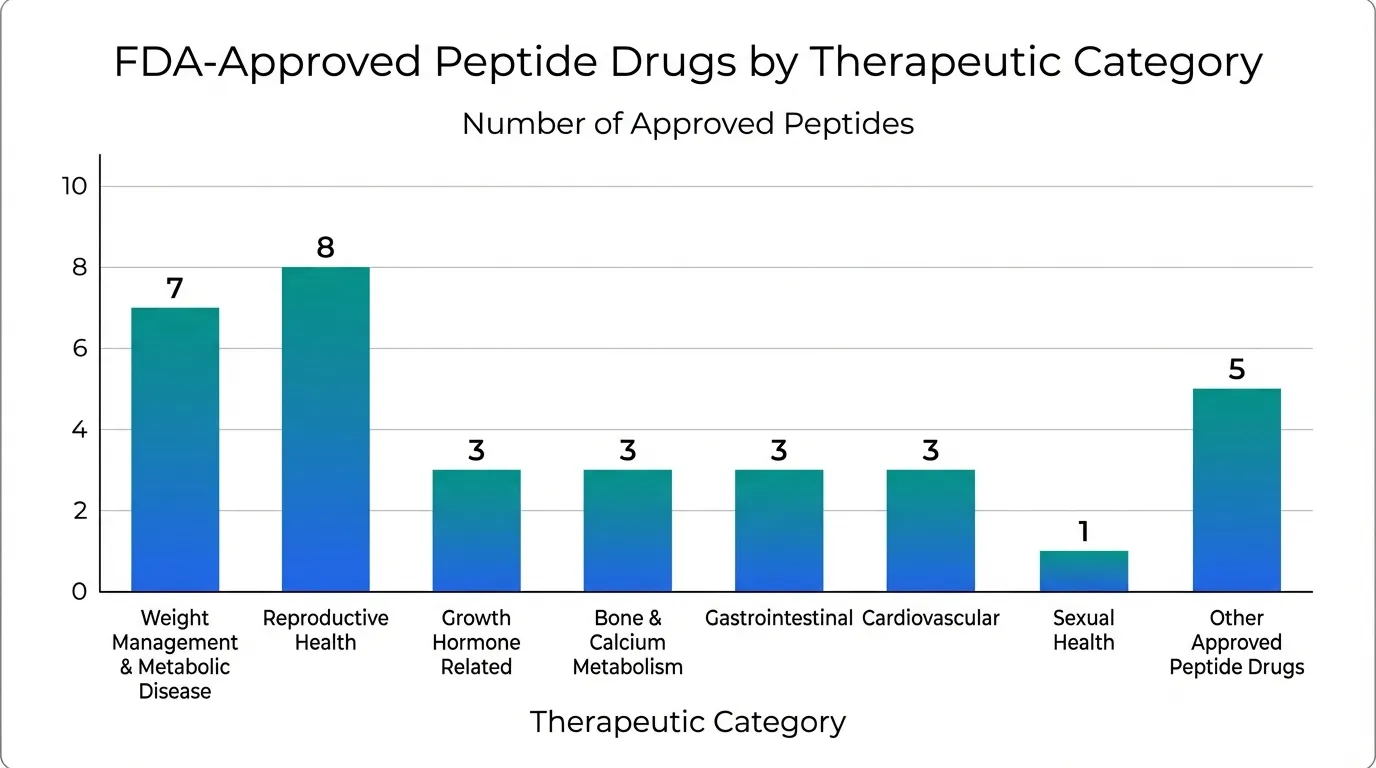
FDA-Approved Peptide Drugs by Category#
Weight Management and Metabolic Disease#
| Peptide | Brand Name(s) | Approved Indications | Approval Year |
|---|---|---|---|
| Semaglutide | Ozempic, Wegovy, Wegovy HD, Rybelsus | Type 2 diabetes (Ozempic, Rybelsus); Obesity/weight management (Wegovy, Wegovy HD, oral Wegovy) | 2017 (Ozempic), 2021 (Wegovy), 2026 (Wegovy HD) |
| Tirzepatide | Mounjaro, Zepbound | Type 2 diabetes (Mounjaro); Obesity/weight management (Zepbound) | 2022 (Mounjaro), 2023 (Zepbound) |
| Liraglutide | Victoza, Saxenda | Type 2 diabetes (Victoza); Obesity (Saxenda) | 2010 (Victoza), 2014 (Saxenda) |
| Dulaglutide | Trulicity | Type 2 diabetes | 2014 |
| Exenatide | Byetta, Bydureon | Type 2 diabetes | 2005 (Byetta), 2012 (Bydureon) |
| Lixisenatide | Adlyxin | Type 2 diabetes | 2016 |
| Pramlintide | Symlin | Type 1 and type 2 diabetes (adjunct to insulin) | 2005 |
The GLP-1 receptor agonist class represents the most commercially successful category of peptide drugs, with semaglutide and tirzepatide becoming some of the highest-revenue pharmaceutical products globally.
Growth Hormone Related#
| Peptide | Brand Name(s) | Approved Indications | Approval Year |
|---|---|---|---|
| Tesamorelin | Egrifta, Egrifta SV | HIV-associated lipodystrophy (excess abdominal fat) | 2010 |
| Somatropin (rHGH) | Genotropin, Norditropin, Humatrope, and others | Growth hormone deficiency, Turner syndrome, others | Various (1980s-present) |
| Mecasermin | Increlex | Severe primary IGF-1 deficiency | 2005 |
Tesamorelin is notable as the only FDA-approved GHRH analog, specifically approved for reducing visceral adipose tissue in HIV patients with lipodystrophy.
Reproductive Health#
| Peptide | Brand Name(s) | Approved Indications | Approval Year |
|---|---|---|---|
| Gonadorelin | Factrel | Diagnostic evaluation of gonadotropic function | 1981 |
| Triptorelin | Trelstar | Advanced prostate cancer | 2000 |
| Leuprolide | Lupron, Eligard | Prostate cancer, endometriosis, precocious puberty | 1985 |
| Goserelin | Zoladex | Prostate cancer, breast cancer, endometriosis | 1989 |
| Nafarelin | Synarel | Endometriosis, central precocious puberty | 1990 |
| Cetrorelix | Cetrotide | Prevention of premature ovulation in IVF | 2000 |
| Ganirelix | Antagon | Prevention of premature ovulation in IVF | 1999 |
| Degarelix | Firmagon | Advanced prostate cancer | 2008 |
| Elagolix | Orilissa | Endometriosis-related pain | 2018 |
| Relugolix | Orgovyx | Advanced prostate cancer | 2020 |
GnRH agonists and antagonists represent one of the most established classes of peptide therapeutics, with applications spanning oncology, reproductive medicine, and endocrinology.
Sexual Health#
| Peptide | Brand Name(s) | Approved Indications | Approval Year |
|---|---|---|---|
| PT-141 (Bremelanotide) | Vyleesi | Hypoactive sexual desire disorder in premenopausal women | 2019 |
PT-141 is the only FDA-approved melanocortin receptor agonist for sexual dysfunction, making it distinct from most other approved peptide drugs in both its target and mechanism.
Bone and Calcium Metabolism#
| Peptide | Brand Name(s) | Approved Indications | Approval Year |
|---|---|---|---|
| Teriparatide | Forteo | Osteoporosis (high fracture risk) | 2002 |
| Abaloparatide | Tymlos | Osteoporosis in postmenopausal women | 2017 |
| Calcitonin (salmon) | Miacalcin, Fortical | Osteoporosis, Paget's disease, hypercalcemia | 1984 |
Gastrointestinal#
| Peptide | Brand Name(s) | Approved Indications | Approval Year |
|---|---|---|---|
| Octreotide | Sandostatin | Acromegaly, carcinoid tumors, VIPomas | 1988 |
| Lanreotide | Somatuline Depot | Acromegaly, gastroenteropancreatic neuroendocrine tumors | 2007 |
| Teduglutide | Gattex | Short bowel syndrome | 2012 |
| Linaclotide | Linzess | IBS-C, chronic idiopathic constipation | 2012 |
| Plecanatide | Trulance | IBS-C, chronic idiopathic constipation | 2017 |
Cardiovascular#
| Peptide | Brand Name(s) | Approved Indications | Approval Year |
|---|---|---|---|
| Nesiritide | Natrecor | Acute decompensated heart failure | 2001 |
| Eptifibatide | Integrilin | Acute coronary syndrome | 1998 |
| Bivalirudin | Angiomax | Anticoagulation during PCI | 2000 |
Hematology and Immune#
| Peptide | Brand Name(s) | Approved Indications | Approval Year |
|---|---|---|---|
| Romiplostim | Nplate | Chronic immune thrombocytopenia | 2008 |
| Enfuvirtide | Fuzeon | HIV-1 infection (fusion inhibitor) | 2003 |
| Icatibant | Firazyr | Hereditary angioedema | 2011 |
Other Approved Peptide Drugs#
| Peptide | Brand Name(s) | Approved Indications | Approval Year |
|---|---|---|---|
| Oxytocin | Pitocin | Labor induction, postpartum hemorrhage | 1980 (synthetic form) |
| Vasopressin | Vasostrict | Vasodilatory shock | 2014 (updated formulation) |
| Desmopressin | DDAVP, Stimate | Diabetes insipidus, nocturnal enuresis, hemophilia A | 1978 |
| Glucagon | GlucaGen, Baqsimi | Severe hypoglycemia | 1998 (various) |
| Ziconotide | Prialt | Severe chronic pain | 2004 |
| Pasireotide | Signifor | Cushing's disease, acromegaly | 2012 |
| Setmelanotide | Imcivree | Obesity from POMC/LEPR/PCSK1 deficiency | 2020 |
| Afamelanotide | Scenesse | Erythropoietic protoporphyria | 2019 |
Peptides in Late-Stage Clinical Trials#
Several peptides are in Phase 3 clinical trials and may receive FDA approval in the coming years:
| Peptide | Class | Phase | Target Indication |
|---|---|---|---|
| Retatrutide | Triple agonist (GLP-1/GIP/Glucagon) | Phase 3 | Obesity, type 2 diabetes |
| Survodutide | Dual agonist (GLP-1/Glucagon) | Phase 3 | Obesity, MASH/NASH |
| Cagrisema | Semaglutide + Cagrilintide | Phase 3 (approval expected late 2026) | Obesity |
Orforglipron graduated from this list in April 2026 when the FDA approved it as Foundayo for weight management; a type 2 diabetes submission is expected during 2026.
These pipeline peptides represent the next wave of potential approvals, particularly in the metabolic disease space. For more on upcoming peptides, see our clinical trials 2026 article.
FDA-Approved vs. Category 1 Compounding vs. Research Peptides#
| Feature | FDA-Approved | Category 1 (Compounding) | Research Peptides |
|---|---|---|---|
| Clinical evidence | Phase 1-3 clinical trials | Varies (preclinical to Phase 2) | Varies (often preclinical only) |
| Quality standards | cGMP manufacturing | USP compounding standards | Variable; supplier-dependent |
| Legal status | Prescription medication | Prescription via compounding pharmacy | "For research use only" |
| Safety monitoring | Post-market surveillance | Physician oversight required | No systematic monitoring |
| Access | Retail/specialty pharmacies | Licensed compounding pharmacies | Research chemical suppliers |
| Cost | Often expensive (may be insurance-covered) | Moderate (not insurance-covered) | Generally less expensive |
| Purity guarantee | Pharmaceutical grade (>99%) | USP standards (~98-99%) | Varies (typically 95-99%) |
| Examples | Semaglutide, Tirzepatide | BPC-157, Thymosin Alpha-1 | Various unclassified peptides |
The difference in evidence quality between these categories is significant. An FDA-approved peptide has been studied in thousands to tens of thousands of human subjects with rigorous safety monitoring. Category 1 compounding peptides have varying levels of human data but have been deemed safe enough for compounding under physician supervision. Many research peptides have never been formally studied in humans at all.
How to Access FDA-Approved Peptides#
FDA-approved peptide drugs are obtained through:
- Prescription from a licensed healthcare provider: A physician, nurse practitioner, or physician assistant evaluates whether the peptide is medically appropriate
- Dispensing from a licensed pharmacy: Retail, specialty, or mail-order pharmacies fill the prescription
- Insurance coverage: Many approved peptides are covered by health insurance, though coverage varies by plan and indication
How to Access Category 1 Compounding Peptides#
Category 1 peptides like BPC-157 and Thymosin Alpha-1 require:
- Physician consultation: A licensed provider determines if the peptide is appropriate for your situation
- Prescription: The provider writes a prescription specifying the peptide, dose, and formulation
- Compounding pharmacy: A licensed 503A or 503B pharmacy prepares the peptide per the prescription
- Out-of-pocket payment: Compounded peptides are generally not covered by insurance
For peptide dosing information and calculations, use our dosing calculator. For understanding how long peptides take to produce effects, see our peptide timelines guide.
Key Takeaways#
-
Over 50 peptide drugs have received FDA approval across categories including metabolic disease, reproductive health, bone metabolism, gastrointestinal disorders, and hematology.
-
GLP-1 receptor agonists are the most commercially successful peptide drug class. Semaglutide and tirzepatide have become blockbuster medications for diabetes and obesity.
-
14 previously restricted peptides are returning to legal compounding access following the February 27, 2026 announcement by HHS Secretary RFK Jr., including BPC-157, Thymosin Alpha-1, AOD-9604, Semax, and Selank.
-
Category 1 compounding status is not the same as FDA approval. Compounding peptides have not completed full clinical trials but are deemed safe enough for preparation by licensed pharmacies under physician oversight.
-
Approximately 5 peptides remain on Category 2, including Melanotan II, GHRP-2, GHRP-6, CJC-1295 with DAC, and LL-37, due to safety concerns or insufficient human data.
-
Several promising peptides are in late-stage clinical trials and may receive full FDA approval in the coming years, including retatrutide, survodutide, and cagrisema.
-
Access to all peptides -- whether FDA-approved or Category 1 -- requires a prescription from a licensed healthcare provider.
Related Peptide Profiles#
Learn more about the peptides discussed in this article:
- Semaglutide Overview and Research Guide
- Tirzepatide Overview and Research Guide
- BPC-157 Overview and Research Guide
- Thymosin Alpha-1 Overview and Research Guide
- AOD-9604 Overview and Research Guide
- Semax Overview and Research Guide
- Selank Overview and Research Guide
- GHK-Cu Overview and Research Guide
- MOTS-c Overview and Research Guide
- KPV Overview and Research Guide
- Gonadorelin Overview and Research Guide
- Triptorelin Overview and Research Guide
- Tesamorelin Overview and Research Guide
- PT-141 Overview and Research Guide

Frequently Asked Questions About What Peptides Are FDA Approved? The Complete List (2026)
Is orforglipron (Foundayo) FDA approved?
Yes. The FDA approved orforglipron under the brand name Foundayo on April 1, 2026 for weight management in adults with obesity or overweight with a weight-related condition. It is the first oral small-molecule GLP-1 receptor agonist and the only GLP-1 pill that can be taken any time of day without food or water restrictions. It comes in six tablet strengths from 0.8 mg to 17.2 mg.
Are peptides legal in 2026?
Yes, many peptides are legal in 2026. Over 50 peptides are FDA-approved prescription drugs. Additionally, as of February 27, 2026, HHS Secretary RFK Jr. announced that 14 previously restricted peptides would be reclassified from Category 2 to Category 1, restoring legal access through compounding pharmacies with a physician prescription.
Can I get BPC-157 from a compounding pharmacy?
As of the February 2026 announcement, BPC-157 is expected to return to Category 1 status, which would allow licensed compounding pharmacies to legally prepare it under a physician prescription. However, the formal FDA rulemaking process must be completed before this takes effect. Check with your provider for current availability.
What changed with the FDA in 2026?
On February 27, 2026, HHS Secretary Robert F. Kennedy Jr. announced that 14 of 19 peptides on the FDA Category 2 restricted list would be moved back to Category 1. This restores legal compounding access for peptides including BPC-157, Thymosin Alpha-1, AOD-9604, Semax, Selank, and others. Approximately 5 peptides remain on Category 2.
What is the difference between Category 1 and Category 2 peptides?
Category 1 peptides are eligible for compounding by licensed pharmacies under physician prescription while FDA evaluation continues. Category 2 peptides are flagged for safety concerns and are generally not permitted for compounding. The February 2026 reclassification moved 14 peptides from Category 2 back to Category 1.
Which peptides are still banned from compounding?
Approximately 5 peptides are expected to remain on the Category 2 restricted list, likely including Melanotan II, GHRP-2, GHRP-6, CJC-1295, and LL-37. These remain restricted due to stronger safety concerns or insufficient human safety data.
Is FDA approved the same as legal for compounding?
No. FDA-approved peptides have completed full clinical trials and are available as brand-name prescription drugs. Category 1 compounding status means a peptide can be prepared by licensed pharmacies under a physician prescription, but has not undergone full FDA approval. Both require a prescription, but the evidence standards differ significantly.
Continue reading this research review
Free access to the complete analysis with citations and evidence ratings.
150+ peptide profiles · 30+ comparisons · 18 research tools
Medical Disclaimer
This website is for educational and informational purposes only. The information provided is not intended to diagnose, treat, cure, or prevent any disease. Always consult with a qualified healthcare professional before using any peptide or supplement.
Join 2,000+ researchers getting biweekly updates
Enjoyed this article?
The Research Briefing delivers deep-dives like this biweekly — plus new study breakdowns, safety updates, and tool announcements.
Free forever. No spam. Unsubscribe in one click.
Where to Find These Peptides
Continue Exploring
Peptide Profiles
Keep Reading
Most Popular Therapeutic Peptides in 2026: 15 Ranked by Research Interest
The 15 most popular therapeutic peptides in 2026, ranked by clinical trial activity, search interest, and research community adoption. From semaglutide to BPC-157.

How to Choose Your First Peptide: A Decision Framework by Goal
A comprehensive decision framework to help beginners identify the right peptide for their goals. Maps 10 health categories to specific peptide recommendations with evidence levels, administration routes, and regulatory context.

Peptide Interactions with Medications: What Your Doctor Needs to Know
Critical reference guide on peptide-drug interactions for healthcare professionals and patients. Covers GLP-1 delayed gastric emptying effects on oral medications, GH peptide interactions with diabetes and thyroid medications, immune peptide conflicts with immunosuppressants, and key information gaps.
You Might Also Like
Related content you may find interesting