Peptides in Clinical Trials 2026: What Is Coming Next

Introduction#
The peptide therapeutic pipeline in 2026 is dominated by next-generation metabolic peptides — compounds that build on the success of semaglutide and tirzepatide by targeting additional receptor pathways. The race to develop multi-agonist peptides that surpass current therapies in weight loss efficacy, metabolic improvement, and organ-specific benefits is producing some of the most closely watched clinical trials in pharmaceutical development.
This article covers the most significant peptide clinical programs active in 2026, focusing on compounds with Phase 2 or Phase 3 data and realistic paths to regulatory decisions. For an overview of FDA regulatory activity affecting existing peptides, see Peptides Under FDA Scrutiny.
The Evolution from Single to Multi-Agonist Peptides#
To understand the current pipeline, it helps to see the progression:
- Generation 1 — single-target GLP-1 receptor agonists (semaglutide, liraglutide): ~15-17% weight loss
- Generation 2 — dual GIP/GLP-1 agonists (tirzepatide): ~20-22% weight loss
- Generation 3 — triple agonists (retatrutide) and dual GLP-1/glucagon agonists (survodutide, mazdutide): potentially 24%+ weight loss with additional metabolic benefits
Each generation adds receptor targets to achieve greater efficacy and broader metabolic effects. However, more targets also mean more complex pharmacology and potentially more complex side effect profiles.
1. Retatrutide (LY3437943)#
Developer: Eli Lilly Mechanism: Triple GIP/GLP-1/glucagon receptor agonist Phase: Phase 3 (TRIUMPH program) Expected Timeline: Phase 3 readouts expected 2026; potential FDA submission 2026-2027
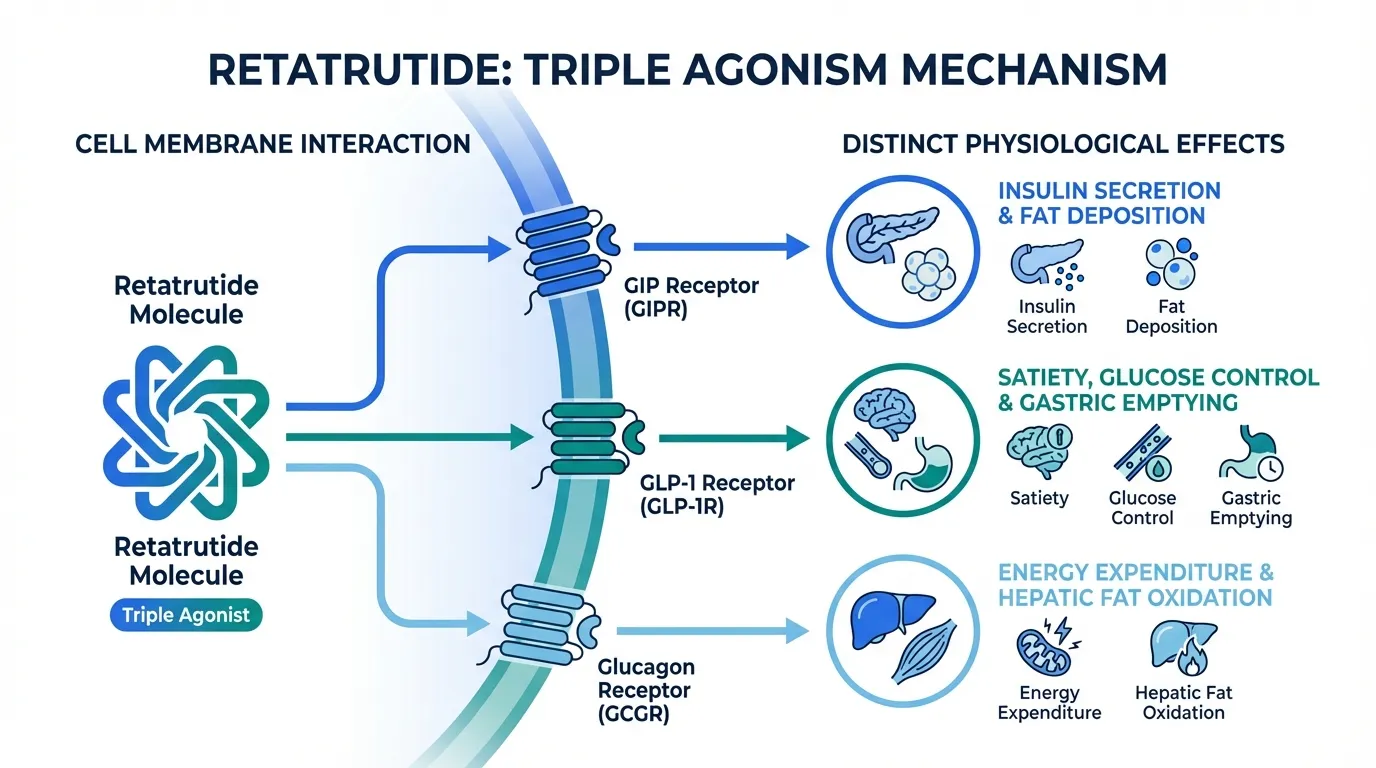
Retatrutide is the most anticipated investigational peptide in the obesity space. As the first triple incretin agonist to reach Phase 3 development, it adds glucagon receptor agonism to the GIP/GLP-1 dual agonism of tirzepatide.
Key Data#
The Phase 2 study published in 2023 produced headline results that set new benchmarks for pharmaceutical weight loss:
- 24.2% mean weight loss at the highest dose (12 mg) over 48 weeks — the highest weight loss reported for any investigational peptide at that time
- Dose-dependent efficacy across the 1, 4, 8, and 12 mg dose groups
- Significant improvements in glycemic parameters, lipid profiles, and blood pressure
- The glucagon receptor component is believed to contribute to energy expenditure and hepatic fat reduction beyond what GIP/GLP-1 agonism alone provides
What to Watch in 2026#
The TRIUMPH Phase 3 program is evaluating retatrutide across multiple indications:
- Obesity — the primary indication, with large-scale trials comparing retatrutide to placebo and potentially to active comparators
- Type 2 diabetes — glycemic control studies
- MASH (metabolic dysfunction-associated steatohepatitis) — the glucagon receptor component may provide differentiated liver benefits, as glucagon signaling promotes hepatic fat oxidation
Retatrutide's GI side effect profile (nausea, diarrhea, vomiting) was broadly similar to other incretin-based therapies in Phase 2, though the Phase 3 data will provide more definitive safety characterization. For detailed comparisons with existing therapies, see Retatrutide vs Semaglutide and Retatrutide vs Tirzepatide.
2. Survodutide (BI 456906)#
Developer: Boehringer Ingelheim / Zealand Pharma Mechanism: Dual GLP-1/glucagon receptor agonist Phase: Phase 3 (SYNCHRONIZE program for MASH; Phase 3 for obesity) Expected Timeline: Phase 3 readouts in 2026
Survodutide takes a different approach from retatrutide — rather than triple agonism, it combines GLP-1 and glucagon receptor agonism without the GIP component. This positions survodutide with a differentiated profile, particularly for liver-related metabolic disease.
Key Data#
Phase 2 data for survodutide has been notable for both weight loss and liver-specific outcomes:
- Weight loss — up to approximately 19% body weight reduction at 46 weeks in the obesity Phase 2 trial
- MASH resolution — in the Phase 2 MASH trial, survodutide demonstrated histological improvement in liver fibrosis and steatohepatitis resolution at rates significantly exceeding placebo
- Liver fat reduction — substantial reductions in hepatic fat content, consistent with glucagon's role in promoting hepatic lipid oxidation
What to Watch in 2026#
Survodutide's clinical story may be most compelling in MASH, where the glucagon receptor component provides a mechanistic advantage:
- SYNCHRONIZE-1 and -2 — the Phase 3 MASH program is among the most advanced liver-targeted peptide trials
- Obesity Phase 3 — ongoing enrollment with results expected to clarify survodutide's position relative to semaglutide and tirzepatide
- The key question is whether survodutide's GLP-1/glucagon profile can carve out a distinct niche from triple agonists, potentially in patients where liver disease is the primary concern
Survodutide's Phase 2 GI side effect profile was consistent with other incretin therapies, though the glucagon component raises theoretical questions about glycemic effects that the Phase 3 diabetes-focused studies will address.
3. Mazdutide (IBI362 / LY3305677)#
Developer: Innovent Biologics (licensed from Eli Lilly) Mechanism: Dual GLP-1/glucagon receptor agonist Phase: Phase 3 (GLORY program, primarily in China) Expected Timeline: Chinese NDA submission anticipated; global development ongoing
Mazdutide is a dual GLP-1/glucagon agonist being developed primarily in Chinese populations — a distinction that makes it particularly significant for global metabolic disease treatment, as most incretin therapy data has been generated in predominantly Western populations.
Key Data#
Phase 3 data from the GLORY program has shown strong results:
- Weight loss — Phase 3 data demonstrated approximately 15-17% body weight reduction in Chinese populations with obesity
- Glycemic control — significant HbA1c reductions in patients with type 2 diabetes
- The dual agonist mechanism is similar in principle to survodutide, though mazdutide's specific receptor binding profile and pharmacokinetics differ
What to Watch in 2026#
Mazdutide's development trajectory is unique among pipeline peptides:
- Chinese regulatory approval — mazdutide is closest to approval in China, where it addresses a massive unmet need (China has the largest absolute population with obesity and type 2 diabetes)
- Global expansion — whether Innovent and Lilly pursue regulatory submissions in the US and Europe will determine mazdutide's global significance
- Asian population data — metabolic peptide responses may differ across ethnic populations due to differences in GLP-1 receptor expression, body composition, and metabolic phenotypes. Mazdutide's Asian-focused data fills an important evidence gap
4. CagriSema (Cagrilintide + Semaglutide)#
Developer: Novo Nordisk Mechanism: Dual amylin receptor agonist + GLP-1 receptor agonist (co-formulated) Phase: Phase 3 (REDEFINE program) Expected Timeline: Phase 3 readouts and potential regulatory submission in 2026
Cagrilintide, combined with semaglutide in a single injection called CagriSema, represents Novo Nordisk's strategy for surpassing semaglutide monotherapy. Rather than adding incretin receptor targets, CagriSema combines the GLP-1 pathway with amylin receptor agonism — a distinct satiety pathway mediated by the area postrema in the brainstem.
Key Data#
Phase 2 data for CagriSema showed:
- Weight loss — approximately 15-17% body weight reduction at 32 weeks, exceeding semaglutide 2.4 mg monotherapy results at the same timepoint
- Complementary mechanisms — amylin and GLP-1 act on different satiety circuits, and the combination produced additive weight loss effects
- Tolerability — the GI side effect profile was broadly similar to semaglutide monotherapy, suggesting the amylin component does not substantially worsen GI tolerability
What to Watch in 2026#
CagriSema's Phase 3 program is extensive:
- REDEFINE trials — evaluating CagriSema across obesity, type 2 diabetes, and cardiovascular outcomes
- Head-to-head data — CagriSema vs. tirzepatide comparisons will be among the most closely watched results, as they will directly position Novo Nordisk's combination against Lilly's dual agonist
- Manufacturing and access — whether the combination injection format creates manufacturing complexity or cost implications relative to monotherapy is a practical concern
For more on this combination, see the Cagrilintide + Semaglutide Stack article.
5. Tirzepatide — Expanding Indications#
Developer: Eli Lilly Mechanism: Dual GIP/GLP-1 receptor agonist Phase: Approved (expanding indications in Phase 3) Status: FDA-approved for obesity and type 2 diabetes; studying additional indications
While tirzepatide is already approved, its clinical development program continues to expand into new therapeutic areas that could significantly broaden its clinical impact in 2026 and beyond.
Active Expansion Programs#
- Heart failure with preserved ejection fraction (HFpEF) — the SUMMIT trial evaluated tirzepatide in HFpEF patients with obesity. Positive results could establish tirzepatide as the first incretin therapy approved for heart failure — a paradigm-shifting indication
- MASH — tirzepatide is being studied for metabolic liver disease, leveraging the metabolic improvements that accompany significant weight loss
- Obstructive sleep apnea — the SURMOUNT-OSA trial evaluated tirzepatide for obesity-related sleep apnea, with positive Phase 3 results
- Chronic kidney disease — studies are exploring tirzepatide's renal protective effects, following the path established by semaglutide in the FLOW trial
What to Watch in 2026#
Tirzepatide's expansion into cardiovascular and organ-specific indications represents a broader industry trend: metabolic peptides are being repositioned from weight management drugs to multi-organ therapeutic platforms. Each new approved indication expands the eligible patient population and strengthens the clinical rationale for GLP-1-based therapies.
The Broader Pipeline#
Beyond these five headline programs, several other peptide clinical programs are noteworthy:
- Orforglipron (Eli Lilly) — an oral non-peptide GLP-1 receptor agonist in Phase 3, which could eliminate the need for injections entirely
- Pemvidutide (Altimmune) — a dual GLP-1/glucagon agonist with Phase 2 MASH data
- Ecnoglutide (GPCR Therapeutics) — a long-acting GLP-1 agonist with a once-monthly dosing potential
- Kisspeptin analogs — longer-acting kisspeptin derivatives in development for reproductive health (see Reproductive Health Peptides)
- Elamipretide (SS-31) — expanding studies beyond Barth syndrome into age-related mitochondrial conditions (see Mitochondrial Peptides and Longevity)
Key Themes for 2026#
1. Multi-Agonism vs. Combination Therapy#
The two dominant strategies for surpassing current therapies are fundamentally different: multi-agonist single molecules (retatrutide, survodutide) combine receptor activities in one peptide, while combination approaches (CagriSema) co-formulate two distinct peptides. Both have theoretical advantages, and 2026 data will help determine which approach delivers superior outcomes.
2. Beyond Weight Loss#
The most important development may be the expansion of metabolic peptides into organ-specific disease. MASH, heart failure, kidney disease, and sleep apnea studies represent a conceptual shift from "weight loss drugs" to "metabolic disease platforms."
3. Manufacturing and Access#
Even as clinical data improves, manufacturing capacity for GLP-1 class therapies remains constrained. The ability to produce these peptides at scale will be a critical factor in their real-world impact.
4. Regulatory Landscape#
The FDA's approach to peptide regulation continues to evolve. The Category 2 designations that affected compounded peptides (see Peptides Under FDA Scrutiny) may influence how pipeline peptides are developed and distributed. For the weight loss peptide landscape as a whole, see Weight Loss Peptides and Triple Agonists.
Conclusion#
The peptide clinical trial landscape in 2026 is the most dynamic in the history of the field. Retatrutide's triple agonism, survodutide's liver-targeted profile, mazdutide's Asian population data, CagriSema's combination approach, and tirzepatide's expanding indications collectively represent a transformation in metabolic medicine.
For researchers and clinicians, the key challenge is evaluating which data readouts will genuinely advance patient care versus which will simply add to an already crowded competitive landscape. The most impactful results will likely come from trials demonstrating organ-specific benefits (MASH resolution, heart failure improvement) rather than incremental weight loss improvements over existing therapies.
For tools to evaluate these compounds, visit the GLP-1 Saturation Calculator for pharmacokinetic modeling, and the Safety page for risk assessment guidance.
Related Peptide Profiles#
Learn more about the peptides discussed in this article:
- Retatrutide Overview and Research Guide
- Retatrutide Dosing Protocols
- Retatrutide Side Effects and Safety
- Survodutide Overview and Research Guide
- Survodutide Dosing Protocols
- Survodutide Side Effects and Safety
- Mazdutide Overview and Research Guide
- Mazdutide Dosing Protocols
- Mazdutide Side Effects and Safety
- Cagrilintide Overview and Research Guide
- Cagrilintide Dosing Protocols
- Cagrilintide Side Effects and Safety
- Tirzepatide Overview and Research Guide
- Tirzepatide Dosing Protocols
- Tirzepatide Side Effects and Safety

Frequently Asked Questions About Peptides in Clinical Trials 2026: What Is Coming Next
What does this article cover?
Key peptide clinical trials in 2026 — retatrutide, survodutide, mazdutide, cagrilintide, and tirzepatide expansion studies reviewed. This news article is for educational purposes only and does not constitute medical advice.
Which peptides are discussed in this article?
This article covers Retatrutide, Survodutide, Mazdutide, Cagrilintide, Tirzepatide. Key context: Retatrutide (Triple GIP/GLP-1/glucagon agonist in Phase 3 trials with highest reported weight loss of any inve...); Survodutide (Dual GLP-1/glucagon agonist in Phase 3 for obesity and MASH with differentiated liver benefits); Mazdutide (Dual GLP-1/glucagon agonist developed in China with Phase 3 data in Asian populations). Each peptide is discussed based on available research evidence.
How current is the information in this article?
This article was published on 2026-02-10 and last updated on 2026-02-10. The peptide research landscape evolves rapidly, so readers should verify time-sensitive information such as regulatory status or clinical trial progress.
What are the key takeaways from this article?
The main findings covered in this article include: Triple GIP/GLP-1/glucagon agonist in Phase 3 trials with highest reported weight loss of any inve.... Dual GLP-1/glucagon agonist in Phase 3 for obesity and MASH with differentiated liver benefits. Dual GLP-1/glucagon agonist developed in China with Phase 3 data in Asian populations. These takeaways are based on the research data available at the time of publication.
What is Retatrutide and why is it significant?
Retatrutide is a peptide discussed in this article because: Triple GIP/GLP-1/glucagon agonist in Phase 3 trials with highest reported weight loss of any investigational peptide. For a complete profile of Retatrutide, see the dedicated peptide page on this site.
Continue reading this research review
Free access to the complete analysis with citations and evidence ratings.
150+ peptide profiles · 30+ comparisons · 18 research tools
Medical Disclaimer
This website is for educational and informational purposes only. The information provided is not intended to diagnose, treat, cure, or prevent any disease. Always consult with a qualified healthcare professional before using any peptide or supplement.
Join 2,000+ researchers getting biweekly updates
Enjoyed this article?
The Research Briefing delivers deep-dives like this biweekly — plus new study breakdowns, safety updates, and tool announcements.
Free forever. No spam. Unsubscribe in one click.
Where to Find These Peptides
Continue Exploring
Peptide Profiles
Keep Reading
Peptides in Clinical Trials 2026: The Most Promising Pipeline
A research-focused overview of the most promising peptides in clinical trials as of 2026, including Retatrutide Phase 3 TRIUMPH data, Survodutide, Mazdutide, Ecnoglutide, and other emerging compounds reshaping metabolic medicine.
Weight Loss Peptides: Mechanisms, Evidence, and How They Compare
A mechanism-focused guide to weight loss peptides — how GLP-1, GIP, and glucagon pathways drive fat loss, how single, dual, and triple agonists compare, and what the clinical evidence actually shows.

Complete Guide to GLP-1 Receptor Agonists: Every Drug Explained
A comprehensive guide to every GLP-1 receptor agonist drug, from FDA-approved semaglutide and tirzepatide to pipeline therapies like retatrutide, amycretin, MariTide, and oral orforglipron.
You Might Also Like
Related content you may find interesting