What Is the Wolverine Stack? BPC-157 and TB-500 Explained

Introduction#
The Wolverine stack is the popular name for a peptide combination pairing BPC-157 and TB-500. Named after the Marvel character known for rapid healing, this stack has become one of the most widely discussed peptide combinations in the recovery and regenerative therapy communities.
The appeal is straightforward: BPC-157 and TB-500 both have preclinical evidence suggesting tissue healing properties, but they work through different mechanisms. Combining them is proposed to provide broader and potentially synergistic healing support.
This article examines the science behind each component, the rationale for combining them, what the evidence actually shows, and the important limitations that are often overlooked in community discussions.
For a broader overview of peptide stacking principles, see our guide on taking multiple peptides together.
BPC-157: The First Component#
What It Is#
BPC-157 (Body Protection Compound-157) is a synthetic peptide consisting of 15 amino acids, derived from a sequence found in human gastric juice. It was first isolated and characterized by researchers at the University of Zagreb, Croatia, who have produced the majority of the published research on this peptide.
Research Evidence#
BPC-157 has been studied in over 100 animal studies across a range of injury models:
| Tissue Type | Findings in Animal Models |
|---|---|
| Tendons | Accelerated healing of transected Achilles tendons in rats |
| Ligaments | Improved medial collateral ligament healing |
| Muscle | Enhanced recovery from crush injuries and lacerations |
| Bone | Promoted fracture healing and bone-tendon junction repair |
| Gut | Protective effects against various GI injury models (colitis, ulcers, fistulas) |
| Nerve | Promoted peripheral nerve regeneration after transection |
Proposed Mechanisms#
BPC-157 appears to work through several pathways:
- Angiogenesis: Promotes new blood vessel formation at injury sites, improving nutrient and oxygen delivery
- Growth factor modulation: Upregulates growth factors including VEGF, EGF, and FGF
- Nitric oxide system: Interacts with the NO system, which plays a role in blood flow and tissue repair
- Anti-inflammatory effects: Reduces inflammatory markers in various injury models
- Cytoprotection: Protects cells against damage from toxins, NSAIDs, and alcohol in animal models
Key Limitation#
BPC-157 has very limited human data. Fewer than 15 total human subjects have been included in published clinical studies. The extensive animal data is encouraging but does not establish that the same effects will be observed in humans at the doses commonly used.
For the full BPC-157 research profile, see our BPC-157 peptide page.
TB-500: The Second Component#
What It Is#
TB-500 is a synthetic peptide corresponding to the active region (amino acids 17-23) of thymosin beta-4, a naturally occurring 43-amino-acid peptide found in nearly all human cells. Thymosin beta-4 is one of the most abundant intracellular peptides and plays roles in cell migration, wound healing, and anti-inflammatory signaling.
Research Evidence#
Thymosin beta-4 (the parent compound) has been studied more extensively than the TB-500 fragment:
| Application | Findings |
|---|---|
| Wound healing | Accelerated wound closure in animal models; Phase 2 trial (RGN-259) for dry eye showed benefit |
| Cardiac repair | Improved cardiac function after myocardial infarction in mouse models |
| Hair regrowth | Stimulated hair follicle stem cells in animal models |
| Neurological | Promoted neural progenitor cell migration and functional recovery after stroke in rats |
| Anti-inflammatory | Reduced inflammation through modulation of cytokine profiles |
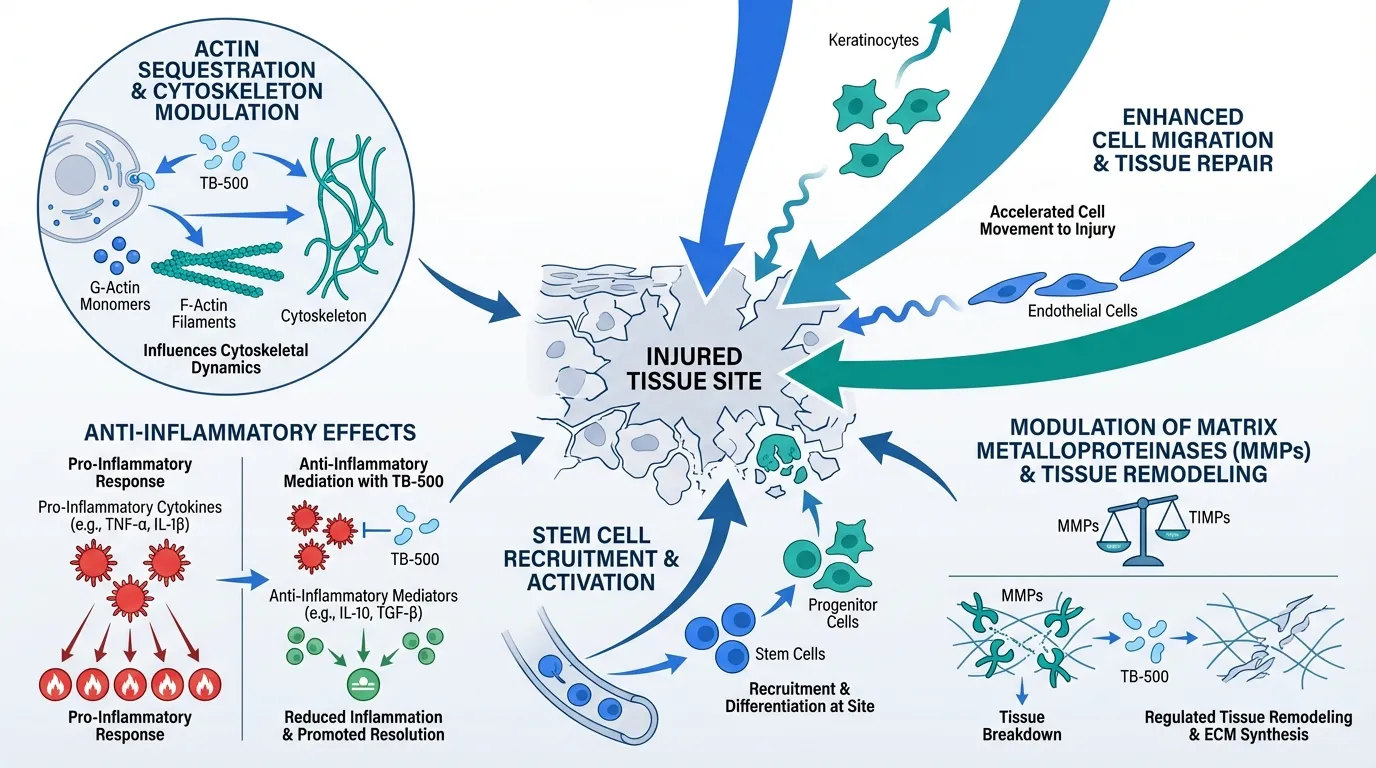
Proposed Mechanisms#
- Actin sequestration: Thymosin beta-4's primary known function is binding G-actin, regulating cytoskeletal dynamics critical for cell migration
- Cell migration: Promotes keratinocyte and endothelial cell migration to wound sites
- Anti-inflammatory: Reduces pro-inflammatory cytokines (IL-1, TNF-alpha) and promotes anti-inflammatory mediators
- Stem cell recruitment: Appears to activate resident stem cells and progenitor cells at injury sites
- Matrix metalloproteinase regulation: Modulates tissue remodeling enzymes
Key Limitation#
Like BPC-157, the human clinical data for TB-500 specifically (as opposed to thymosin beta-4) is extremely limited. The synthetic fragment is assumed to retain the healing-related activity of the full-length protein, but this has not been rigorously validated in human studies.
For the full TB-500 research profile, see our TB-500 peptide page.
The Rationale for Combining Them#
Complementary Mechanisms#
The central argument for the Wolverine stack is that BPC-157 and TB-500 promote healing through different but complementary pathways:
| Aspect | BPC-157 | TB-500 |
|---|---|---|
| Primary mechanism | Angiogenesis, growth factor upregulation | Cell migration, actin regulation |
| Anti-inflammatory approach | NO system modulation | Cytokine modulation |
| Tissue focus | Strong GI and musculoskeletal data | Strong wound healing and cardiac data |
| Source | Derived from gastric juice protein | Fragment of ubiquitous intracellular protein |
| Molecular target | Growth factor receptors, NO pathways | G-actin, cytoskeletal regulation |
The theory is that BPC-157 prepares the injury environment (promoting blood vessel growth and growth factor signaling) while TB-500 facilitates the cellular response (promoting cell migration to the injury site and reducing inflammation). Together, they would address more steps in the healing cascade than either alone.
Is There Evidence for Synergy?#
No controlled study has tested BPC-157 and TB-500 together. The synergy claim is based entirely on:
- The fact that their mechanisms appear to be different and complementary
- Anecdotal reports from users who report better outcomes with the combination than with either peptide alone
- General pharmacological principles that combining drugs with different mechanisms can produce additive or synergistic effects
This is a reasonable hypothesis, but it remains unproven. It is possible that the combination provides no additional benefit beyond either peptide alone, or that there are unexpected interactions.
Common Wolverine Stack Protocols#
Disclaimer: The following information describes protocols discussed in the peptide community. It is provided for educational context, not as medical advice. These protocols have not been validated in clinical trials.
Typical Components#
The basic Wolverine stack consists of:
- BPC-157: Typically administered via subcutaneous injection
- TB-500: Typically administered via subcutaneous injection
Some expanded versions of the stack add:
- GHK-Cu: Applied topically for skin and wound healing, or injected subcutaneously
- A growth hormone secretagogue: Such as ipamorelin or sermorelin, based on the rationale that elevated GH supports tissue repair
Administration Considerations#
Injection site: Practitioners often discuss whether to inject locally (near the injury site) or systemically (e.g., in the abdominal subcutaneous fat). BPC-157 animal research has shown effects with both local and systemic administration. For more on injection technique, see our injection route guide.
Timing: BPC-157 and TB-500 are commonly administered at the same time of day. They should be drawn up in separate syringes to avoid chemical interaction in solution.
Duration: Community protocols typically run for 4-8 weeks, sometimes longer for chronic injuries. There is no clinical trial data establishing optimal treatment duration.
What Users Report#
Anecdotal reports from the peptide community describe the following experiences with the Wolverine stack, though these are not validated by clinical trials:
Commonly reported benefits:
- Faster recovery from soft tissue injuries (strains, sprains, tendinopathy)
- Reduced joint pain and stiffness
- Improved recovery from surgical procedures
- Reduced gut symptoms (attributed primarily to BPC-157)
- Better sleep quality during recovery periods
Commonly reported side effects:
- Injection site reactions (redness, soreness)
- Fatigue or lethargy (reported by some users, particularly with TB-500)
- Headaches (reported infrequently)
- GI discomfort (reported infrequently)
For a comprehensive review of peptide side effects, see our peptide therapy side effects guide.
Important Limitations#
Regulatory Status#
Both BPC-157 and TB-500 (as thymosin beta-4) have been placed in FDA Category 2, meaning they are banned from compounding by US pharmacies. This does not make them illegal to possess for research purposes, but it means they cannot be legally prescribed and compounded as medications in the United States.
For the full regulatory context, see our FDA banned peptides guide and FDA regulation overview.
Evidence Gaps#
Several critical questions remain unanswered:
- Does the combination actually outperform either peptide alone? No study has compared BPC-157 alone, TB-500 alone, and BPC-157 + TB-500 together.
- What are the optimal doses when used in combination? Community doses are extrapolated from animal studies, not derived from human dose-finding trials.
- What are the long-term safety implications? Neither peptide has been studied for long-term safety in humans, individually or in combination.
- Are there populations who should not use this combination? Without human data, contraindications are largely unknown.
Quality Concerns#
Because these peptides are not FDA-approved and are typically sourced from research chemical suppliers, quality and purity vary significantly between vendors. When combining two peptides, the risk is compounded -- impurities or degradation products from either peptide could cause unexpected effects.
For guidance on evaluating peptide quality, see our peptide quality guide.
Alternatives to the Wolverine Stack#
For those seeking evidence-based approaches to tissue healing and recovery:
| Approach | Evidence Level | Notes |
|---|---|---|
| Physical therapy | Strong | Gold standard for musculoskeletal recovery |
| PRP (Platelet-Rich Plasma) | Moderate | FDA-regulated procedure with clinical trial data |
| Prescribed growth hormone | Strong (for approved indications) | FDA-approved for specific conditions |
| Collagen supplementation | Moderate | Oral collagen peptides have some clinical support |
| Optimized nutrition and sleep | Strong | Foundation of all recovery |
Key Takeaways#
-
The Wolverine stack combines BPC-157 and TB-500, two healing peptides with different but potentially complementary mechanisms of action.
-
Both peptides have substantial preclinical evidence for tissue healing, but very limited human clinical data.
-
No study has tested the specific combination. The rationale for combining them is based on complementary mechanisms and anecdotal reports, not controlled trials.
-
Both peptides are FDA Category 2, meaning they cannot be legally compounded by US pharmacies.
-
Quality and purity vary significantly between suppliers, adding an additional layer of uncertainty when using these research peptides.
-
Evidence-based alternatives exist for tissue healing and recovery, including physical therapy, PRP, and optimized nutrition -- all with stronger clinical evidence than the Wolverine stack.
For dosing calculations when researching these peptides, see the dosing calculator. To compare the half-lives of BPC-157, TB-500, and other healing peptides, use the half-life comparison tool.
Related Peptide Profiles#
Learn more about the peptides discussed in this article:

Frequently Asked Questions About What Is the Wolverine Stack? BPC-157 and TB-500 Explained
What does this article cover?
The Wolverine stack: BPC-157 and TB-500 combined. Covers the science behind each peptide, rationale for stacking, and research evidence. This guide is for educational purposes only and does not constitute medical advice.
Which peptides are discussed in this article?
This article covers BPC-157, TB-500, GHK-Cu. Key context: BPC-157 (One of the two core peptides in the Wolverine stack, studied for tissue healing properties includ...); TB-500 (The second core peptide in the Wolverine stack, a fragment of thymosin beta-4 studied for wound h...); GHK-Cu (Sometimes added to the Wolverine stack as a third component for skin healing and tissue remodeling). Each peptide is discussed based on available research evidence.
Who is this guide written for?
This guide is written for researchers and individuals seeking an evidence-based overview of the topic covered in "What Is the Wolverine Stack? BPC-157 and TB-500 Explained." It summarizes available research data without making treatment recommendations. Always consult a healthcare provider for medical decisions.
What are the key takeaways from this article?
The main findings covered in this article include: One of the two core peptides in the Wolverine stack, studied for tissue healing properties includ.... The second core peptide in the Wolverine stack, a fragment of thymosin beta-4 studied for wound h.... Sometimes added to the Wolverine stack as a third component for skin healing and tissue remodeling. These takeaways are based on the research data available at the time of publication.
What is BPC-157 and why is it significant?
BPC-157 is a peptide discussed in this article because: One of the two core peptides in the Wolverine stack, studied for tissue healing properties including tendon, ligament, and gut repair. For a complete profile of BPC-157, see the dedicated peptide page on this site.
Continue reading this research review
Free access to the complete analysis with citations and evidence ratings.
150+ peptide profiles · 30+ comparisons · 18 research tools
Medical Disclaimer
This website is for educational and informational purposes only. The information provided is not intended to diagnose, treat, cure, or prevent any disease. Always consult with a qualified healthcare professional before using any peptide or supplement.
Join 2,000+ researchers getting biweekly updates
Enjoyed this article?
The Research Briefing delivers deep-dives like this biweekly — plus new study breakdowns, safety updates, and tool announcements.
Free forever. No spam. Unsubscribe in one click.
Where to Find These Peptides
Continue Exploring
Peptide Profiles
Keep Reading
Peptide Stacking Guide 2026: Best Combinations by Goal
The definitive 2026 guide to peptide stacking organized by goal. Fat loss, muscle growth, healing, anti-aging, and cognitive stacks with evidence levels, dosing timing, and safety considerations.
Most Popular Therapeutic Peptides in 2026: 15 Ranked by Research Interest
The 15 most popular therapeutic peptides in 2026, ranked by clinical trial activity, search interest, and research community adoption. From semaglutide to BPC-157.

Peptides for Athletic Recovery: Beyond BPC-157 and TB-500
A comprehensive guide to peptides researched for athletic recovery, covering BPC-157, TB-500, GH secretagogues, MGF, GHK-Cu, and DSIP. Includes WADA anti-doping considerations, evidence levels, and recovery-focused protocol rationale.
You Might Also Like
Related content you may find interesting