Peptide Quality: How to Evaluate Purity and Authenticity

Introduction#
Not all peptides are created equal. The research peptide market includes suppliers ranging from pharmaceutical-grade manufacturers to questionable operations selling products of unknown composition. For researchers, the ability to evaluate peptide quality is essential -- unreliable peptides produce unreliable results.
This guide explains the analytical methods used to assess peptide purity and identity, how to read a Certificate of Analysis (COA), and what red flags indicate a supplier may not be providing what they claim.
What Is Peptide Purity?#
Peptide purity refers to the percentage of the desired peptide in a sample relative to the total amount of material present. A peptide with 98% purity contains 98% of the target peptide and 2% impurities.
Impurities in peptide preparations can include:
- Deletion sequences -- peptides missing one or more amino acids from the intended sequence
- Truncated sequences -- incomplete peptides where synthesis stopped prematurely
- Oxidized forms -- peptides where methionine or other residues have been oxidized
- Residual solvents -- chemicals left over from the synthesis and purification process (TFA, acetonitrile, DMF)
- Salts and counterions -- trifluoroacetate (TFA) or acetate salts from purification
- Endotoxins -- bacterial contaminants that can cause inflammatory responses
- Other peptides -- completely different peptides from cross-contamination
Purity Grades#
| Purity Level | Typical Use | Notes |
|---|---|---|
| >99% | Pharmaceutical / clinical | Required for human-use products |
| >98% | High-quality research | Standard for reputable research suppliers |
| >95% | General research | Acceptable for most in vitro and animal studies |
| >90% | Crude / screening | May be adequate for initial screening assays |
| <90% | Low quality | Not recommended for quantitative research |
For most research applications, a purity of 95% or higher is the minimum standard. Peptides intended for in vivo (animal) studies or any application where accurate dosing matters should be 98% or higher.
Key Testing Methods#
HPLC (High-Performance Liquid Chromatography)#
HPLC is the primary method used to determine peptide purity. It separates components of a mixture based on their chemical properties, producing a chromatogram that shows peaks corresponding to each substance.
How it works: The peptide sample is dissolved and passed through a column packed with a stationary phase (typically C18 reversed-phase material). Different molecules interact with the column material to different degrees, causing them to elute (come off the column) at different times. A UV detector measures the absorbance of each component as it exits the column.
What to look for on an HPLC report:
- Main peak: The largest peak should correspond to your target peptide. Its area percentage relative to all peaks is the reported purity.
- Retention time: The time at which the main peak elutes. This should be consistent with the expected value for the peptide.
- Minor peaks: Small peaks flanking the main peak typically represent related impurities (deletion peptides, oxidized forms).
- Baseline: A clean, flat baseline indicates good separation and minimal interference.
A high-quality HPLC report should include the chromatogram image, not just a stated purity percentage.
Mass Spectrometry (MS)#
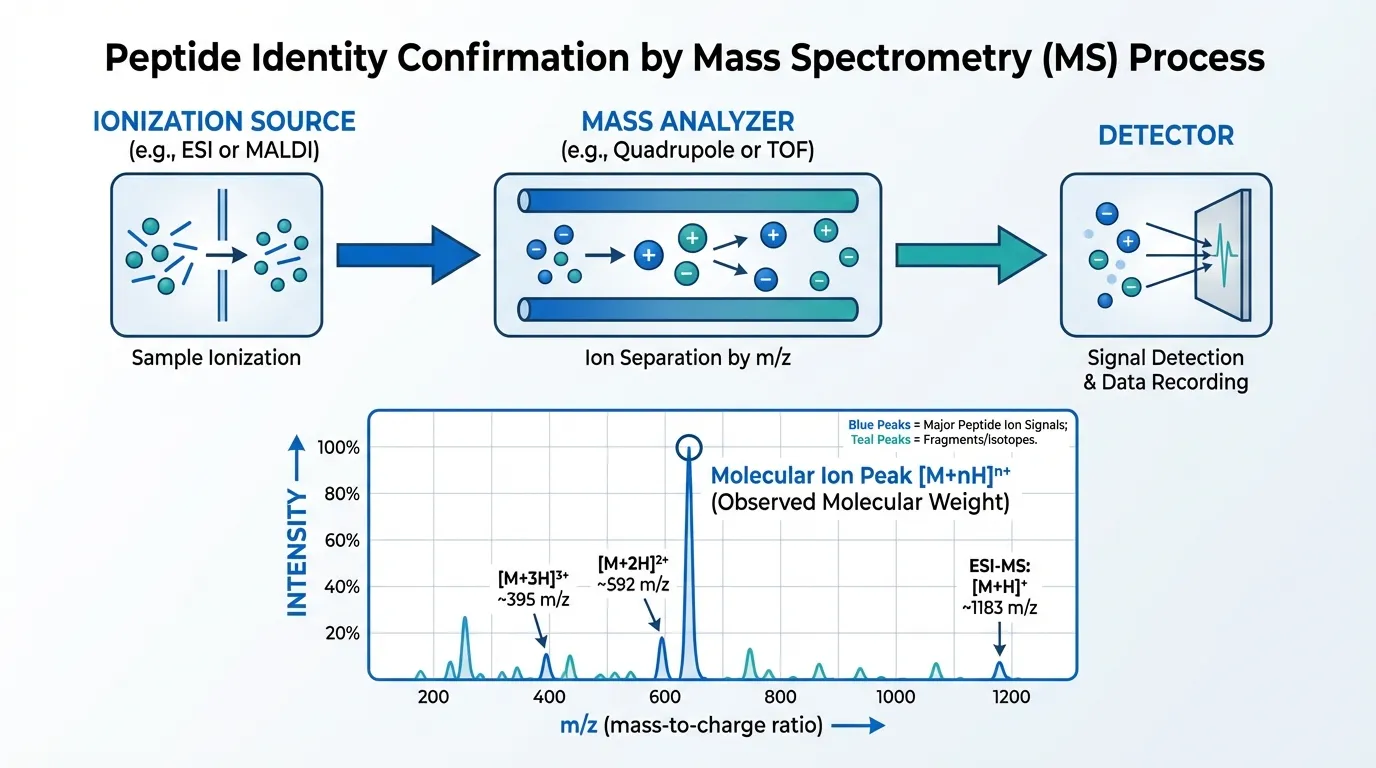
Mass spectrometry confirms the identity of a peptide by measuring its molecular weight. This is the definitive test for verifying that the peptide in a vial is actually the claimed compound.
How it works: The peptide is ionized and passed through a mass analyzer that separates ions by their mass-to-charge ratio (m/z). The resulting spectrum shows peaks corresponding to the molecular weight of the intact peptide and its fragments.
Common MS techniques for peptides:
| Technique | Abbreviation | Best For |
|---|---|---|
| Electrospray ionization | ESI-MS | Routine molecular weight confirmation |
| Matrix-assisted laser desorption | MALDI-TOF | Larger peptides and proteins |
| Liquid chromatography-mass spectrometry | LC-MS | Combined purity and identity analysis |
What to look for on an MS report:
- Observed molecular weight: Should match the calculated (theoretical) molecular weight within an acceptable tolerance (typically within 0.1% or 1 Dalton for ESI-MS)
- Charge states: ESI-MS produces multiply charged ions. The molecular weight should be consistent across all observed charge states.
- Absence of unexpected masses: Additional mass peaks could indicate impurities, degradation products, or wrong peptide.
Additional Testing Methods#
| Test | What It Measures | When It Matters |
|---|---|---|
| Amino acid analysis (AAA) | Amino acid composition and content | Confirms sequence composition; measures net peptide content |
| Endotoxin testing (LAL) | Bacterial endotoxin levels | Critical for any injectable application |
| Sterility testing | Microbial contamination | Required for injectable products |
| Residual solvent analysis | TFA, acetonitrile, DMF levels | Important for understanding actual peptide content |
| Heavy metals testing | Lead, mercury, arsenic, cadmium | Required for products meeting pharmaceutical standards |
| Moisture content (Karl Fischer) | Water content in lyophilized peptide | Affects actual peptide content and stability |
How to Read a Certificate of Analysis (COA)#
A Certificate of Analysis (COA) is a document provided by the peptide manufacturer or testing laboratory that summarizes the quality testing results for a specific batch of peptide.
Essential COA Elements#
A credible COA should include:
- Product identification: Peptide name, sequence, catalog number, and batch/lot number
- Purity by HPLC: Percentage purity with method details (column type, solvent system, gradient)
- Molecular weight by MS: Observed vs. calculated molecular weight
- Net peptide content: The actual weight of peptide in the vial (not including salts, moisture, and counterions)
- Appearance: Physical description of the lyophilized product
- Date of analysis: When the testing was performed
- Analyst identification: Who performed or approved the analysis
Understanding Net Peptide Content#
This is one of the most commonly misunderstood aspects of peptide quality. A vial labeled "5 mg" of a 98% pure peptide does not necessarily contain 5 mg of active peptide.
Net peptide content accounts for:
- Water/moisture content (typically 5-10% by weight)
- Counterion content (TFA salt can represent 10-30% of total weight depending on the peptide)
- Impurities (the remaining 2% if purity is 98%)
A vial labeled "5 mg" might contain only 3-4 mg of actual active peptide, with the rest being water, TFA salt, and trace impurities. Reputable suppliers will state the net peptide content on the COA.
Red Flags in COAs#
Watch for these warning signs:
- No chromatogram image: A stated purity without the actual HPLC trace cannot be verified
- Missing batch/lot number: Without this, the COA cannot be traced to a specific production batch
- Generic or templated COAs: Documents that appear identical across different peptides or batches suggest the COA is not based on actual testing
- Purity claims without method details: "99% pure" without specifying the analytical method is meaningless
- No molecular weight data: Without MS confirmation, you cannot verify the peptide identity
- Outdated analysis dates: Testing should be recent relative to the manufacture date
Third-Party Testing#
The most reliable way to verify peptide quality is through independent third-party testing. This means sending a sample to a laboratory that has no financial relationship with the supplier.
Why Third-Party Testing Matters#
Supplier-provided COAs represent a conflict of interest -- the entity selling the product is also reporting on its quality. While many reputable suppliers provide accurate COAs, third-party verification eliminates this concern.
What to Request#
When submitting a peptide for third-party analysis, request:
- HPLC purity analysis with chromatogram
- MS identity confirmation with spectrum
- Endotoxin testing if the peptide will be used for injection research
- Net peptide content if accurate dosing is critical
For information on analytical laboratories that provide peptide testing services, see our labs directory.
Evaluating Peptide Suppliers#
Beyond the COA, several factors can help you assess a supplier's reliability:
Positive Indicators#
- Batch-specific COAs: Every batch has its own COA with unique lot numbers
- In-house analytical lab: The supplier operates its own HPLC and MS equipment
- Third-party testing partnerships: The supplier uses or encourages independent verification
- Transparent sourcing: Clear information about where peptides are synthesized
- Consistent community reputation: Long track record with positive feedback from researchers
- Responsive to quality inquiries: Willingness to discuss analytical methods and provide additional data
Warning Signs#
- No COA available: Any supplier that cannot provide analytical documentation should be avoided
- Unusually low prices: Peptide synthesis is expensive. Prices significantly below market average may indicate corners being cut
- Generic product photos: Stock images instead of actual product photographs
- No batch traceability: Inability to track a product back to its manufacturing batch
- Health claims: Suppliers marketing peptides with therapeutic claims for human use are operating outside legal boundaries and may also cut corners on quality
- Payment only via cryptocurrency: While some legitimate suppliers accept crypto, exclusively cryptocurrency-only payment with no other options can be a red flag
For a curated list of evaluated suppliers, visit our vendor directory.
The Impact of Purity on Research#
Peptide purity directly affects research outcomes. Impure peptides can:
- Alter dose-response curves: If only 70% of the material is the target peptide, your actual dose is 30% lower than calculated
- Introduce confounding variables: Impurities may have their own biological activity, obscuring the effects of the target peptide
- Cause adverse reactions: Endotoxin contamination can trigger inflammatory responses unrelated to the peptide itself
- Reduce reproducibility: Different batches with different purity levels will produce inconsistent results
For quantitative research, knowing the net peptide content and adjusting doses accordingly is essential for producing reliable, reproducible data.
Key Takeaways#
-
HPLC purity and MS identity confirmation are the two essential quality tests. A credible peptide should have both, with actual chromatogram and spectrum data.
-
Aim for 95% purity minimum for general research and 98%+ for in vivo studies or applications requiring accurate dosing.
-
Understand net peptide content. A "5 mg" vial may contain significantly less active peptide due to moisture, counterions, and impurities.
-
Read COAs critically. Look for batch-specific data, chromatogram images, MS spectra, and method details. Be wary of generic or incomplete documentation.
-
Consider third-party testing for critical research applications. Independent verification eliminates the conflict of interest inherent in supplier-provided quality data.
-
Evaluate suppliers holistically. Quality is not just about a single COA -- consider the supplier's analytical capabilities, transparency, reputation, and responsiveness to quality questions.
Related Peptide Profiles#
Learn more about the peptides discussed in this article:

Frequently Asked Questions About Peptide Quality: How to Evaluate Purity and Authenticity
What does this article cover?
How to evaluate peptide quality and purity. Covers HPLC testing, mass spectrometry, certificates of analysis, and supplier red flags. This guide is for educational purposes only and does not constitute medical advice.
Which peptides are discussed in this article?
This article covers BPC-157, Semaglutide, Ipamorelin. Key context: BPC-157 (); Semaglutide (); Ipamorelin (). Each peptide is discussed based on available research evidence.
Who is this guide written for?
This guide is written for researchers and individuals seeking an evidence-based overview of the topic covered in "Peptide Quality: How to Evaluate Purity and Authenticity." It summarizes available research data without making treatment recommendations. Always consult a healthcare provider for medical decisions.
What are the key takeaways from this article?
The main findings covered in this article include: . These takeaways are based on the research data available at the time of publication.
Continue reading this research review
Free access to the complete analysis with citations and evidence ratings.
150+ peptide profiles · 30+ comparisons · 18 research tools
Medical Disclaimer
This website is for educational and informational purposes only. The information provided is not intended to diagnose, treat, cure, or prevent any disease. Always consult with a qualified healthcare professional before using any peptide or supplement.
Join 2,000+ researchers getting biweekly updates
Enjoyed this article?
The Research Briefing delivers deep-dives like this biweekly — plus new study breakdowns, safety updates, and tool announcements.
Free forever. No spam. Unsubscribe in one click.
Where to Find These Peptides
Continue Exploring
Peptide Profiles
Keep Reading
Core Peptides Review 2026: COAs, Finnrick Controversy, and Whether the Score Holds Up
An honest 2026 review of Core Peptides covering product range, payment flexibility, shipping, COA transparency, and how the Finnrick Analytics controversy should change how you read vendor ratings. Includes 8-dimension scoring.
How to Reconstitute Peptides: A Complete Step-by-Step Guide
A detailed guide to peptide reconstitution covering bacteriostatic water vs sterile water, step-by-step mixing technique, post-reconstitution dosing calculations, proper storage, and the most common mistakes to avoid.
Understanding Peptide Side Effects: A Comprehensive Safety Guide
A thorough, evidence-based guide to peptide side effects by category — covering GLP-1 agonists, GH secretagogues, tissue repair peptides, and melanocortins — with serious risk flags, drug interactions, monitoring recommendations, and guidance on when to stop.
You Might Also Like
Related content you may find interesting