Can You Take Multiple Peptides Together? Research-Based Guidance

Introduction#
Using multiple peptides simultaneously -- commonly called peptide stacking -- is widespread in the peptide community. The reasoning is straightforward: if one peptide targets healing and another targets growth hormone release, combining them should address multiple goals at once.
But is this approach supported by evidence? The honest answer is that very little clinical research has specifically studied peptide combinations as they are used in the community. Most peptides have been studied individually, and even then, many only in preclinical models. Combining them introduces variables that have rarely been formally evaluated.
This guide reviews what is known about peptide combinations, the theoretical basis for common stacks, the potential risks, and practical considerations for anyone evaluating multi-peptide protocols.
For general safety information, see our peptide safety guide. To check specific peptide combinations, try our stack checker tool.
The Case for Combining Peptides#
Different Mechanisms, Different Targets#
The primary rationale for peptide stacking is that peptides targeting different receptors and biological pathways should not interfere with each other. This principle -- mechanistic independence -- is the same reasoning used in pharmaceutical medicine when combining drugs that work through different pathways (e.g., combining an ACE inhibitor with a calcium channel blocker for blood pressure).
Common examples of mechanistically independent combinations:
| Combination | Rationale |
|---|---|
| Healing peptide + GH secretagogue | Tissue repair via different pathways than GH axis stimulation |
| GLP-1 agonist + healing peptide | Metabolic regulation operates independently from tissue repair |
| Skin peptide (topical) + injectable peptide | Different routes and targets with minimal systemic overlap |
Synergistic Combinations#
Some peptide combinations are specifically designed to work together by targeting complementary steps in the same pathway:
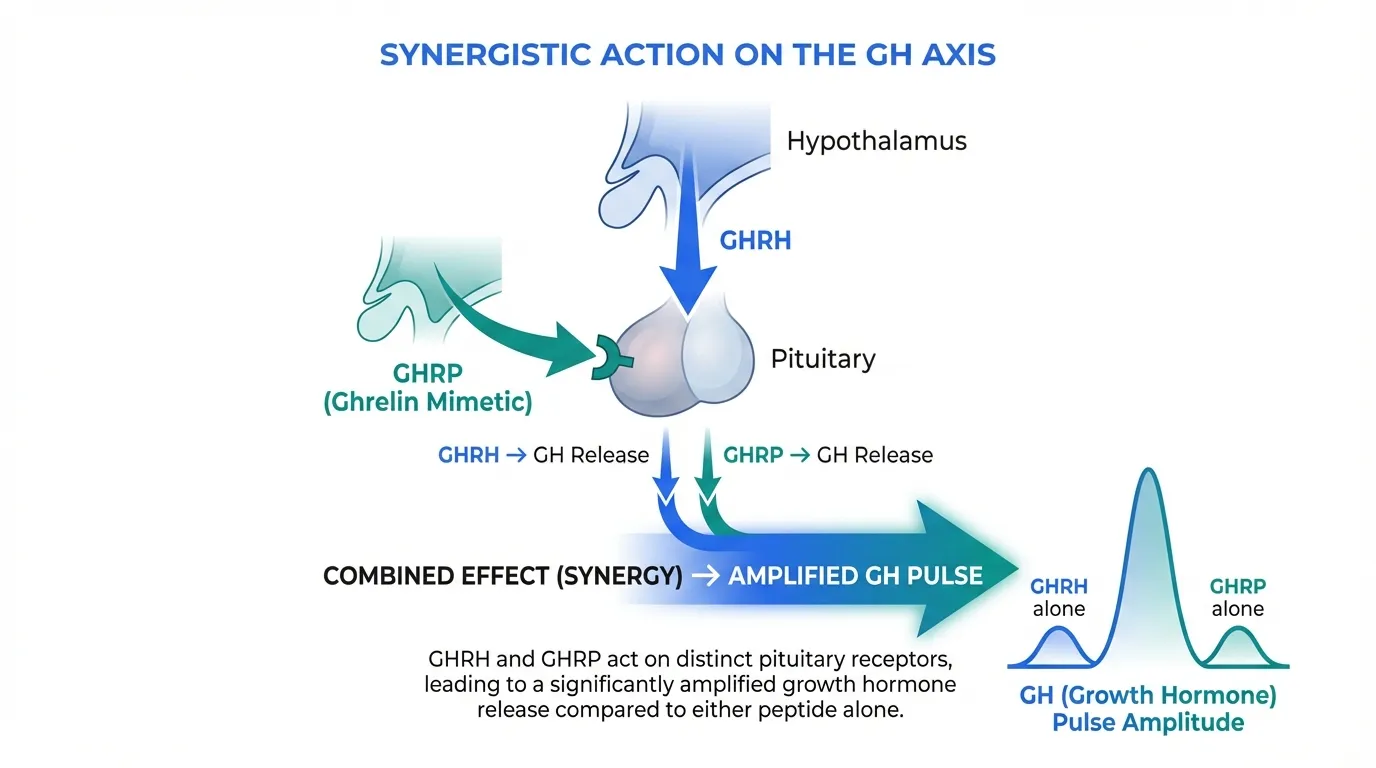
GHRH + GHRP combinations: CJC-1295 (No DAC) (a GHRH analog) combined with ipamorelin (a ghrelin mimetic) is one of the most studied synergistic peptide combinations. GHRH stimulates GH release at the pituitary, while ghrelin mimetics amplify the GH pulse through a separate receptor. Research on the parent compounds (GHRH + GHRP-6) has demonstrated that the combined GH response is greater than either compound alone -- a true synergistic effect.
BPC-157 + TB-500: BPC-157 and TB-500 are frequently combined for healing, though the evidence for synergy specifically between these two peptides comes from anecdotal reports rather than controlled studies. The rationale is that BPC-157 promotes angiogenesis and growth factor signaling while TB-500 (thymosin beta-4) promotes cell migration and reduces inflammation through different pathways.
For more on the BPC-157 and TB-500 combination, see our Wolverine stack guide.
Known Peptide Interactions#
Established Interactions#
Very few peptide-peptide interactions have been formally studied. The interactions that are documented mostly involve FDA-approved peptides:
| Interaction | Nature | Evidence Level |
|---|---|---|
| GLP-1 agonists + insulin | GLP-1 agonists reduce insulin requirements; dose adjustment needed | Strong (clinical trials) |
| GLP-1 agonists + sulfonylureas | Increased hypoglycemia risk when combined | Strong (clinical trials) |
| GHRH + ghrelin mimetics | Synergistic GH release (additive to super-additive) | Moderate (clinical studies) |
| Multiple GH secretagogues | Potential for excessive GH stimulation | Theoretical |
| Somatostatin analogs + GH secretagogues | Somatostatin suppresses GH release, opposing secretagogue effects | Strong (pharmacological) |
Theoretical Concerns#
Several theoretical interactions warrant caution, even without direct clinical evidence:
Receptor competition: Peptides that bind the same receptor family may compete for binding sites. For example, combining multiple melanocortin receptor agonists could lead to unpredictable receptor activation patterns.
Additive side effects: Combining peptides with overlapping side effect profiles increases the likelihood of those side effects. Two peptides that both cause nausea (e.g., two different GLP-1 agonists) would likely produce more nausea together than either alone.
Metabolic burden: The liver and kidneys process peptide metabolites. While individual peptides at standard doses are unlikely to stress these organs, combining many peptides simultaneously increases the total metabolic load.
Immune responses: Administering multiple foreign peptides may increase the overall chance of an immune reaction, though short peptides are generally low in immunogenicity.
Categories That Are Commonly Combined#
Healing + Recovery Stacks#
The most common multi-peptide approach combines healing peptides:
- BPC-157 + TB-500: The "Wolverine stack" -- widely used for soft tissue recovery
- BPC-157 + GHK-Cu: Systemic healing peptide with a topical skin/wound healing peptide
- Healing peptide + GH secretagogue: BPC-157 combined with ipamorelin or sermorelin, based on the rationale that elevated GH supports tissue repair
Growth Hormone Optimization Stacks#
GH-focused stacks typically combine a GHRH analog with a GHRP:
- CJC-1295 (No DAC) + Ipamorelin: The most popular GH stack, combining GHRH pathway stimulation with ghrelin receptor activation
- Sermorelin + Ipamorelin: Similar concept using a different GHRH analog
- CJC-1295 (No DAC) + GHRP-2 or GHRP-6: Higher potency GH secretagogue combinations
Note: Combining multiple GH secretagogues from the same class (e.g., ipamorelin + GHRP-6) is generally considered redundant since they target the same receptor. The synergy comes from combining peptides that target different parts of the GH axis.
Categories to Avoid Combining#
Some combinations raise enough concern that most guidance advises against them:
| Combination to Avoid | Reason |
|---|---|
| Two GLP-1 receptor agonists | Excessive GLP-1 receptor activation; amplified GI side effects |
| Multiple melanocortin agonists | Unpredictable receptor activation; additive cardiovascular effects |
| Insulin + GLP-1 agonists (without medical supervision) | Hypoglycemia risk requires careful dose management |
| Large numbers of peptides simultaneously (5+) | No safety data; unpredictable interactions; unnecessary complexity |
Practical Considerations#
Timing and Administration#
When using multiple peptides, timing matters:
Same syringe mixing: Generally, peptides should not be mixed in the same syringe unless specifically designed to be combined. Peptides can interact chemically in solution -- binding to each other, altering pH, or accelerating degradation. Each peptide should be reconstituted and injected separately.
Injection timing: Peptides that target the same general pathway may be administered close together (e.g., CJC-1295 and ipamorelin are commonly injected at the same time, in separate syringes). Peptides targeting different systems can be spaced throughout the day based on their individual optimal timing.
Fasting considerations: Some peptides (particularly GH secretagogues) work best on an empty stomach because food intake can blunt the GH response. Semaglutide and other GLP-1 agonists do not have the same fasting requirement.
Starting New Peptides#
A critical principle when beginning a multi-peptide protocol: start one peptide at a time. This allows you to:
- Assess your individual response to each peptide
- Identify which peptide is responsible if side effects occur
- Determine the effective dose for each peptide independently
- Establish a baseline before adding complexity
Starting multiple new peptides simultaneously makes it impossible to attribute effects -- positive or negative -- to any specific peptide.
Dose Adjustments#
When combining peptides, some practitioners reduce individual doses based on the theory that synergistic effects may allow lower doses of each component. This approach has some support in the GHRH + GHRP literature (where the synergistic GH response means lower individual doses can achieve the same GH output), but it has not been validated for most other combinations.
For dosing calculations, see our dosing calculator. For understanding how animal study doses translate to human doses, see our HED calculator guide.
What the Evidence Actually Shows#
Strong Evidence#
- GHRH + ghrelin mimetic synergy: Multiple studies confirm that combining GHRH-pathway and ghrelin-pathway stimulation produces greater GH release than either alone
- GLP-1 agonist + insulin interactions: Well-documented in clinical trials; requires careful dose management
Moderate Evidence#
- BPC-157 + TB-500: Theoretical rationale is sound (different mechanisms), but no controlled study has tested the specific combination
- Healing peptide + GH secretagogue: Growth hormone supports tissue repair, so the combination is biologically plausible
Weak or No Evidence#
- Most community-recommended stacks involving 3+ peptides have no direct evidence supporting the specific combination
- Long-term safety data for multi-peptide protocols does not exist
- Optimal dosing for peptides used in combination has not been established for most pairs
Risk Management#
If using multiple peptides, the following principles can help minimize risk:
- Start one at a time: Add peptides sequentially, with at least 1-2 weeks between additions
- Use the minimum effective number: More peptides means more variables, more cost, and more potential for interactions
- Monitor for side effects: Keep a log of when each peptide is started and any changes in how you feel
- Do not combine peptides from the same class: Two GLP-1 agonists, two melanocortin agonists, or two ghrelin mimetics are redundant and potentially risky
- Prioritize quality: When using multiple peptides, the quality of each matters even more. See our peptide quality guide
- Consider periodic breaks: Cycling off all peptides periodically allows your body to return to baseline and may help you assess what is actually providing benefit
For a broader overview of peptide safety, including side effect management, see our peptide safety guide.
Key Takeaways#
-
Combining peptides with different mechanisms is the most rational approach. Peptides targeting different receptor systems and biological pathways are least likely to interfere with each other.
-
GHRH + GHRP combinations have the strongest evidence for synergy. The combined GH response exceeds what either pathway produces alone.
-
Most popular peptide stacks lack direct clinical evidence. The rationale is often sound, but the specific combinations have rarely been tested in controlled studies.
-
Starting one peptide at a time is essential. This allows you to attribute effects and side effects to specific peptides.
-
Avoid combining peptides from the same class. Two GLP-1 agonists or two melanocortin agonists together offer no benefit and increase risk.
-
Do not mix peptides in the same syringe. Chemical interactions in solution can degrade peptides or alter their properties.
Related Peptide Profiles#
Learn more about the peptides discussed in this article:
- BPC-157 Overview and Research Guide
- BPC-157 Dosing Protocols
- BPC-157 Side Effects and Safety
- TB-500 Overview and Research Guide
- TB-500 Dosing Protocols
- TB-500 Side Effects and Safety
- Ipamorelin Overview and Research Guide
- Ipamorelin Dosing Protocols
- Ipamorelin Side Effects and Safety
- CJC-1295 (No DAC) Overview and Research Guide
- CJC-1295 (No DAC) Dosing Protocols
- CJC-1295 (No DAC) Side Effects and Safety
- Semaglutide Overview and Research Guide
- Semaglutide Dosing Protocols
- Semaglutide Side Effects and Safety

Frequently Asked Questions About Can You Take Multiple Peptides Together? Research-Based Guidance
What does this article cover?
Can you combine multiple peptides safely? Stacking principles, known interactions, timing considerations, and evidence-based guidance. This guide is for educational purposes only and does not constitute medical advice.
Which peptides are discussed in this article?
This article covers BPC-157, TB-500, Ipamorelin, CJC-1295 (No DAC), Semaglutide. Key context: BPC-157 (One of the most commonly stacked healing peptides, frequently combined with TB-500 in recovery pr...); TB-500 (Often paired with BPC-157 in the popular 'Wolverine stack' healing combination); Ipamorelin (Growth hormone secretagogue commonly combined with CJC-1295 to enhance GH release). Each peptide is discussed based on available research evidence.
Who is this guide written for?
This guide is written for researchers and individuals seeking an evidence-based overview of the topic covered in "Can You Take Multiple Peptides Together? Research-Based Guidance." It summarizes available research data without making treatment recommendations. Always consult a healthcare provider for medical decisions.
What are the key takeaways from this article?
The main findings covered in this article include: One of the most commonly stacked healing peptides, frequently combined with TB-500 in recovery pr.... Often paired with BPC-157 in the popular 'Wolverine stack' healing combination. Growth hormone secretagogue commonly combined with CJC-1295 to enhance GH release. These takeaways are based on the research data available at the time of publication.
What is BPC-157 and why is it significant?
BPC-157 is a peptide discussed in this article because: One of the most commonly stacked healing peptides, frequently combined with TB-500 in recovery protocols. For a complete profile of BPC-157, see the dedicated peptide page on this site.
Continue reading this research review
Free access to the complete analysis with citations and evidence ratings.
150+ peptide profiles · 30+ comparisons · 18 research tools
Medical Disclaimer
This website is for educational and informational purposes only. The information provided is not intended to diagnose, treat, cure, or prevent any disease. Always consult with a qualified healthcare professional before using any peptide or supplement.
Join 2,000+ researchers getting biweekly updates
Enjoyed this article?
The Research Briefing delivers deep-dives like this biweekly — plus new study breakdowns, safety updates, and tool announcements.
Free forever. No spam. Unsubscribe in one click.
Where to Find These Peptides
Continue Exploring
Peptide Profiles
Keep Reading
How to Reconstitute Peptides: A Complete Step-by-Step Guide
A detailed guide to peptide reconstitution covering bacteriostatic water vs sterile water, step-by-step mixing technique, post-reconstitution dosing calculations, proper storage, and the most common mistakes to avoid.

Subcutaneous vs Intramuscular Peptide Injection: What Research Shows
Subcutaneous vs intramuscular peptide injection compared. Covers absorption, technique, site selection, and preferred routes by peptide.
Peptide Sciences Shuts Down: What Happened and What It Means for the Research Peptide Industry
Peptide Sciences, one of the largest U.S. research peptide vendors, voluntarily shut down on March 6, 2026. Here's what happened, the regulatory forces behind the closure, and what it means for the peptide industry going forward.
You Might Also Like
Related content you may find interesting