FDA Peptide Regulation in 2026: What Is Banned and What Is Legal

Introduction#
The regulatory landscape for peptides in the United States has undergone dramatic shifts since 2023. What was once a loosely regulated market of compounding pharmacies producing research peptides has become a tightly controlled space, with the FDA taking increasingly aggressive action to restrict which peptides can be compounded and under what circumstances.
For researchers, clinicians, and patients, understanding the current state of peptide regulation is essential. This article provides an overview of the regulatory framework as it stands in 2026, covering which peptides have been banned from compounding, which remain legally available, and what the ongoing regulatory battles mean for the future of peptide access.
The Regulatory Framework: How Peptide Compounding Works#
Section 503A and 503B#
Compounding pharmacies in the United States operate under two sections of the Federal Food, Drug, and Cosmetic Act:
Section 503A governs traditional compounding pharmacies that prepare medications for individual patients based on prescriptions. These pharmacies must compound using bulk drug substances that appear on an FDA-approved list or are components of FDA-approved drugs.
Section 503B governs outsourcing facilities that can compound without individual prescriptions but are subject to more stringent FDA oversight, including current Good Manufacturing Practice (cGMP) requirements and regular inspections.
For a substance to be legally compounded under either section, it must either be a component of an FDA-approved drug or appear on the FDA's "bulks" list of approved compounding ingredients.
The Category System#
The FDA uses a nomination and review process to evaluate bulk drug substances for compounding eligibility. Substances are placed into categories:
- Category 1: Approved for compounding. These substances have been reviewed and accepted for use by compounding pharmacies.
- Category 2: Not approved for compounding. These substances have been reviewed and rejected, meaning compounding pharmacies cannot legally use them.
- Category 3: Under review. These substances are still being evaluated and their status is pending.
The category designation is critical because it determines whether a peptide can be legally prepared by a compounding pharmacy in the United States.
Peptides Banned from Compounding (Category 2)#
The following peptides have been placed in FDA Category 2 and are not permitted to be compounded by US pharmacies. This list reflects the status as of early 2026.
BPC-157#
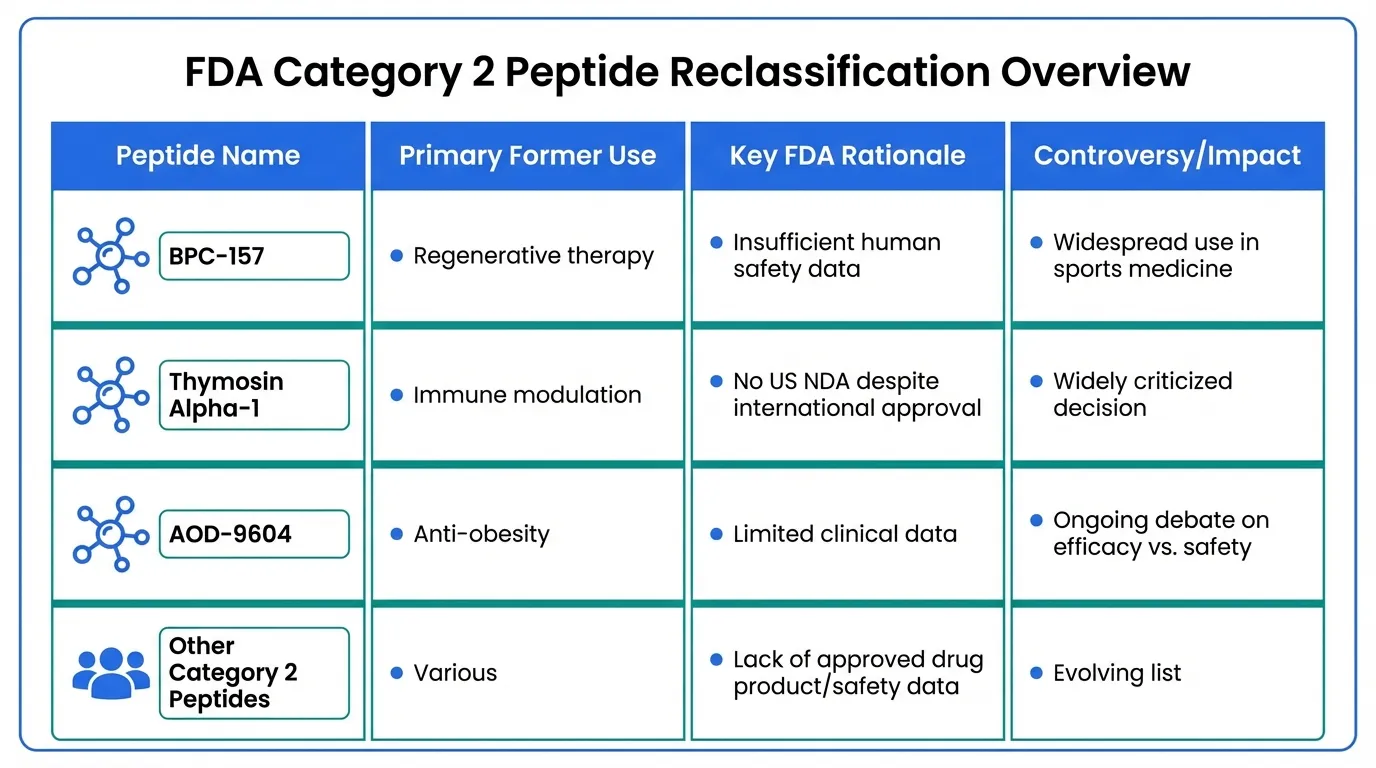
BPC-157 was one of the most widely compounded research peptides before its Category 2 designation in 2024. The FDA's primary rationale was the lack of an FDA-approved drug product containing BPC-157 and insufficient safety data from human clinical trials. Despite over 100 published animal studies showing regenerative potential, the extremely limited human data (fewer than 15 total participants across all published studies) was deemed inadequate.
The ban on BPC-157 compounding was particularly controversial because of its widespread use in sports medicine and regenerative therapy communities.
Thymosin Alpha-1#
Thymosin Alpha-1 was placed in Category 2 despite being approved in over 35 countries under the brand name Zadaxin. It has been studied in more than 11,000 human subjects across 30+ clinical trials. The FDA's decision was based on the fact that the peptide does not have an approved New Drug Application (NDA) in the United States, not on safety concerns.
This decision was widely criticized by the medical community, as Thymosin Alpha-1 has an extensive international safety record.
AOD-9604#
AOD-9604 is a modified fragment of human growth hormone (amino acids 177-191) studied for anti-obesity properties. It was placed in Category 2 due to the absence of an approved drug product and limited clinical data supporting its use.
Other Category 2 Peptides#
Several additional peptides have been placed in Category 2 or are effectively banned from compounding:
- GHK-Cu -- Copper peptide used for skin regeneration research
- KPV -- Anti-inflammatory tripeptide derived from alpha-MSH
- Dihexa -- Cognitive research peptide
- Selank -- Anxiolytic peptide developed in Russia
- PE-22-28 -- TREK-1 channel peptide
Important: The Category 2 list may continue to evolve. Researchers should check the FDA's current bulk drug substance evaluations for the most up-to-date status of specific peptides.
Peptides That Remain Legally Available#
FDA-Approved Peptide Drugs#
Several peptides are FDA-approved drugs and remain fully legal when prescribed and dispensed through standard pharmaceutical channels:
| Peptide | Brand Name(s) | Approved Indication |
|---|---|---|
| Semaglutide | Ozempic, Wegovy, Rybelsus | Type 2 diabetes, obesity |
| Tirzepatide | Mounjaro, Zepbound | Type 2 diabetes, obesity |
| Tesamorelin | Egrifta | HIV-associated lipodystrophy |
| Gonadorelin | Factrel | Diagnostic agent for gonadotropic function |
| Triptorelin | Trelstar | Prostate cancer |
| PT-141 | Vyleesi | Hypoactive sexual desire disorder in women |
These peptides can be prescribed by licensed healthcare providers and dispensed by pharmacies. They can also potentially be compounded if drug shortage conditions apply (see below).
The Semaglutide and Tirzepatide Compounding Debate#
One of the most contentious regulatory issues involves the compounding of semaglutide and tirzepatide. During periods when these drugs were listed on the FDA Drug Shortage Database, compounding pharmacies were permitted to produce compounded versions to address supply gaps.
The situation became complex when manufacturers reported that shortages had been resolved while demand for lower-cost compounded versions remained high. The FDA has moved to restrict compounding of these drugs once they are no longer in shortage, leading to legal challenges from compounding pharmacies and patient advocacy groups.
Key points in the debate:
- Manufacturer position: Brand-name supply is adequate and compounded versions pose safety risks due to lack of equivalent quality controls
- Compounding pharmacy position: Compounded versions provide essential access for patients who cannot afford brand-name prices
- Patient advocacy position: Restricting compounding after patients have been stabilized on compounded versions causes treatment disruption
- FDA position: Compounding is only permitted during verified shortages under specific conditions
The legal and regulatory resolution of this issue will likely have lasting implications for peptide access.
Category 1 Peptides (Approved for Compounding)#
Some peptides have been reviewed and approved for compounding under Section 503A or 503B. These include certain established pharmaceutical compounds that have a history of safe compounding use. The specific list of approved bulk drug substances is maintained by the FDA and is subject to updates.
The Gray Area: Research Peptides#
"For Research Use Only"#
Many peptides are sold with the label "for research use only" or "not for human consumption." This designation places these products outside the pharmaceutical regulatory framework -- they are marketed as laboratory research chemicals, not as drugs.
The legal status of these products is nuanced:
- Purchasing research peptides is generally legal in the United States for legitimate research purposes
- Self-administration is not sanctioned by the FDA, and products labeled for research use are not intended for human use
- Quality and purity vary widely among research peptide suppliers, as these products are not subject to pharmaceutical manufacturing standards
- State laws may vary regarding the purchase and possession of specific peptides
Peptides Without Category Designations#
Many peptides have not been formally reviewed by the FDA and do not have a category designation. These include:
- Most growth hormone secretagogues (ipamorelin, GHRP-2, hexarelin)
- Nootropic peptides (semax, cerebrolysin)
- Mitochondrial peptides (MOTS-c, SS-31)
- Anti-aging peptides (epitalon, FOXO4-DRI)
The lack of a formal category designation does not mean these peptides are approved for compounding. In the absence of Category 1 approval or FDA-approved drug status, compounding pharmacies generally cannot legally use these substances.
International Regulatory Landscape#
Peptide regulation varies significantly across jurisdictions:
Canada has a different regulatory framework where some peptides that are restricted in the US may be available through compounding pharmacies or special access programs.
European Union regulates peptides under the European Medicines Agency (EMA), with some peptides like Thymosin Alpha-1 having a longer history of approved use in member states.
Australia classifies peptides under its Therapeutic Goods Administration (TGA), and some peptides have been reclassified to require prescriptions.
Russia and Eastern Europe have approved several peptides (such as Semax and Selank) as pharmaceutical products that are not recognized by Western regulatory agencies.
Understanding the international context is important because researchers may encounter studies conducted in jurisdictions where a peptide is an approved pharmaceutical product, even if it is restricted in the United States.
What Changed and Why#
The 2024 Category 2 Wave#
The 2024 round of Category 2 designations represented the most significant restriction of peptide access in US history. Several factors contributed:
- Safety concerns: The FDA cited insufficient human safety data for many compounded peptides, particularly those with only animal study evidence
- Quality control issues: Inspections of compounding pharmacies revealed instances of contamination, incorrect potency, and poor manufacturing practices
- Lack of NDA pathway: Most research peptides have no pharmaceutical sponsor pursuing FDA approval, leaving them without the regulatory infrastructure that approved drugs have
- Market growth: The rapid growth of the peptide therapy market attracted regulatory attention, particularly as more consumers sought compounded peptides for anti-aging, weight loss, and performance purposes
Industry Response#
The compounding pharmacy industry and patient advocacy groups have responded through several channels:
- Legal challenges to specific Category 2 designations
- Lobbying for legislative reforms to compounding regulations
- Advocacy for expedited review pathways for peptides with extensive international safety data
- Development of patient registries and observational studies to build safety evidence
Impact on Researchers and Clinicians#
For Clinical Researchers#
Researchers conducting clinical studies involving banned peptides face additional hurdles. Investigational New Drug (IND) applications may be required even for academic research, and sourcing pharmaceutical-grade material becomes more difficult.
For Clinicians#
Healthcare providers who previously prescribed compounded peptides must adapt their practice:
- Focus on FDA-approved alternatives where available
- Stay current with the FDA's drug shortage database for compounding eligibility
- Understand the legal risks of prescribing compounded versions of restricted peptides
- Communicate regulatory changes clearly to patients
For Patients#
Patients who were receiving compounded peptide therapies have been significantly affected by the regulatory changes. Options include:
- Transitioning to FDA-approved alternatives when possible
- Exploring clinical trial participation for peptides under investigation
- Consulting with healthcare providers about alternative treatment strategies
Looking Ahead: The Regulatory Future#
Several developments may shape the regulatory landscape for peptides going forward:
Ongoing litigation around semaglutide and tirzepatide compounding will set precedents for how the FDA handles compounding of FDA-approved drugs.
Legislative proposals to reform compounding regulations have been introduced in Congress, though their passage is uncertain.
International harmonization efforts may eventually standardize peptide regulation across major markets, potentially providing a pathway for peptides with extensive international safety data.
New FDA approvals of peptides currently in clinical trials (such as retatrutide and survodutide) will expand the list of legally available peptide drugs.
For the latest information on peptide safety and regulatory considerations, visit our safety guide. To compare side effect profiles of available peptides, try our side effects comparison tool.
Key Takeaways#
-
The FDA Category 2 designation bans specific peptides from compounding. BPC-157, Thymosin Alpha-1, AOD-9604, GHK-Cu, and several others cannot be legally compounded by US pharmacies.
-
FDA-approved peptide drugs remain fully legal when prescribed through standard pharmaceutical channels. These include semaglutide, tirzepatide, tesamorelin, and others.
-
The compounding of semaglutide and tirzepatide is tied to drug shortage status and remains a contested regulatory and legal issue.
-
Research peptides sold "for research use only" occupy a legal gray area and are not intended for human use under current regulations.
-
International regulations differ significantly. Peptides banned from US compounding may be approved pharmaceutical products in other countries.
-
The regulatory landscape continues to evolve. Researchers, clinicians, and patients should monitor FDA announcements and legal developments for updates that may affect peptide access.
Related Peptide Profiles#
Learn more about the peptides discussed in this article:
- BPC-157 Overview and Research Guide
- BPC-157 Dosing Protocols
- BPC-157 Side Effects and Safety
- Thymosin Alpha-1 Overview and Research Guide
- Thymosin Alpha-1 Dosing Protocols
- Thymosin Alpha-1 Side Effects and Safety
- AOD-9604 Overview and Research Guide
- AOD-9604 Dosing Protocols
- AOD-9604 Side Effects and Safety
- Semaglutide Overview and Research Guide
- Semaglutide Dosing Protocols
- Semaglutide Side Effects and Safety
- Tirzepatide Overview and Research Guide
- Tirzepatide Dosing Protocols
- Tirzepatide Side Effects and Safety

Frequently Asked Questions About FDA Peptide Regulation in 2026: What Is Banned and What Is Legal
What does this article cover?
FDA peptide regulation in 2026: which peptides are banned from compounding, which remain legal, and what the changes mean for researchers. This news article is for educational purposes only and does not constitute medical advice.
Which peptides are discussed in this article?
This article covers BPC-157, Thymosin Alpha-1, AOD-9604, Semaglutide, Tirzepatide. Key context: BPC-157 (One of the most prominent peptides placed in FDA Category 2, banned from compounding despite wide...); Thymosin Alpha-1 (Immune-modulating peptide banned from US compounding despite being approved in over 35 countries ...); AOD-9604 (Anti-obesity peptide placed in Category 2, illustrating the FDA approach to peptides without appr...). Each peptide is discussed based on available research evidence.
How current is the information in this article?
This article was published on 2026-02-10 and last updated on 2026-02-10. The peptide research landscape evolves rapidly, so readers should verify time-sensitive information such as regulatory status or clinical trial progress.
What are the key takeaways from this article?
The main findings covered in this article include: One of the most prominent peptides placed in FDA Category 2, banned from compounding despite wide.... Immune-modulating peptide banned from US compounding despite being approved in over 35 countries .... Anti-obesity peptide placed in Category 2, illustrating the FDA approach to peptides without appr.... These takeaways are based on the research data available at the time of publication.
What is BPC-157 and why is it significant?
BPC-157 is a peptide discussed in this article because: One of the most prominent peptides placed in FDA Category 2, banned from compounding despite widespread research interest. For a complete profile of BPC-157, see the dedicated peptide page on this site.
Continue reading this research review
Free access to the complete analysis with citations and evidence ratings.
150+ peptide profiles · 30+ comparisons · 18 research tools
Medical Disclaimer
This website is for educational and informational purposes only. The information provided is not intended to diagnose, treat, cure, or prevent any disease. Always consult with a qualified healthcare professional before using any peptide or supplement.
Join 2,000+ researchers getting biweekly updates
Enjoyed this article?
The Research Briefing delivers deep-dives like this biweekly — plus new study breakdowns, safety updates, and tool announcements.
Free forever. No spam. Unsubscribe in one click.
Where to Find These Peptides
Continue Exploring
Peptide Profiles
Keep Reading

Compounding Pharmacy Peptide Access: 2026 Regulatory Changes
An overview of the 2026 regulatory landscape for compounded peptides, covering FDA enforcement actions, the impact on semaglutide and tirzepatide compounding, 503A and 503B pharmacy rules, and what patients and providers need to know about peptide access.

Peptide Interactions with Medications: What Your Doctor Needs to Know
Critical reference guide on peptide-drug interactions for healthcare professionals and patients. Covers GLP-1 delayed gastric emptying effects on oral medications, GH peptide interactions with diabetes and thyroid medications, immune peptide conflicts with immunosuppressants, and key information gaps.

What Peptides Are FDA Approved? The Complete List (2026)
Complete list of FDA-approved peptide drugs with brand names, indications, and approval dates. Includes Foundayo (orforglipron), Wegovy HD, and the RFK Jr. Category 1 reclassification of 14 peptides.
You Might Also Like
Related content you may find interesting