How Much Does Peptide Therapy Cost? A 2026 Price Guide

Introduction#
One of the most common questions about peptide therapy is straightforward: how much does it cost? The answer, unfortunately, is anything but simple. Peptide pricing in 2026 spans from $30 per month for a topical serum to over $1,400 per month for a brand-name injectable medication, with the differences driven by regulatory status, manufacturing standards, and supply chain factors.
This guide provides a comprehensive overview of peptide costs across three categories -- FDA-approved medications, compounded peptides, and research peptides -- with estimated monthly costs for the most commonly discussed compounds. It also covers what influences pricing, insurance considerations, and practical strategies for managing costs.
Important note: All prices cited are approximate ranges based on publicly available information as of early 2026. Actual costs vary by location, pharmacy, vendor, insurance plan, and dosing protocol. This guide does not endorse any specific vendor or pharmacy.
Understanding the Three Pricing Tiers#
Peptide costs fall into three broad tiers that correspond to their regulatory status and manufacturing standards.
Tier 1: FDA-Approved Peptide Medications#
These are manufactured under Good Manufacturing Practice (GMP) standards, available by prescription, and may be partially covered by insurance. They carry the highest prices but also the highest quality assurance.
Tier 2: Compounded Peptides#
Prepared by licensed compounding pharmacies under USP standards. Available with a prescription for peptides in FDA Category 1. Pricing falls between FDA-approved and research peptides. Quality is generally reliable but varies by pharmacy.
Tier 3: Research Peptides#
Sold as "for research purposes only" by peptide vendors. Not manufactured under GMP or USP standards. Lowest prices but also lowest quality assurance. Not intended for human use.
FDA-Approved Peptide Pricing#
GLP-1 Agonists (Weight Management and Diabetes)#
GLP-1 receptor agonists represent the largest market segment and the most expensive peptide therapies.
| Medication | Brand | Indication | List Price (Monthly) | With Typical Insurance |
|---|---|---|---|---|
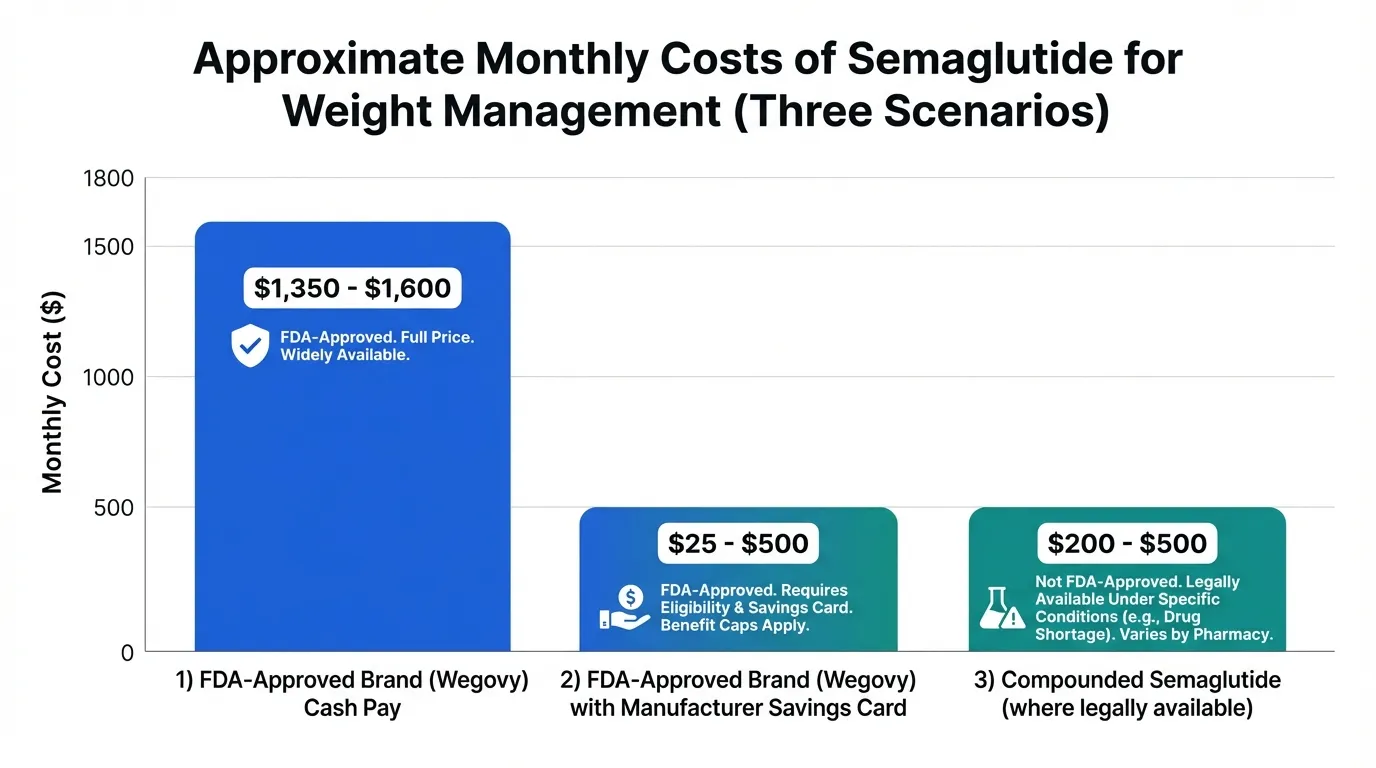
| Semaglutide 2.4 mg | Wegovy | Weight management | $1,300-1,400 | $0-500 (varies widely) |
| Semaglutide 0.5-2 mg | Ozempic | Type 2 diabetes | $900-1,000 | $25-150 (better coverage) |
| Semaglutide (oral) | Rybelsus | Type 2 diabetes | $900-1,000 | $25-200 |
| Tirzepatide 5-15 mg | Zepbound | Weight management | $1,000-1,100 | $0-550 (varies widely) |
| Tirzepatide 5-15 mg | Mounjaro | Type 2 diabetes | $1,000-1,100 | $25-150 (better coverage) |
| Liraglutide 3 mg | Saxenda | Weight management | $1,300-1,500 | $0-500 |
Insurance reality: Coverage for weight management indications (Wegovy, Zepbound, Saxenda) is inconsistent. Many plans exclude weight loss medications or require prior authorization with specific BMI and comorbidity criteria. Diabetes indications (Ozempic, Mounjaro) generally have better coverage.
Manufacturer savings programs: Novo Nordisk and Eli Lilly offer savings cards that can reduce costs to $0-$25 per month for commercially insured patients who meet eligibility criteria. These programs change frequently -- check manufacturer websites for current offers.
For detailed GLP-1 cost comparisons, see Semaglutide vs Tirzepatide Cost.
Other FDA-Approved Peptides#
| Medication | Brand | Indication | Approximate Monthly Cost |
|---|---|---|---|
| PT-141 (bremelanotide) | Vyleesi | HSDD (women) | $800-1,000 (on-demand dosing) |
| Tesamorelin | Egrifta SV | HIV lipodystrophy | $1,500-2,000 |
| Teriparatide | Forteo | Osteoporosis | $1,800-3,500 |
| Abaloparatide | Tymlos | Osteoporosis | $1,800-2,500 |
| Exenatide | Bydureon BCise | Type 2 diabetes | $700-900 |
Compounded Peptide Pricing#
Compounding pharmacies can legally prepare Category 1 peptides with a valid prescription. These offer significant cost savings over brand-name medications but with less manufacturing oversight.
GLP-1 Compounded Options#
Where legally available, compounded versions of GLP-1 agonists have been among the most cost-effective options:
| Compounded Peptide | Typical Monthly Cost | Notes |
|---|---|---|
| Semaglutide (compounded) | $200-500 | Availability affected by FDA enforcement; check current legal status |
| Liraglutide (compounded) | $150-400 | Less commonly compounded than semaglutide |
Critical caveat: The compounding landscape for GLP-1 agonists is evolving rapidly. FDA enforcement actions and drug shortage declarations directly affect the legality and availability of compounded versions. Verify current status before assuming availability.
Growth Hormone Secretagogues (Compounded)#
| Peptide | Typical Monthly Cost | Usual Protocol |
|---|---|---|
| Ipamorelin | $150-350 | 200-300 mcg, 1-3x daily |
| Sermorelin | $150-400 | 200-500 mcg daily |
| CJC-1295/Ipamorelin blend | $200-450 | Combined GHRH+GHRP |
| Tesamorelin (compounded) | $300-600 | 1-2 mg daily |
Other Compounded Peptides#
| Peptide | Typical Monthly Cost | Category Status |
|---|---|---|
| BPC-157 | Previously $150-300 | Category 2 (no longer compoundable) |
| Thymosin Alpha-1 | Previously $200-500 | Category 2 (no longer compoundable) |
| KPV | $100-250 | Check current category status |
Note: Several popular compounded peptides were moved to Category 2 in 2024, restricting pharmacy access. See What Peptides Did the FDA Ban for the current list.
Research Peptide Pricing#
Research peptides represent the lowest price tier but also the lowest manufacturing quality assurance. These are sold for laboratory research only and are not intended for human use.
Common Research Peptide Costs#
| Peptide | Typical Price per Vial | Vial Size | Estimated Monthly Supply Cost |
|---|---|---|---|
| BPC-157 | $30-60 | 5 mg | $30-120 (depends on dose) |
| TB-500 | $35-70 | 5 mg | $35-140 |
| Ipamorelin | $25-50 | 5 mg | $40-80 |
| CJC-1295 (no DAC) | $30-55 | 2 mg | $45-90 |
| CJC-1295 (DAC) | $35-65 | 2 mg | $35-65 (less frequent dosing) |
| GHK-Cu (injectable) | $25-45 | 50 mg | $25-45 |
| DSIP | $25-45 | 5 mg | $25-90 |
| Selank | $30-55 | 5 mg | $30-110 |
| Semax | $30-60 | 30 mg (nasal) | $30-60 |
| Epitalon | $35-65 | 10 mg | $35-65 (cycled use) |
What Affects Research Peptide Pricing#
Several factors drive price variation between vendors:
- Purity level: Higher purity (99%+) costs more than standard (95-98%) purity
- Testing rigor: Vendors providing comprehensive third-party COAs with HPLC, mass spec, and endotoxin testing charge more
- Batch size: Larger batches reduce per-unit cost
- Origin: US-synthesized peptides typically cost 2-3x more than Chinese-manufactured peptides
- Vendor reputation: Established vendors with community trust and transparent testing charge a premium
For guidance on evaluating vendor quality, see the Peptide Quality and Purity Guide and the Vendor Directory.
Topical Peptide Products#
Topical peptide formulations represent the most affordable entry point into peptide use:
| Product Type | Typical Monthly Cost | Peptides Included |
|---|---|---|
| GHK-Cu serum (basic) | $30-60 | GHK-Cu 1-3% |
| GHK-Cu serum (premium) | $60-120 | GHK-Cu + additional actives |
| Argireline cream | $20-50 | Argireline 5-10% |
| SNAP-8 serum | $30-65 | SNAP-8 3-10% |
| Matrixyl serum | $25-55 | Palmitoyl pentapeptide-4 |
| Multi-peptide anti-aging | $50-150 | Various combinations |
Topical products are available without a prescription and do not require reconstitution or injection equipment.
Hidden and Ancillary Costs#
When budgeting for peptide therapy, account for these additional expenses:
Supplies for Injectable Peptides#
| Supply Item | Cost | Frequency |
|---|---|---|
| Bacteriostatic water (30 mL) | $10-20 | Every 1-2 months |
| Insulin syringes (100 count) | $15-25 | Every 2-3 months |
| Alcohol swabs (200 count) | $5-10 | Every 3-6 months |
| Sharps disposal container | $5-15 | Every 3-6 months |
Estimated monthly supply cost: $15-30
Lab Work and Monitoring#
| Lab Panel | Approximate Cost (Cash Pay) | Frequency |
|---|---|---|
| Basic metabolic panel | $30-80 | Every 3-6 months |
| IGF-1 level | $50-100 | Every 3-6 months (GH peptides) |
| HbA1c | $25-60 | Every 3-6 months (GLP-1 agonists) |
| Comprehensive metabolic panel | $50-150 | Annually |
| Thyroid panel | $50-120 | Annually |
| Lipid panel | $30-80 | Annually |
Note: Lab costs vary dramatically. Insurance may cover routine panels. Cash-pay lab services like walk-in lab networks often offer discounted pricing.
Medical Consultations#
- Telemedicine peptide consultation: $100-300 (initial), $50-150 (follow-up)
- In-person consultation with peptide-knowledgeable provider: $150-500 (initial)
- Ongoing monitoring visits: $75-200 per visit
Total Monthly Cost Estimates by Goal#
These estimates combine peptide costs, supplies, and periodic lab work:
| Goal | Budget Option | Mid-Range Option | Premium Option |
|---|---|---|---|
| Weight Management | Compounded semaglutide: $250-550/mo | Brand Ozempic with insurance: $25-150/mo | Brand Wegovy cash pay: $1,300-1,400/mo |
| Healing/Recovery | BPC-157 research: $50-150/mo | Previously compounded: $180-350/mo | N/A (no FDA-approved option for this use) |
| GH Optimization | Ipamorelin research: $60-110/mo | Compounded CJC/Ipa blend: $230-500/mo | Compounded tesamorelin: $350-650/mo |
| Anti-Aging (topical) | GHK-Cu serum: $30-60/mo | Premium peptide serum: $60-150/mo | Clinical-grade multi-peptide: $100-200/mo |
| Cognitive Enhancement | Selank nasal: $30-110/mo | Semax nasal: $30-60/mo | N/A |
| Sleep | DSIP research: $25-90/mo | N/A | N/A |
Cost-Saving Strategies#
For FDA-Approved Peptides#
- Manufacturer savings cards -- Novo Nordisk and Eli Lilly offer programs that can reduce GLP-1 costs to $0-25/month for eligible commercially insured patients (see our detailed GLP-1 cost comparison for full pricing breakdowns)
- Patient assistance programs -- For uninsured or underinsured patients, manufacturer programs may provide medications at no cost
- Insurance appeals -- If denied coverage, formal appeals with medical documentation of necessity succeed in a meaningful percentage of cases
- Diabetes vs weight loss indications -- For patients with type 2 diabetes, the same medications often have better coverage when prescribed for diabetes rather than weight loss
- Dose optimization -- Work with your provider to find the minimum effective dose rather than automatically titrating to the maximum
For Compounded Peptides#
- Compare pharmacy pricing -- Costs vary significantly between compounding pharmacies
- Multi-month supplies -- Some pharmacies offer discounts for 3-month supplies
- Combination formulations -- Blends (like CJC-1295/ipamorelin) may cost less than purchasing each separately
For Research Peptides#
- Bulk purchasing -- Many vendors offer discounts for larger quantities
- Compare vendors -- Price differences of 30-50% exist between reputable vendors for the same peptide
- Verify purity -- A cheaper peptide with lower purity may actually cost more per unit of active compound
- Use the Dosing Calculator -- Accurate reconstitution prevents waste from dosing errors
General Strategies#
- Prioritize evidence -- Spending on an FDA-approved peptide with proven efficacy may be more cost-effective than a cheaper research peptide with unproven effects
- Start with one peptide -- Avoid stacking multiple compounds before confirming the first one is working. See our guide on how to choose your first peptide for decision framework
- Factor in total cost -- Include supplies, lab work, and medical consultations in your budget, not just the peptide itself
- Consider topical first -- For skin and anti-aging goals, topical GHK-Cu offers an affordable, evidence-supported starting point
Key Takeaways#
-
Peptide costs span a wide range -- from $30/month for topical serums to $1,400+/month for brand-name injectable medications. Your budget depends on the specific peptide, its regulatory status, and the source.
-
Three pricing tiers exist -- FDA-approved (highest cost, highest quality assurance), compounded (moderate cost, prescription required), and research (lowest cost, no quality guarantees).
-
Insurance coverage is inconsistent -- FDA-approved GLP-1 agonists for diabetes have the best coverage; weight management indications and all non-FDA-approved peptides generally have no coverage. See our compounding pharmacy guide for the latest on compounded peptide access.
-
Hidden costs add up -- Supplies ($15-30/month), lab work ($100-300 periodically), and medical consultations ($100-500) should be factored into your budget.
-
Price does not equal value -- The cheapest option is not always the best value. An FDA-approved peptide with proven efficacy at $300/month with insurance may deliver more value than a $50/month research peptide with no confirmed human efficacy.
-
The landscape is shifting -- Compounding pharmacy availability, insurance coverage policies, and generic/biosimilar entries are actively changing peptide costs. Verify current pricing before committing.
This article is for educational and informational purposes only. It does not constitute financial, medical, or treatment advice. All prices are approximate and subject to change. Insurance coverage varies by plan and location. This guide does not endorse any specific vendor, pharmacy, or product. Always verify current pricing directly with providers and consult a healthcare professional before starting any peptide therapy.

Frequently Asked Questions About How Much Does Peptide Therapy Cost? A 2026 Price Guide
How much does semaglutide cost without insurance?
Brand-name semaglutide (Wegovy) has a list price of approximately $1,300-1,400 per month without insurance. Compounded semaglutide, where available, typically costs $200-500 per month. Manufacturer savings programs and patient assistance programs may reduce out-of-pocket costs significantly for eligible patients. Prices vary by pharmacy and location.
Are peptides covered by insurance?
FDA-approved peptides may be covered by insurance for their approved indications, though coverage varies widely by plan. Semaglutide for diabetes (Ozempic) generally has better insurance coverage than semaglutide for weight loss (Wegovy). Compounded and research peptides are not covered by insurance. Prior authorization is often required for GLP-1 medications.
Why are research peptides so much cheaper than FDA-approved versions?
Research peptides are cheaper because they are not manufactured under FDA Good Manufacturing Practice (GMP) standards, have not undergone the billion-dollar clinical trial process, do not carry liability insurance, and are sold without regulatory oversight. The lower price reflects lower manufacturing standards and the absence of the regulatory costs that ensure quality, safety, and efficacy in FDA-approved products.
What is the cheapest effective peptide to start with?
The answer depends on your goal. For skin and anti-aging, topical GHK-Cu serums start at $30-60 per month. For weight management, compounded semaglutide (where legally available) offers the best value relative to its evidence level at $200-500 per month. For growth hormone optimization, ipamorelin from research vendors typically costs $40-80 per month. Always prioritize evidence quality and source reliability over price alone.
How much should I budget for peptide therapy per month?
Monthly budgets vary dramatically. Topical peptides like GHK-Cu serums cost $30-100. Research peptides like BPC-157 or ipamorelin typically run $40-120 per month including supplies. Compounded peptides from pharmacies cost $150-500. FDA-approved GLP-1 medications cost $300-1,400 depending on insurance coverage. Factor in supplies (syringes, bacteriostatic water) at $15-30 per month for injectable peptides, plus periodic lab work ($100-300 per panel).
Continue reading this research review
Free access to the complete analysis with citations and evidence ratings.
150+ peptide profiles · 30+ comparisons · 18 research tools
Medical Disclaimer
This website is for educational and informational purposes only. The information provided is not intended to diagnose, treat, cure, or prevent any disease. Always consult with a qualified healthcare professional before using any peptide or supplement.
Join 2,000+ researchers getting biweekly updates
Enjoyed this article?
The Research Briefing delivers deep-dives like this biweekly — plus new study breakdowns, safety updates, and tool announcements.
Free forever. No spam. Unsubscribe in one click.
Where to Find These Peptides
Continue Exploring
Peptide Profiles
Keep Reading
Most Popular Therapeutic Peptides in 2026: 15 Ranked by Research Interest
The 15 most popular therapeutic peptides in 2026, ranked by clinical trial activity, search interest, and research community adoption. From semaglutide to BPC-157.

How Long Do Peptides Take to Work? Timelines by Category
How long peptides take to work: timelines for GLP-1 agonists, healing peptides, GH secretagogues, and factors influencing onset.

Subcutaneous vs Intramuscular Peptide Injection: What Research Shows
Subcutaneous vs intramuscular peptide injection compared. Covers absorption, technique, site selection, and preferred routes by peptide.
You Might Also Like
Related content you may find interesting