Semaglutide Vs Tirzepatide Cost

Introduction#
Semaglutide and tirzepatide are the two dominant injectable GLP-1-based therapies available in Canada for the management of type 2 diabetes and obesity. Both are administered as once-weekly subcutaneous injections, both require a prescription, and both have demonstrated substantial clinical efficacy in large Phase 3 trial programs. However, they differ in mechanism of action, regulatory history, clinical performance, and -- critically for many patients -- cost and insurance coverage.
For patients and prescribers navigating the Canadian healthcare landscape, cost is not an abstract consideration. Monthly out-of-pocket expenses for branded GLP-1 therapies can reach well over $1,000, and provincial formulary coverage varies significantly depending on the province, the indication, and the specific brand. The arrival of tirzepatide in Canada in 2024 has introduced a new option that offers superior efficacy in head-to-head trials but comes with its own pricing and access challenges.
This article provides a detailed comparison of semaglutide and tirzepatide from a cost and value perspective, examining list prices, provincial coverage, clinical efficacy relative to cost, and practical access considerations for Canadian patients.
Semaglutide: Overview and Cost#
Mechanism and Pharmacology#
Semaglutide is a GLP-1 receptor monoagonist -- it selectively activates the glucagon-like peptide-1 receptor without engaging other incretin or metabolic receptors. Structurally, semaglutide is a modified GLP-1 analog with a C18 fatty diacid side chain that enables binding to serum albumin, extending its plasma half-life to approximately 7 days and permitting once-weekly dosing.
By activating GLP-1 receptors in the pancreas, gut, and central nervous system, semaglutide enhances glucose-dependent insulin secretion, suppresses glucagon release, slows gastric emptying, and reduces appetite through hypothalamic and brainstem satiety circuits.
Brand Names and Regulatory Status in Canada#
Semaglutide is marketed under two brand names in Canada:
-
Ozempic (semaglutide for type 2 diabetes): Approved by Health Canada and available since 2018. Ozempic is prescribed at doses of 0.25 mg, 0.5 mg, and 1.0 mg weekly for glycemic control in adults with type 2 diabetes. It is the more established product and has broader formulary coverage across Canadian provinces.
-
Wegovy (semaglutide for chronic weight management): Approved by Health Canada in 2022, but did not launch in Canada until 2024 due to global supply constraints. Wegovy is prescribed at a higher maintenance dose of 2.4 mg weekly for adults with obesity (BMI of 30 or greater) or overweight (BMI of 27 or greater) with at least one weight-related comorbidity. Supply remains limited across Canadian pharmacies.
Pricing in Canada#
Semaglutide pricing in Canada depends on the brand name and dosage:
| Product | Indication | Dose Range | Approximate Monthly Cost (CAD) |
|---|---|---|---|
| Ozempic | Type 2 Diabetes | 0.25 mg - 1.0 mg/week | $250 - $350 |
| Wegovy | Obesity | 0.25 mg - 2.4 mg/week | $350 - $500 |
For reference, United States list prices are substantially higher, ranging from approximately $900 to $1,350 USD per month depending on the brand and indication. Canadian prices benefit from the Patented Medicine Prices Review Board (PMPRB) framework, which caps patented drug prices relative to international comparators.
Clinical Efficacy#
The clinical evidence base for semaglutide spans two major trial programs:
-
SUSTAIN trials (type 2 diabetes): Across the SUSTAIN program, semaglutide 1.0 mg weekly demonstrated HbA1c reductions of approximately 1.5% to 1.8% from baseline, consistently outperforming comparators including sitagliptin, exenatide extended-release, and insulin glargine.
-
STEP trials (obesity): The STEP-1 trial demonstrated approximately 15% to 17% body weight loss at 68 weeks with semaglutide 2.4 mg weekly in adults with obesity but without diabetes, compared to approximately 2.4% with placebo. STEP-2 through STEP-5 confirmed efficacy across diverse populations including adults with type 2 diabetes and those requiring sustained treatment.
Additionally, the SELECT cardiovascular outcomes trial demonstrated a 20% reduction in major adverse cardiovascular events (MACE) with semaglutide 2.4 mg in overweight or obese adults, establishing cardiovascular benefit independent of diabetes status.
Tirzepatide: Overview and Cost#
Mechanism and Pharmacology#
Tirzepatide represents a mechanistic advancement over semaglutide. It is a dual GIP/GLP-1 receptor agonist -- a single 39-amino acid peptide that simultaneously activates both the glucose-dependent insulinotropic polypeptide (GIP) receptor and the GLP-1 receptor. Tirzepatide was engineered with approximately 5-fold selectivity for the GIP receptor over the GLP-1 receptor, a deliberate design choice based on preclinical evidence that GIP receptor activation in the brain engages satiety pathways partially distinct from GLP-1 signaling.
The C20 fatty diacid moiety provides albumin binding and a half-life compatible with once-weekly dosing. By engaging two incretin receptors rather than one, tirzepatide produces metabolic effects that exceed what GLP-1 monoagonism can achieve, including greater insulin secretion, more pronounced appetite suppression through complementary central nervous system pathways, and potentially improved gastrointestinal tolerability relative to the degree of weight loss achieved.
Brand Names and Regulatory Status in Canada#
Tirzepatide is available in Canada under one approved brand name, with the second indication still pending:
-
Mounjaro (tirzepatide for type 2 diabetes): Approved by Health Canada in 2024. Mounjaro is prescribed at doses of 2.5 mg, 5 mg, 7.5 mg, 10 mg, 12.5 mg, and 15 mg weekly for glycemic control in adults with type 2 diabetes. As a newer entrant to the Canadian market, formulary coverage is still being established across provinces.
-
Zepbound (tirzepatide for chronic weight management): Not yet approved in Canada. In the United States, Zepbound received FDA approval in November 2023 for chronic weight management in adults with obesity or overweight with weight-related comorbidities. Canadian patients seeking tirzepatide specifically for weight loss currently have no Health Canada-approved option under that indication.
Pricing in Canada#
Tirzepatide pricing in Canada reflects its newer market entry and dual-agonist mechanism:
| Product | Indication | Dose Range | Approximate Monthly Cost (CAD) |
|---|---|---|---|
| Mounjaro | Type 2 Diabetes | 2.5 mg - 15 mg/week | $300 - $450 |
| Zepbound | Obesity | Not available in Canada | N/A |
In the United States, tirzepatide carries a list price of approximately $1,000 to $1,200 USD per month across both brand names. The absence of Zepbound approval in Canada means that Canadian patients cannot currently access tirzepatide for the obesity indication at any price through standard domestic pharmaceutical channels.
Clinical Efficacy#
Tirzepatide's efficacy data comes from two comprehensive Phase 3 programs:
-
SURPASS trials (type 2 diabetes): The SURPASS program demonstrated HbA1c reductions of 1.87% to 2.59% across tirzepatide doses, placing it at the top of available glycemic therapies. These reductions exceeded those achieved by semaglutide, insulin degludec, and insulin glargine across comparator trials.
-
SURMOUNT trials (obesity): SURMOUNT-1 demonstrated up to 20.9% body weight reduction at 72 weeks with tirzepatide 15 mg in adults with obesity but without diabetes -- a magnitude of weight loss that approaches outcomes historically seen only with bariatric surgery. SURMOUNT-2 confirmed 14.7% weight loss in patients with both obesity and type 2 diabetes.
Head-to-Head Pricing Comparison#
Direct Cost Comparison#
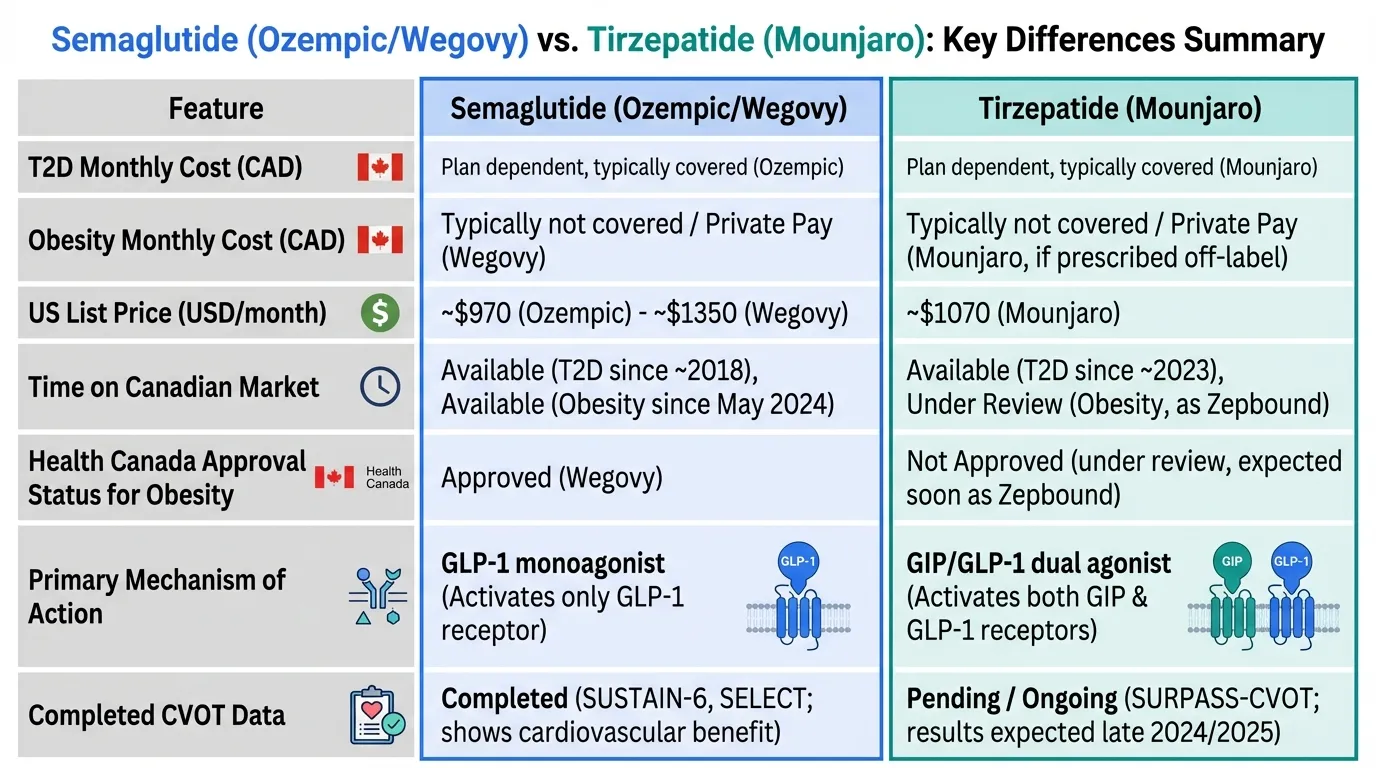
For Canadian patients comparing these two therapies, the pricing landscape can be summarized as follows:
| Factor | Semaglutide (Ozempic/Wegovy) | Tirzepatide (Mounjaro) |
|---|---|---|
| T2D Monthly Cost (CAD) | $250 - $350 | $300 - $450 |
| Obesity Monthly Cost (CAD) | $350 - $500 (Wegovy, limited supply) | Not available (Zepbound not approved) |
| US List Price (USD/month) | $900 - $1,350 | $1,000 - $1,200 |
| Time on Canadian Market | Since 2018 (Ozempic) | Since 2024 (Mounjaro) |
| Generic Availability | Not available | Not available |
At face value, semaglutide carries a lower monthly cost in Canada for the type 2 diabetes indication. Ozempic's longer market presence has also allowed more time for provincial formulary negotiations, manufacturer access programs, and pharmacy familiarity with the product. Mounjaro's pricing is higher on a per-month basis, reflecting both its newer status and the additional complexity of its dual-agonist mechanism.
Annual Cost Estimates#
When projected over a full year of treatment, the cost differences become more apparent:
| Scenario | Semaglutide Annual Cost (CAD) | Tirzepatide Annual Cost (CAD) |
|---|---|---|
| T2D (lower dose) | ~$3,000 - $4,200 | ~$3,600 - $5,400 |
| Obesity (maintenance dose) | ~$4,200 - $6,000 | Not available in Canada |
These figures represent list prices before insurance, provincial formulary coverage, or manufacturer rebates. Actual out-of-pocket costs vary widely depending on coverage status, which is discussed in detail below.
Efficacy Per Dollar: What the Data Shows#
The SURPASS-2 Head-to-Head Trial#
The most direct comparison of semaglutide and tirzepatide efficacy comes from SURPASS-2, a randomized, open-label, Phase 3 trial that compared tirzepatide at 5 mg, 10 mg, and 15 mg weekly against semaglutide 1.0 mg weekly in adults with type 2 diabetes inadequately controlled on metformin alone. This trial enrolled 1,879 patients over 40 weeks and provides the only randomized head-to-head data between the two compounds.
Key results from SURPASS-2:
| Outcome | Semaglutide 1 mg | Tirzepatide 5 mg | Tirzepatide 10 mg | Tirzepatide 15 mg |
|---|---|---|---|---|
| HbA1c Reduction | -1.86% | -2.01% | -2.24% | -2.30% |
| Body Weight Change | -5.7 kg | -7.6 kg | -9.3 kg | -11.2 kg |
| HbA1c < 7% Achieved | 79% | 82% | 86% | 86% |
Tirzepatide demonstrated statistically superior HbA1c reduction and weight loss at all three doses compared to semaglutide 1 mg. The magnitude of difference increased with tirzepatide dose escalation: at 15 mg, tirzepatide produced an additional 0.44% HbA1c reduction and nearly double the weight loss of semaglutide.
Calculating Cost-Effectiveness#
When clinical efficacy is considered alongside pricing, the value calculation becomes more nuanced:
Per-percentage-point HbA1c reduction:
- Semaglutide (Ozempic, ~$300/month): Approximately $160 to $200 per month per 1% HbA1c reduction
- Tirzepatide (Mounjaro, ~$375/month): Approximately $160 to $190 per month per 1% HbA1c reduction
Per-kilogram weight loss (based on SURPASS-2 data at 40 weeks):
- Semaglutide: Approximately $53 per kg lost per month
- Tirzepatide 15 mg: Approximately $34 per kg lost per month
These calculations suggest that tirzepatide, despite its higher absolute monthly cost, may deliver more clinical value per dollar spent, particularly for patients where weight loss is a primary treatment goal. The cost-per-kilogram advantage of tirzepatide reflects its substantially greater weight loss efficacy -- roughly double that of semaglutide 1 mg in the SURPASS-2 trial.
Important Caveats#
Several limitations apply to this analysis. SURPASS-2 compared tirzepatide against semaglutide 1 mg, not the higher 2.4 mg dose used in the STEP obesity trials. The optimal comparison for obesity outcomes would be tirzepatide 15 mg against semaglutide 2.4 mg, but this head-to-head trial has not been conducted. Extrapolating from separate trial programs (STEP and SURMOUNT) is methodologically imperfect due to differences in patient populations, trial design, and endpoints.
Additionally, cost-effectiveness in a clinical context extends beyond simple efficacy ratios. Factors including long-term durability of effect, cardiovascular outcomes (where semaglutide has completed CVOT data from SELECT and tirzepatide has not), side effect burden, and treatment discontinuation rates all affect real-world value.
Insurance and Coverage in Canada#
Provincial Formulary Coverage#
In Canada, prescription drug coverage operates through a patchwork of provincial formularies, federal programs (for eligible Indigenous peoples, veterans, and refugees), and private insurance plans. Coverage for GLP-1-based therapies varies significantly across provinces:
Semaglutide (Ozempic):
- Listed on the formulary of most Canadian provinces for type 2 diabetes, typically with clinical criteria including failure of or intolerance to metformin, and documented HbA1c above a specified threshold
- Coverage criteria and specific listing status differ by province -- some provinces list Ozempic as a general benefit while others restrict it to exceptional access or special authorization programs
- Ozempic's longer market presence has given it a broader coverage footprint compared to newer entrants
Semaglutide (Wegovy):
- Formulary coverage for the obesity indication is more limited across provinces
- Several provinces have not yet listed Wegovy on their public formularies, and where coverage exists, it often requires documentation of specific BMI thresholds, weight-related comorbidities, and prior lifestyle intervention
- Supply constraints since the 2024 Canadian launch have compounded access challenges
Tirzepatide (Mounjaro):
- As a 2024 market entrant, Mounjaro is still undergoing provincial formulary review in many jurisdictions
- Early coverage decisions are emerging, but the formulary landscape remains incomplete
- Provinces that have initiated review are generally applying similar clinical criteria as those used for Ozempic, including documented metformin failure and HbA1c thresholds
Private Insurance#
For Canadians with employer-sponsored or individual private insurance plans, coverage for these medications depends on the plan's drug formulary and any applicable special authorization requirements:
- Most major private insurance carriers in Canada have added Ozempic to their formularies, though some require prior authorization or step therapy documentation
- Mounjaro coverage through private plans is still being negotiated in many cases, and patients may encounter delays or denials during this transitional period
- Wegovy coverage through private plans is inconsistent, with many plans excluding weight management medications or imposing lifetime treatment limits
Out-of-Pocket Strategies#
For patients without adequate insurance coverage, several strategies may reduce costs:
- Manufacturer patient support programs: Both Novo Nordisk (semaglutide) and Eli Lilly (tirzepatide) operate patient assistance programs in Canada that may provide co-pay support, starter kits, or compassionate access for eligible patients
- Pharmacy discount programs: Some pharmacy chains offer loyalty pricing or discount cards that reduce the retail cost of these medications
- Provincial exceptional access programs: Patients who do not meet standard formulary criteria may apply for exceptional access coverage through their province, typically requiring documentation of clinical need from the prescribing physician
Availability and Access#
Supply Chain Considerations#
The practical availability of both medications in Canada has been affected by global supply constraints:
Semaglutide supply: Ozempic experienced significant supply shortages in 2022 and 2023, driven in part by off-label prescribing for weight loss before Wegovy's Canadian launch. While Ozempic supply has stabilized for the type 2 diabetes indication, Wegovy availability remains limited at many Canadian pharmacies. Novo Nordisk has implemented a phased rollout and has periodically restricted new patient starts to manage supply.
Tirzepatide supply: As a newer product in Canada, Mounjaro has experienced the supply variability typical of a recent launch. Eli Lilly has worked to ensure adequate supply for the Canadian market, but regional availability can fluctuate. The absence of Zepbound in Canada means that the higher-dose formulations specifically indicated for obesity are not available through Canadian channels.
Prescription Requirements#
Both semaglutide and tirzepatide require a prescription from a licensed Canadian healthcare provider. Neither medication is available over the counter or through direct-to-consumer purchase. The prescribing process typically involves:
- Clinical assessment confirming the appropriate indication (type 2 diabetes or, for Wegovy, obesity)
- Documentation of prior treatment history, particularly metformin use for type 2 diabetes
- Baseline laboratory work including HbA1c, fasting glucose, renal function, and lipid panel
- Dose titration following the manufacturer's recommended schedule to minimize gastrointestinal side effects
- Ongoing monitoring every 3 to 6 months to assess efficacy, tolerability, and continued appropriateness
Compounding and Non-Branded Alternatives#
Some Canadian patients have explored compounding pharmacies as a lower-cost alternative. It is important to note that compounded semaglutide and tirzepatide are not Health Canada-approved products. Compounded formulations do not undergo the same regulatory review for safety, purity, and potency as branded pharmaceuticals, and Health Canada has issued advisories regarding the use of compounded GLP-1 agonists. Patients considering compounded alternatives should discuss the risks and regulatory status with their prescribing physician.
Which One Is Right for You?#
When Semaglutide May Be the Better Choice#
Semaglutide remains the preferred option in several clinical scenarios:
-
Established type 2 diabetes management: Ozempic has a longer track record in Canada, broader formulary coverage, and extensive long-term safety data. For patients who achieve adequate glycemic control with semaglutide 0.5 mg or 1.0 mg weekly, the lower monthly cost and easier insurance coverage make it a practical first-line choice.
-
Cardiovascular risk reduction: Semaglutide is the only GLP-1-based therapy with completed cardiovascular outcomes trial data (SELECT) demonstrating reduced MACE in patients with obesity. For patients where cardiovascular risk reduction is a primary treatment objective, semaglutide currently has a stronger evidence base.
-
Cost sensitivity: At a lower monthly price point and with more established insurance coverage pathways, semaglutide imposes a smaller financial burden for patients paying out of pocket or navigating restrictive formularies.
-
Obesity indication (with access): For patients who can access Wegovy, semaglutide 2.4 mg is a Health Canada-approved option for chronic weight management. Tirzepatide does not have an approved obesity indication in Canada.
When Tirzepatide May Be the Better Choice#
Tirzepatide is worth considering in the following situations:
-
Insufficient response to semaglutide: For patients who have not achieved adequate glycemic control or weight loss on semaglutide, tirzepatide's dual-agonist mechanism offers a pharmacologically distinct approach. The SURPASS-2 data demonstrate that tirzepatide provides superior efficacy at all tested doses compared to semaglutide 1 mg.
-
Aggressive weight loss goals: Tirzepatide has demonstrated the highest weight loss among approved GLP-1-based therapies, with up to 20.9% body weight reduction in the SURMOUNT-1 trial. For patients with severe obesity or obesity-related complications requiring maximal weight reduction, tirzepatide offers a greater magnitude of effect.
-
Greater HbA1c reduction needed: With HbA1c reductions of 2.0% to 2.3% in the SURPASS trials, tirzepatide provides more potent glycemic control than semaglutide. Patients with higher baseline HbA1c levels who need substantial glycemic improvement may benefit from tirzepatide's greater glucose-lowering efficacy.
-
Value-oriented decision making: Despite the higher monthly cost, tirzepatide's greater efficacy per dollar -- particularly in terms of weight loss -- may represent better long-term value for patients who factor clinical outcomes into their cost assessment.
Factors That Apply to Both#
Regardless of which medication is selected, patients should be aware of shared considerations:
- Both medications cause gastrointestinal side effects (nausea, vomiting, diarrhea, constipation) that are most pronounced during dose titration and typically improve over time
- Both require indefinite use to maintain clinical benefits -- weight regain and glycemic deterioration are expected upon discontinuation
- Both are contraindicated in patients with a personal or family history of medullary thyroid carcinoma or multiple endocrine neoplasia syndrome type 2
- Neither medication has been studied in pregnant or breastfeeding women, and both should be discontinued well before planned conception
Conclusion#
The choice between semaglutide and tirzepatide in Canada involves balancing clinical efficacy, cost, insurance coverage, and practical availability. Semaglutide, available as Ozempic since 2018 and as Wegovy since 2024, offers a well-established treatment option with broader provincial formulary coverage, lower monthly cost, and completed cardiovascular outcomes data. Tirzepatide, available as Mounjaro since 2024, delivers superior glycemic control and weight loss through its dual GIP/GLP-1 agonist mechanism but at a higher price point and with less established insurance coverage in the Canadian system.
Head-to-head data from SURPASS-2 clearly favor tirzepatide for both HbA1c reduction and weight loss when compared to semaglutide 1 mg. On a cost-per-outcome basis, tirzepatide may offer comparable or better value despite its higher absolute price, particularly for patients prioritizing weight loss. However, semaglutide retains advantages in cardiovascular outcomes evidence, market availability, and formulary access that make it the more practical choice for many Canadian patients today.
As provincial formularies continue to evaluate Mounjaro, as Zepbound potentially enters the Canadian market for the obesity indication, and as both manufacturers negotiate pricing and patient support programs, the cost and access landscape for these therapies will continue to evolve. Patients should work closely with their healthcare providers and pharmacists to navigate coverage options, weigh clinical benefits against out-of-pocket costs, and select the therapy that best aligns with their individual medical needs and financial circumstances.
This article is for informational purposes only and does not constitute medical advice. All treatment decisions should be made in consultation with a qualified healthcare provider who can assess individual clinical circumstances.
Related Peptide Profiles#
Learn more about the peptides discussed in this article:

Frequently Asked Questions About Semaglutide Vs Tirzepatide Cost
What does this article cover?
Semaglutide vs Tirzepatide: Cost Comparison — part of the GLP-1 Pricing & Access content cluster. This article is for educational purposes only and does not constitute medical advice.
Which peptides are discussed in this article?
This article covers Semaglutide, Tirzepatide. Key context: Semaglutide (Referenced in cluster "GLP-1 Pricing & Access"); Tirzepatide (Referenced in cluster "GLP-1 Pricing & Access"). Each peptide is discussed based on available research evidence.
Is this article based on research evidence?
This article draws on published research data and publicly available information about the peptides discussed. It is intended for educational purposes only. Pricing and availability may vary by region and change over time.
What are the key takeaways from this article?
The main findings covered in this article include: Referenced in cluster "GLP-1 Pricing & Access". Referenced in cluster "GLP-1 Pricing & Access". These takeaways are based on the research data available at the time of publication.
What is Semaglutide and why is it significant?
Semaglutide is a peptide discussed in this article because: Referenced in cluster "GLP-1 Pricing & Access". For a complete profile of Semaglutide, see the dedicated peptide page on this site.
Continue reading this research review
Free access to the complete analysis with citations and evidence ratings.
150+ peptide profiles · 30+ comparisons · 18 research tools
Medical Disclaimer
This website is for educational and informational purposes only. The information provided is not intended to diagnose, treat, cure, or prevent any disease. Always consult with a qualified healthcare professional before using any peptide or supplement.
Join 2,000+ researchers getting biweekly updates
Enjoyed this article?
The Research Briefing delivers deep-dives like this biweekly — plus new study breakdowns, safety updates, and tool announcements.
Free forever. No spam. Unsubscribe in one click.
Where to Find These Peptides
Continue Exploring
Peptide Profiles
Keep Reading

The History of Peptide Research: From Insulin to Modern Therapeutics
History of peptide research from insulin's 1921 discovery to modern GLP-1 agonists. Key milestones in synthesis and therapeutics.

The Evolution of GLP-1 Receptor Agonists: From Single-Target to Multi-Receptor Metabolic Therapeutics
A research review tracing the evolution of GLP-1 receptor agonists from semaglutide through tirzepatide, retatrutide, and survodutide, examining how multi-receptor approaches have progressively expanded efficacy in obesity and metabolic disease.
Compounded Semaglutide Cost Guide 2026: Prices, Pharmacies & What to Expect
A deep dive into compounded semaglutide pricing in 2026, covering 503A and 503B pharmacy costs, telehealth platform pricing, dose-by-dose monthly breakdowns, and how to evaluate compounding pharmacy quality.
You Might Also Like
Related content you may find interesting