Retatrutide vs Tirzepatide: Comprehensive Comparison
A detailed comparison of Retatrutide and Tirzepatide, covering their receptor pharmacology, weight loss efficacy, side effects, and clinical development as next-generation metabolic peptides.
Verdict at a Glance
Tirzepatide is the proven choice with FDA approval and extensive clinical data; Retatrutide shows potential for greater efficacy through triple-agonism but awaits Phase 3 results
| Best for | Pick | Why |
|---|---|---|
| Currently Available Treatment | Tirzepatide | FDA-approved and commercially available as Mounjaro/Zepbound with established dosing protocols and post-market safety data |
| Maximum Weight Loss Potential | Retatrutide | Phase 3 TRIUMPH-4 data showed 28.7% weight loss at 68 weeks (24.2% at 48 weeks in Phase 2), exceeding tirzepatide's results |
| Non-Alcoholic Fatty Liver Disease | Retatrutide | Glucagon receptor agonism directly promotes hepatic fat oxidation, showing up to 82% liver fat reduction in trials |
| Type 2 Diabetes Management | Tirzepatide | Proven HbA1c reduction with FDA approval specifically for glycemic control in type 2 diabetes |
| Category | Retatrutide | Tirzepatide | Advantage |
|---|---|---|---|
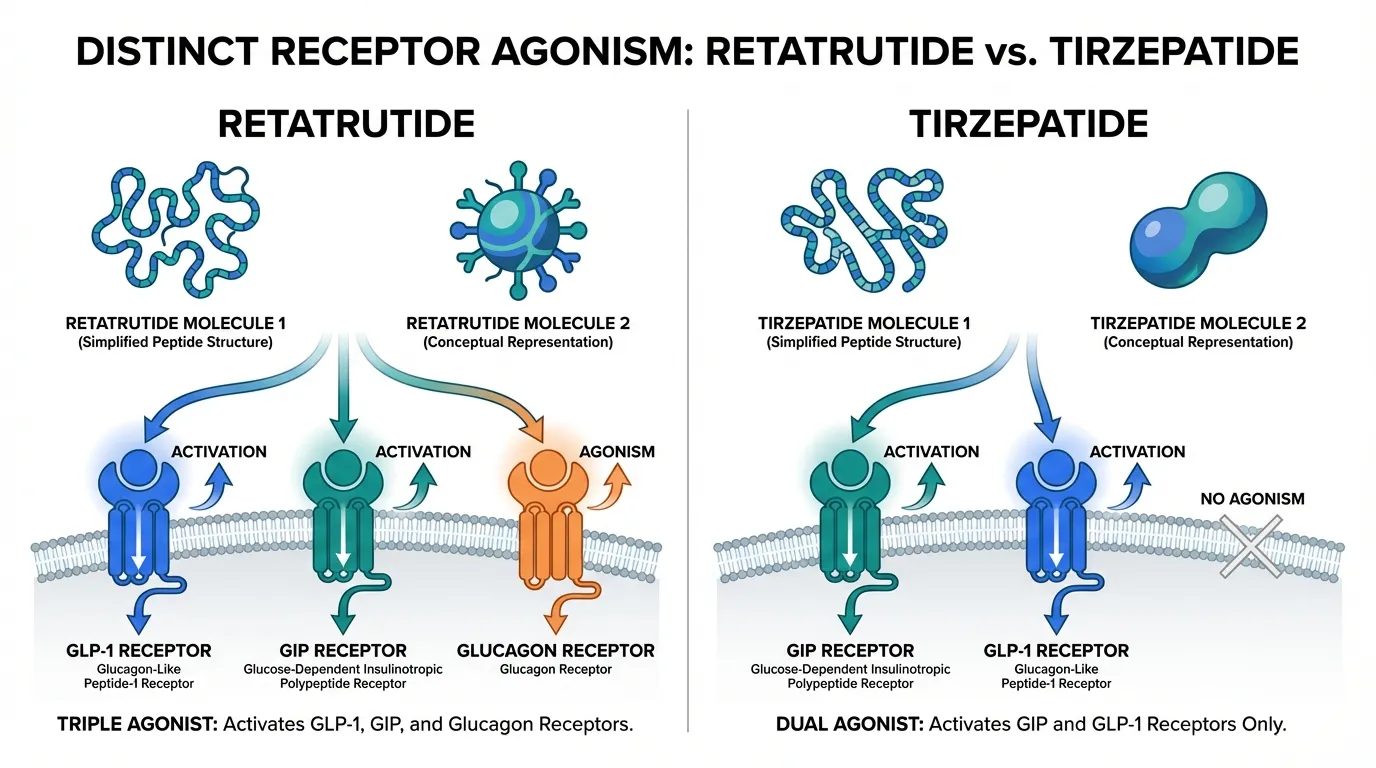
| Receptor Targets | Triple agonist: GIP, GLP-1, and glucagon receptors simultaneously | Dual agonist: GIP and GLP-1 receptors | Retatrutide |
| Weight Loss Efficacy | Up to 28.7% body weight reduction at 68 weeks (Phase 3 TRIUMPH-4); 24.2% at 48 weeks in Phase 2 | Up to 20.9% body weight reduction (SURMOUNT trials) | Retatrutide |
| Regulatory Status | Phase 1-3 clinical trials; not yet approved | FDA-approved as Mounjaro (2022) for T2D and Zepbound (2023) for obesity | Tirzepatide |
| Side Effect Profile | GI side effects common; glucagon component may cause transient heart rate increase | GI side effects common but well-characterized; extensive post-market safety data | Tirzepatide |
| Liver Fat Reduction | Significant hepatic fat reduction via glucagon receptor activation (up to 82% reduction) | Moderate hepatic fat reduction observed in trials | Retatrutide |
| Dosing Convenience | Once-weekly subcutaneous injection | Once-weekly subcutaneous injection with established titration schedule | Comparable |

Introduction#
Retatrutide and tirzepatide represent the cutting edge of incretin-based metabolic therapeutics, both developed by Eli Lilly. While tirzepatide made history as the first dual GIP/GLP-1 receptor agonist to receive FDA approval, retatrutide pushes the pharmacological envelope further with triple receptor agonism that adds glucagon receptor activation. This comparison examines how the addition of a third receptor target affects efficacy, safety, and clinical positioning.
Both peptides address obesity and type 2 diabetes, conditions that affect hundreds of millions of people worldwide. Understanding their mechanistic differences is essential for appreciating why retatrutide may offer advantages in certain clinical scenarios while tirzepatide remains the established standard of care.
Mechanism of Action Comparison#
Retatrutide#
Retatrutide (LY3437943) is a 39-amino acid peptide that simultaneously activates three metabolically important receptors:
- GLP-1 receptor: Enhances glucose-dependent insulin secretion, suppresses glucagon release, slows gastric emptying, and promotes central satiety signaling
- GIP receptor: Potentiates insulin secretion, may improve beta-cell function, and contributes to adipose tissue metabolism
- Glucagon receptor: Increases hepatic glucose output acutely but chronically promotes hepatic fat oxidation, thermogenesis, and energy expenditure
The glucagon receptor component distinguishes retatrutide from all other approved or late-stage metabolic peptides. While glucagon traditionally raises blood glucose, its catabolic effects on liver fat and its thermogenic properties provide metabolic benefits when balanced by the glucose-lowering effects of GLP-1 and GIP agonism.
Tirzepatide#
Tirzepatide is a 39-amino acid peptide with a C20 fatty diacid side chain that activates two receptors:
- GIP receptor: Tirzepatide shows approximately 5-fold selectivity for GIP over GLP-1 receptors, representing a GIP-dominant dual agonist
- GLP-1 receptor: Provides complementary glucose-lowering and appetite-suppressing effects
The GIP receptor engagement is a key differentiator from pure GLP-1 agonists like semaglutide. GIP receptor activation in the brain may contribute to appetite regulation through mechanisms distinct from GLP-1 signaling, potentially explaining tirzepatide's superior weight loss compared to GLP-1 monoagonists.
Dosing Comparison#
Retatrutide Dosing#
Based on Phase 2 trial data:
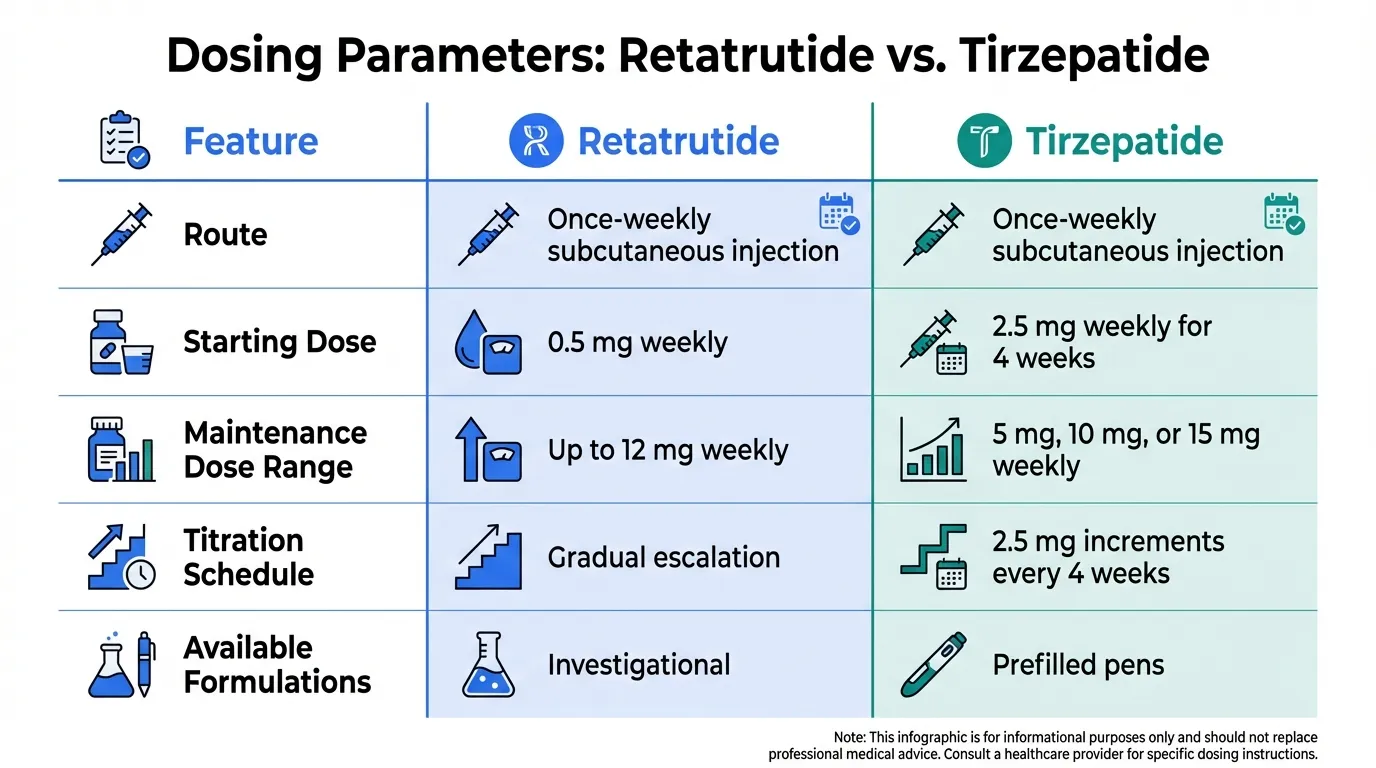
- Route: Once-weekly subcutaneous injection
- Dose range studied: 0.5 mg to 12 mg weekly
- Optimal dose: 12 mg weekly showed maximum efficacy in Phase 2
- Titration: Gradual dose escalation over several weeks to manage GI tolerability
Tirzepatide Dosing#
Established FDA-approved dosing:
- Route: Once-weekly subcutaneous injection
- Starting dose: 2.5 mg weekly for 4 weeks
- Maintenance range: 5 mg, 10 mg, or 15 mg weekly
- Titration: 2.5 mg increments every 4 weeks to target dose
- Available formulations: Prefilled pens (Mounjaro/Zepbound)
Tirzepatide's established titration protocol and prefilled pen delivery system offer practical advantages in clinical use.
Side Effects Comparison#
Retatrutide Side Effects#
Phase 2 trial data revealed:
- Gastrointestinal: Nausea (24-46%), diarrhea (16-26%), vomiting (9-20%), constipation (6-16%)
- Heart rate: Small mean increase (2-4 bpm) potentially related to glucagon receptor activation
- Injection site reactions: Mild and transient
- Hepatic: Transient elevations in liver enzymes observed
- Discontinuation rate: 6-10% due to adverse events in Phase 2
The glucagon receptor component introduces a unique side effect profile compared to GLP-1-only or GIP/GLP-1 dual agonists. The small heart rate increase requires monitoring in ongoing Phase 3 trials.
Tirzepatide Side Effects#
Well-characterized from Phase 3 (SURPASS, SURMOUNT) trials and post-market surveillance:
- Gastrointestinal: Nausea (12-33%), diarrhea (12-21%), vomiting (5-12%), constipation (6-11%)
- Decreased appetite: Common and expected pharmacological effect
- Injection site reactions: Mild, occurring in 2-5% of patients
- Pancreatitis: Rare; reported in <0.2% of patients
- Gallbladder events: Slightly increased risk, consistent with rapid weight loss
Tirzepatide benefits from extensive safety data across multiple large Phase 3 trials and ongoing post-market surveillance.
Research Evidence Comparison#
Retatrutide Research#
- Phase 1: First-in-human study established safety and pharmacokinetics
- Phase 2 (n=338): Published in NEJM (2023), demonstrated dose-dependent weight loss up to 24.2% at 48 weeks with 12 mg dose. Also showed significant reductions in liver fat (up to 82.4%) and improvements in metabolic parameters
- Phase 3 (TRIUMPH-4): The Phase 3 TRIUMPH-4 trial confirmed and exceeded Phase 2 results, demonstrating 28.7% mean weight loss at 68 weeks with the 12 mg dose -- the highest reported for any metabolic peptide in a Phase 3 trial
- Phase 3 program: Additional Phase 3 trials ongoing for obesity (TRIUMPH-1) and type 2 diabetes (TRANSCEND)
- MASLD/MASH: Specific trials underway evaluating liver-related endpoints
Phase 3 TRIUMPH-4 data have confirmed the Phase 2 promise, though the full Phase 3 program across all indications is still ongoing.
Tirzepatide Research#
- SURPASS program (Type 2 diabetes): Five Phase 3 trials demonstrating superior HbA1c reduction compared to insulin glargine, semaglutide, and insulin degludec
- SURMOUNT program (Obesity): Phase 3 trials showing up to 20.9% weight loss at 72 weeks
- FDA approvals: Mounjaro (May 2022) for T2D; Zepbound (November 2023) for chronic weight management
- Real-world data: Growing post-market evidence supporting efficacy and safety in diverse populations
- Cardiovascular outcomes: SURPASS-CVOT trial evaluating cardiovascular endpoints
Key Differences Summary#
- Receptor pharmacology: Retatrutide is a triple agonist (GIP/GLP-1/glucagon); tirzepatide is a dual agonist (GIP/GLP-1)
- Peak weight loss: Retatrutide showed 28.7% at 68 weeks (Phase 3 TRIUMPH-4) and 24.2% at 48 weeks (Phase 2) vs tirzepatide 20.9% (Phase 3)
- Liver fat: Retatrutide's glucagon agonism provides pronounced hepatic fat reduction (up to 82%)
- Regulatory status: Tirzepatide is FDA-approved; retatrutide is investigational
- Safety data: Tirzepatide has years of clinical and post-market data; retatrutide now has Phase 3 data but limited post-market experience
- Heart rate: Retatrutide shows small increases; tirzepatide does not significantly affect heart rate
- Molecular weight: Retatrutide 4894.58 Da; tirzepatide 4813.45 Da
Conclusion#
Tirzepatide and retatrutide represent successive generations of incretin-based therapeutics. Tirzepatide is the established option with FDA approval, extensive clinical trial data, and growing real-world evidence supporting its efficacy in both type 2 diabetes and obesity. Retatrutide's triple receptor agonism offers theoretical and early clinical advantages, particularly in weight loss magnitude and hepatic fat reduction, but these benefits must be confirmed in Phase 3 trials.
For clinicians, tirzepatide remains the evidence-based choice for current patient care. Retatrutide represents a promising pipeline compound that could expand the therapeutic toolkit, especially for patients with concurrent MASLD/MASH where glucagon-mediated hepatic fat oxidation may provide additional benefit. The field awaits Phase 3 data to determine whether retatrutide's triple agonism translates into clinically meaningful advantages over the already substantial efficacy of tirzepatide.
Detailed Category Analysis#
Receptor Targets#
Retatrutide: Triple agonist: GIP, GLP-1, and glucagon receptors simultaneously
Tirzepatide: Dual agonist: GIP and GLP-1 receptors
Advantage: Retatrutide
Weight Loss Efficacy#
Retatrutide: Up to 28.7% body weight reduction at 68 weeks (Phase 3 TRIUMPH-4); 24.2% at 48 weeks in Phase 2
Tirzepatide: Up to 20.9% body weight reduction (SURMOUNT trials)
Advantage: Retatrutide
Regulatory Status#
Retatrutide: Phase 1-3 clinical trials; not yet approved
Tirzepatide: FDA-approved as Mounjaro (2022) for T2D and Zepbound (2023) for obesity
Advantage: Tirzepatide
Side Effect Profile#
Retatrutide: GI side effects common; glucagon component may cause transient heart rate increase
Tirzepatide: GI side effects common but well-characterized; extensive post-market safety data
Advantage: Tirzepatide
Liver Fat Reduction#
Retatrutide: Significant hepatic fat reduction via glucagon receptor activation (up to 82% reduction)
Tirzepatide: Moderate hepatic fat reduction observed in trials
Advantage: Retatrutide
Dosing Convenience#
Retatrutide: Once-weekly subcutaneous injection
Tirzepatide: Once-weekly subcutaneous injection with established titration schedule
Advantage: Neither (tie)
Summary and Verdict#
Tirzepatide is the proven choice with FDA approval and extensive clinical data; Retatrutide shows potential for greater efficacy through triple-agonism but awaits Phase 3 results
Best For Recommendations#
Currently Available Treatment#
Recommendation: Tirzepatide
Reason: FDA-approved and commercially available as Mounjaro/Zepbound with established dosing protocols and post-market safety data
Maximum Weight Loss Potential#
Recommendation: Retatrutide
Reason: Phase 2 data showed 24.2% weight loss at 48 weeks, exceeding tirzepatide's results, though Phase 3 confirmation is pending
Non-Alcoholic Fatty Liver Disease#
Recommendation: Retatrutide
Reason: Glucagon receptor agonism directly promotes hepatic fat oxidation, showing up to 82% liver fat reduction in trials
Type 2 Diabetes Management#
Recommendation: Tirzepatide
Reason: Proven HbA1c reduction with FDA approval specifically for glycemic control in type 2 diabetes
Further Reading#

Which Is Better For...
Currently Available Treatment
Tirzepatide
FDA-approved and commercially available as Mounjaro/Zepbound with established dosing protocols and post-market safety data
Maximum Weight Loss Potential
Retatrutide
Phase 3 TRIUMPH-4 data showed 28.7% weight loss at 68 weeks (24.2% at 48 weeks in Phase 2), exceeding tirzepatide's results
Non-Alcoholic Fatty Liver Disease
Retatrutide
Glucagon receptor agonism directly promotes hepatic fat oxidation, showing up to 82% liver fat reduction in trials
Type 2 Diabetes Management
Tirzepatide
Proven HbA1c reduction with FDA approval specifically for glycemic control in type 2 diabetes
Continue Your Research
Get comparison updates
We publish new head-to-head comparisons regularly. Subscribe to see them first.
Frequently Asked Questions About Retatrutide vs Tirzepatide: Comprehensive Comparison
What are the key differences between Retatrutide and Tirzepatide?
The main differences across comparison categories are: Receptor Targets: advantage goes to Retatrutide; Weight Loss Efficacy: advantage goes to Retatrutide; Regulatory Status: advantage goes to Tirzepatide. 3 additional categories are analyzed in the full comparison. Each category evaluates a different dimension of the two peptides.
When should I consider Tirzepatide over Retatrutide?
For the scenario of "Currently Available Treatment," research data suggests Tirzepatide may be more relevant. FDA-approved and commercially available as Mounjaro/Zepbound with established dosing protocols and post-market safety data. This is based on currently available evidence and individual circumstances may differ.
Which has fewer side effects, Retatrutide or Tirzepatide?
In terms of side effects and tolerability, the advantage goes to Tirzepatide. Retatrutide: GI side effects common; glucagon component may cause transient heart rate increase. Tirzepatide: GI side effects common but well-characterized; extensive post-market safety data.
Medical Disclaimer
This website is for educational and informational purposes only. The information provided is not intended to diagnose, treat, cure, or prevent any disease. Always consult with a qualified healthcare professional before using any peptide or supplement.