SS-31 (also known as Elamipretide, Bendavia, and MTP-131) is a synthetic
mitochondria-targeted tetrapeptide consisting of four amino acids arranged
in an alternating aromatic-cationic motif: D-Arg-Dmt-Lys-Phe-NH2, where
Dmt represents 2',6'-dimethyltyrosine. It is a member of the Szeto-Schiller
(SS) peptide family, named after its co-discoverers Hazel H. Szeto and
Peter W. Schiller, who developed a series of cell-permeable peptide
antioxidants in the early 2000s.
The defining characteristic of SS-31 is its ability to selectively
concentrate more than 1,000-fold within the inner mitochondrial membrane
(IMM), driven by electrostatic interaction between its positively charged
residues and cardiolipin, a signature phospholipid of the IMM. This
selective targeting distinguishes SS-31 from other antioxidants and
mitochondrial agents, providing direct access to the site of oxidative
phosphorylation and electron transport.
SS-31 is being developed by Stealth BioTherapeutics (now Larimar
Therapeutics following acquisition of the elamipretide program) and has
progressed through multiple clinical trials. It has received Orphan Drug
Designation and Fast Track Designation from the FDA for the treatment of
Barth syndrome, a rare X-linked genetic disorder characterized by
cardiomyopathy, skeletal myopathy, and neutropenia caused by mutations
in the tafazzin gene that lead to defective cardiolipin remodeling.
The SS peptide family was designed based on a structural motif that enables
both cell penetration and mitochondrial targeting without requiring the
mitochondrial membrane potential that is necessary for other
mitochondria-targeted compounds such as triphenylphosphonium (TPP)
conjugates. The alternating aromatic-cationic motif
(aromatic-cationic-aromatic-cationic) allows SS-31 to freely cross cell
membranes and concentrate in mitochondria even in cells with depolarized
mitochondria, a critical advantage in pathological conditions where
mitochondrial membrane potential is compromised.
The incorporation of D-arginine at the N-terminus provides resistance to
aminopeptidase degradation, while the 2',6'-dimethyltyrosine residue
contributes both to the aromatic character necessary for membrane
interaction and to the intrinsic radical scavenging activity of the
molecule. The C-terminal amidation eliminates the negative charge that
would otherwise impede membrane penetration.
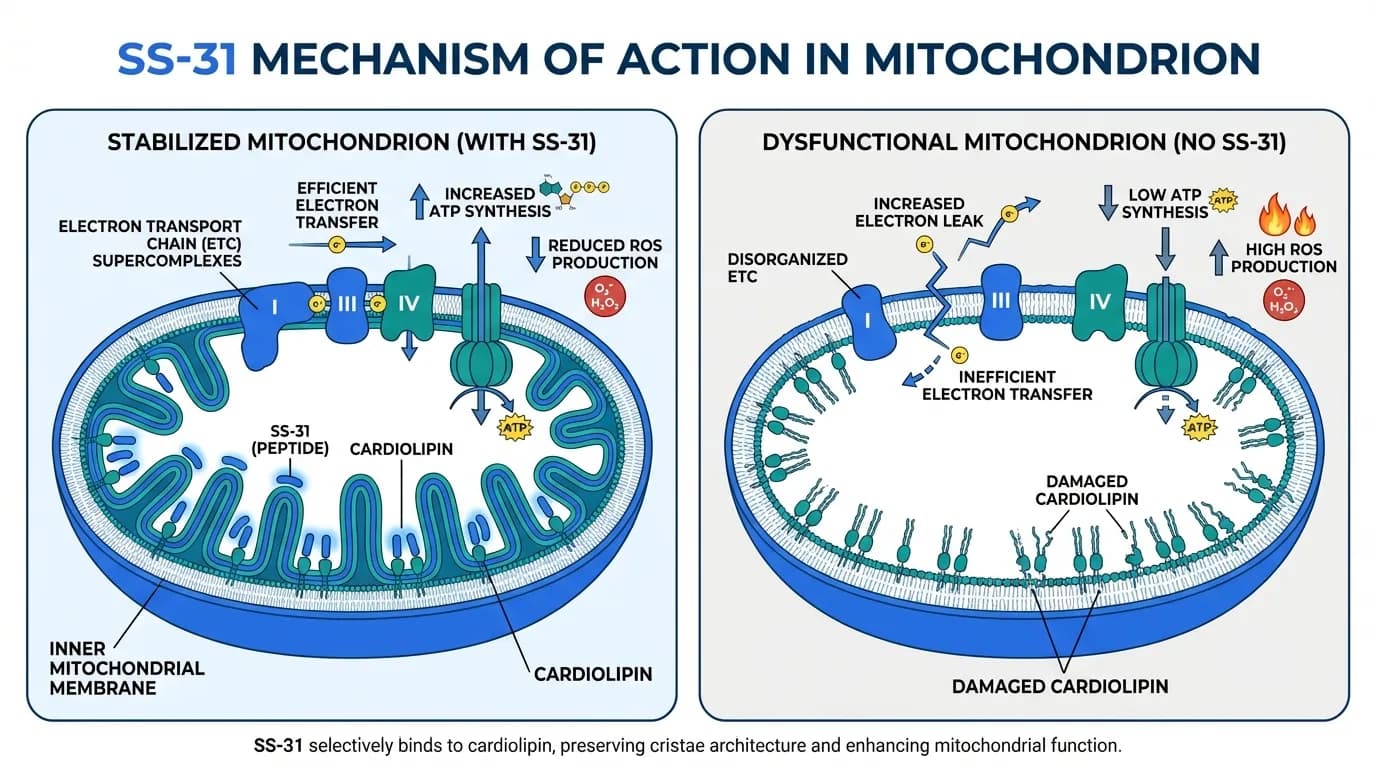
The primary molecular target of SS-31 is cardiolipin, a unique
diphosphatidylglycerol lipid found almost exclusively in the inner
mitochondrial membrane. Cardiolipin plays essential structural and
functional roles in mitochondrial bioenergetics, including proper assembly
and function of electron transport chain (ETC) complexes, formation of ETC
supercomplexes, and activity of ATP synthase. Cardiolipin also plays a role
in mitochondrial dynamics, cristae formation, and the regulation of
apoptosis through its interaction with cytochrome c.
SS-31 binds to cardiolipin through electrostatic interactions between its
cationic residues and the phosphate headgroups of cardiolipin, along with
hydrophobic interactions between its aromatic residues and the acyl chains.
This binding interaction stabilizes cardiolipin within the IMM, protecting
it from oxidative damage by reactive oxygen species (ROS) generated during
electron transport.
By preserving cardiolipin integrity, SS-31 maintains the structural
organization of ETC complexes and supercomplexes, thereby optimizing
electron transfer efficiency and reducing electron leak that would
otherwise generate additional ROS. This creates a virtuous cycle where
reduced ROS production further protects cardiolipin from oxidative damage.
Through its stabilization of cardiolipin, SS-31 has been demonstrated to
improve the efficiency of mitochondrial oxidative phosphorylation. In
preclinical studies, SS-31 treatment has been shown to restore the formation
of ETC supercomplexes (sometimes called respirasomes), which are
higher-order assemblies of Complexes I, III, and IV that facilitate more
efficient electron channeling.
Disruption of these supercomplexes is a common feature of mitochondrial
dysfunction in aging, heart failure, and genetic mitochondrial diseases.
By restoring supercomplex formation, SS-31 reduces the generation of ROS
at Complexes I and III, improves the coupling of electron transport to ATP
synthesis, and increases the maximum capacity for oxidative phosphorylation.
This improvement in mitochondrial bioenergetics is considered the primary
mechanism underlying the therapeutic benefits observed in preclinical and
clinical studies, rather than direct antioxidant scavenging activity that
was originally hypothesized for the SS peptide series.
SS-31 has also been shown to interact directly with cytochrome c, modifying
its function as an electron carrier. Specifically, SS-31 alters the
interaction between cytochrome c and cardiolipin in a manner that preserves
the electron carrier function of cytochrome c while inhibiting its
peroxidase activity.
The peroxidase activity of the cytochrome c-cardiolipin complex is
responsible for cardiolipin oxidation during mitochondrial stress, which in
turn triggers the release of cytochrome c from the IMM and the initiation
of the intrinsic apoptosis pathway. By inhibiting this peroxidase activity,
SS-31 may provide cytoprotection against apoptotic cell death in addition
to its bioenergetic benefits.
The TAZPOWER trial was a pivotal Phase 3, randomized, double-blind,
placebo-controlled crossover study evaluating elamipretide in patients with
Barth syndrome. Barth syndrome is caused by mutations in the tafazzin gene,
which encodes the enzyme responsible for cardiolipin remodeling. As a
result, patients with Barth syndrome have defective cardiolipin composition,
making this condition a particularly rational target for a
cardiolipin-stabilizing agent.
The trial (Thompson WR et al., 2021)1 enrolled 12 patients with genetically confirmed Barth syndrome and
evaluated subcutaneous elamipretide (40 mg/day) in two 12-week treatment
periods separated by a washout period. The primary endpoint was the
six-minute walk test (6MWT) distance.
While the trial demonstrated trends toward improvement in 6MWT distance and
reported statistically significant improvements in the five-times sit-to-stand test, the primary 6MWT endpoint did not reach conventional statistical significance, attributed to the very small sample size inherent to ultra-rare disease
trials1.
Stealth BioTherapeutics submitted a New Drug Application (NDA) to the FDA
based on data from the TAZPOWER trial and open-label extension studies, but
the FDA issued a Complete Response Letter requesting additional data.
Subsequent analyses and longer-term follow-up from open-label extension
studies have provided additional evidence of clinical benefit, and the
development program has continued under Larimar Therapeutics.
SS-31 has been evaluated in multiple clinical trials for heart failure. The
EMBRACE STEMI trial (Gibson CM et al., 2016)2 was a Phase 2a study in patients with ST-elevation
myocardial infarction (STEMI) undergoing percutaneous coronary intervention.
The trial evaluated intravenous elamipretide administered as a single dose
(0.25 mg/kg) at the time of reperfusion.
While the primary endpoint of reduction in creatine kinase-MB (CK-MB)
release was not met, the trial demonstrated trends toward reduced infarct
size as measured by cardiac MRI2. These imaging results suggested a potential
cardioprotective effect that warranted further investigation.
The Phase 2 trial in heart failure with reduced ejection fraction (Daubert MA et al., 2017)3
evaluated 4 weeks of subcutaneous elamipretide (40 mg) and demonstrated improvements
in left ventricular end-systolic volume and trends toward improved cardiac
output3. These findings supported the concept that mitochondrial dysfunction
contributes to heart failure pathophysiology and that targeting cardiolipin
can improve cardiac function.
A Phase 2 trial (Karaa A et al., 2018)4 evaluated elamipretide (0.25 mg/kg daily IV) in patients with primary
mitochondrial myopathy due to nuclear or mitochondrial DNA mutations. The
trial assessed changes in the 6MWT distance over 5 days of intravenous
elamipretide4. Numerical improvements in walking distance were
observed but were not conclusive due to short treatment duration and small sample size4.
The most advanced clinical application of SS-31 is in Barth syndrome, where
the direct mechanistic rationale (correcting the consequences of defective
cardiolipin remodeling) provides a strong biological basis for therapeutic
intervention. Subcutaneous injection is the primary route of administration
for chronic treatment, with intravenous administration used in acute care
settings such as myocardial infarction.
Beyond Barth syndrome, SS-31 is being investigated for a range of conditions
characterized by mitochondrial dysfunction, including heart failure, primary
mitochondrial myopathies, age-related macular degeneration (in collaboration
with Allergan/AbbVie), and age-related decline in skeletal muscle function.
The breadth of potential applications reflects the central role of
mitochondrial dysfunction in numerous disease states.
In preclinical models of aging, SS-31 has demonstrated reversal of
age-related mitochondrial dysfunction in the heart, skeletal muscle,
kidneys, and brain, restoring function to levels more consistent with
younger tissues. These findings have generated interest in SS-31 as a
potential geroprotective agent, though clinical development in aging
indications remains at an early stage.
Despite a robust preclinical profile and a substantial clinical development
program, several significant evidence gaps remain for SS-31. The pivotal
TAZPOWER trial in Barth syndrome, while demonstrating trends toward benefit
and significant improvements on some endpoints, did not meet its primary
endpoint with conventional statistical significance, in part due to the
very small sample size imposed by the rarity of the disease. The FDA's
Complete Response Letter underscored the regulatory challenges of
demonstrating efficacy in ultra-rare diseases.
In heart failure, while early-phase trials have shown promising signals,
no Phase 3 trial has yet demonstrated a definitive clinical benefit. The
EMBRACE STEMI trial's failure to meet its primary CK-MB endpoint, despite
trends on imaging endpoints, illustrates the challenge of translating
mechanistic improvements in mitochondrial function into measurable
clinical outcomes in acute settings.
The long-term safety profile of chronic SS-31 administration is still being
characterized. While the open-label extension studies in Barth syndrome
have provided encouraging safety data over months to years of treatment,
the consequences of sustained cardiolipin stabilization and modified
cytochrome c function over decades of use are unknown.
An important conceptual limitation is that SS-31 addresses the consequences
of mitochondrial dysfunction (cardiolipin damage, ROS generation, ETC
inefficiency) rather than the underlying causes. In genetic mitochondrial
diseases, the causative mutations remain present, and SS-31 would likely
need to be administered chronically. Whether the benefits of SS-31 are
sustained with long-term use or whether compensatory mechanisms could
attenuate its effects over time is an open question.
The transition of the elamipretide program from Stealth BioTherapeutics to
Larimar Therapeutics has introduced uncertainties regarding the future
development timeline and strategy. The regulatory path forward for the
Barth syndrome indication, following the FDA's Complete Response Letter,
will likely require additional clinical data or analyses, potentially
delaying patient access.
Finally, while preclinical data supporting applications in aging and
age-related disease are compelling, clinical translation in these areas is
inherently challenging due to the long timelines required to demonstrate
benefits on aging-related endpoints and the current lack of regulatory
frameworks specifically designed for geroprotective interventions.
TAZPOWER: A Randomized, Double-Blind, Placebo-Controlled, Crossover Trial of Elamipretide in Barth Syndrome, published in Cardiology in the Young (Thompson WR et al., 2021):
Pivotal Phase 3 crossover trial evaluating 40 mg daily SC elamipretide in 12 patients with genetically confirmed Barth syndrome. Demonstrated trends toward improved 6MWT distance and significant improvements in the five-times sit-to-stand test, though the primary endpoint did not achieve conventional statistical significance due to the very small sample size inherent to ultra-rare disease trials.
- Trends toward improved six-minute walk test distance
- Statistically significant improvements in five-times sit-to-stand test
- Generally well tolerated with injection site reactions as most common AE
EMBRACE STEMI: Evaluating Myocardial Effects of Bendavia for Reducing Reperfusion Injury in Patients with Acute Coronary Events, published in American Heart Journal (Gibson CM et al., 2016):
Phase 2a randomized, double-blind, placebo-controlled trial evaluating single IV dose of elamipretide (0.25 mg/kg) in first-time STEMI patients undergoing PCI. Primary endpoint of CK-MB AUC reduction was not met, but cardiac MRI showed trends toward reduced infarct size.
- Primary CK-MB endpoint not met
- Trends toward reduced infarct size on cardiac MRI
- Well tolerated in acute cardiac care setting
Phase 2 Trial of Elamipretide in Heart Failure with Reduced Ejection Fraction, published in Circulation Heart Failure (Daubert MA et al., 2017):
Phase 2 randomized trial evaluating 4 weeks of daily SC elamipretide (40 mg) in patients with HFrEF. Demonstrated improvements in left ventricular end-systolic volume and trends toward improved cardiac output, supporting the role of mitochondrial dysfunction in HF pathophysiology.
- Improvement in left ventricular end-systolic volume
- Trends toward improved cardiac output
- Supported mitochondrial targeting as a therapeutic strategy in heart failure
Phase 2 Trial of Elamipretide in Primary Mitochondrial Myopathy, published in Neurology (Karaa A et al., 2018):
Phase 2 trial evaluating 5 days of IV elamipretide (0.25 mg/kg daily) in patients with genetically confirmed primary mitochondrial myopathy. Numerical improvements in 6MWT distance were observed but were not conclusive due to short treatment duration and small sample size.
- Numerical improvements in six-minute walk test distance
- Demonstrated feasibility of mitochondrial targeting in genetically heterogeneous PMM population
- Well tolerated over 5-day IV treatment