Peptide Safety: What Every Researcher Should Know

Introduction#
Safety is the most important consideration in peptide research. While peptides as a class are generally considered to have favorable safety profiles compared to small-molecule drugs -- owing to their natural degradation into amino acids -- this generalization obscures significant differences between individual peptides, dosing regimens, and sources of supply.
The safety landscape for peptides spans a wide spectrum. At one end are FDA-approved peptide drugs like semaglutide with extensive clinical trial data involving tens of thousands of participants. At the other end are research peptides with only animal study data and no human safety information at all.
This guide covers the key safety considerations for peptide research, from common side effects to contamination risks, and provides a framework for evaluating the safety profile of any peptide.
The Safety Spectrum: From Approved to Experimental#
Not all peptides carry the same level of risk or the same quality of safety evidence. Understanding where a peptide falls on this spectrum is essential.
| Category | Safety Evidence | Examples |
|---|---|---|
| FDA-approved drugs | Phase 1-3 clinical trials + post-market surveillance | Semaglutide, tirzepatide, tesamorelin |
| Internationally approved | Clinical trials + post-market data (non-US) | Thymosin Alpha-1 (35+ countries) |
| Clinical trial stage | Phase 1-2 human data | Retatrutide, survodutide |
| Extensive preclinical | Numerous animal studies, very limited human data | BPC-157, TB-500 |
| Early preclinical | Limited animal data, no human data | Many novel research peptides |
The strength of safety conclusions is directly proportional to the quality and quantity of human data. Animal studies can identify potential risks and mechanisms, but they cannot substitute for human clinical experience.
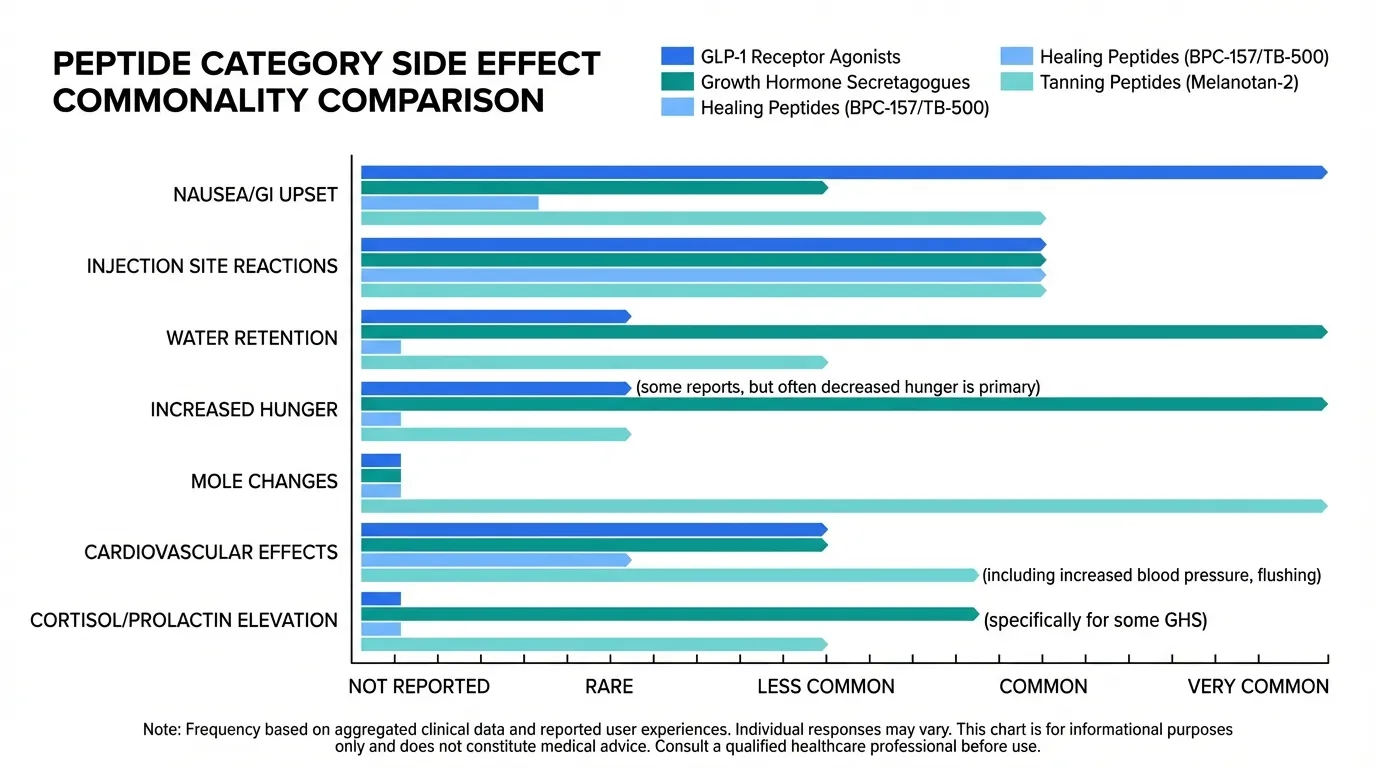
Common Side Effects by Peptide Category#
GLP-1 Receptor Agonists#
Semaglutide and tirzepatide have the most comprehensive safety data of any peptide class. Common side effects include:
- Gastrointestinal effects (most common): Nausea, vomiting, diarrhea, constipation, and abdominal discomfort. These are dose-dependent and typically improve over time with dose titration.
- Injection site reactions: Mild redness, swelling, or itching at the injection site
- Headache: Commonly reported during the dose titration phase
- Fatigue: Reported by some users, particularly during early treatment
More serious but less common concerns include pancreatitis risk, gallbladder events, and potential thyroid effects (boxed warning based on animal data showing thyroid C-cell tumors in rodents).
For a detailed comparison of side effect profiles, try our side effects comparison tool.
Growth Hormone Secretagogues#
Peptides like ipamorelin, sermorelin, and GHRP-2 stimulate growth hormone release. Common concerns include:
- Water retention: Can cause bloating, joint stiffness, and carpal tunnel-like symptoms
- Increased hunger: Particularly with GHRP-2 and GHRP-6, which stimulate ghrelin receptors
- Numbness and tingling: In hands and feet, related to growth hormone effects
- Blood sugar effects: Growth hormone can reduce insulin sensitivity
- Cortisol and prolactin elevation: Some GH secretagogues (particularly GHRP-2 and hexarelin) can raise cortisol and prolactin levels
Ipamorelin is generally considered to have the most selective profile among GH secretagogues, with minimal effects on cortisol and prolactin.
Healing Peptides#
BPC-157 and TB-500 have very limited human safety data. The available evidence suggests:
- BPC-157: Animal studies generally report no significant adverse effects. The limited human data (fewer than 15 total participants) showed no adverse effects, but this sample size is far too small to draw safety conclusions.
- TB-500: No significant safety concerns in the available preclinical literature, but again, human data is extremely limited.
Important: The absence of reported side effects in a small number of studies does not equal a demonstration of safety. It simply means adverse effects have not yet been identified, which is a very different statement.
Tanning Peptides#
Melanotan-2 and related melanocortin peptides carry notable safety concerns:
- Nausea: Common, particularly at higher doses
- Facial flushing: Frequently reported
- Mole changes: Darkening of existing moles, which raises dermatological screening concerns
- Nevi development: New mole formation has been reported
- Cardiovascular effects: Including changes in blood pressure
- Spontaneous erections: A known melanocortin side effect
Melanotan peptides are not approved in any country and are considered to carry a higher risk profile than many other research peptides.
Contamination Risks#
For research peptides that are not manufactured under pharmaceutical GMP conditions, contamination is a significant safety concern.
Types of Contamination#
| Contaminant | Source | Potential Effect |
|---|---|---|
| Bacterial endotoxins | Poor manufacturing hygiene | Fever, chills, hypotension, organ damage |
| Heavy metals | Manufacturing equipment, impure reagents | Cumulative toxicity |
| Residual solvents | Peptide synthesis and purification | Organ toxicity depending on solvent type |
| Wrong peptide | Cross-contamination or mislabeling | Unpredictable effects from wrong compound |
| Microorganisms | Non-sterile manufacturing or handling | Infection at injection site or systemic |
Mitigating Contamination Risk#
- Source from reputable suppliers with batch-specific Certificates of Analysis (see our quality guide)
- Verify through third-party testing when possible (see our labs directory)
- Use proper aseptic technique during reconstitution and injection
- Inspect solutions visually before each use -- discard any solution that is cloudy, discolored, or contains particles
- Store properly to prevent microbial growth (see our storage guide)
Drug Interactions#
Peptide drug interactions are less studied than interactions between conventional pharmaceuticals, but several important considerations exist:
GLP-1 Agonists and Oral Medications#
GLP-1 receptor agonists slow gastric emptying, which can delay the absorption of oral medications taken at the same time. This is particularly relevant for:
- Oral contraceptives
- Antibiotics requiring specific timing
- Thyroid medications (levothyroxine)
- Medications with narrow therapeutic windows
Healthcare providers should be consulted about timing adjustments for concurrent oral medications.
Growth Hormone Secretagogues and Glucose-Lowering Drugs#
Because GH can reduce insulin sensitivity, individuals using growth hormone secretagogues alongside diabetes medications should be aware of potential blood glucose changes.
Immune-Modulating Peptides and Immunosuppressants#
Peptides that modulate immune function (such as Thymosin Alpha-1) could theoretically interact with immunosuppressive medications. This interaction has not been well-studied but represents a theoretical concern.
Contraindications and Precautions#
General Contraindications for Most Peptides#
- Active cancer or history of cancer: Growth-promoting peptides (GH secretagogues, IGF-1 variants) may theoretically promote tumor growth. This applies to all peptides that directly or indirectly increase growth factor levels.
- Pregnancy and breastfeeding: Safety data is absent for most peptides in pregnant or nursing women.
- Severe kidney or liver disease: Impaired metabolism may alter peptide clearance and increase risk.
- Known allergy to the peptide or its components: Including benzyl alcohol in bacteriostatic water.
GLP-1 Agonist-Specific Precautions#
- Personal or family history of medullary thyroid carcinoma
- Multiple endocrine neoplasia syndrome type 2 (MEN 2)
- History of pancreatitis
- History of gallbladder disease
Growth Hormone-Related Precautions#
- Active malignancy
- Diabetic retinopathy
- Intracranial hypertension
- Uncontrolled diabetes
The Evidence Gap Problem#
One of the greatest safety challenges in the peptide field is the gap between animal data and human experience. Many popular research peptides have:
- Extensive animal study data showing benefits
- Very little or no human clinical trial data
- No long-term safety monitoring
- No standardized dosing established through clinical research
This means that for many peptides, the true safety profile in humans is unknown -- not "safe" or "unsafe," but genuinely not characterized.
What "No Reported Side Effects" Actually Means#
When a peptide's literature reports "no significant adverse effects," consider:
- How many subjects were studied? (n=10 vs n=10,000 tells very different stories)
- How long was the observation period? (2 weeks vs 2 years)
- Was it a controlled trial or observational? (Controlled trials are more reliable)
- Were the subjects human or animal? (Animal safety does not guarantee human safety)
- Who conducted the study? (Independent replication increases confidence)
A peptide studied in 10 rats for 2 weeks with "no adverse effects" provides essentially no safety information relevant to long-term human use.
Best Practices for Minimizing Risk#
Before Starting Any Peptide Protocol#
- Research the evidence base: Check for human clinical trial data, not just animal studies. Review the peptide's profile on our site for research summaries.
- Consult a healthcare provider: Especially if you have pre-existing health conditions or take medications.
- Start low, go slow: Whenever possible, begin with the lowest reasonable dose and increase gradually.
- Know your source: Only use peptides from suppliers with verified quality documentation.
During Peptide Use#
- Monitor for adverse effects: Keep a log of any symptoms, their timing, and severity.
- Use proper injection technique: Follow aseptic practices to minimize infection risk (see our injection guide).
- Adhere to recommended dosing: More is not better with peptides. Exceeding researched dose ranges increases risk without proportional benefit.
- Store correctly: Improper storage leads to degraded peptides with unpredictable effects.
Knowing When to Stop#
Discontinue use and consult a healthcare provider if you experience:
- Severe or persistent nausea, vomiting, or abdominal pain
- Signs of allergic reaction (hives, swelling, difficulty breathing)
- Injection site infection (increasing redness, warmth, pus, fever)
- Unexplained symptoms that began after starting a peptide
- Changes in moles or skin lesions (particularly with melanocortin peptides)
Resources for Safety Information#
- Our safety learn page covers foundational peptide safety concepts
- The side effects comparison tool allows head-to-head comparison of side effect profiles
- Individual peptide profiles on our site include dedicated risks and side effects pages for each peptide
- Our regulatory guide explains the current legal landscape
Key Takeaways#
-
Safety evidence varies enormously between peptides. FDA-approved peptides have extensive human data; many research peptides have essentially none.
-
Contamination is a real risk with non-pharmaceutical peptides. Source quality, third-party testing, and proper handling are critical safety measures.
-
"No reported side effects" does not mean "safe." It may simply mean the peptide has not been adequately studied in humans.
-
Drug interactions exist, particularly for GLP-1 agonists affecting oral medication absorption. Consult a healthcare provider about potential interactions.
-
Start low, go slow. Dose titration reduces the risk of adverse effects and allows for early detection of intolerance.
-
Cancer history and growth-promoting peptides require extreme caution. Any peptide that increases growth factors should be avoided by individuals with active or recent malignancy.
-
When in doubt, consult a healthcare professional. Peptide safety decisions should not be made based solely on online resources.
Related Peptide Profiles#
Learn more about the peptides discussed in this article:
- Semaglutide Overview and Research Guide
- Semaglutide Dosing Protocols
- Semaglutide Side Effects and Safety
- Tirzepatide Overview and Research Guide
- Tirzepatide Dosing Protocols
- Tirzepatide Side Effects and Safety
- BPC-157 Overview and Research Guide
- BPC-157 Dosing Protocols
- BPC-157 Side Effects and Safety
- Ipamorelin Overview and Research Guide
- Ipamorelin Dosing Protocols
- Ipamorelin Side Effects and Safety

Frequently Asked Questions About Peptide Safety: What Every Researcher Should Know
What does this article cover?
Peptide safety guide covering common side effects, risk factors, contamination concerns, drug interactions, and risk minimization. This guide is for educational purposes only and does not constitute medical advice.
Which peptides are discussed in this article?
This article covers Semaglutide, Tirzepatide, BPC-157, Ipamorelin. Key context: Semaglutide (FDA-approved peptide with extensive safety data from large clinical trials, serving as a benchmar...); Tirzepatide (FDA-approved dual agonist with documented gastrointestinal side effect profile, illustrating dose...); BPC-157 (Widely researched peptide with very limited human safety data, representing the evidence gap for ...). Each peptide is discussed based on available research evidence.
Who is this guide written for?
This guide is written for researchers and individuals seeking an evidence-based overview of the topic covered in "Peptide Safety: What Every Researcher Should Know." It summarizes available research data without making treatment recommendations. Always consult a healthcare provider for medical decisions.
What are the key takeaways from this article?
The main findings covered in this article include: FDA-approved peptide with extensive safety data from large clinical trials, serving as a benchmar.... FDA-approved dual agonist with documented gastrointestinal side effect profile, illustrating dose.... Widely researched peptide with very limited human safety data, representing the evidence gap for .... These takeaways are based on the research data available at the time of publication.
What is Semaglutide and why is it significant?
Semaglutide is a peptide discussed in this article because: FDA-approved peptide with extensive safety data from large clinical trials, serving as a benchmark for well-characterized peptide safety profiles. For a complete profile of Semaglutide, see the dedicated peptide page on this site.
Continue reading this research review
Free access to the complete analysis with citations and evidence ratings.
150+ peptide profiles · 30+ comparisons · 18 research tools
Medical Disclaimer
This website is for educational and informational purposes only. The information provided is not intended to diagnose, treat, cure, or prevent any disease. Always consult with a qualified healthcare professional before using any peptide or supplement.
Join 2,000+ researchers getting biweekly updates
Enjoyed this article?
The Research Briefing delivers deep-dives like this biweekly — plus new study breakdowns, safety updates, and tool announcements.
Free forever. No spam. Unsubscribe in one click.
Where to Find These Peptides
Continue Exploring
Peptide Profiles
Keep Reading
Core Peptides Review 2026: COAs, Finnrick Controversy, and Whether the Score Holds Up
An honest 2026 review of Core Peptides covering product range, payment flexibility, shipping, COA transparency, and how the Finnrick Analytics controversy should change how you read vendor ratings. Includes 8-dimension scoring.
Understanding Peptide Side Effects: A Comprehensive Safety Guide
A thorough, evidence-based guide to peptide side effects by category — covering GLP-1 agonists, GH secretagogues, tissue repair peptides, and melanocortins — with serious risk flags, drug interactions, monitoring recommendations, and guidance on when to stop.
Most Popular Therapeutic Peptides in 2026: 15 Ranked by Research Interest
The 15 most popular therapeutic peptides in 2026, ranked by clinical trial activity, search interest, and research community adoption. From semaglutide to BPC-157.
You Might Also Like
Related content you may find interesting