Epitalon: Side Effects
Known side effects, contraindications, and interactions
📌TL;DR
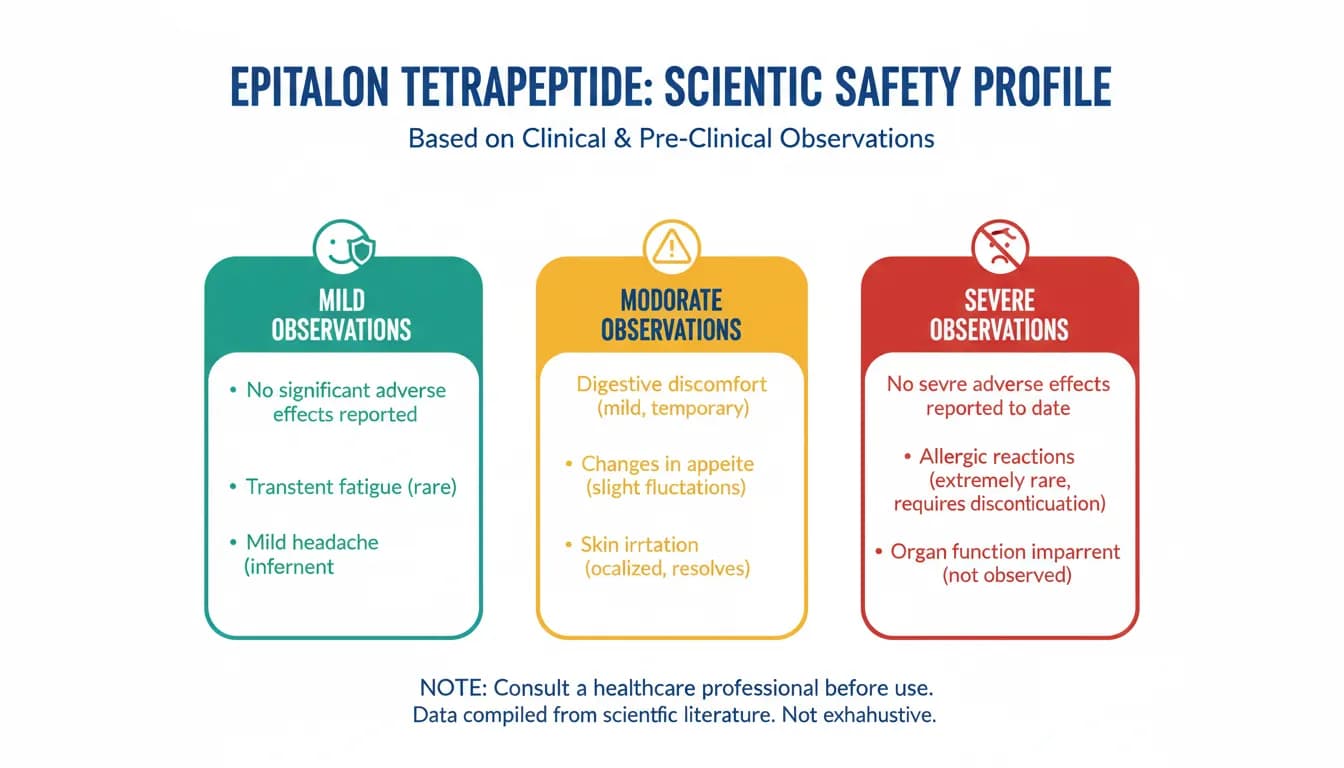
- •1 known side effects documented
- •1 mild, 0 moderate, 0 severe
- •2 contraindications listed
Compare side effects across multiple peptides →
Side Effects Severity Chart
Redness, swelling, or discomfort at the injection site based on limited anecdotal reports from clinical and non-clinical use settings
⛔Contraindications
- •Active cancer or history of cancer (telomerase activation is a hallmark of malignant cells and could theoretically promote tumor growth or progression)
- •Pregnancy and breastfeeding (no reproductive toxicity or safety data exist for Epitalon in any species)
⚠️Drug Interactions
- •Melatonin supplements (Epitalon is proposed to increase endogenous melatonin production via pineal gland stimulation, potentially leading to additive effects)
- •Other pineal-active compounds such as pinealon or other Khavinson bioregulatory peptides (overlapping mechanisms of action on pineal function)
- •Chemotherapy and anti-cancer agents (telomerase activation could theoretically counteract the mechanism of action of therapies designed to limit cancer cell proliferation)
Community-Reported Side Effects
See which side effects community members report most frequently.
Based on 90+ community reports
View community protocolsSafety Notice#
The safety profile of Epitalon in humans has not been established through controlled clinical trials. No formal adverse event monitoring, dose-escalation safety studies, or pharmacovigilance data exist for this compound. The information below is derived primarily from preclinical animal studies conducted by the Khavinson group and general principles of peptide pharmacology, and should be interpreted accordingly. Epitalon is not approved for human use in any regulatory jurisdiction.
Reported Adverse Effects#
Overview of Available Safety Data#
The published literature on Epitalon contains very limited safety and tolerability reporting. The Khavinson group has described Epitalon administration in animal studies and in observational human studies conducted at bioregulation clinics in St. Petersburg, but detailed adverse event tabulations, severity grading, and frequency data conforming to modern pharmacovigilance standards have not been published.
Animal Studies#
In published studies by the Khavinson group, Epitalon was administered to rodents (rats and mice) at doses of 10 mg daily for courses of 10 to 20 days, typically by intramuscular injection. These publications generally describe Epitalon as well tolerated without specifying adverse events, toxicity endpoints, or histopathologic findings in a systematic manner. No formal toxicology studies (acute toxicity, repeated-dose toxicity, genotoxicity, carcinogenicity, or reproductive toxicity) following GLP standards have been published for Epitalon.
The absence of reported adverse effects in animal studies should not be interpreted as evidence of safety. The small number of studies, limited sample sizes, and the lack of comprehensive toxicological assessment mean that the safety profile of Epitalon in animals is largely uncharacterized.
Human Reports#
Human data on Epitalon specifically are extremely limited. The Khavinson group has published observational studies of elderly patients receiving periodic courses of peptide bioregulators including Epithalamin (the natural pineal extract from which Epitalon was derived) at St. Petersburg clinics. These reports describe reduced mortality over follow-up periods of 6 to 15 years in treated groups compared with controls, but adverse event reporting in these publications does not meet contemporary standards. Systematic adverse event capture, severity grading, and causal attribution are not described.
No formal Phase 1 safety studies, dose-escalation trials, or pharmacovigilance programs have been conducted for Epitalon. Therefore, the frequency, severity, and nature of adverse effects in humans remain unknown.
Injection Site Reactions#
Based on general peptide injection experience and limited anecdotal reports, injection site reactions including redness, mild swelling, and transient discomfort are expected to be the most common adverse effect of subcutaneous or intramuscular Epitalon administration. These reactions are typical of injectable peptides and are generally self-limiting.
Contraindications#
The following contraindications are theoretical, based on the proposed mechanism of action and general pharmacological principles, as no controlled human safety data exist.
Active Cancer#
The most significant theoretical contraindication for Epitalon is active cancer or a history of malignancy. Telomerase reactivation is a hallmark of approximately 85 to 90 percent of human cancers, where it enables unlimited replicative potential and contributes to tumor immortality. Any agent proposed to activate hTERT expression in somatic cells must be considered a potential cancer risk until rigorously evaluated.
While the Khavinson group has reported anti-tumor rather than pro-tumor effects of Epitalon in some animal models (including reduced tumor incidence in HER-2/neu transgenic mice), these findings have not been independently replicated, and the general oncological concern remains that exogenous telomerase activation could support the survival or progression of subclinical or established malignancies. Individuals with active cancer, a recent history of cancer, or known pre-malignant conditions should avoid telomerase-activating agents pending definitive safety data.
Pregnancy and Breastfeeding#
No reproductive toxicity studies have been published for Epitalon. The effects of telomerase activation on embryonic development, fetal growth, and lactation are unknown. Given the absence of any safety data in pregnant or nursing individuals and the proposed effects on fundamental cellular processes, use during pregnancy and breastfeeding should be avoided.
Drug and Supplement Interactions#
No formal drug interaction studies have been conducted for Epitalon. The following potential interactions are inferred from the proposed mechanisms of action.
Melatonin Supplements#
Epitalon is proposed to restore age-related decline in pineal gland function and increase endogenous melatonin synthesis. Concurrent use of exogenous melatonin supplements could theoretically produce additive or excessive melatonin levels, potentially leading to excessive sedation, disrupted circadian signaling, or other effects of melatonin excess. Individuals using melatonin supplements should consider this potential overlap if Epitalon use is being evaluated in a research context.
Pineal-Active Compounds#
Other compounds that modulate pineal gland function, including Khavinson bioregulatory peptides such as Pinealon or other pineal extracts, could have overlapping or synergistic effects with Epitalon on the pineal-neuroendocrine axis. The consequences of combined pineal stimulation have not been studied and remain unpredictable.
Chemotherapy and Anti-Cancer Agents#
The proposed telomerase-activating mechanism of Epitalon raises a theoretical concern for pharmacodynamic interaction with cancer therapies. Many chemotherapeutic agents function by inducing DNA damage and triggering apoptosis in rapidly dividing cells, a process that can be influenced by telomere status and telomerase activity. Telomerase activation could theoretically reduce the efficacy of agents that rely on telomere-dependent apoptotic signaling or could provide a survival advantage to cancer cells. Use of Epitalon concurrent with any anti-cancer therapy should be avoided.
Immunosuppressive Medications#
The Khavinson group has reported immunomodulatory effects for Epitalon, including restoration of age-related thymic involution and modulation of immune cell function. These proposed effects could theoretically interfere with immunosuppressive medications used in transplant patients, autoimmune diseases, or other conditions requiring immune modulation. No interaction data exist.
Toxicology#
No formal toxicology studies for Epitalon have been published. The following toxicological information is absent from the public literature:
- Acute toxicity studies (LD50 determination)
- Repeated-dose toxicity studies of any duration
- Genotoxicity battery (Ames, chromosomal aberration, micronucleus)
- Carcinogenicity studies
- Reproductive and developmental toxicity studies
- Safety pharmacology (cardiovascular, CNS, respiratory)
- Immunotoxicity assessment
This absence of toxicological data represents one of the most significant safety gaps for Epitalon. Without these foundational studies, even basic safety parameters such as the no-observed-adverse-effect level (NOAEL), maximum tolerated dose, and target organ toxicity are unknown.
Summary of Safety Limitations#
| Safety Domain | Available Data | Assessment |
|---|---|---|
| Formal toxicology | None published | Major gap; no LD50, NOAEL, or target organ data |
| Human adverse events | No systematic data; anecdotal reports only | Cannot characterize frequency or severity |
| Drug interactions | No studies conducted | All interactions are theoretical |
| Reproductive safety | No studies | Use in pregnancy/lactation contraindicated by default |
| Carcinogenicity | No studies; mechanism raises concern | Telomerase activation is a hallmark of cancer |
| Long-term safety | No data | Completely unknown |
| Injection site reactions | Expected based on peptide class | Mild, self-limiting; limited direct reporting |
Evidence Gaps#
- No formal toxicology program has been conducted for Epitalon
- No Phase 1 safety and tolerability studies exist
- Adverse event reporting in existing publications does not meet pharmacovigilance standards
- Drug interaction potential is entirely uncharacterized experimentally
- The oncogenic potential of hTERT activation by Epitalon has not been systematically assessed
- Long-term safety consequences of periodic Epitalon administration are unknown
- No comparative safety data between Epitalon and Epithalamin exist
Related Reading#
Unlock full side effects analysis
Free access to detailed safety profiles and interaction guidance for all peptides.
150+ peptide profiles · 30+ comparisons · 18 research tools
Frequently Asked Questions About Epitalon
What are the most common side effects of Epitalon?
The most commonly reported side effects of Epitalon include injection site reaction. Redness, swelling, or discomfort at the injection site based on limited anecdotal reports from clinical and non-clinical use settings. Management: Rotate injection sites and follow proper aseptic injection technique. Most reported side effects are mild and transient based on available data.
Who should not use Epitalon?
Epitalon should be avoided in the following situations: Active cancer or history of cancer (telomerase activation is a hallmark of malignant cells and could theoretically promote tumor growth or progression); Pregnancy and breastfeeding (no reproductive toxicity or safety data exist for Epitalon in any species). Always consult with a healthcare provider before considering any peptide for research purposes.
Does Epitalon interact with other medications?
Potential interactions have been identified with: Melatonin supplements (Epitalon is proposed to increase endogenous melatonin production via pineal gland stimulation, potentially leading to additive effects); Other pineal-active compounds such as pinealon or other Khavinson bioregulatory peptides (overlapping mechanisms of action on pineal function); Chemotherapy and anti-cancer agents (telomerase activation could theoretically counteract the mechanism of action of therapies designed to limit cancer cell proliferation). Drug interaction studies for Epitalon are limited, so caution is advised when using alongside any medications. Consult a healthcare provider for specific guidance.
Explore Further
Medical Disclaimer
This website is for educational and informational purposes only. The information provided is not intended to diagnose, treat, cure, or prevent any disease. Always consult with a qualified healthcare professional before using any peptide or supplement.