Next-Generation Myostatin Inhibitors: Bimagrumab, Trevogrumab, and Apitegromab Compared

Introduction#
The myostatin inhibition field has entered a new era. While earlier approaches like ACE-031 and follistatin gene therapy faced setbacks due to off-target effects from broad TGF-beta family inhibition, a new generation of highly selective anti-myostatin antibodies is producing compelling clinical results. For background on earlier myostatin inhibitor strategies, see our Myostatin Inhibitors and Muscle Growth Peptides overview.
Three antibodies stand out in 2025-2026: bimagrumab, which has demonstrated remarkable body composition effects in obesity; trevogrumab, being developed in combination with semaglutide for muscle preservation during GLP-1-mediated weight loss; and apitegromab, which achieved a historic Phase 3 success in spinal muscular atrophy (SMA).
This article compares these three compounds, their mechanisms, clinical data, and what they mean for the future of myostatin-targeted therapy.
How They Target Myostatin Differently#
All three antibodies reduce myostatin signaling, but each takes a distinct approach to the GDF-8 (myostatin) pathway.
Bimagrumab: Blocking the Receptor#
Bimagrumab is a fully human monoclonal antibody that blocks activin type II receptors (ActRII), preventing myostatin and related ligands from binding. By targeting the receptor rather than the ligand, bimagrumab blocks multiple growth-inhibiting signals simultaneously, including myostatin, activin A, and GDF-11.
This broader mechanism may explain bimagrumab's pronounced effects on both muscle and fat tissue. ActRII signaling is involved in adipocyte differentiation, and blocking it appears to simultaneously promote lean mass and reduce fat mass -- a dual effect not seen with myostatin-specific approaches.
Trevogrumab: Targeting Mature Myostatin#
Trevogrumab (REGN-1033), developed by Regeneron, is a monoclonal antibody that directly binds and neutralizes mature GDF-8 (myostatin). By specifically targeting the active form of myostatin rather than the receptor, trevogrumab is more selective than bimagrumab, avoiding interference with other TGF-beta family members that signal through ActRII.
Regeneron is evaluating trevogrumab in combination with semaglutide, with and without garetosmab (an anti-activin A antibody), to determine whether layering multiple anti-muscle-loss mechanisms can improve body composition during GLP-1-mediated weight loss.
Apitegromab: Blocking Myostatin Activation#
Apitegromab takes yet another approach: it binds to pro/latent myostatin, preventing its activation rather than neutralizing the mature protein. This mechanism targets myostatin at an earlier stage in its processing, potentially offering more complete local inhibition in muscle tissue where latent myostatin is stored.
Apitegromab's development has focused on SMA rather than obesity, where enhancing muscle function in patients already receiving SMN-targeted therapies (nusinersen or risdiplam) represents a complementary treatment approach.
Clinical Trial Data#
Bimagrumab: The BELIEVE Trial#
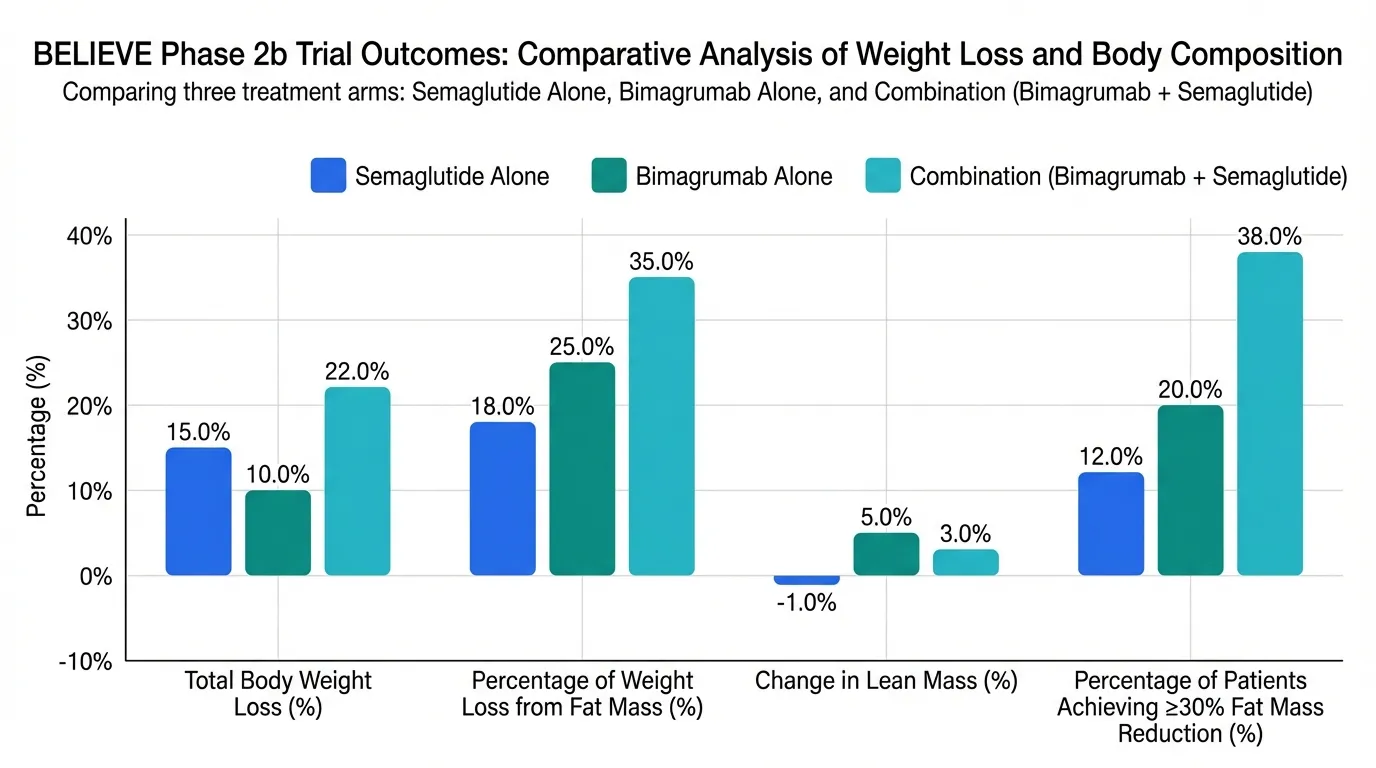
The Phase 2b BELIEVE trial (507 participants) evaluated bimagrumab in combination with semaglutide for obesity. Results presented at the 2025 ADA Scientific Sessions were striking:
- Combination therapy: 22.1% total body weight loss, with 92.8% of weight loss from fat mass
- Semaglutide alone: 15.7% weight loss, with 71.8% from fat mass
- Bimagrumab alone: 10.8% weight loss, with lean mass increasing by 2.5%
- Fat mass reduction: 94.0% of combination patients achieved 30% or more fat mass reduction, versus 50.0% (bimagrumab) and 36.4% (semaglutide)
The combination's ability to achieve greater weight loss while preserving significantly more lean mass than semaglutide alone addresses one of the central criticisms of GLP-1 receptor agonist therapy -- that substantial weight loss comes partly from muscle.
An earlier Phase 2 trial in adults with type 2 diabetes and obesity showed bimagrumab produced significant reductions in fat mass with simultaneous increases in lean mass compared to placebo over 48 weeks.
Note: Eli Lilly terminated a Phase IIb trial combining bimagrumab with tirzepatide (Zepbound) for "strategic business reasons," though a separate non-diabetic obesity trial remains ongoing.
Trevogrumab: Phase 2 Combination Studies#
Regeneron announced Phase 2 results in September 2025 evaluating trevogrumab in combination with semaglutide, with and without garetosmab (anti-activin A). The trial examined whether targeting muscle-loss pathways during GLP-1-induced weight loss could improve body composition outcomes.
Detailed results from these combination studies are being analyzed, with the critical question being whether trevogrumab's more selective myostatin inhibition provides sufficient muscle preservation compared to bimagrumab's broader receptor blockade.
Apitegromab: Phase 3 SAPPHIRE in SMA#
The Phase 3 SAPPHIRE trial represents the most advanced clinical success for any myostatin-targeted therapy:
- 188 patients aged 2-21 with Type 2 or 3 SMA, all receiving background SMN-targeted treatment
- Primary endpoint met: Clinically meaningful improvement on HFMSE (Hammersmith Functional Motor Scale Expanded) versus placebo (p=0.0192), with a mean difference of 1.8 points
- Functional responders: 30.4% of apitegromab patients achieved 3 or more point HFMSE improvement versus 12.5% placebo
- Upper limb function: Consistent improvement measured by RULM (Revised Upper Limb Module)
- Published in The Lancet Neurology
This is notable because it overcomes the historical "mass-function disconnect" that plagued earlier myostatin inhibitors -- apitegromab improved actual motor function, not just muscle mass. The BLA (Biologics License Application) was submitted to the FDA, though approval was deferred pending manufacturing facility remediation (not efficacy or safety concerns).
A Phase 2 OPAL trial is enrolling infants with SMA under 2 years old, the first study of apitegromab in this youngest cohort.
Head-to-Head Comparison#
| Feature | Bimagrumab | Trevogrumab | Apitegromab |
|---|---|---|---|
| Target | ActRII receptor | Mature GDF-8 | Pro/latent myostatin |
| Selectivity | Broad (blocks myostatin, activins, GDF-11) | Selective (myostatin only) | Selective (latent myostatin) |
| Administration | IV infusion every 12 weeks | Subcutaneous injection | IV infusion every 4 weeks |
| Primary indication | Obesity / body composition | Obesity (with GLP-1) | Spinal muscular atrophy |
| Phase | Phase 2b completed | Phase 2 | Phase 3 completed |
| Developer | Versanis / Eli Lilly | Regeneron | Scholar Rock |
| Key result | 22.1% WL with semaglutide; 92.8% fat loss | Phase 2 data pending | HFMSE +1.8 points vs placebo (p=0.019) |
| Muscle effect | +2.5% lean mass (monotherapy) | TBD | Improved motor function |
The GLP-1 Combination Opportunity#
The most significant commercial development in the myostatin field is the convergence with GLP-1 receptor agonists. As semaglutide and tirzepatide have become blockbuster obesity treatments, a critical limitation has emerged: approximately 25-40% of weight lost with GLP-1 therapy comes from lean mass, not just fat.
Anti-myostatin antibodies offer a potential solution. The BELIEVE trial demonstrated that bimagrumab plus semaglutide shifted the composition of weight loss dramatically -- from 72% fat (semaglutide alone) to 93% fat (combination). This "quality of weight loss" improvement could become a major differentiator in the competitive obesity therapeutics landscape.
Both bimagrumab and trevogrumab are being positioned as GLP-1 adjuncts, while apitegromab occupies a distinct niche in neuromuscular disease. For broader context on how these muscle-preserving approaches fit alongside GLP-1 therapies, see our Non-GLP-1 Weight Loss Peptides article.
Lessons from Earlier Failures#
The success of these newer antibodies reflects lessons learned from earlier setbacks:
-
Selectivity matters: ACE-031 failed because it trapped too many TGF-beta ligands, causing vascular side effects. Bimagrumab is more selective (ActRII only), and trevogrumab/apitegromab target myostatin specifically.
-
Function over mass: Earlier anti-myostatin antibodies (domagrozumab, stamulumab) increased muscle mass but failed to improve function. Apitegromab's SAPPHIRE success in SMA demonstrates that functional improvement is achievable with the right target engagement and patient population.
-
Combination strategy: Rather than treating muscle wasting as a standalone indication, the field has pivoted to combining anti-myostatin therapy with GLP-1 agonists -- addressing the muscle loss side effect of an existing blockbuster drug class.
Safety Considerations#
Bimagrumab#
The BELIEVE trial reported adverse events consistent with both the GLP-1 (GI events) and anti-ActRII (muscle-related) mechanisms. Bimagrumab has been studied in over 1,000 patients across multiple indications (IBM, sarcopenia, obesity). The broader receptor blockade raises theoretical concerns about interference with ActRII-dependent developmental and reproductive signaling.
Trevogrumab#
Limited safety data from Phase 2. The selective myostatin targeting may offer a cleaner safety profile than bimagrumab's broader mechanism, though less clinical data is available to confirm this.
Apitegromab#
The SAPPHIRE trial reported a safety profile consistent with expectations for the SMA population. Targeting latent myostatin rather than active myostatin or the receptor may limit off-target effects.
Conclusion#
The next-generation myostatin inhibitors represent a meaningful advance over earlier approaches. Bimagrumab's body composition data in combination with semaglutide is among the most compelling in the obesity field -- achieving both greater weight loss and dramatically better lean mass preservation. Apitegromab's Phase 3 success in SMA marks the first time a myostatin-targeted therapy has demonstrated functional improvement in a pivotal trial.
The commercial future of this class likely depends on the GLP-1 combination opportunity. As the weight loss drug market continues to expand, the ability to improve the "quality" of weight loss by preserving muscle could become a critical differentiator. Whether bimagrumab's broader mechanism or trevogrumab's more selective approach wins in this space remains to be determined by ongoing trials.
For related reading, see Myostatin Inhibitors and Muscle Growth Peptides, Top Peptides for Muscle Recovery and Growth, and the GDF-8 (Myostatin) peptide profile.
Related Peptide Profiles#
Learn more about the peptides discussed in this article:
- Bimagrumab Overview and Research Guide
- Bimagrumab Dosing Protocols
- Bimagrumab Side Effects and Safety
- Trevogrumab Overview and Research Guide
- Trevogrumab Dosing Protocols
- Trevogrumab Side Effects and Safety
- Apitegromab Overview and Research Guide
- Apitegromab Dosing Protocols
- Apitegromab Side Effects and Safety
- GDF-8 Overview and Research Guide
- GDF-8 Dosing Protocols
- GDF-8 Side Effects and Safety
- Follistatin Overview and Research Guide
- Follistatin Dosing Protocols
- Follistatin Side Effects and Safety

Frequently Asked Questions About Next-Generation Myostatin Inhibitors: Bimagrumab, Trevogrumab, and Apitegromab Compared
What does this article cover?
A research review comparing bimagrumab, trevogrumab, and apitegromab — three anti-myostatin antibodies in clinical development for muscle preservation, obesity, and spinal muscular atrophy. This research review is for educational purposes only and does not constitute medical advice.
Which peptides are discussed in this article?
This article covers Bimagrumab, Trevogrumab, Apitegromab, GDF-8, Follistatin. Key context: Bimagrumab (Anti-activin type II receptor antibody that promotes muscle growth and fat loss, studied in combi...); Trevogrumab (Anti-myostatin antibody developed by Regeneron, being studied in combination with semaglutide for...); Apitegromab (Anti-myostatin antibody that met primary endpoint in Phase 3 SAPPHIRE trial for spinal muscular a...). Each peptide is discussed based on available research evidence.
What level of evidence does this research review cover?
This research review examines published preclinical and clinical studies related to the peptides discussed. Evidence quality varies between peptides and indications. The article distinguishes between FDA-approved uses and investigational applications where applicable.
What are the key takeaways from this article?
The main findings covered in this article include: Anti-activin type II receptor antibody that promotes muscle growth and fat loss, studied in combi.... Anti-myostatin antibody developed by Regeneron, being studied in combination with semaglutide for.... Anti-myostatin antibody that met primary endpoint in Phase 3 SAPPHIRE trial for spinal muscular a.... These takeaways are based on the research data available at the time of publication.
What is Bimagrumab and why is it significant?
Bimagrumab is a peptide discussed in this article because: Anti-activin type II receptor antibody that promotes muscle growth and fat loss, studied in combination with semaglutide for obesity. For a complete profile of Bimagrumab, see the dedicated peptide page on this site.
Continue reading this research review
Free access to the complete analysis with citations and evidence ratings.
150+ peptide profiles · 30+ comparisons · 18 research tools
Medical Disclaimer
This website is for educational and informational purposes only. The information provided is not intended to diagnose, treat, cure, or prevent any disease. Always consult with a qualified healthcare professional before using any peptide or supplement.
Join 2,000+ researchers getting biweekly updates
Enjoyed this article?
The Research Briefing delivers deep-dives like this biweekly — plus new study breakdowns, safety updates, and tool announcements.
Free forever. No spam. Unsubscribe in one click.
Where to Find These Peptides
Continue Exploring
Peptide Profiles
Keep Reading

Peptides for Muscle Growth and Preservation: Research Guide
Comprehensive guide to peptides for muscle growth and preservation — myostatin inhibitors (follistatin, bimagrumab, trevogrumab, apitegromab), IGF-1 pathway (IGF-1 LR3, MGF), and growth hormone secretagogues (ibutamoren, HGH) with clinical evidence and body recomp strategies.

Peptides for Sarcopenia: Research on Preserving Muscle Mass with Aging
Research review of peptides targeting sarcopenia and age-related muscle loss, including myostatin inhibitors, growth factors, and GH secretagogues with clinical trial data.

Myostatin Inhibitors and Muscle Growth Peptides: The Research Frontier
Myostatin inhibitors and muscle growth peptides — follistatin, ACE-031, GDF-8, IGF-1 LR3, and MGF — mechanisms and clinical evidence.
You Might Also Like
Related content you may find interesting