Peptides for Cellular Longevity: From Telomeres to Senescence

Introduction#
Aging is not a single process. At the cellular level, it involves the accumulation of senescent cells, shortening of telomeres, decline of autophagy (cellular self-cleaning), mitochondrial dysfunction, and loss of protective signaling factors. Each of these mechanisms represents a distinct therapeutic target -- and for each, researchers have identified peptides that may intervene.
This guide examines six peptides that target specific cellular aging pathways, going deeper than the broad overview in our Best Anti-Aging Peptides article. While that guide covered the seven most-researched anti-aging peptides overall, this article focuses specifically on the cellular mechanisms of aging and how each peptide addresses them.
Important note: None of the peptides in this article are FDA-approved for anti-aging indications. Several are preclinical research compounds with limited human data. This article is for educational and research purposes only.
The Hallmarks of Cellular Aging#
Before examining individual peptides, it helps to understand the cellular aging processes they target:
- Cellular senescence -- Cells that stop dividing but refuse to die, accumulating with age and secreting inflammatory factors (SASP -- senescence-associated secretory phenotype) that damage surrounding tissue
- Telomere attrition -- Progressive shortening of chromosome-protective telomere caps with each cell division, eventually triggering growth arrest or apoptosis
- Autophagy decline -- Reduced efficiency of the cell's self-cleaning machinery, leading to accumulation of damaged proteins and organelles
- Mitochondrial dysfunction -- Declining energy production, increased oxidative stress, and impaired mitochondrial quality control
- Loss of protective factors -- Age-related decline in endogenous longevity proteins like klotho and humanin
1. FOXO4-DRI: Targeting Senescent Cells#
Aging Pathway: Cellular senescence Evidence Level: Preclinical (in vivo mouse studies, in vitro human cells) Mechanism: Disrupts the FOXO4-p53 interaction to selectively trigger apoptosis in senescent cells
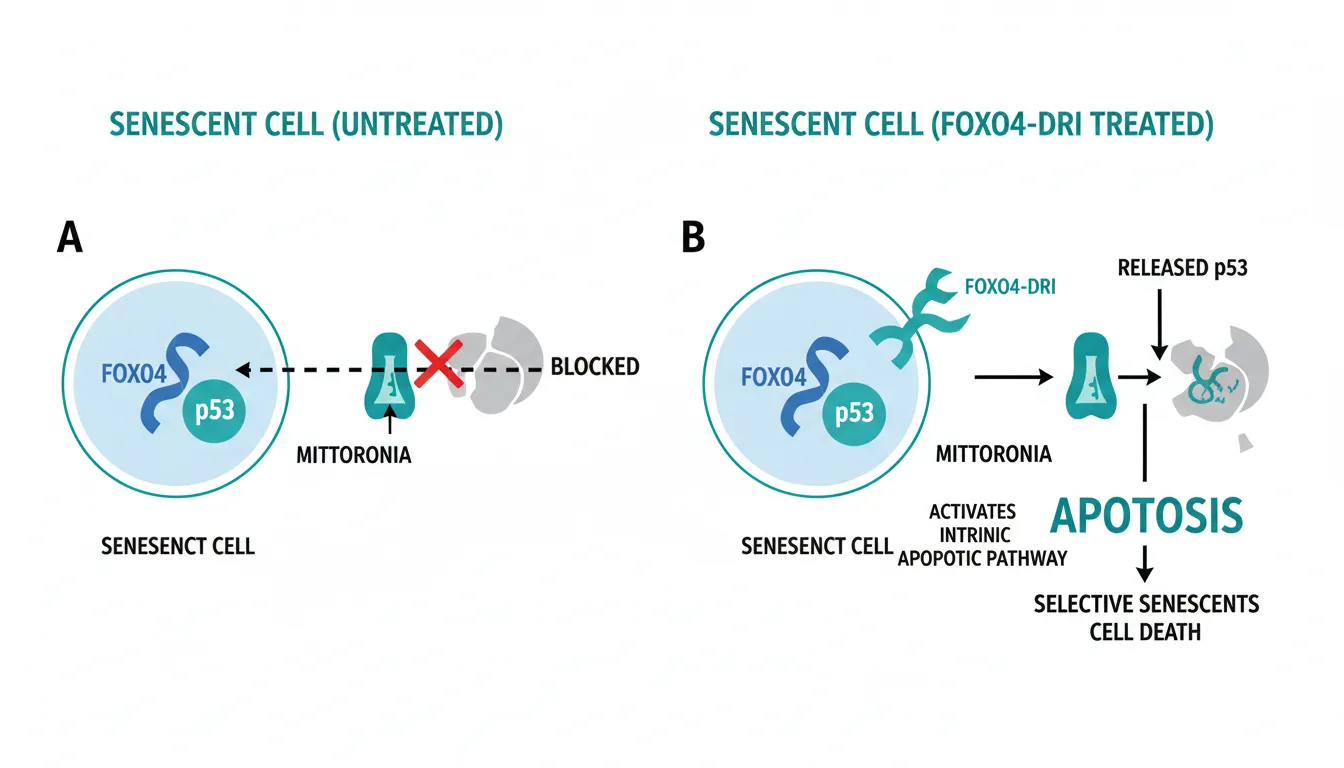
FOXO4-DRI is a D-retro-inverso peptide -- a mirror-image version of a segment of the FOXO4 transcription factor -- designed to selectively eliminate senescent cells. In senescent cells, FOXO4 binds p53 in the nucleus, preventing p53 from triggering apoptosis. FOXO4-DRI competitively disrupts this interaction, releasing p53 to translocate to mitochondria and activate the intrinsic apoptotic pathway.
Key Research Findings#
The foundational study (Baar et al., Cell 2017) demonstrated that FOXO4-DRI:
- Selectively induced apoptosis in senescent cells while sparing healthy, non-senescent cells
- Restored fitness, fur density, and renal function in naturally aged mice
- Counteracted chemotherapy-induced senescence in mouse models
Since then, additional research has expanded FOXO4-DRI's applications:
- Chondrocyte rejuvenation: FOXO4-DRI selectively removed senescent cells from expanded human chondrocytes, enhancing their potential to generate high-quality cartilage tissue (Frontiers in Bioengineering, 2021)
- Testosterone restoration: In naturally aged mice, FOXO4-DRI improved the testicular microenvironment and alleviated age-related testosterone secretion insufficiency by targeting senescent Leydig cells (Aging, 2020)
- Keloid treatment: A 2025 study in Communications Biology showed FOXO4-DRI induces apoptosis in keloid senescent fibroblasts through p53-serine 15 phosphorylation and nuclear exclusion
Limitations#
FOXO4-DRI remains preclinical with no human clinical trials. The peptide is large (D-retro-inverso peptides have challenging pharmacokinetics), delivery optimization is ongoing, and the long-term consequences of senescent cell clearance in humans are unknown. Senescent cells may serve protective functions in some contexts (wound healing, tumor suppression).
2. Epitalon: Telomere Modulation#
Aging Pathway: Telomere attrition Evidence Level: Preclinical (primarily Russian research) Mechanism: Reported to activate telomerase in human somatic cells; pineal gland bioregulator
Epitalon (Ala-Glu-Asp-Gly) is a synthetic tetrapeptide analog of epithalamin, a pineal gland extract studied extensively by the Khavinson research group in Russia. Epitalon's proposed anti-aging mechanism centers on telomerase activation -- the enzyme that maintains telomere length.
Key Research Findings#
- Telomerase activation: In vitro studies reported that epitalon increased telomerase activity in human fetal fibroblasts and CD8+ T cells, with cells exceeding their normal Hayflick limit by approximately 10 passages
- Pineal regulation: Epitalon is reported to regulate melatonin production from the pineal gland, potentially restoring age-related declines in circadian signaling
- Lifespan studies: Animal studies (primarily in rodents) reported modest lifespan extensions, though these were conducted primarily by one research group
Limitations#
The epitalon literature is dominated by a single research group (Khavinson Institute), and independent replication is limited. The claimed mechanism (a 4-amino-acid peptide activating telomerase) would be extraordinary and requires more rigorous validation. No clinical trials have been conducted. Epitalon is in FDA Category 2 (banned from compounding in the US as of 2024). For broader context, see our Epitalon peptide profile.
3. Tat-Beclin-1: Autophagy Induction#
Aging Pathway: Autophagy decline Evidence Level: Preclinical (in vivo mouse lifespan data; in vitro extensively validated) Mechanism: Disrupts the beclin 1-BCL2 complex to induce autophagy
Tat-Beclin-1 is a cell-permeable peptide derived from the autophagy protein beclin 1, linked to the HIV-1 Tat protein transduction domain for cellular uptake. It induces autophagy -- the cell's primary mechanism for clearing damaged proteins, organelles, and other cellular debris -- by competitively disrupting the inhibitory interaction between beclin 1 and BCL2.
Key Research Findings#
The connection between autophagy and longevity is well-established:
- Lifespan extension: Mice engineered with a mutation that disrupts the beclin 1-BCL2 interaction (mimicking Tat-Beclin-1's mechanism) showed increased basal autophagy, improved healthspan, and extended lifespan (Fernandez et al., Nature 2018)
- Centenarian biomarker: Serum beclin-1 levels above 1.5 ng/mL were associated with a 3.4-fold increased odds of being a healthy centenarian, suggesting that elevated autophagy may be a biomarker of exceptional human longevity
- Infectious disease: Tat-Beclin-1 reduced mortality in mice infected with chikungunya and West Nile virus by enhancing autophagic clearance of viral particles
- Protein aggregates: Tat-Beclin-1 decreased the accumulation of polyglutamine expansion protein aggregates relevant to Huntington's disease
Limitations#
Tat-Beclin-1 has not been tested in human clinical trials. While the genetic evidence for autophagy-longevity connections is strong, pharmacological autophagy induction carries theoretical risks: excessive autophagy could damage healthy tissue, and autophagy plays complex roles in cancer (both tumor-suppressive and tumor-promoting depending on context). The peptide requires injection due to its size and cell-penetrating domain.
4. Humanin: Mitochondrial Protection#
Aging Pathway: Mitochondrial dysfunction Evidence Level: Preclinical with growing translational data Mechanism: Mitochondrial-derived peptide (MDP) with broad cytoprotective effects
Humanin is a 24-amino-acid peptide encoded in mitochondrial DNA, making it one of the first identified mitochondrial-derived peptides (MDPs). Endogenous humanin levels decline with age, and this decline correlates with age-related disease risk. Humanin acts through both intracellular (anti-apoptotic, mitochondrial protective) and extracellular (receptor-mediated signaling through FPRL1 and CNTFR/WSX-1/gp130) pathways.
Key Research Findings#
- Neuroprotection: Humanin protects neurons against amyloid-beta toxicity, oxidative stress, and other age-related insults relevant to Alzheimer's disease
- Metabolic effects: Humanin improves insulin sensitivity and glucose homeostasis in animal models of diabetes and metabolic syndrome
- Cardiovascular protection: Humanin reduces myocardial infarct size and protects against atherosclerosis in preclinical models
- Age-related decline: Circulating humanin levels decline with age in humans, and higher humanin levels are associated with better metabolic health in epidemiological studies
- Related MDPs: Humanin belongs to a family of mitochondrial-derived peptides that includes MOTS-c, another MDP with exercise-mimetic properties (see our Mitochondrial Peptides article)
Limitations#
No clinical trials for humanin in aging or longevity. The peptide's mechanism of action is complex and not fully elucidated. Synthetic humanin analogs (such as HNG, a potent humanin variant) have been developed to improve pharmacological properties, but these remain preclinical.
5. Klotho Peptides: The Longevity Factor#
Aging Pathway: Loss of protective factors Evidence Level: Preclinical with early primate data Mechanism: Derived from the klotho anti-aging protein; enhances cognition and may oppose multiple aging pathways
Klotho peptides are derived from alpha-klotho, a transmembrane protein discovered in 1997 that profoundly influences aging. Mice lacking klotho age rapidly and die young; mice overexpressing klotho live significantly longer. In humans, klotho levels decline beginning around the fourth decade of life.
Key Research Findings#
- Cognitive enhancement in primates: A single low-dose klotho injection enhanced memory in aged nonhuman primates (Nature Aging, 2023), a major translational milestone
- NMDA receptor signaling: Klotho enhances cognition through GluN2B-dependent NMDA receptor signaling, strengthening synaptic plasticity
- Meta-analysis: A 2025 systematic review pooling data from 6,645 subjects confirmed a statistically significant positive correlation between klotho levels and cognitive function
- Neuroprotection: In animal models of Alzheimer's and Parkinson's disease, increasing klotho levels improved memory and learning
- APOE interaction: A 2025 PNAS study found that klotho modifies the effect of APOE genotype on cognitive decline, suggesting klotho as a resilience factor against genetic Alzheimer's risk
Limitations#
Klotho is a large protein (~130 kDa), making peptide-based delivery challenging. The shed ectodomain fragment (soluble klotho) is the presumed active form for systemic effects, but therapeutic formulation remains under development. Klotho Neurosciences is developing klotho-based gene therapies for neurodegeneration. No peptide-form clinical trials have been conducted.
6. Vilon: Thymic Bioregulation#
Aging Pathway: Immunosenescence and thymic involution Evidence Level: Preclinical with limited human observational data Mechanism: Dipeptide bioregulator (Lys-Glu) from the Khavinson peptide bioregulation program
Vilon is a synthetic dipeptide (KE, Lys-Glu) developed as part of the Russian peptide bioregulation program led by Vladimir Khavinson. It is designed to target the thymus -- the organ responsible for T-cell maturation that progressively involutes (shrinks) with age, contributing to immunosenescence.
Key Research Findings#
- Thymic restoration: Khavinson group studies report that vilon promotes thymic tissue regeneration in aged animal models
- Immune markers: Limited studies suggest vilon may restore T-cell subpopulation ratios toward more youthful profiles
- Bioregulator concept: Vilon is part of a broader theory of "peptide bioregulation" that proposes short peptides (2-4 amino acids) can regulate gene expression in specific tissues. Other peptides in this program include epitalon (pineal), thymalin (thymus), and pinealon (brain)
Limitations#
Vilon research comes almost exclusively from the Khavinson research group, with very limited independent replication. The proposed mechanism (a dipeptide acting as a gene regulator for thymic tissue) lacks robust mechanistic validation by Western research standards. No peer-reviewed clinical trials have been published in international journals.
Comparing Cellular Aging Targets#
| Peptide | Aging Pathway | Mechanism | Evidence Level | Key Finding |
|---|---|---|---|---|
| FOXO4-DRI | Senescence | Disrupts FOXO4-p53 interaction | Preclinical (mouse) | Selectively kills senescent cells; restores fitness in aged mice |
| Epitalon | Telomeres | Reported telomerase activation | Preclinical (limited) | In vitro telomere extension; limited independent replication |
| Tat-Beclin-1 | Autophagy | Disrupts beclin 1-BCL2 complex | Preclinical (mouse lifespan) | Beclin 1-BCL2 disruption extends mouse lifespan |
| Humanin | Mitochondrial | MDP with cytoprotective signaling | Preclinical (translational) | Neuroprotective; levels decline with age |
| Klotho | Protective factors | Longevity protein supplementation | Primate data | Enhanced cognition in aged primates |
| Vilon | Immunosenescence | Thymic bioregulator | Preclinical (limited) | Single research group; limited replication |
What This Means for Longevity Research#
The peptides in this article target distinct but interconnected aging pathways. This is important because aging is a multi-factorial process -- no single intervention is likely to address all cellular aging mechanisms simultaneously.
The most promising near-term translational targets are:
- Klotho -- The nonhuman primate cognition data is a strong translational signal, and gene therapy approaches are being developed
- FOXO4-DRI -- Senolytic therapy is an active clinical research field, and FOXO4-DRI's selectivity for senescent cells is a genuine advance, though small-molecule senolytics (dasatinib + quercetin) are further along in human trials
- Autophagy induction -- The genetic evidence linking autophagy to longevity is robust (beclin 1 mouse models, centenarian biomarker data), making Tat-Beclin-1's mechanism well-validated even if the peptide itself has not been clinically tested
The more speculative targets (epitalon, vilon) require substantially more independent validation before they can be considered credible longevity interventions.
Conclusion#
Cellular longevity is a multi-target problem, and the peptides reviewed here represent distinct approaches to distinct aging mechanisms. The field is still largely preclinical, with klotho's primate data being the closest to human translation. However, the convergence of senolytic research (FOXO4-DRI), autophagy biology (Tat-Beclin-1), mitochondrial peptides (humanin), and longevity factors (klotho) points toward a future where aging interventions may be rationally combined based on which cellular pathways are most impaired in a given individual.
For broader anti-aging peptide coverage, see 7 Best Peptides for Anti-Aging Research and Mitochondrial Peptides: The Next Frontier in Longevity. For peptide safety and handling guidance, visit our Safety and Peptide Storage Guide resources.
Related Peptide Profiles#
Learn more about the peptides discussed in this article:
- FOXO4-DRI Overview and Research Guide
- FOXO4-DRI Dosing Protocols
- FOXO4-DRI Side Effects and Safety
- Epitalon Overview and Research Guide
- Epitalon Dosing Protocols
- Epitalon Side Effects and Safety
- Tat-Beclin-1 Overview and Research Guide
- Tat-Beclin-1 Dosing Protocols
- Tat-Beclin-1 Side Effects and Safety
- Humanin Overview and Research Guide
- Humanin Dosing Protocols
- Humanin Side Effects and Safety
- Klotho Peptides Overview and Research Guide
- Klotho Peptides Dosing Protocols
- Klotho Peptides Side Effects and Safety
- Vilon Overview and Research Guide
- Vilon Dosing Protocols
- Vilon Side Effects and Safety

Frequently Asked Questions About Peptides for Cellular Longevity: From Telomeres to Senescence
What does this article cover?
A guide to peptides targeting cellular aging mechanisms — senolytic peptides (FOXO4-DRI), telomere modulators (Epitalon), autophagy inducers (Tat-Beclin-1), mitochondrial protectors (Humanin), and longevity factors (Klotho, Vilon). This guide is for educational purposes only and does not constitute medical advice.
Which peptides are discussed in this article?
This article covers FOXO4-DRI, Epitalon, Tat-Beclin-1, Humanin, Klotho Peptides, Vilon. Key context: FOXO4-DRI (Senolytic peptide that selectively triggers apoptosis in senescent cells by disrupting the FOXO4-...); Epitalon (Tetrapeptide studied for telomerase activation and pineal gland regulation in aging models); Tat-Beclin-1 (Autophagy-inducing peptide derived from beclin 1 that extends lifespan and healthspan in mouse mo...). Each peptide is discussed based on available research evidence.
Who is this guide written for?
This guide is written for researchers and individuals seeking an evidence-based overview of the topic covered in "Peptides for Cellular Longevity: From Telomeres to Senescence." It summarizes available research data without making treatment recommendations. Always consult a healthcare provider for medical decisions.
What are the key takeaways from this article?
The main findings covered in this article include: Senolytic peptide that selectively triggers apoptosis in senescent cells by disrupting the FOXO4-.... Tetrapeptide studied for telomerase activation and pineal gland regulation in aging models. Autophagy-inducing peptide derived from beclin 1 that extends lifespan and healthspan in mouse mo.... These takeaways are based on the research data available at the time of publication.
What is FOXO4-DRI and why is it significant?
FOXO4-DRI is a peptide discussed in this article because: Senolytic peptide that selectively triggers apoptosis in senescent cells by disrupting the FOXO4-p53 interaction. For a complete profile of FOXO4-DRI, see the dedicated peptide page on this site.
Continue reading this research review
Free access to the complete analysis with citations and evidence ratings.
150+ peptide profiles · 30+ comparisons · 18 research tools
Medical Disclaimer
This website is for educational and informational purposes only. The information provided is not intended to diagnose, treat, cure, or prevent any disease. Always consult with a qualified healthcare professional before using any peptide or supplement.
Join 2,000+ researchers getting biweekly updates
Enjoyed this article?
The Research Briefing delivers deep-dives like this biweekly — plus new study breakdowns, safety updates, and tool announcements.
Free forever. No spam. Unsubscribe in one click.
Where to Find These Peptides
Continue Exploring
Peptide Profiles
Keep Reading

13 Best Anti-Aging Peptides (2026): Ranked by Clinical Evidence
From senolytic FOXO4-DRI to mitochondrial SS-31, we ranked 13 anti-aging peptides by clinical trial evidence across 6 mechanisms. See which have human data vs. animal-only studies.

The Hallmarks of Aging: Which Peptides Target Which?
Definitive mapping of the 12 hallmarks of aging to specific peptide interventions including Epitalon, FOXO4-DRI, SS-31, MOTS-c, and NAD+.

Anti-Aging Peptides by Mechanism: Senolytics, Telomeres, Mitochondria, and Hormones
Research review of anti-aging peptides organized by mechanism of action including senolytic peptides (FOXO4-DRI), telomere peptides (epitalon), mitochondrial peptides (SS-31, MOTS-c), tissue remodelers (GHK-Cu), and bioregulators (pinealon, thymalin). Evidence quality assessment for each approach.
You Might Also Like
Related content you may find interesting