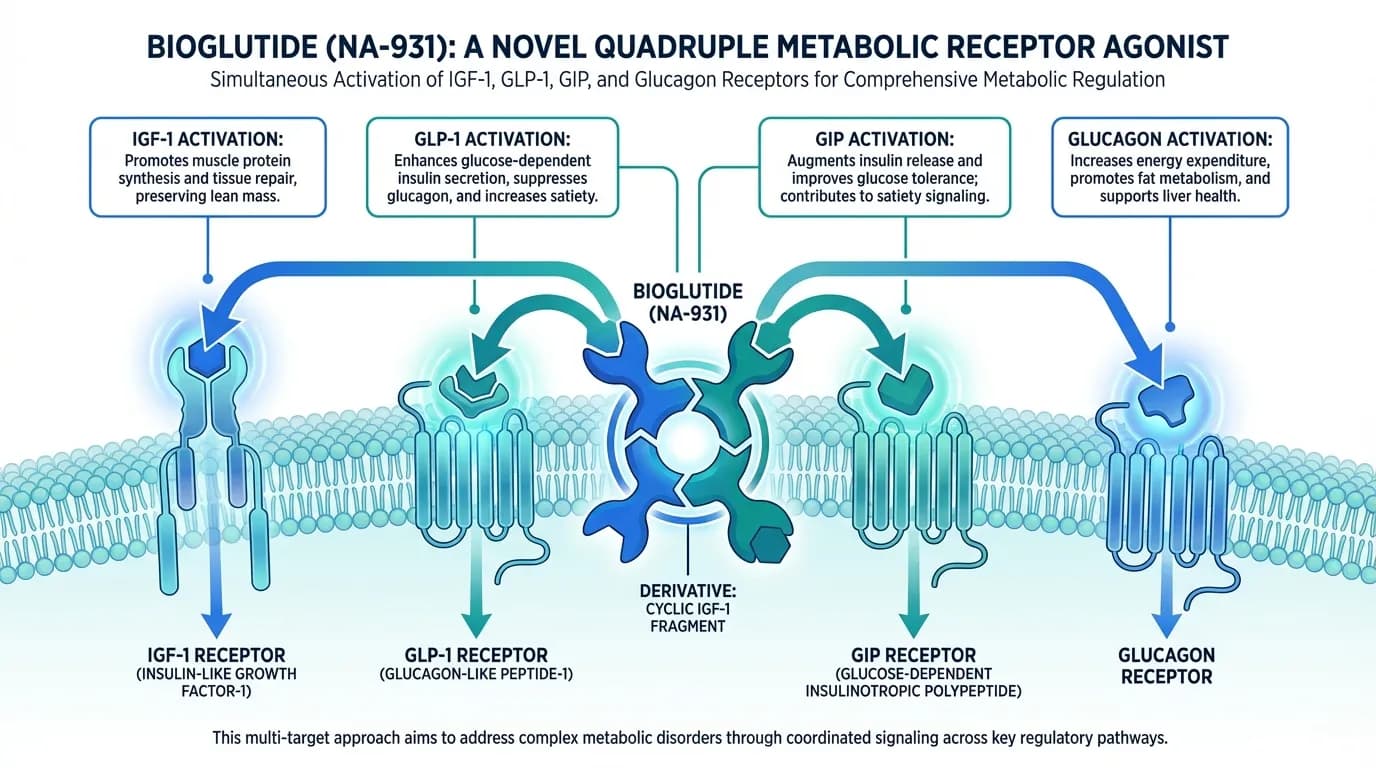
Bioglutide (NA-931) is a first-in-class, orally active small-molecule quadruple receptor agonist developed by Biomed Industries, Inc. (San Jose, CA). It is designed to simultaneously activate four key metabolic hormone receptors: insulin-like growth factor 1 receptor (IGF-1R), glucagon-like peptide-1 receptor (GLP-1R), glucose-dependent insulinotropic polypeptide receptor (GIPR), and glucagon receptor (GCGR).
Unlike existing injectable GLP-1 receptor agonists such as semaglutide and tirzepatide, Bioglutide is a small synthetic molecule derived from a cyclic IGF-1 fragment. This cyclic structure confers lipophilicity and stability, enabling oral bioavailability without the need for absorption enhancers (such as the SNAC used in oral semaglutide/Rybelsus). The compound is also reported to cross the blood-brain barrier, allowing direct central nervous system effects on appetite-regulating neurons at lower doses.
Bioglutide is being developed for chronic weight management in adults with obesity (BMI 30 kg/m2 or greater) or overweight (BMI 27 kg/m2 or greater) with at least one weight-related comorbid condition such as hypertension, dyslipidemia, type 2 diabetes, obstructive sleep apnea, or cardiovascular disease.
Bioglutide represents a significant advancement over first-generation single-agonist and second-generation dual-agonist obesity therapies by engaging four complementary receptor pathways simultaneously.
-
GLP-1 receptor activation: Enhances glucose-dependent insulin secretion, suppresses glucagon in the hyperglycemic state, delays gastric emptying, and acts centrally to reduce appetite and increase satiety. This is the primary mechanism shared with semaglutide, liraglutide, and other GLP-1 agonists.
-
GIP receptor activation: Augments insulin secretion through a complementary incretin pathway, modulates lipid metabolism, and may influence fat distribution and adipose tissue function. This is the mechanism added by dual agonists such as tirzepatide.
-
Glucagon receptor activation: Promotes hepatic energy expenditure, stimulates lipid oxidation and thermogenesis in liver and adipose tissue, and may enhance fat burning. This is the mechanism added by triple agonists such as retatrutide and survodutide.
-
IGF-1 receptor activation: Promotes muscle protein synthesis and preservation of lean body mass during caloric deficit. This receptor target is unique to Bioglutide and distinguishes it from all current incretin-based therapies. IGF-1 signaling also supports insulin sensitivity and glucose homeostasis.
By distributing the metabolic workload across four receptor systems, Bioglutide achieves a more natural balance between energy intake reduction, energy expenditure enhancement, satiety signaling, and body composition preservation. The inclusion of IGF-1 receptor agonism specifically addresses one of the major concerns with existing GLP-1-based weight loss therapies: the loss of lean muscle mass during significant weight reduction.
Bioglutide's small cyclic molecular structure enables it to cross the blood-brain barrier, allowing direct action on hypothalamic and brainstem appetite-regulating centers. This central activity contributes to appetite suppression and satiety at lower circulating doses than would otherwise be required.
Bioglutide has progressed through Phase 1 and Phase 2 clinical trials, with Phase 3 development planned.
The Phase 1 study (NCT06615700) was a randomized, double-blind, placebo-controlled, multiple ascending dose trial in 74 otherwise healthy overweight or obese adults, with or without type 2 diabetes, conducted over 28 days.
- Dose-dependent weight loss up to 6.4% at 28 days
- Placebo-adjusted weight loss up to 5.3% maintained or improved at Day 35 (7 days after last dose)
- Up to 63% of treated subjects achieved 5% or more weight loss (versus 0% placebo)
- All adverse events rated as insignificant or mild
- 84% of GI adverse events rated as insignificant
- No mild nausea or vomiting reported among NA-931-treated subjects in Phase 1
- Pharmacokinetics supported once-daily dosing with consistent blood levels regardless of fasting status or high-fat meals
The Phase 2 study (NCT06564753) was a 13-week randomized, double-blind, placebo-controlled, parallel-arm trial enrolling 125 adults with obesity or overweight with comorbidities. Results were presented at EASD 2025 (Vienna), ENDO 2025 (San Francisco), and ADA 2025.
- Maximum mean weight loss of 13.8% at the 150 mg daily dose (12.4% placebo-adjusted)
- 72% of treated participants achieved 12% or more weight loss versus 2% with placebo
- No muscle loss observed
- GI adverse events predominantly insignificant or mild (83% insignificant)
- Mild nausea and vomiting in 7.3% of treated subjects
- Diarrhea in 6.3% of treated subjects
- No clinically meaningful differences in GI adverse events versus placebo
In diet-induced obese (DIO) mouse models, NA-931 demonstrated:
- Body weight reduction up to 26% (P < 0.0001)
- Plasma glucose reduction of 23%
- Plasma triglyceride reduction of 34% (P < 0.003)
- Preservation of muscle mass during weight loss
- NCT06732245: Phase 2 study evaluating the combination of NA-931 with tirzepatide in 224 adults with obesity or overweight, designed to assess whether the combination produces synergistic effects on weight loss while reducing GI adverse events and preserving muscle mass
- Phase 3 trials for obesity and type 2 diabetes are planned
- Bioglutide (NA-931) is an investigational drug that is not FDA-approved for any indication
- All clinical data are from Phase 1 and Phase 2 trials with limited sample sizes (74 and 125 participants respectively) and short duration (28 days and 13 weeks)
- Long-term safety and efficacy data are not yet available
- The drug should not be used outside of clinical trials
- Phase 3 trials with larger populations and longer duration are needed to confirm the efficacy and safety profile
- No peer-reviewed publications of the Phase 2 data in major journals are available as of early 2026; data have been presented at medical conferences (EASD, ENDO, ADA) and published as conference abstracts
Phase 1 Clinical Trials Results of NA-931, a Novel Quadruple IGF-1, GLP-1, GIP, and Glucagon Receptor Agonist for the Treatment of Obesity, published in Endocrine Practice (Tran LL et al., 2025):
- The study showed dose dependent weight loss up to 6.4% at Day 28
- The study showed placebo adjusted weight loss up to 5.3% maintained at Day 35
- The study showed up to 63% achieved 5% or more weight loss versus 0% placebo
- The study demonstrated of GI adverse events rated as insignificant of 84%
- The study showed phase 1 randomized, double blind, placebo controlled, multiple ascending dose study of NA-931 in 74 overweight/obese adults over 28 days. Demonstrated dose dependent weight loss up to 6.4%, with placebo adjusted loss up to 5.3%. All adverse events were insignificant or mild. Published as conference abstract.
Phase 2 Clinical Trials of NA-931 to Study Subjects Who Are Obese With at Least One Weight-related Comorbid Condition, published in Presented at EASD 2025, ENDO 2025, and ADA 2025 (Tran LL et al., 2025):
- The study showed mean weight loss of 13.8% at 150 mg daily dose
- The study showed GI adverse events of 83% insignificant, 7.3% mild nausea/vomiting, 6.3% diarrhea
143-OR: NA-931, a Novel Quadruple IGF-1, GLP-1, GIP, and Glucagon Receptor Agonist Reduces Body Weight without Muscle Loss, published in Diabetes (ADA 2025 Supplement) (Tran LL et al., 2025):
- The study showed dose dependent weight reduction up to 13.8% from baseline