Bioglutide vs Tirzepatide: Oral Quad Agonist vs Approved Dual GIP/GLP-1
Evidence-based comparison of bioglutide (NA-931, oral quadruple GLP-1/GIP/glucagon/IGF-1 agonist) and tirzepatide (dual GIP/GLP-1 agonist) for obesity treatment.
Verdict at a Glance
Bioglutide (NA-931) and tirzepatide represent different generations and levels of clinical validation. Tirzepatide is the established leader with 20.9% weight loss, FDA approval, and thousands of patients studied. Bioglutide's quad-agonist mechanism adds glucagon and IGF-1 activation to the GLP-1/GIP foundation that tirzepatide uses, and its Phase 2 data (14.8% at 13 weeks, muscle preservation) suggest rapid and potentially muscle-sparing weight loss. However, 13-week Phase 2 conference data from 125 patients cannot be meaningfully compared to rigorous 72-week Phase 3 data from thousands of patients. Tirzepatide is real, proven, and available. Bioglutide is promising but requires extensive Phase 3 validation before any clinical comparison is meaningful.
| Best for | Pick | Why |
|---|---|---|
| Treatment Available Now | Tirzepatide | Tirzepatide is FDA-approved and available as Mounjaro/Zepbound. Bioglutide is years from potential approval with only Phase 2 data available. |
| Maximum Proven Weight Loss | Tirzepatide | SURMOUNT-1 demonstrated 20.9% weight loss at 15 mg over 72 weeks in 2,539 patients. This is the highest approved efficacy, backed by rigorous Phase 3 evidence. |
| Muscle-Sparing Weight Loss (Future) | Bioglutide | Bioglutide's IGF-1 receptor activation reportedly preserves muscle mass during weight loss. If confirmed, this would address the lean mass loss (~40% of total weight lost) seen with tirzepatide and other GLP-1 agents. |
| Oral Administration (Future) | Bioglutide | Bioglutide is an oral daily tablet requiring no injections. Tirzepatide requires weekly subcutaneous injection. For injection-averse patients, an oral quad agonist would be transformative. |
| Type 2 Diabetes | Tirzepatide | Five SURPASS trials with 9,000+ patients, FDA approval, and demonstrated superiority over semaglutide for glycemic control. Bioglutide has no published T2D-specific efficacy data. |
| Category | Bioglutide | Tirzepatide | Advantage |
|---|---|---|---|
| Mechanism of Action | First-in-class oral quadruple receptor agonist targeting GLP-1, GIP, glucagon, and IGF-1 receptors simultaneously. Adds glucagon (energy expenditure) and IGF-1 (muscle preservation) to the dual incretin mechanism. Small molecule by Biomed Industries. | Dual GIP/GLP-1 receptor agonist. First-in-class molecule activating both incretin pathways with ~5-fold potency at GIPR relative to native GIP. Does not activate glucagon or IGF-1 receptors. | Bioglutide |
| Weight Loss Efficacy | Phase 2 showed 14.8% mean weight loss at 150 mg at 13 weeks (13.2% placebo-adjusted). 72% achieved 12% or more loss. Rapid onset in a very short trial. No plateau observed. | SURMOUNT-1 demonstrated 20.9% mean weight loss at 15 mg at 72 weeks. Up to 36% achieved 25% or more weight loss. The highest weight loss of any FDA-approved anti-obesity medication. | Tirzepatide |
| Development Stage and Evidence | Phase 2 completed (125 patients, 13 weeks). Presented at EASD 2025 and ENDO 2025. Phase 2b/3 ongoing. Not peer-reviewed in a major journal. Very early in clinical development. | FDA-approved 2022. SURPASS (5 T2D trials, 9,000+ patients) and SURMOUNT (obesity trials). Head-to-head superiority over semaglutide. Growing real-world experience with millions of prescriptions. | Tirzepatide |
| Formulation and Dosing | Oral daily tablet (150 mg). No injection required. No fasting restrictions reported. Potentially simpler patient adherence with pill-based treatment. | Once-weekly subcutaneous injection via pre-filled pen with hidden needle. Six dose strengths (2.5-15 mg). Requires injection technique training. 52 injections per year. | Bioglutide |
| Safety Profile | GI adverse events reported as predominantly mild and comparable to placebo. Company claims lower GI side effects than existing GLP-1 therapies. No muscle loss observed. Very limited safety data (125 patients, 13 weeks). | Well-characterized GI profile (nausea 12-33%, diarrhea 12-21%). FDA-approved with growing post-marketing experience. CVOT underway. Extensive safety database with rare events well documented. | Tirzepatide |

Introduction#
Bioglutide (NA-931, Biomed Industries) and tirzepatide (Eli Lilly) share two of their four and two receptor targets, respectively: both activate GLP-1 and GIP receptors. But bioglutide adds glucagon and IGF-1 receptor activation, making it the broadest-mechanism obesity agent in clinical development. Tirzepatide is the established dual GIP/GLP-1 leader with the highest approved weight loss of any medication.
This comparison pits an ambitious early-stage quad agonist against the proven dual agonist market leader. The mechanistic differences are significant, but the evidence gap is vast.
Mechanism of Action Comparison#
Bioglutide (NA-931)#
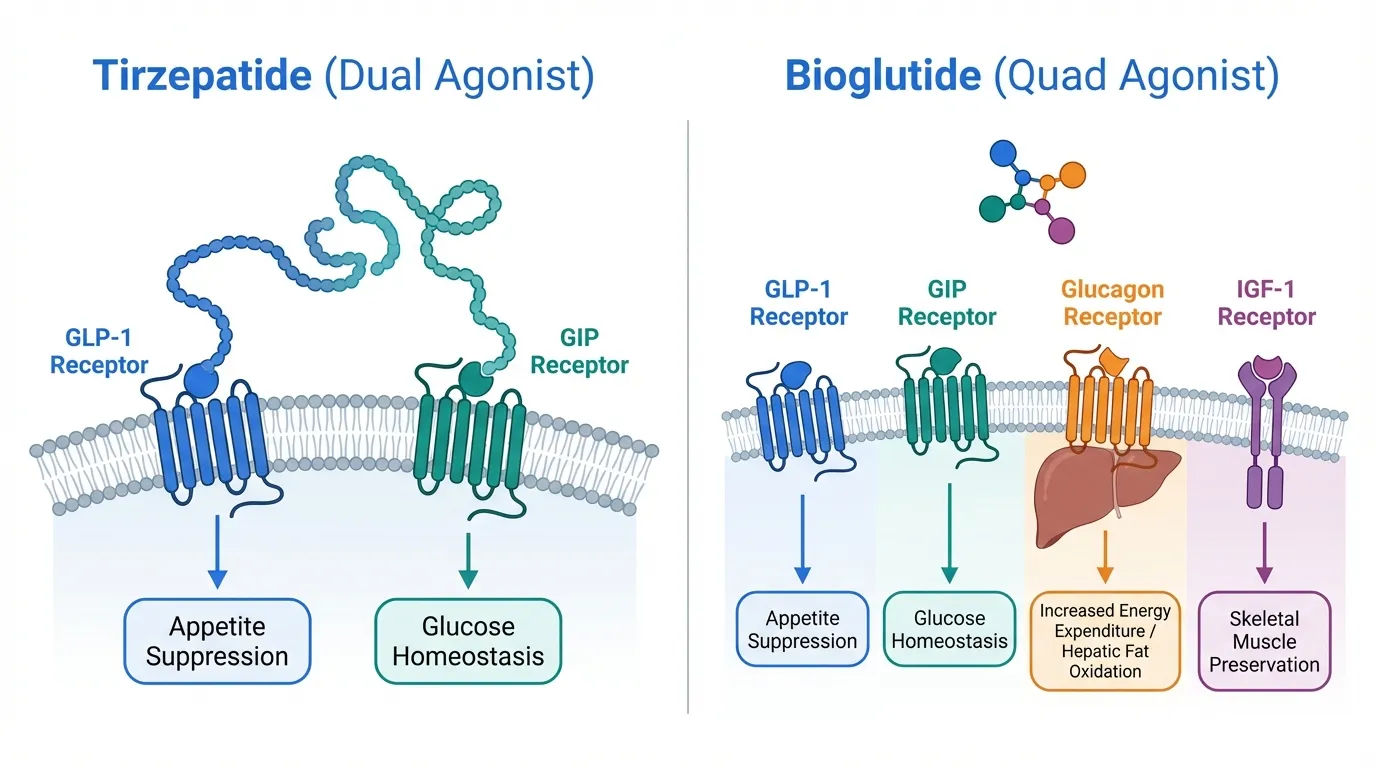
Bioglutide is an oral small molecule that simultaneously activates four metabolic hormone receptors. GLP-1 activation provides appetite suppression and glucose homeostasis. GIP activation potentiates incretin signaling. Glucagon receptor activation increases energy expenditure and hepatic fat oxidation. IGF-1 receptor activation provides anabolic signaling that may preserve skeletal muscle during caloric deficit, addressing a fundamental limitation of all current weight loss therapies.
Tirzepatide#
Tirzepatide is a 39-amino acid single molecule that simultaneously activates GIP and GLP-1 receptors with approximately 5-fold potency at GIPR relative to native GIP. The dual incretin mechanism produces synergistic effects on weight loss and glycemic control but does not engage glucagon or IGF-1 pathways.
Dual vs Quadruple Receptor Activation#
| Feature | Bioglutide (NA-931) | Tirzepatide |
|---|---|---|
| GLP-1 activation | Yes | Yes |
| GIP activation | Yes | Yes |
| Glucagon activation | Yes | No |
| IGF-1 activation | Yes | No |
| Total receptors | 4 | 2 |
| Molecule type | Small molecule (oral) | Peptide (injectable) |
| Muscle preservation | Claimed (IGF-1) | Not established |
| Energy expenditure boost | Yes (glucagon) | Not established |
Weight Loss Data#
| Parameter | Bioglutide (Phase 2) | Tirzepatide (SURMOUNT-1) |
|---|---|---|
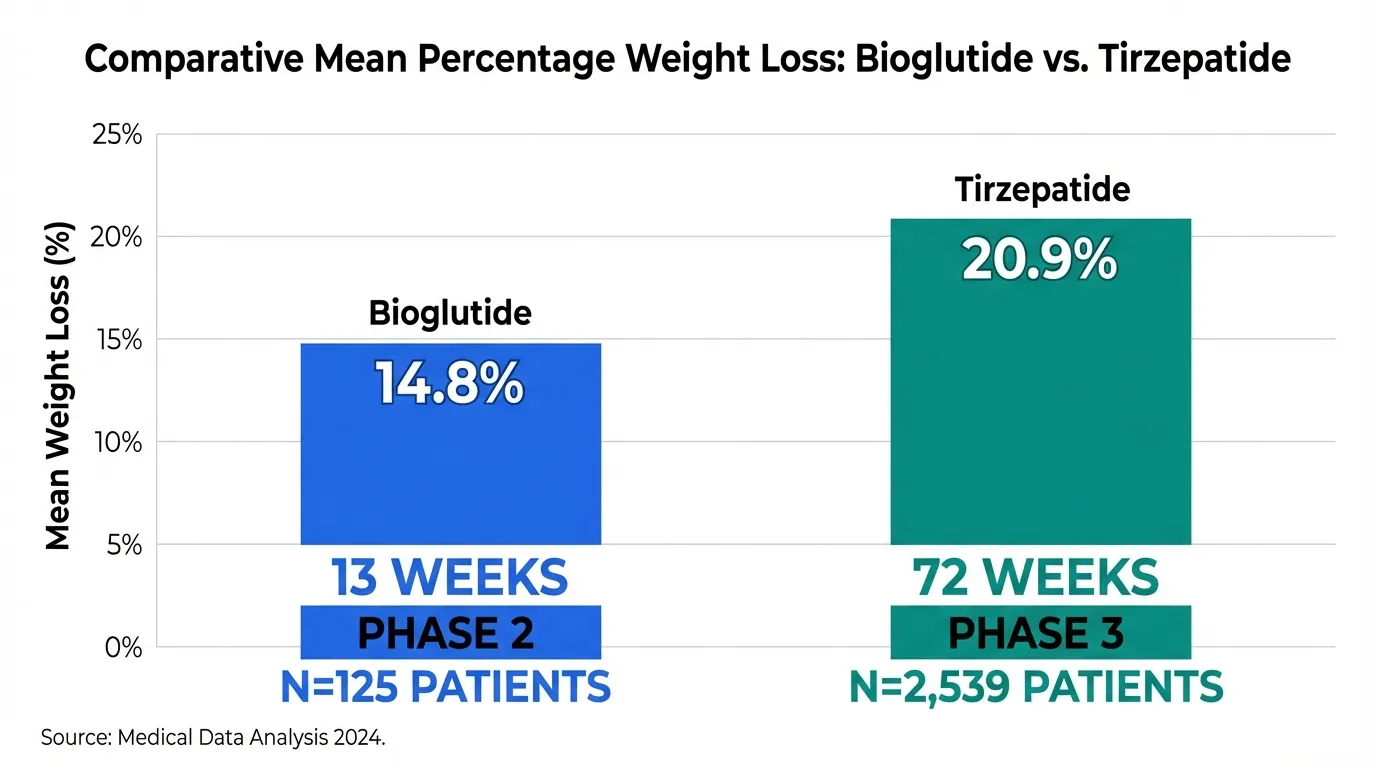
| Mean weight loss | 14.8% at 150 mg | 20.9% at 15 mg |
| Placebo-adjusted | 13.2% | ~18.5% |
| Duration | 13 weeks | 72 weeks |
| Sample size | 125 patients | 2,539 patients |
| Achieved 12%+ loss | 72% | ~65% (15 mg) |
| Trial phase | Phase 2 | Phase 3 |
| Weight plateau | Not reached | Approaching plateau |
| Publication | Conference presentations | NEJM |
Critical context: Bioglutide's 14.8% in 13 weeks is striking, but cannot be meaningfully compared to tirzepatide's 20.9% at 72 weeks. Weight loss trajectories often plateau significantly after the initial rapid-loss phase. Additionally, the 125-patient Phase 2 sample cannot match the statistical rigor of a 2,539-patient Phase 3 trial.
Safety Comparison#
| Parameter | Bioglutide | Tirzepatide |
|---|---|---|
| Total patients studied | 125 | 14,000+ |
| GI events | Reported as mild/comparable to placebo | Nausea 12-33%, diarrhea 12-21% |
| Muscle loss | Not observed | Expected (~40% lean mass) |
| CV outcomes data | None | CVOT underway |
| Long-term data | 13 weeks | Growing (2+ years) |
| Post-marketing | None | Extensive |
Key Differences Summary#
- Receptor targets: Bioglutide activates 4 receptors; tirzepatide activates 2
- Administration: Bioglutide is oral; tirzepatide requires injection
- Weight loss: Tirzepatide 20.9% at 72 weeks (proven); bioglutide 14.8% at 13 weeks (preliminary)
- Muscle preservation: Bioglutide claims IGF-1-mediated preservation; tirzepatide causes lean mass loss
- Evidence quality: Tirzepatide has 14,000+ patients and FDA approval; bioglutide has 125 patients
- GI tolerability: Bioglutide reports lower GI events (requires confirmation)
- Glucagon pathway: Bioglutide activates glucagon for energy expenditure; tirzepatide does not
Conclusion#
Bioglutide's quadruple-agonist approach is the most mechanistically ambitious obesity treatment in development, adding glucagon-mediated energy expenditure and IGF-1-mediated muscle preservation to the dual incretin foundation that makes tirzepatide so effective. If these additional pathways translate into clinical advantages in Phase 3, bioglutide could address two key limitations of all current obesity treatments: lean mass loss and GI side effects. However, tirzepatide is proven, available, and effective today, with 20.9% weight loss backed by the most rigorous evidence in the field. Bioglutide's Phase 2 data are intriguing but far too preliminary for clinical comparison. The distance from 125 patients over 13 weeks to thousands of patients over 72+ weeks is where most promising drug candidates fail. Tirzepatide remains the clear evidence-based choice.
Detailed Category Analysis#
Mechanism of Action#
Bioglutide: First-in-class oral quadruple receptor agonist targeting GLP-1, GIP, glucagon, and IGF-1 receptors simultaneously. Adds glucagon (energy expenditure) and IGF-1 (muscle preservation) to the dual incretin mechanism. Small molecule by Biomed Industries.
Tirzepatide: Dual GIP/GLP-1 receptor agonist. First-in-class molecule activating both incretin pathways with ~5-fold potency at GIPR relative to native GIP. Does not activate glucagon or IGF-1 receptors.
Advantage: Bioglutide
Weight Loss Efficacy#
Bioglutide: Phase 2 showed 14.8% mean weight loss at 150 mg at 13 weeks (13.2% placebo-adjusted). 72% achieved 12% or more loss. Rapid onset in a very short trial. No plateau observed.
Tirzepatide: SURMOUNT-1 demonstrated 20.9% mean weight loss at 15 mg at 72 weeks. Up to 36% achieved 25% or more weight loss. The highest weight loss of any FDA-approved anti-obesity medication.
Advantage: Tirzepatide
Development Stage and Evidence#
Bioglutide: Phase 2 completed (125 patients, 13 weeks). Presented at EASD 2025 and ENDO 2025. Phase 2b/3 ongoing. Not peer-reviewed in a major journal. Very early in clinical development.
Tirzepatide: FDA-approved 2022. SURPASS (5 T2D trials, 9,000+ patients) and SURMOUNT (obesity trials). Head-to-head superiority over semaglutide. Growing real-world experience with millions of prescriptions.
Advantage: Tirzepatide
Formulation and Dosing#
Bioglutide: Oral daily tablet (150 mg). No injection required. No fasting restrictions reported. Potentially simpler patient adherence with pill-based treatment.
Tirzepatide: Once-weekly subcutaneous injection via pre-filled pen with hidden needle. Six dose strengths (2.5-15 mg). Requires injection technique training. 52 injections per year.
Advantage: Bioglutide
Safety Profile#
Bioglutide: GI adverse events reported as predominantly mild and comparable to placebo. Company claims lower GI side effects than existing GLP-1 therapies. No muscle loss observed. Very limited safety data (125 patients, 13 weeks).
Tirzepatide: Well-characterized GI profile (nausea 12-33%, diarrhea 12-21%). FDA-approved with growing post-marketing experience. CVOT underway. Extensive safety database with rare events well documented.
Advantage: Tirzepatide
Summary and Verdict#
Bioglutide (NA-931) and tirzepatide represent different generations and levels of clinical validation. Tirzepatide is the established leader with 20.9% weight loss, FDA approval, and thousands of patients studied. Bioglutide's quad-agonist mechanism adds glucagon and IGF-1 activation to the GLP-1/GIP foundation that tirzepatide uses, and its Phase 2 data (14.8% at 13 weeks, muscle preservation) suggest rapid and potentially muscle-sparing weight loss. However, 13-week Phase 2 conference data from 125 patients cannot be meaningfully compared to rigorous 72-week Phase 3 data from thousands of patients. Tirzepatide is real, proven, and available. Bioglutide is promising but requires extensive Phase 3 validation before any clinical comparison is meaningful.
Best For Recommendations#
Treatment Available Now#
Recommendation: Tirzepatide
Reason: Tirzepatide is FDA-approved and available as Mounjaro/Zepbound. Bioglutide is years from potential approval with only Phase 2 data available.
Maximum Proven Weight Loss#
Recommendation: Tirzepatide
Reason: SURMOUNT-1 demonstrated 20.9% weight loss at 15 mg over 72 weeks in 2,539 patients. This is the highest approved efficacy, backed by rigorous Phase 3 evidence.
Muscle-Sparing Weight Loss (Future)#
Recommendation: Bioglutide
Reason: Bioglutide's IGF-1 receptor activation reportedly preserves muscle mass during weight loss. If confirmed, this would address the lean mass loss (~40% of total weight lost) seen with tirzepatide and other GLP-1 agents.
Oral Administration (Future)#
Recommendation: Bioglutide
Reason: Bioglutide is an oral daily tablet requiring no injections. Tirzepatide requires weekly subcutaneous injection. For injection-averse patients, an oral quad agonist would be transformative.
Type 2 Diabetes#
Recommendation: Tirzepatide
Reason: Five SURPASS trials with 9,000+ patients, FDA approval, and demonstrated superiority over semaglutide for glycemic control. Bioglutide has no published T2D-specific efficacy data.
Further Reading#

Which Is Better For...
Treatment Available Now
Tirzepatide
Tirzepatide is FDA-approved and available as Mounjaro/Zepbound. Bioglutide is years from potential approval with only Phase 2 data available.
Maximum Proven Weight Loss
Tirzepatide
SURMOUNT-1 demonstrated 20.9% weight loss at 15 mg over 72 weeks in 2,539 patients. This is the highest approved efficacy, backed by rigorous Phase 3 evidence.
Muscle-Sparing Weight Loss (Future)
Bioglutide
Bioglutide's IGF-1 receptor activation reportedly preserves muscle mass during weight loss. If confirmed, this would address the lean mass loss (~40% of total weight lost) seen with tirzepatide and other GLP-1 agents.
Oral Administration (Future)
Bioglutide
Bioglutide is an oral daily tablet requiring no injections. Tirzepatide requires weekly subcutaneous injection. For injection-averse patients, an oral quad agonist would be transformative.
Type 2 Diabetes
Tirzepatide
Five SURPASS trials with 9,000+ patients, FDA approval, and demonstrated superiority over semaglutide for glycemic control. Bioglutide has no published T2D-specific efficacy data.
Continue Your Research
Get comparison updates
We publish new head-to-head comparisons regularly. Subscribe to see them first.
Frequently Asked Questions About Bioglutide vs Tirzepatide: Oral Quad Agonist vs Approved Dual GIP/GLP-1
Which is better, Bioglutide or Tirzepatide?
Bioglutide (NA-931) and tirzepatide represent different generations and levels of clinical validation. Tirzepatide is the established leader with 20.9% weight loss, FDA approval, and thousands of patients studied. Bioglutide's quad-agonist mechanism adds glucagon and IGF-1 activation to the GLP-1/GIP foundation that tirzepatide uses, and its Phase 2 data (14.8% at 13 weeks, muscle preservation) suggest rapid and potentially muscle-sparing weight loss. However, 13-week Phase 2 conference data ... Individual responses may vary, and this comparison is based on available research data, not a treatment recommendation.
What are the key differences between Bioglutide and Tirzepatide?
The main differences across comparison categories are: Mechanism of Action: advantage goes to Bioglutide; Weight Loss Efficacy: advantage goes to Tirzepatide; Development Stage and Evidence: advantage goes to Tirzepatide. 2 additional categories are analyzed in the full comparison. Each category evaluates a different dimension of the two peptides.
When should I consider Tirzepatide over Bioglutide?
For the scenario of "Treatment Available Now," research data suggests Tirzepatide may be more relevant. Tirzepatide is FDA-approved and available as Mounjaro/Zepbound. Bioglutide is years from potential approval with only Phase 2 data available.. This is based on currently available evidence and individual circumstances may differ.
How do Bioglutide and Tirzepatide differ in their mechanisms of action?
Bioglutide: First-in-class oral quadruple receptor agonist targeting GLP-1, GIP, glucagon, and IGF-1 receptors simultaneously. Adds glucagon (energy expenditure) and IGF-1 (muscle preservation) to the dual inc.... Tirzepatide: Dual GIP/GLP-1 receptor agonist. First-in-class molecule activating both incretin pathways with ~5-fold potency at GIPR relative to native GIP. Does not activate glucagon or IGF-1 receptors..
Which has fewer side effects, Bioglutide or Tirzepatide?
In terms of side effects and tolerability, the advantage goes to Tirzepatide. Bioglutide: GI adverse events reported as predominantly mild and comparable to placebo. Company claims lower GI side effects than existing GLP-1 therapies. No .... Tirzepatide: Well-characterized GI profile (nausea 12-33%, diarrhea 12-21%). FDA-approved with growing post-marketing experience. CVOT underway. Extensive safet....
Medical Disclaimer
This website is for educational and informational purposes only. The information provided is not intended to diagnose, treat, cure, or prevent any disease. Always consult with a qualified healthcare professional before using any peptide or supplement.