Bioglutide vs Semaglutide: Oral Quad Agonist vs Proven GLP-1 Standard
Evidence-based comparison of bioglutide (NA-931, oral quadruple GLP-1/GIP/glucagon/IGF-1 agonist) and semaglutide, including Phase 2 EASD 2025 data and muscle preservation claims.
Verdict at a Glance
Bioglutide (NA-931) presents a novel quadruple-agonist mechanism that is scientifically ambitious, targeting GLP-1, GIP, glucagon, and IGF-1 receptors in a single oral molecule. The Phase 2 data (14.8% weight loss at 13 weeks with reported muscle preservation) are remarkable if confirmed, suggesting rapid, substantial weight loss that approaches semaglutide's 68-week results in just a fraction of the time. However, extreme caution is warranted. The data come from a small (125-patient), short (13-week) trial presented at conferences but not yet peer-reviewed in a major journal. The muscle preservation claims lack published DEXA data. Semaglutide remains the proven standard with massive evidence, cardiovascular benefit, and years of real-world safety data. Bioglutide's claims require rigorous Phase 3 validation before meaningful clinical comparison.
| Best for | Pick | Why |
|---|---|---|
| Proven Treatment Today | Semaglutide | Semaglutide is FDA-approved, globally available, and backed by 25,000+ trial participants and 7+ years of real-world data. Bioglutide is in early clinical development. |
| Cardiovascular Risk Reduction | Semaglutide | SELECT demonstrated 20% MACE reduction with semaglutide 2.4 mg in 17,604 patients. Bioglutide has no cardiovascular outcomes data. |
| Muscle Preservation During Weight Loss (Future) | Bioglutide | Bioglutide's IGF-1 receptor activation may preserve muscle mass during weight loss, addressing a key limitation of all current GLP-1 therapies. This claim requires Phase 3 confirmation with body composition data. |
| Multi-Pathway Metabolic Correction (Future) | Bioglutide | The four-receptor mechanism (GLP-1/GIP/glucagon/IGF-1) is the broadest metabolic coverage of any obesity agent in development, theoretically providing more comprehensive metabolic improvement than single-target agents. |
| Oral Treatment Without GI Issues (Future) | Bioglutide | Phase 2 reported lower GI adverse events compared to existing GLP-1 therapies, though this requires confirmation in larger trials. If confirmed, this would be a significant tolerability advantage. |
| Category | Bioglutide | Semaglutide | Advantage |
|---|---|---|---|
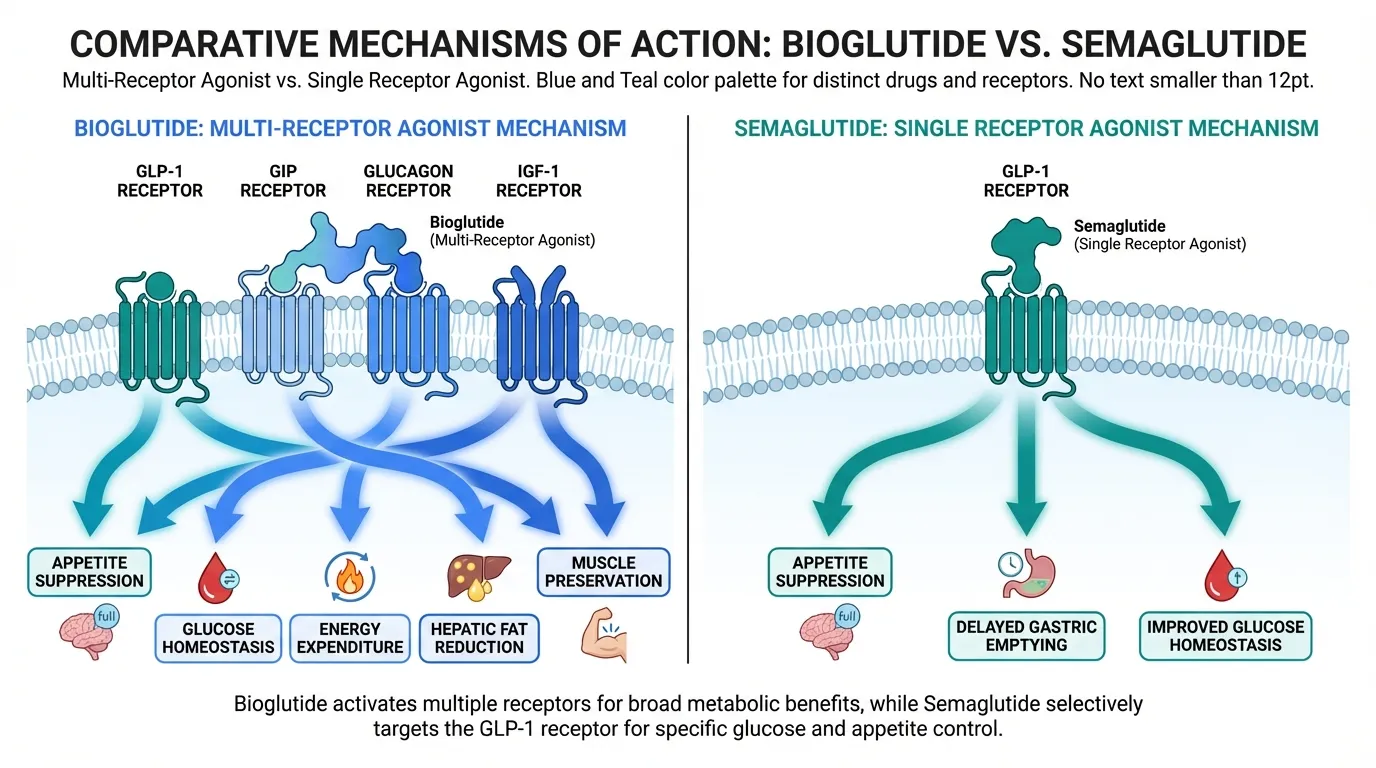
| Mechanism of Action | First-in-class oral quadruple receptor agonist targeting GLP-1, GIP, glucagon, and IGF-1 receptors simultaneously. Four-pathway activation provides weight loss, metabolic improvement, and muscle preservation via IGF-1 signaling. Small molecule by Biomed Industries. | Selective GLP-1 receptor agonist. Activates GLP-1 receptors only for appetite suppression, gastric emptying delay, and glucose homeostasis. Available as injectable (Ozempic/Wegovy) and oral (Rybelsus). | Bioglutide |
| Weight Loss Efficacy | Phase 2 showed 14.8% mean weight loss at 150 mg at 13 weeks (13.2% placebo-adjusted). 72% achieved 12% or more weight loss. Rapid onset of weight reduction in a short trial. No plateau observed. | STEP 1 demonstrated 14.9% mean weight loss at 2.4 mg over 68 weeks. 50.5% achieved 15% or more loss. Proven, reproducible efficacy across multiple large Phase 3 trials. | Bioglutide |
| Muscle Preservation | Phase 2 data indicate body fat reduction without muscle loss, attributed to IGF-1 receptor activation. This is unique among obesity treatments and could reduce sarcopenic obesity risk. No DEXA or detailed body composition data published. | Weight loss includes both fat and lean mass reduction, typical of GLP-1 agonists. STEP trials showed approximately 40% of weight loss was lean mass. No specific muscle-preserving mechanism. | Bioglutide |
| Development Stage and Evidence | Phase 2 completed (125 patients, 13 weeks). Presented at EASD 2025 and ENDO 2025 conferences. Phase 2b/3 ongoing. Not peer-reviewed in a major journal. Very limited total safety exposure. | FDA-approved since 2017 for T2D, 2021 for obesity. Over 25,000 clinical trial participants across SUSTAIN, PIONEER, STEP, SELECT programs. 7+ years of post-marketing surveillance. | Semaglutide |
| Safety Profile | GI adverse events predominantly mild or comparable between treatment and placebo arms. Company reports lower GI side effects than existing GLP-1 therapies. Very limited safety database (125 patients, 13 weeks). | Well-characterized over 7+ years. Proven CV safety (SELECT, 20% MACE reduction). GI side effects are the most common AE class. Extensive post-marketing surveillance with rare events identified. | Semaglutide |

Introduction#
Bioglutide (NA-931, Biomed Industries) and semaglutide (Novo Nordisk) represent vastly different stages and approaches to metabolic disease treatment. Semaglutide is the proven GLP-1 agonist that established the modern obesity pharmacotherapy era. Bioglutide is a first-in-class oral quadruple receptor agonist (GLP-1/GIP/glucagon/IGF-1) with ambitious Phase 2 data but very limited clinical validation.
The comparison is inherently unequal: semaglutide has decades of development, tens of thousands of patients, and proven cardiovascular benefit. Bioglutide has 125 patients over 13 weeks. However, the quad-agonist mechanism and reported muscle preservation make it scientifically notable.
Mechanism of Action Comparison#
Bioglutide (NA-931)#
Bioglutide is an oral small molecule that simultaneously activates four metabolic hormone receptors: GLP-1 (appetite suppression, glucose homeostasis), GIP (incretin potentiation), glucagon (energy expenditure, hepatic fat reduction), and IGF-1 (muscle preservation, anabolic signaling). The IGF-1 component is unique and theoretically addresses the lean mass loss seen with all current GLP-1 therapies. The multi-pathway approach aims to mimic the body's natural metabolic regulation more closely.
Semaglutide#
Semaglutide is a selective GLP-1 receptor agonist that provides appetite suppression, delayed gastric emptying, and improved glucose homeostasis through a single receptor pathway. It is highly effective but operates through GLP-1 only, without GIP, glucagon, or IGF-1 receptor activation.
Single vs Quadruple Receptor Activation#
| Feature | Bioglutide (NA-931) | Semaglutide |
|---|---|---|
| GLP-1 activation | Yes | Yes |
| GIP activation | Yes | No |
| Glucagon activation | Yes | No |
| IGF-1 activation | Yes | No |
| Molecule type | Small molecule | Peptide |
| Administration | Oral daily | SC weekly or oral daily |
| Muscle preservation | Claimed (IGF-1) | No |
| Developer | Biomed Industries | Novo Nordisk |
Weight Loss Data#
| Parameter | Bioglutide (Phase 2) | Semaglutide (STEP 1) |
|---|---|---|
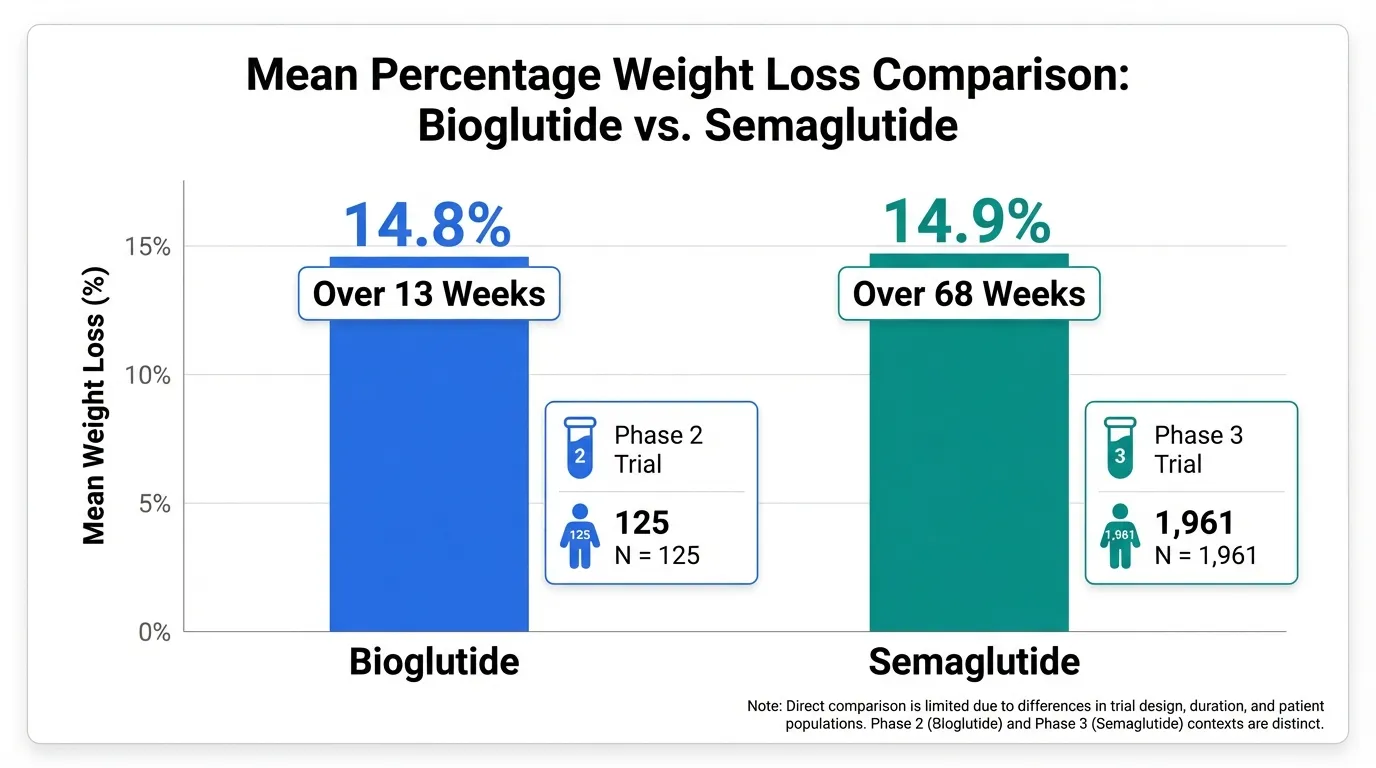
| Mean weight loss | 14.8% at 150 mg | 14.9% at 2.4 mg |
| Placebo-adjusted | 13.2% | ~12.5% |
| Duration | 13 weeks | 68 weeks |
| Sample size | 125 patients | 1,961 patients |
| Achieved 12%+ loss | 72% | ~55% |
| Trial phase | Phase 2 | Phase 3 |
| Weight plateau | Not reached | Approaching plateau |
| Peer-reviewed | Conference presentations | NEJM |
Critical caveat: Bioglutide achieved comparable weight loss to semaglutide in 13 weeks versus 68 weeks, which if sustained would represent dramatically superior efficacy. However, 13-week Phase 2 data in 125 patients cannot be meaningfully compared to 68-week Phase 3 data in 1,961 patients. Early-phase weight loss trajectories frequently do not extrapolate linearly, and many promising Phase 2 results have failed to replicate in Phase 3.
Safety Comparison#
| Parameter | Bioglutide | Semaglutide |
|---|---|---|
| Total patients studied | 125 | 25,000+ |
| GI events | Reported as mild/comparable to placebo | Most common AE class |
| Muscle loss | Not observed (company report) | ~40% of weight is lean mass |
| CV outcomes data | None | SELECT (20% MACE reduction) |
| Long-term data | 13 weeks | 7+ years |
| Peer review | Conference presentations only | Extensively peer-reviewed |
Key Differences Summary#
- Receptor targets: Bioglutide activates 4 receptors (GLP-1/GIP/glucagon/IGF-1); semaglutide activates 1 (GLP-1)
- Weight loss timeline: Bioglutide 14.8% in 13 weeks vs semaglutide 14.9% in 68 weeks
- Muscle preservation: Bioglutide claims IGF-1-mediated preservation; semaglutide causes lean mass loss
- Evidence quality: Semaglutide has 25,000+ patients and NEJM publication; bioglutide has 125 patients and conference data
- Administration: Both have oral options; semaglutide also has injectable
- GI tolerability: Bioglutide reports lower GI events; requires larger trial confirmation
- CV benefit: Semaglutide has proven MACE reduction; bioglutide has no CV data
Conclusion#
Bioglutide's quadruple-agonist mechanism and Phase 2 data are scientifically intriguing, with weight loss approaching semaglutide's results in a fraction of the time and claims of muscle preservation that would address a fundamental limitation of current obesity treatments. However, the evidence gap between these two agents is enormous. Semaglutide has 25,000+ trial participants, proven cardiovascular benefit, 7+ years of safety data, and global availability. Bioglutide has 125 patients over 13 weeks with conference-only presentations. Until Phase 3 data with rigorous body composition analysis and long-term safety monitoring are available, semaglutide remains the proven standard by a wide margin. Bioglutide's potential is high but entirely unvalidated at this stage.
Detailed Category Analysis#
Mechanism of Action#
Bioglutide: First-in-class oral quadruple receptor agonist targeting GLP-1, GIP, glucagon, and IGF-1 receptors simultaneously. Four-pathway activation provides weight loss, metabolic improvement, and muscle preservation via IGF-1 signaling. Small molecule by Biomed Industries.
Semaglutide: Selective GLP-1 receptor agonist. Activates GLP-1 receptors only for appetite suppression, gastric emptying delay, and glucose homeostasis. Available as injectable (Ozempic/Wegovy) and oral (Rybelsus).
Advantage: Bioglutide
Weight Loss Efficacy#
Bioglutide: Phase 2 showed 14.8% mean weight loss at 150 mg at 13 weeks (13.2% placebo-adjusted). 72% achieved 12% or more weight loss. Rapid onset of weight reduction in a short trial. No plateau observed.
Semaglutide: STEP 1 demonstrated 14.9% mean weight loss at 2.4 mg over 68 weeks. 50.5% achieved 15% or more loss. Proven, reproducible efficacy across multiple large Phase 3 trials.
Advantage: Bioglutide
Muscle Preservation#
Bioglutide: Phase 2 data indicate body fat reduction without muscle loss, attributed to IGF-1 receptor activation. This is unique among obesity treatments and could reduce sarcopenic obesity risk. No DEXA or detailed body composition data published.
Semaglutide: Weight loss includes both fat and lean mass reduction, typical of GLP-1 agonists. STEP trials showed approximately 40% of weight loss was lean mass. No specific muscle-preserving mechanism.
Advantage: Bioglutide
Development Stage and Evidence#
Bioglutide: Phase 2 completed (125 patients, 13 weeks). Presented at EASD 2025 and ENDO 2025 conferences. Phase 2b/3 ongoing. Not peer-reviewed in a major journal. Very limited total safety exposure.
Semaglutide: FDA-approved since 2017 for T2D, 2021 for obesity. Over 25,000 clinical trial participants across SUSTAIN, PIONEER, STEP, SELECT programs. 7+ years of post-marketing surveillance.
Advantage: Semaglutide
Safety Profile#
Bioglutide: GI adverse events predominantly mild or comparable between treatment and placebo arms. Company reports lower GI side effects than existing GLP-1 therapies. Very limited safety database (125 patients, 13 weeks).
Semaglutide: Well-characterized over 7+ years. Proven CV safety (SELECT, 20% MACE reduction). GI side effects are the most common AE class. Extensive post-marketing surveillance with rare events identified.
Advantage: Semaglutide
Summary and Verdict#
Bioglutide (NA-931) presents a novel quadruple-agonist mechanism that is scientifically ambitious, targeting GLP-1, GIP, glucagon, and IGF-1 receptors in a single oral molecule. The Phase 2 data (14.8% weight loss at 13 weeks with reported muscle preservation) are remarkable if confirmed, suggesting rapid, substantial weight loss that approaches semaglutide's 68-week results in just a fraction of the time. However, extreme caution is warranted. The data come from a small (125-patient), short (13-week) trial presented at conferences but not yet peer-reviewed in a major journal. The muscle preservation claims lack published DEXA data. Semaglutide remains the proven standard with massive evidence, cardiovascular benefit, and years of real-world safety data. Bioglutide's claims require rigorous Phase 3 validation before meaningful clinical comparison.
Best For Recommendations#
Proven Treatment Today#
Recommendation: Semaglutide
Reason: Semaglutide is FDA-approved, globally available, and backed by 25,000+ trial participants and 7+ years of real-world data. Bioglutide is in early clinical development.
Cardiovascular Risk Reduction#
Recommendation: Semaglutide
Reason: SELECT demonstrated 20% MACE reduction with semaglutide 2.4 mg in 17,604 patients. Bioglutide has no cardiovascular outcomes data.
Muscle Preservation During Weight Loss (Future)#
Recommendation: Bioglutide
Reason: Bioglutide's IGF-1 receptor activation may preserve muscle mass during weight loss, addressing a key limitation of all current GLP-1 therapies. This claim requires Phase 3 confirmation with body composition data.
Multi-Pathway Metabolic Correction (Future)#
Recommendation: Bioglutide
Reason: The four-receptor mechanism (GLP-1/GIP/glucagon/IGF-1) is the broadest metabolic coverage of any obesity agent in development, theoretically providing more comprehensive metabolic improvement than single-target agents.
Oral Treatment Without GI Issues (Future)#
Recommendation: Bioglutide
Reason: Phase 2 reported lower GI adverse events compared to existing GLP-1 therapies, though this requires confirmation in larger trials. If confirmed, this would be a significant tolerability advantage.
Further Reading#

Which Is Better For...
Proven Treatment Today
Semaglutide
Semaglutide is FDA-approved, globally available, and backed by 25,000+ trial participants and 7+ years of real-world data. Bioglutide is in early clinical development.
Cardiovascular Risk Reduction
Semaglutide
SELECT demonstrated 20% MACE reduction with semaglutide 2.4 mg in 17,604 patients. Bioglutide has no cardiovascular outcomes data.
Muscle Preservation During Weight Loss (Future)
Bioglutide
Bioglutide's IGF-1 receptor activation may preserve muscle mass during weight loss, addressing a key limitation of all current GLP-1 therapies. This claim requires Phase 3 confirmation with body composition data.
Multi-Pathway Metabolic Correction (Future)
Bioglutide
The four-receptor mechanism (GLP-1/GIP/glucagon/IGF-1) is the broadest metabolic coverage of any obesity agent in development, theoretically providing more comprehensive metabolic improvement than single-target agents.
Oral Treatment Without GI Issues (Future)
Bioglutide
Phase 2 reported lower GI adverse events compared to existing GLP-1 therapies, though this requires confirmation in larger trials. If confirmed, this would be a significant tolerability advantage.
Continue Your Research
Get comparison updates
We publish new head-to-head comparisons regularly. Subscribe to see them first.
Frequently Asked Questions About Bioglutide vs Semaglutide: Oral Quad Agonist vs Proven GLP-1 Standard
Which is better, Bioglutide or Semaglutide?
Bioglutide (NA-931) presents a novel quadruple-agonist mechanism that is scientifically ambitious, targeting GLP-1, GIP, glucagon, and IGF-1 receptors in a single oral molecule. The Phase 2 data (14.8% weight loss at 13 weeks with reported muscle preservation) are remarkable if confirmed, suggesting rapid, substantial weight loss that approaches semaglutide's 68-week results in just a fraction of the time. However, extreme caution is warranted. The data come from a small (125-patient), short ... Individual responses may vary, and this comparison is based on available research data, not a treatment recommendation.
What are the key differences between Bioglutide and Semaglutide?
The main differences across comparison categories are: Mechanism of Action: advantage goes to Bioglutide; Weight Loss Efficacy: advantage goes to Bioglutide; Muscle Preservation: advantage goes to Bioglutide. 2 additional categories are analyzed in the full comparison. Each category evaluates a different dimension of the two peptides.
When should I consider Semaglutide over Bioglutide?
For the scenario of "Proven Treatment Today," research data suggests Semaglutide may be more relevant. Semaglutide is FDA-approved, globally available, and backed by 25,000+ trial participants and 7+ years of real-world data. Bioglutide is in early clinical development.. This is based on currently available evidence and individual circumstances may differ.
How do Bioglutide and Semaglutide differ in their mechanisms of action?
Bioglutide: First-in-class oral quadruple receptor agonist targeting GLP-1, GIP, glucagon, and IGF-1 receptors simultaneously. Four-pathway activation provides weight loss, metabolic improvement, and muscle pr.... Semaglutide: Selective GLP-1 receptor agonist. Activates GLP-1 receptors only for appetite suppression, gastric emptying delay, and glucose homeostasis. Available as injectable (Ozempic/Wegovy) and oral (Rybels....
Which has fewer side effects, Bioglutide or Semaglutide?
In terms of side effects and tolerability, the advantage goes to Semaglutide. Bioglutide: GI adverse events predominantly mild or comparable between treatment and placebo arms. Company reports lower GI side effects than existing GLP-1 th.... Semaglutide: Well-characterized over 7+ years. Proven CV safety (SELECT, 20% MACE reduction). GI side effects are the most common AE class. Extensive post-marke....
Medical Disclaimer
This website is for educational and informational purposes only. The information provided is not intended to diagnose, treat, cure, or prevent any disease. Always consult with a qualified healthcare professional before using any peptide or supplement.