Bioglutide (NA-931) Dosage Guide: Phase 2 Doses & Titration
What Is Bioglutide (NA-931)?#
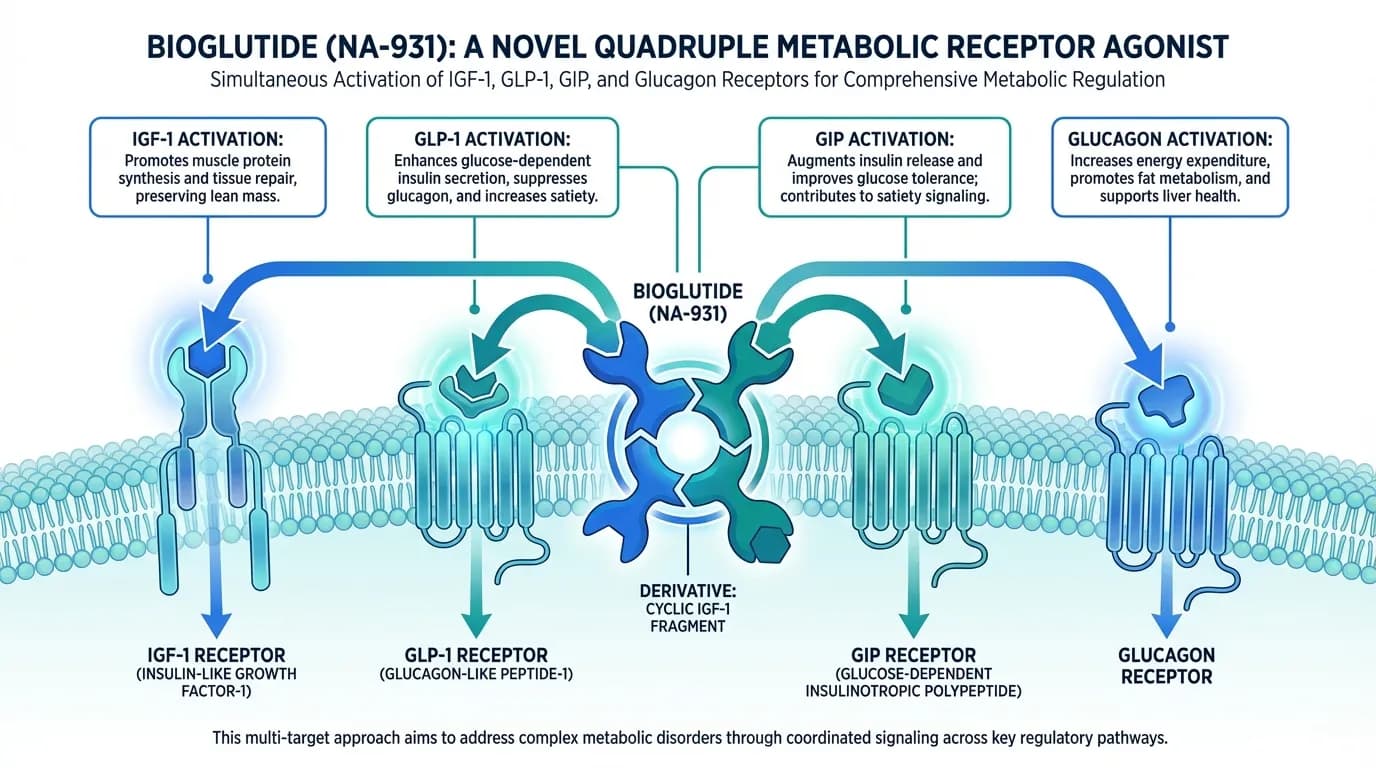
Bioglutide (NA-931) is a first-in-class, orally active small-molecule quadruple receptor agonist developed by Biomed Industries. Unlike existing GLP-1 drugs that target one or two receptors, bioglutide simultaneously activates four metabolic hormone receptors: IGF-1, GLP-1, GIP, and glucagon. It is derived from a cyclic IGF-1 fragment and designed as a once-daily oral capsule.
The drug's four-receptor mechanism is designed to address limitations of current GLP-1 agonists, particularly muscle mass loss during weight reduction (the IGF-1 component) and the high rate of gastrointestinal side effects (the balanced multi-receptor approach).
As of March 2026, bioglutide has completed Phase 1 and Phase 2 clinical trials and is not approved for any indication. Phase 3 trials are planned.
Phase 1 Dose Escalation Data#
The Phase 1 study (NCT06615700) enrolled 74 otherwise healthy overweight and obese adults and tested multiple ascending doses up to 150 mg daily over 28 days.
Key findings from Phase 1:
- Doses of 60 mg and above showed sustained weight loss effects
- The highest dose group achieved 6.4% mean weight loss at Day 28
- Weight loss was maintained or continued to improve at Day 35, seven days after the last dose, suggesting a sustained pharmacological effect
- The drug was administered as a once-daily oral capsule
Phase 2 Dosing and Results#
The Phase 2 study (NCT06564753) enrolled 125 adults with obesity (BMI 30 or greater) or overweight with comorbidities and tested ascending doses up to 150 mg daily over 13 weeks.
Results at the 150 mg daily dose:
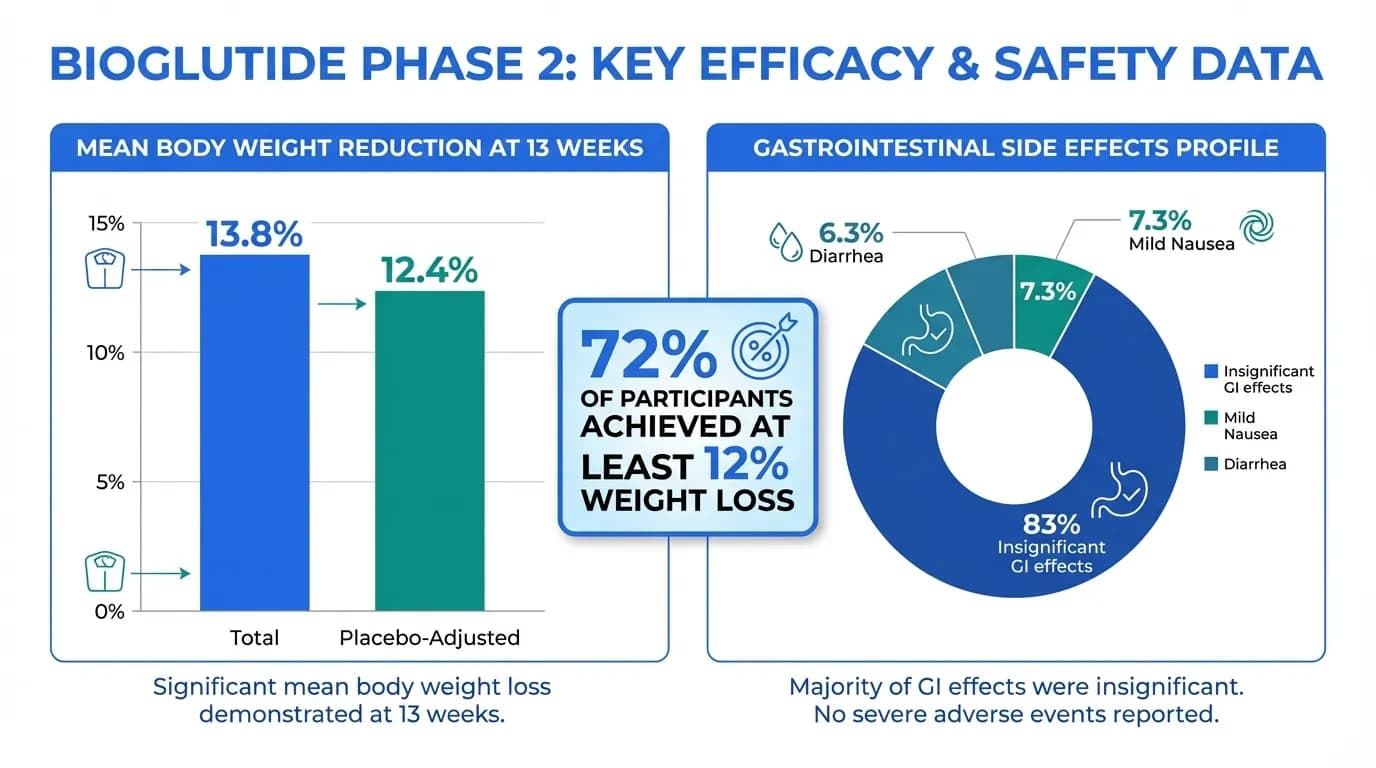
- 13.8% mean body weight reduction at 13 weeks (12.4% placebo-adjusted)
- 72% of participants achieved at least 12% weight loss
- Gastrointestinal side effects were minimal: 83% reported insignificant GI effects, 7.3% experienced mild nausea, and 6.3% experienced diarrhea
- No fasting or food restrictions were required for dosing
- Blood levels were consistent regardless of fasting state or consumption of a high-fat meal
The exact titration schedule (how doses were escalated from lower to higher amounts) has not been publicly disclosed in detail. Conference abstracts describe "ascending doses up to 150 mg daily" without specifying the step-by-step escalation protocol.
For complete dosing protocol details, see the bioglutide dosing page.
Combination Therapy Trial#
A Phase 2 combination study (NCT06732245) is enrolling 224 participants to test bioglutide 150 mg daily combined with tirzepatide subcutaneous injection. Preclinical studies showed synergistic effects on weight, glucose, and lipids. This trial is designed to assess whether the combination produces greater weight loss while reducing GI adverse events and preserving muscle mass compared to either drug alone.
How Bioglutide Dosing Compares to Other GLP-1 Agonists#
| Feature | Bioglutide (NA-931) | Semaglutide (Wegovy) | Tirzepatide (Zepbound) |
|---|---|---|---|
| Route | Oral capsule | Weekly injection | Weekly injection |
| Target dose | 150 mg daily | 2.4 mg weekly | 15 mg weekly |
| Titration period | ~13 weeks (Phase 2) | 16-20 weeks | 20-28 weeks |
| Receptors targeted | 4 (IGF-1, GLP-1, GIP, glucagon) | 1 (GLP-1) | 2 (GLP-1, GIP) |
| Fasting required | No | No (injection); Yes (oral Rybelsus) | No |
| GI side effects | 7.3% mild nausea | ~40-45% nausea | ~25-35% nausea |
| Weight loss at trial endpoint | 13.8% at 13 weeks | ~15% at 68 weeks | ~20-22% at 72 weeks |
The most notable differences are the oral route of administration, the shorter trial duration showing substantial weight loss, and the markedly lower rate of GI side effects. However, direct head-to-head comparisons have not been conducted, and the Phase 2 trial was only 13 weeks long compared to the much longer pivotal trials for semaglutide and tirzepatide.
Important Caveats#
Bioglutide is an investigational drug that is not FDA-approved for any indication. The dosing information in this article is drawn from clinical trial data and conference abstracts, not prescribing information.
Key limitations of current data:
- Small sample sizes: Phase 1 (n=74) and Phase 2 (n=125) trials
- Short duration: Maximum 13 weeks of treatment data
- No peer-reviewed publications: Phase 2 results are available only as conference abstracts as of early 2026
- Unknown long-term safety: No data beyond 13 weeks of continuous use
- No head-to-head trials: Comparisons to semaglutide and tirzepatide are indirect
Frequently Asked Questions#
Frequently Asked Questions About Bioglutide (NA-931) Dosage Guide: Phase 2 Doses & Titration
What is the recommended dose of bioglutide?
Bioglutide (NA-931) is an investigational drug with no approved dose. In Phase 2 clinical trials, the highest tested dose of 150 mg taken once daily as an oral capsule produced the greatest weight loss (13.8% at 13 weeks). Phase 1 data showed that doses of 60 mg and above produced sustained weight loss effects.
Does bioglutide require injection?
No. Bioglutide is an oral capsule taken once daily by mouth. Unlike semaglutide (Ozempic/Wegovy) and tirzepatide (Mounjaro/Zepbound), it does not require injection. It also does not require fasting or food restrictions before or after dosing.
How does bioglutide dosing compare to semaglutide?
Semaglutide requires a multi-month titration from 0.25 mg to 2.4 mg via weekly injection, reaching full dose around month 4-5. Bioglutide in Phase 2 used ascending doses up to 150 mg daily as an oral capsule over 13 weeks. The full titration schedule for bioglutide has not been publicly disclosed.
Is bioglutide FDA approved?
No. Bioglutide (NA-931) is not FDA approved for any indication as of March 2026. It has completed Phase 1 and Phase 2 clinical trials, with Phase 3 trials planned. It is developed by Biomed Industries.
Continue reading this research review
Free access to the complete analysis with citations and evidence ratings.
150+ peptide profiles · 30+ comparisons · 18 research tools
Medical Disclaimer
This website is for educational and informational purposes only. The information provided is not intended to diagnose, treat, cure, or prevent any disease. Always consult with a qualified healthcare professional before using any peptide or supplement.
Join 2,000+ researchers getting biweekly updates
Enjoyed this article?
The Research Briefing delivers deep-dives like this biweekly — plus new study breakdowns, safety updates, and tool announcements.
Free forever. No spam. Unsubscribe in one click.
Where to Find These Peptides
Continue Exploring
Peptide Profiles
Keep Reading

GLP-1 Side Effects Compared: Which Drug Is Best Tolerated?
A comprehensive comparison of GI side effects across GLP-1 drugs, from semaglutide and tirzepatide to next-generation biased agonists like ecnoglutide and CT-388 that may improve tolerability.
Where to Buy Semaglutide in Canada: 2026 Vendor Guide
Where to buy semaglutide in Canada in 2026: Canadian-domestic research vendors, CAD pricing, payment options, customs risk, and shipping speeds compared. Vendor picks by use case included.
Core Peptides Review 2026: COAs, Finnrick Controversy, and Whether the Score Holds Up
An honest 2026 review of Core Peptides covering product range, payment flexibility, shipping, COA transparency, and how the Finnrick Analytics controversy should change how you read vendor ratings. Includes 8-dimension scoring.
You Might Also Like
Related content you may find interesting