Peptide Safety Checklist: What to Verify Before Starting Any Peptide

Introduction#
The question "are peptides safe?" has no single answer. Safety varies dramatically depending on which peptide you are considering, where it comes from, how it is administered, and your individual health profile. An FDA-approved peptide like semaglutide with data from thousands of clinical trial participants is in a fundamentally different safety category than a preclinical peptide sourced from an unregulated vendor.
This checklist provides 10 actionable steps to verify before starting any peptide. Unlike general safety guides that describe risks in broad terms, this article is prescriptive -- it tells you exactly what to check, how to check it, and what answers should give you pause.
For comprehensive background on peptide safety principles, see the Safety page and the Peptide Safety Guide.
The 10-Point Peptide Safety Checklist#
1. Verify the Research Status#
What to check: What is the highest level of clinical evidence for this peptide, for the specific use you are considering?
How to check it: Look up the peptide's profile on this site and note the research status badge. Then search ClinicalTrials.gov for any active or completed trials.
What the answer means:
| Research Status | Safety Implications |
|---|---|
| FDA Approved | Comprehensive safety data from Phase 3 trials; known side effects documented in prescribing information |
| Phase 2-3 | Meaningful human safety data but not comprehensive; dose-dependent effects still being characterized |
| Phase 1 | Basic human safety profile at tested doses; limited data |
| Preclinical Only | No confirmed human safety data; animal safety data may not translate |
Red flag: If a peptide has only animal data, claims about its "safety profile" in humans are extrapolations, not confirmed findings. This applies to popular peptides including BPC-157 and many others.
2. Confirm Regulatory Status and Legality#
What to check: Is this peptide FDA-approved, available through compounding, or sold as a research chemical?
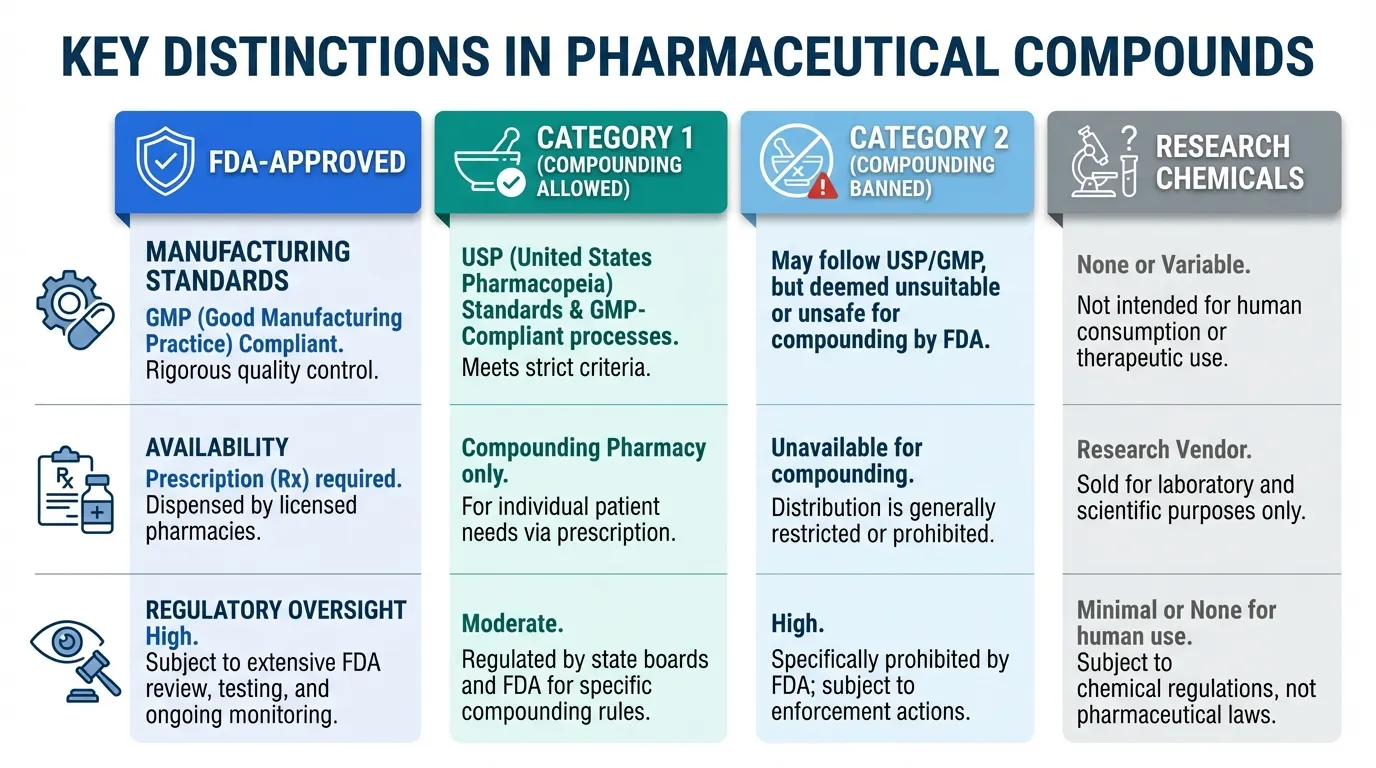
How to check it: Review the FDA-Approved Peptides list and the FDA Peptide Regulation 2026 article for current Category 1/2/3 classifications.
Key distinctions:
- FDA-approved -- Manufactured under GMP standards, available by prescription, quality assured
- Category 1 (compounding allowed) -- Available from compounding pharmacies with a prescription; manufactured under USP standards
- Category 2 (compounding banned) -- Not legally available through compounding pharmacies (includes BPC-157, thymosin alpha-1 as of 2024)
- Research chemicals -- Not regulated as drugs, not intended for human use, no manufacturing quality guarantees
Red flag: If a peptide is sold for "research purposes only," there is no regulatory body ensuring its purity, sterility, or identity. Quality verification falls entirely on you.
3. Evaluate Source Quality#
What to check: Where is the peptide coming from, and what quality documentation is available?
What to request from any supplier:
- Certificate of Analysis (COA) showing:
- HPLC purity analysis (look for 98%+ purity)
- Mass spectrometry confirming correct molecular weight
- Endotoxin testing results (for injectable peptides)
- Testing laboratory name and date
- Third-party testing -- COAs from the manufacturer's own lab are a starting point, but independent verification from an accredited analytical lab is far more reliable
How to evaluate a COA: See our guide on Peptide Quality and Purity.
Red flags in sourcing:
- No COA available or vendor refuses to provide one
- COA appears generic (no lot numbers, generic peptide names, no testing lab identified)
- Prices dramatically lower than comparable vendors without clear explanation
- Vendor makes therapeutic claims about "research chemicals"
- No contact information, physical address, or customer support
4. Review Your Medical History for Contraindications#
What to check: Are there medical conditions in your history that could make a specific peptide risky?
Condition-specific considerations:
| If You Have | Be Cautious With | Why |
|---|---|---|
| Type 2 diabetes | GLP-1 agonists, GH secretagogues | GLP-1 agonists may cause hypoglycemia with insulin/sulfonylureas; GH peptides can worsen insulin resistance |
| History of pancreatitis | GLP-1 agonists | Rare but serious association with pancreatitis |
| Active cancer or cancer history | GH secretagogues, IGF-1 peptides | Growth factors may theoretically promote tumor growth |
| Thyroid conditions (MTC/MEN2) | GLP-1 agonists | Black box warning for thyroid C-cell tumors in animal models |
| Autoimmune conditions | Immune-stimulating peptides | May exacerbate autoimmune flares |
| Pregnancy or breastfeeding | Nearly all peptides | Insufficient safety data for fetal/infant exposure |
| Kidney or liver disease | Most peptides | Altered metabolism and excretion may affect dosing and safety |
Action item: Bring a complete medication and supplement list to your healthcare provider and specifically ask about interactions with the peptide you are considering. See the Peptide Drug Interactions Guide for known interactions.
5. Identify Potential Drug Interactions#
What to check: Will this peptide interact with your current medications?
Known interaction categories:
- GLP-1 agonists and oral medications: Semaglutide and tirzepatide slow gastric emptying, which can delay absorption of oral medications. This is particularly important for medications with narrow therapeutic windows (warfarin, levothyroxine, oral contraceptives).
- GH secretagogues and diabetes medications: Ipamorelin and other GH-releasing peptides may counteract the effects of diabetes medications by worsening insulin resistance.
- Immune peptides and immunosuppressants: Immune-stimulating peptides may conflict with immunosuppressive therapy used for transplant patients or autoimmune conditions.
- Healing peptides and anticoagulants: Peptides that promote angiogenesis (blood vessel formation) may theoretically affect bleeding risk.
Red flag: If you are taking medications for chronic conditions and cannot find information about interactions with a specific peptide, the absence of data does not mean the interaction does not exist -- it means it has not been studied. Discuss this gap with your provider.
6. Understand the Dose Titration Protocol#
What to check: Is there an established dosing protocol, and does it include a titration schedule?
Why titration matters: Many peptide side effects are dose-dependent and occur most frequently when starting or increasing doses. Proper titration minimizes these.
Example -- GLP-1 agonist titration:
Tirzepatide follows a specific titration protocol:
- Start at 2.5 mg weekly for 4 weeks
- Increase to 5 mg weekly for 4 weeks
- Continue increasing by 2.5 mg every 4 weeks as tolerated, up to 15 mg
Skipping steps in this titration dramatically increases the risk and severity of gastrointestinal side effects. The same principle applies to other peptide classes.
Red flag: If a peptide has no established human dosing protocol (because it is preclinical), any dose you encounter is extrapolated from animal data or community experimentation, not clinical evidence.
7. Know What Monitoring Is Required#
What to check: What lab tests or health markers should be tracked before and during peptide use?
Monitoring recommendations by peptide class:
| Peptide Class | Baseline Labs | Ongoing Monitoring |
|---|---|---|
| GLP-1 agonists | HbA1c, lipid panel, thyroid function, kidney function | HbA1c every 3-6 months, thyroid function annually |
| GH secretagogues | IGF-1, fasting glucose, insulin, HbA1c | IGF-1 every 3-6 months, fasting glucose periodically |
| Immune peptides | CBC with differential, CRP, thyroid antibodies | CBC periodically, symptom monitoring |
| General (any injectable) | None specific | Injection site monitoring, symptom diary |
Action item: Get baseline lab work before starting any peptide and establish a monitoring schedule with your healthcare provider.
8. Prepare for Common Side Effects#
What to check: What are the most likely side effects for this specific peptide, and how should you manage them?
Side effects by class:
- GLP-1 agonists: Nausea (40-50% in trials), vomiting, diarrhea, constipation. Usually most severe during titration and improve over 2-4 weeks.
- GH secretagogues: Water retention, joint stiffness, transient numbness/tingling, increased hunger (with GHRP-6). Usually mild and dose-dependent.
- Injectable peptides (general): Injection site redness, swelling, or pain. Minimize with proper technique and site rotation.
- Intranasal peptides: Nasal irritation, mild headache, transient taste changes.
Use the Side Effects Comparison tool to compare side effect profiles across peptides.
When to seek immediate medical attention:
- Severe abdominal pain (possible pancreatitis with GLP-1 agonists)
- Difficulty breathing or swelling of face/throat (allergic reaction)
- Symptoms of hypoglycemia (shakiness, sweating, confusion) if using diabetes medications
- Signs of infection at injection site (increasing redness, warmth, pus, fever)
- Any symptom that is severe, unexpected, or worsening
9. Establish a Start-Low, Go-Slow Protocol#
What to check: Am I starting at the lowest reasonable dose and increasing gradually?
General principles:
- Start at the lowest suggested dose -- even if you have seen higher doses discussed online
- Use one peptide at a time initially -- adding multiple compounds simultaneously makes it impossible to identify which one causes any reaction
- Keep a symptom diary -- record dose, time, injection site, and any effects (positive or negative) daily for the first 2-4 weeks
- Have a stopping plan -- know in advance what symptoms would cause you to reduce the dose or discontinue
Red flag: Recommendations to start at high doses or combine multiple peptides from day one prioritize speed over safety. This approach makes it impossible to identify the source of adverse effects.
10. Know How to Report Adverse Effects#
What to check: Do you know the appropriate channels for reporting side effects?
For FDA-approved peptides:
- Report to the FDA's MedWatch system
- Report to your prescribing physician
- Report to the manufacturer (contact information on product labeling)
For all peptides:
- Document the adverse effect with date, dose, symptoms, duration, and outcome
- Report to your healthcare provider
- If you purchased from a vendor, report to the vendor
Why reporting matters: Post-market safety surveillance relies on adverse event reports. For research peptides with limited safety data, your report may contribute to the collective understanding of a peptide's risk profile.
The Safety Spectrum: Where Does Your Peptide Fall?#
Not all peptides carry the same risk. This framework helps calibrate your approach:
Lowest Risk (Most Evidence, Most Oversight)#
FDA-approved peptides prescribed by a physician: Semaglutide (Wegovy), tirzepatide (Zepbound), PT-141 (Vyleesi). Manufactured under GMP, with known dose ranges, established monitoring protocols, and post-market surveillance.
Moderate Risk#
Compounded peptides from licensed pharmacies with a prescription: Category 1 peptides prepared under USP standards. Quality is generally reliable but manufacturing oversight is less rigorous than FDA-approved products.
Higher Risk#
Research peptides from vendors: No manufacturing oversight, no guaranteed purity or sterility, no established human dosing. The burden of quality verification falls entirely on the user. This category includes many popular peptides discussed in online communities.
Highest Risk#
Peptides from unknown or unverified sources: No COA, no vendor reputation, no quality data. The risk of contamination, wrong identity, or incorrect concentration is substantial.
Key Takeaways#
-
Not all peptides are equal in safety. FDA-approved peptides with thousands of clinical trial participants have fundamentally different safety profiles than preclinical peptides with only animal data.
-
Verify before you trust. Check the research status, regulatory classification, source quality, and COA documentation for any peptide you are considering.
-
Discuss with a healthcare provider. Especially for injectable peptides, medical oversight ensures proper monitoring and timely identification of adverse effects. Bring your medication list and ask specifically about interactions.
-
Start low and go slow. Use the lowest reasonable starting dose, one peptide at a time, with a symptom diary. This approach prioritizes safety and helps identify the source of any adverse effects.
-
Know when to stop and when to seek help. Establish stopping criteria in advance, and know the warning signs that require immediate medical attention.
This checklist is not exhaustive -- individual peptides may have unique safety considerations detailed on their profile pages. For comprehensive safety background, visit the Safety page.
This article is for educational and informational purposes only. It does not constitute medical advice, diagnosis, or treatment recommendations. The checklist above is a general framework and may not cover all individual circumstances. Always consult a qualified healthcare provider before starting any peptide. For comprehensive peptide safety information, see the Safety page and the Peptide Safety Guide.

Frequently Asked Questions About Peptide Safety Checklist: What to Verify Before Starting Any Peptide
Are peptides safe to use?
Safety varies enormously between peptides. FDA-approved peptides like semaglutide and tirzepatide have extensive safety data from thousands of clinical trial participants and ongoing post-market surveillance. Preclinical peptides like BPC-157 have no published human safety data from controlled trials. The safety of any peptide depends on its evidence level, source quality, individual health status, and whether use is medically supervised.
What are the most common peptide side effects?
Side effects vary by peptide class. GLP-1 agonists commonly cause nausea, vomiting, and diarrhea, especially during dose titration. Growth hormone secretagogues may cause water retention, joint stiffness, and transient numbness. Injection-site reactions (redness, swelling, pain) are common across all injectable peptides. Each peptide has a unique side effect profile detailed on its individual profile page.
Do I need a doctor to use peptides?
FDA-approved peptides require a prescription and should always be used under medical supervision. For any injectable peptide, medical oversight is strongly recommended to ensure proper technique, dose monitoring, and timely identification of adverse effects. Even for topical or intranasal peptides, consulting a healthcare provider about potential interactions and contraindications is advisable.
How can I verify peptide quality?
Request and review the Certificate of Analysis (COA) from the supplier. A legitimate COA should include HPLC purity analysis (showing 98%+ purity), mass spectrometry confirming molecular identity, endotoxin testing results, and the name of the testing laboratory. Ideally, verify through third-party testing rather than relying solely on vendor-provided COAs.
Continue reading this research review
Free access to the complete analysis with citations and evidence ratings.
150+ peptide profiles · 30+ comparisons · 18 research tools
Medical Disclaimer
This website is for educational and informational purposes only. The information provided is not intended to diagnose, treat, cure, or prevent any disease. Always consult with a qualified healthcare professional before using any peptide or supplement.
Join 2,000+ researchers getting biweekly updates
Enjoyed this article?
The Research Briefing delivers deep-dives like this biweekly — plus new study breakdowns, safety updates, and tool announcements.
Free forever. No spam. Unsubscribe in one click.
Where to Find These Peptides
Continue Exploring
Peptide Profiles
Keep Reading
Core Peptides Review 2026: COAs, Finnrick Controversy, and Whether the Score Holds Up
An honest 2026 review of Core Peptides covering product range, payment flexibility, shipping, COA transparency, and how the Finnrick Analytics controversy should change how you read vendor ratings. Includes 8-dimension scoring.
Understanding Peptide Side Effects: A Comprehensive Safety Guide
A thorough, evidence-based guide to peptide side effects by category — covering GLP-1 agonists, GH secretagogues, tissue repair peptides, and melanocortins — with serious risk flags, drug interactions, monitoring recommendations, and guidance on when to stop.
Most Popular Therapeutic Peptides in 2026: 15 Ranked by Research Interest
The 15 most popular therapeutic peptides in 2026, ranked by clinical trial activity, search interest, and research community adoption. From semaglutide to BPC-157.
You Might Also Like
Related content you may find interesting