Understanding Peptide Dosing: Units, Conversions, and Calculations

Introduction#
Peptide dosing involves a set of unit conversions and calculations that can be confusing for newcomers. Unlike most oral medications where you simply take a tablet, injectable peptides require you to understand weight measurements, volume measurements, concentrations, and how these relate to the markings on an insulin syringe.
Dosing errors are among the most common mistakes in peptide research. An error in unit conversion or concentration calculation can result in doses that are 10 times too high or too low. This guide covers the foundational math and concepts needed to dose peptides accurately, from basic unit conversions to practical syringe measurement techniques.
For automated calculations, our dosing calculator can handle the math for you. This article explains the principles behind those calculations so you understand what the numbers mean.
Essential Units of Measurement#
Weight Units#
Peptide doses are expressed in weight units. The three you will encounter most frequently are:
| Unit | Abbreviation | Equivalent |
|---|---|---|
| Milligram | mg | 1 mg = 1,000 mcg |
| Microgram | mcg (or ug) | 1 mcg = 0.001 mg |
| International Unit | IU | Varies by peptide (bioactivity-based) |
Milligrams (mg) are used to describe the total amount of peptide in a vial. For example, a vial might contain 5 mg or 10 mg of peptide.
Micrograms (mcg) are used to describe individual doses. Most peptide doses fall in the range of 100-500 mcg per injection. The abbreviation "mcg" is preferred over the older "ug" because "ug" can be misread as "mg," which would represent a 1,000-fold error.
International Units (IU) are a bioactivity-based measurement used for certain peptides, most notably HCG and growth hormone. One IU of HCG is not the same weight as one IU of growth hormone -- the IU is defined by biological activity, not mass. Always check which unit system applies to the specific peptide you are working with.
Volume Units#
| Unit | Abbreviation | Equivalent |
|---|---|---|
| Milliliter | mL | 1 mL = 100 insulin syringe units |
| Insulin syringe unit | units (U) | 1 unit = 0.01 mL |
| Cubic centimeter | cc | 1 cc = 1 mL (identical) |
Milliliters (mL) and cubic centimeters (cc) are interchangeable -- 1 mL equals exactly 1 cc. In peptide dosing, mL is more commonly used.
Insulin syringe units are the markings on a standard U-100 insulin syringe. There are 100 units in 1 mL. This means each unit mark represents 0.01 mL. These units have nothing to do with International Units -- they are purely a volume measurement on the syringe.
Important: "Units" on an insulin syringe and "International Units" (IU) are completely different things. Insulin syringe units are a volume measurement (0.01 mL per unit). International Units are a measure of biological activity. Confusing these two can lead to serious dosing errors.
The Concentration Equation#
The single most important formula in peptide dosing is:
Concentration = Amount of peptide / Volume of solvent
Or expressed with units:
Concentration (mcg/mL) = Peptide amount (mcg) / Solvent added (mL)
This tells you how much peptide is dissolved in each milliliter of solution. Once you know the concentration, you can calculate the volume needed for any dose.
Worked Example#
You have a 5 mg vial of peptide and add 2 mL of bacteriostatic water.
- Convert mg to mcg: 5 mg = 5,000 mcg
- Calculate concentration: 5,000 mcg / 2 mL = 2,500 mcg/mL
- This means every 1 mL of solution contains 2,500 mcg of peptide
Calculating Your Dose Volume#
Once you know the concentration, use this formula to determine how much solution to draw:
Volume needed (mL) = Desired dose (mcg) / Concentration (mcg/mL)
Worked Example#
You want a 250 mcg dose from your solution with a concentration of 2,500 mcg/mL.
- Volume needed: 250 mcg / 2,500 mcg/mL = 0.1 mL
- Convert to syringe units: 0.1 mL x 100 = 10 units
- Draw to the 10-unit mark on your insulin syringe
Quick Dose Table#
For a 5 mg vial reconstituted with 2 mL of bacteriostatic water (concentration = 2,500 mcg/mL):
| Desired Dose | Volume (mL) | Syringe Units |
|---|---|---|
| 100 mcg | 0.04 mL | 4 units |
| 200 mcg | 0.08 mL | 8 units |
| 250 mcg | 0.10 mL | 10 units |
| 300 mcg | 0.12 mL | 12 units |
| 500 mcg | 0.20 mL | 20 units |
Common Reconstitution Volumes#
The amount of solvent you add determines the concentration. Here is a reference table for common vial sizes:
| Vial Size | Solvent Added | Concentration | Per 10 Units (0.1 mL) |
|---|---|---|---|
| 2 mg | 1 mL | 2,000 mcg/mL | 200 mcg |
| 2 mg | 2 mL | 1,000 mcg/mL | 100 mcg |
| 5 mg | 1 mL | 5,000 mcg/mL | 500 mcg |
| 5 mg | 2 mL | 2,500 mcg/mL | 250 mcg |
| 5 mg | 2.5 mL | 2,000 mcg/mL | 200 mcg |
| 5 mg | 5 mL | 1,000 mcg/mL | 100 mcg |
| 10 mg | 2 mL | 5,000 mcg/mL | 500 mcg |
| 10 mg | 5 mL | 2,000 mcg/mL | 200 mcg |
| 10 mg | 10 mL | 1,000 mcg/mL | 100 mcg |
Tip: Choose your reconstitution volume so that your target dose falls on an easy-to-read syringe marking. For example, if your dose is 250 mcg from a 5 mg vial, adding 2 mL of water gives you exactly 10 units per dose -- a clean, easy measurement.
Understanding Insulin Syringes#
U-100 Syringes (Standard)#
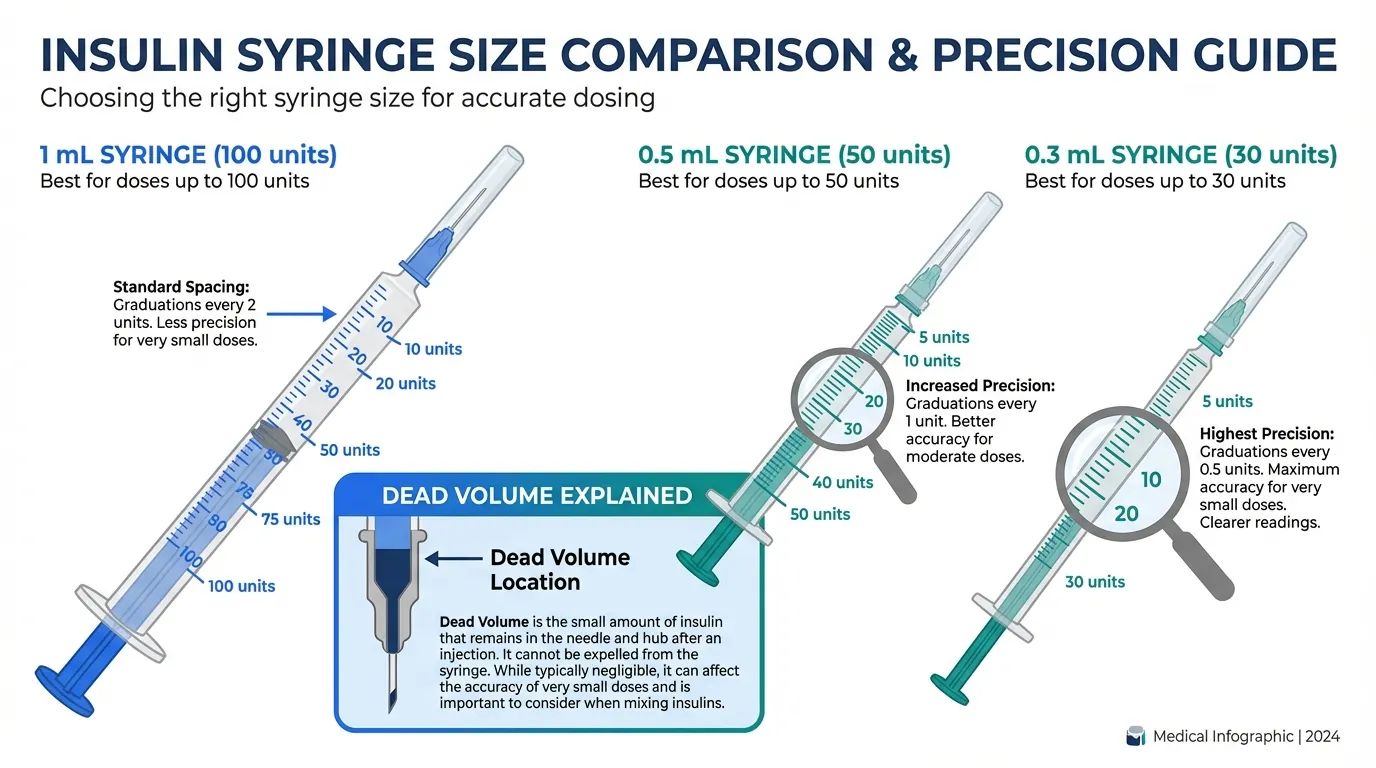
The standard insulin syringe used for peptide dosing is the U-100 syringe, meaning it is calibrated for insulin at 100 units per mL. For peptide use, ignore the "units" label on the syringe packaging -- you are using it as a precision volume measurement tool.
Key markings:
- 100 units = 1.0 mL
- 50 units = 0.5 mL
- 10 units = 0.1 mL
- 1 unit = 0.01 mL
Syringe Sizes#
| Syringe Size | Volume | Best For |
|---|---|---|
| 1 mL (100 unit) | Up to 1.0 mL | Reconstitution and larger doses |
| 0.5 mL (50 unit) | Up to 0.5 mL | Medium doses with better precision |
| 0.3 mL (30 unit) | Up to 0.3 mL | Small doses with best precision |
Smaller syringes have finer graduation marks, making them more accurate for small volumes. If your dose is under 20 units, a 0.5 mL or 0.3 mL syringe will give you better measurement accuracy than a 1 mL syringe.
Dead Volume#
Every syringe retains a small amount of liquid in the hub and needle after injection -- this is called dead volume. In a standard insulin syringe, dead volume is approximately 0.5-1 unit (0.005-0.01 mL). For most doses, this is negligible. However, for very small doses (under 5 units), dead volume can represent a significant percentage of the dose.
Low dead volume (LDV) syringes are available and recommended when dosing very small volumes. These syringes have a redesigned hub that minimizes retained liquid.
Weight-Based Dosing#
Some peptide protocols specify doses based on body weight, typically expressed as mcg per kilogram (mcg/kg). This approach accounts for differences in body mass between individuals.
Conversion Formula#
Dose (mcg) = Body weight (kg) x Dose rate (mcg/kg)
Worked Example#
A protocol specifies 5 mcg/kg of a peptide. The subject weighs 80 kg.
- Dose: 80 kg x 5 mcg/kg = 400 mcg
- If the concentration is 2,500 mcg/mL: 400 / 2,500 = 0.16 mL = 16 units
Converting Pounds to Kilograms#
Many people know their weight in pounds. To convert:
Weight (kg) = Weight (lbs) / 2.205
Example: 180 lbs / 2.205 = 81.6 kg
International Units (IU) Conversion#
For peptides dosed in International Units (like HCG), you need an additional piece of information: the IU-to-weight conversion factor for that specific peptide.
HCG Example#
A common HCG formulation is 5,000 IU per vial. If reconstituted with 2 mL of bacteriostatic water:
- Concentration: 5,000 IU / 2 mL = 2,500 IU/mL
- For a 500 IU dose: 500 / 2,500 = 0.2 mL = 20 units
Growth Hormone Example#
Pharmaceutical growth hormone is typically supplied as 10 IU (approximately 3.33 mg) per vial. If reconstituted with 1 mL:
- Concentration: 10 IU / 1 mL = 10 IU/mL
- For a 2 IU dose: 2 / 10 = 0.2 mL = 20 units
Doses Per Vial: Planning Your Supply#
Knowing how many doses you can get from a vial helps with research planning and budgeting:
Doses per vial = Total peptide in vial (mcg) / Dose per injection (mcg)
Example#
5 mg (5,000 mcg) vial with a dose of 250 mcg per injection:
- Doses per vial: 5,000 / 250 = 20 doses
- At once daily: the vial lasts 20 days
- At twice daily: approximately 10 days
Account for 1-2 doses of waste due to dead volume and the difficulty of withdrawing the very last bit of solution from a vial.
Common Dosing Errors#
Error 1: Confusing mg and mcg#
This is the most dangerous common error. 1 mg = 1,000 mcg. A dose written as "250 mcg" is very different from "250 mg" -- the latter would be 1,000 times larger. Always double-check that your units are correct, especially when transcribing dose information.
Error 2: Confusing Insulin Syringe Units with International Units#
As described above, "units" on an insulin syringe are a volume measurement (0.01 mL each), while International Units (IU) are a bioactivity measurement. These are completely different things. A "500 IU" dose of HCG does not mean drawing to the 500 mark on a syringe -- it means calculating the volume that contains 500 IU based on the concentration.
Error 3: Forgetting to Account for Reconstitution Volume#
If you add 2 mL of water to a 5 mg vial, the concentration is 2,500 mcg/mL. If you then add another 1 mL (perhaps thinking the first was not enough), the total volume is now 3 mL and the concentration drops to approximately 1,667 mcg/mL. Always add the correct amount of water the first time and record the actual volume added.
Error 4: Not Matching Dose to Syringe Precision#
If your calculated dose is 3.7 units, you cannot accurately measure this on most insulin syringes. Either adjust your reconstitution volume to produce a cleaner number, or accept the slight rounding error. For critical precision, choose reconstitution volumes that produce doses falling on even syringe markings.
Error 5: Applying Animal Study Doses Directly#
Research literature often reports doses used in animal studies (typically in rats or mice). These cannot be directly applied to humans due to differences in metabolism, surface area, and body composition. Use our HED calculator to convert animal study doses to human equivalent doses using the FDA's body surface area method.
Dose Titration#
Many peptide protocols involve titration -- starting with a lower dose and gradually increasing to the target dose. This approach allows for monitoring of effects and side effects at each level.
For example, a GLP-1 receptor agonist like semaglutide follows a standardized titration schedule (while GH secretagogues such as ipamorelin and sermorelin typically use simpler titration approaches):
| Week | Dose |
|---|---|
| Weeks 1-4 | 0.25 mg |
| Weeks 5-8 | 0.5 mg |
| Weeks 9-12 | 1.0 mg |
| Weeks 13-16 | 1.7 mg |
| Week 17+ | 2.4 mg |
Other peptides may use a simpler approach of starting at half the target dose for the first week before increasing to the full dose.
Dosing Frequency Terminology#
| Term | Meaning |
|---|---|
| QD | Once daily |
| BID | Twice daily |
| TIW | Three times per week |
| QOD | Every other day |
| QW | Once weekly |
| 5/2 | Five days on, two days off |
Different peptides have different optimal dosing frequencies based on their half-life, mechanism of action, and receptor dynamics. Short half-life peptides like growth hormone secretagogues are typically dosed daily or multiple times daily, while long half-life peptides like semaglutide are dosed weekly.
For a visual comparison of peptide half-lives, see our half-life comparison tool.
Putting It All Together: A Complete Dosing Workflow#
Here is the complete process from opening a new vial to drawing a dose:
- Identify the peptide and vial size (e.g., BPC-157, 5 mg vial)
- Determine your target dose (e.g., 250 mcg)
- Choose a reconstitution volume that produces a convenient concentration (e.g., 2 mL gives 2,500 mcg/mL)
- Reconstitute the peptide following proper technique (see our reconstitution guide)
- Calculate the volume to draw: 250 mcg / 2,500 mcg/mL = 0.1 mL = 10 units
- Draw the calculated volume on your insulin syringe
- Record the dose, date, and time for your research log
For step-by-step reconstitution instructions, see our reconstitution guide. For automated concentration and dose calculations, use our dosing calculator.
Key Takeaways#
-
Master the core conversion: 1 mg = 1,000 mcg. Confusing these units is the most common and most dangerous dosing error.
-
Understand concentration: Concentration (mcg/mL) = peptide amount (mcg) / solvent volume (mL). This is the foundation of all dose calculations.
-
Know your syringe: 100 units on a U-100 insulin syringe = 1 mL. Each unit = 0.01 mL. "Units" on the syringe are not International Units.
-
Choose reconstitution volumes strategically so your target dose falls on an easy-to-measure syringe marking.
-
Never apply animal study doses directly to humans. Use the HED calculator for proper allometric scaling.
-
When in doubt, use a calculator. Our dosing calculator eliminates arithmetic errors from the process.
Related Peptide Profiles#
Learn more about the peptides discussed in this article:
- Semaglutide Overview and Research Guide
- Semaglutide Dosing Protocols
- Semaglutide Side Effects and Safety
- Ipamorelin Overview and Research Guide
- Ipamorelin Dosing Protocols
- Ipamorelin Side Effects and Safety
- Sermorelin Overview and Research Guide
- Sermorelin Dosing Protocols
- Sermorelin Side Effects and Safety
- BPC-157 Overview and Research Guide
- BPC-157 Dosing Protocols
- BPC-157 Side Effects and Safety
- HCG Overview and Research Guide
- HCG Dosing Protocols
- HCG Side Effects and Safety

Frequently Asked Questions About Understanding Peptide Dosing: Units, Conversions, and Calculations
What does this article cover?
Peptide dosing guide: units, conversions, and calculations. Learn mcg-to-mg conversions, syringe units, and common dosing errors. This guide is for educational purposes only and does not constitute medical advice.
Which peptides are discussed in this article?
This article covers Semaglutide, Ipamorelin, Sermorelin, BPC-157, HCG. Key context: Semaglutide (); Ipamorelin (); Sermorelin (). Each peptide is discussed based on available research evidence.
Who is this guide written for?
This guide is written for researchers and individuals seeking an evidence-based overview of the topic covered in "Understanding Peptide Dosing: Units, Conversions, and Calculations." It summarizes available research data without making treatment recommendations. Always consult a healthcare provider for medical decisions.
What are the key takeaways from this article?
The main findings covered in this article include: . These takeaways are based on the research data available at the time of publication.
Continue reading this research review
Free access to the complete analysis with citations and evidence ratings.
150+ peptide profiles · 30+ comparisons · 18 research tools
Medical Disclaimer
This website is for educational and informational purposes only. The information provided is not intended to diagnose, treat, cure, or prevent any disease. Always consult with a qualified healthcare professional before using any peptide or supplement.
Join 2,000+ researchers getting biweekly updates
Enjoyed this article?
The Research Briefing delivers deep-dives like this biweekly — plus new study breakdowns, safety updates, and tool announcements.
Free forever. No spam. Unsubscribe in one click.
Where to Find These Peptides
Continue Exploring
Peptide Profiles
Keep Reading

How to Reconstitute Peptides: A Step-by-Step Guide to Peptide Preparation
Learn how to reconstitute lyophilized peptides safely. Step-by-step guide covering bacteriostatic water, concentration calculations, storage, and common mistakes to avoid.
Understanding Peptide Side Effects: A Comprehensive Safety Guide
A thorough, evidence-based guide to peptide side effects by category — covering GLP-1 agonists, GH secretagogues, tissue repair peptides, and melanocortins — with serious risk flags, drug interactions, monitoring recommendations, and guidance on when to stop.
Peptide Stacking Safety: Synergies, Interactions, and Protocol Design
A safety-focused guide to combining peptides — covering known synergistic combinations, contraindicated pairings, timing and administration principles, recommended bloodwork monitoring, and red flags to watch for during stacked protocols.
You Might Also Like
Related content you may find interesting