The History of Peptide Research: From Insulin to Modern Therapeutics

Introduction#
The history of peptide research spans over a century, from the discovery of insulin in 1921 to the modern era of engineered peptide therapeutics that are reshaping medicine. This history is not merely academic -- it provides essential context for understanding why some peptides are FDA-approved blockbusters while others remain in the early stages of investigation.
Each major advance in peptide science built on what came before: the discovery of peptide hormones led to efforts to synthesize them, which led to techniques for modifying them, which ultimately produced the engineered therapeutics like semaglutide and tirzepatide that are transforming the treatment of obesity and diabetes.
This article traces the key milestones in peptide research from the early 20th century to the present day.
The Discovery Era (1900s-1950s)#
Insulin: The First Peptide Therapeutic (1921)#
The story of peptide therapeutics begins with insulin. In 1921, Frederick Banting and Charles Best, working at the University of Toronto, isolated insulin from the pancreatic extracts of dogs. By January 1922, the first human patient -- 14-year-old Leonard Thompson -- received insulin injections, transforming type 1 diabetes from a death sentence into a manageable condition.
Key milestones in insulin history:
| Year | Milestone |
|---|---|
| 1921 | Banting and Best isolate insulin from canine pancreas |
| 1922 | First human patient treated with insulin |
| 1923 | Banting and Macleod awarded the Nobel Prize in Physiology or Medicine |
| 1926 | John Abel crystallizes insulin, enabling purity assessment |
| 1955 | Frederick Sanger determines the amino acid sequence of insulin (Nobel Prize, 1958) |
| 1969 | Dorothy Hodgkin solves the 3D structure of insulin by X-ray crystallography |
Insulin demonstrated three principles that would guide peptide therapeutics for the next century: peptide hormones regulate critical biological processes, they can be extracted and administered as drugs, and their therapeutic potential is immense.
Discovery of Other Peptide Hormones#
The decades following insulin's discovery saw a wave of peptide hormone identification:
| Decade | Peptides Discovered |
|---|---|
| 1920s-30s | Vasopressin, oxytocin (identified but not yet sequenced) |
| 1940s-50s | ACTH (adrenocorticotropic hormone), melanocyte-stimulating hormone (MSH) |
| 1950s-60s | Glucagon, calcitonin, gastrin, secretin |
| 1960s-70s | Somatostatin, GnRH (gonadotropin-releasing hormone), endorphins, enkephalins |
| 1970s-80s | GLP-1, GHRH (growth hormone-releasing hormone), ANP (atrial natriuretic peptide) |
Each discovery expanded the understanding of how peptides regulate physiology and opened new therapeutic targets.
The Synthesis Revolution (1950s-1980s)#
Vincent du Vigneaud and the First Peptide Synthesis (1953)#
A transformative moment came in 1953 when Vincent du Vigneaud chemically synthesized oxytocin -- a 9-amino-acid peptide hormone involved in labor and lactation. This was the first time a biologically active peptide had been made entirely in the laboratory, proving that peptides could be manufactured rather than just extracted from animal tissues.
Du Vigneaud received the Nobel Prize in Chemistry in 1955 for this achievement.
Solid-Phase Peptide Synthesis (1963)#
The single most important technical advance in peptide chemistry came from Bruce Merrifield, who developed solid-phase peptide synthesis (SPPS) in 1963. Before Merrifield, synthesizing peptides in solution was extraordinarily tedious -- each amino acid addition required purification steps, and yields were poor for longer sequences.
Merrifield's innovation was conceptually simple but revolutionary: anchor the growing peptide chain to an insoluble solid support (a resin bead). This allowed excess reagents and byproducts to be washed away at each step without losing the peptide product. The approach dramatically reduced synthesis time and enabled the production of peptides that were previously impractical to make.
| Aspect | Solution-Phase (Pre-Merrifield) | Solid-Phase (Post-Merrifield) |
|---|---|---|
| Synthesis time | Weeks to months per peptide | Hours to days |
| Maximum practical length | ~10-15 amino acids | 50+ amino acids |
| Purification | Required at each step | Only at final cleavage |
| Automation potential | Very limited | Fully automatable |
| Scalability | Difficult | Routine for research quantities |
Merrifield received the Nobel Prize in Chemistry in 1984. SPPS remains the foundation of peptide synthesis today, though the chemistry has been refined significantly (particularly the introduction of Fmoc chemistry in the 1970s-80s, which replaced Merrifield's original Boc strategy with milder reaction conditions).
Recombinant DNA Technology and Peptide Production (1970s-80s)#
For larger peptides and proteins that exceeded the practical limits of SPPS, recombinant DNA technology provided an alternative production route. In 1978, Genentech produced recombinant human insulin in E. coli bacteria -- the first recombinant pharmaceutical product. This approach enabled the mass production of human-sequence proteins without relying on animal extraction.
Recombinant human growth hormone (somatropin) followed in 1985, replacing the pituitary-derived GH that had been associated with Creutzfeldt-Jakob disease transmission.
The Therapeutic Development Era (1980s-2010s)#
GnRH Agonists: Early Peptide Drug Successes#
The gonadotropin-releasing hormone (GnRH) agonists were among the first peptide drugs designed based on understanding of peptide receptor pharmacology. Leuprolide (Lupron, 1985), goserelin (Zoladex, 1989), and nafarelin (Synarel, 1990) demonstrated that modified peptides could be developed into commercially successful drugs.
These peptides also introduced the concept of depot formulations -- injectable slow-release preparations that could deliver a peptide over weeks to months from a single injection.
Somatostatin Analogs#
Octreotide (Sandostatin, 1988) was a milestone in peptide engineering. Natural somatostatin has a half-life of only 2-3 minutes, making it impractical as a drug. By designing a shorter, modified analog with a half-life of approximately 90 minutes (and later a long-acting release formulation extending this to weeks), researchers demonstrated that peptide modifications could overcome the inherent pharmacokinetic limitations of natural peptides.
The GLP-1 Agonist Story#
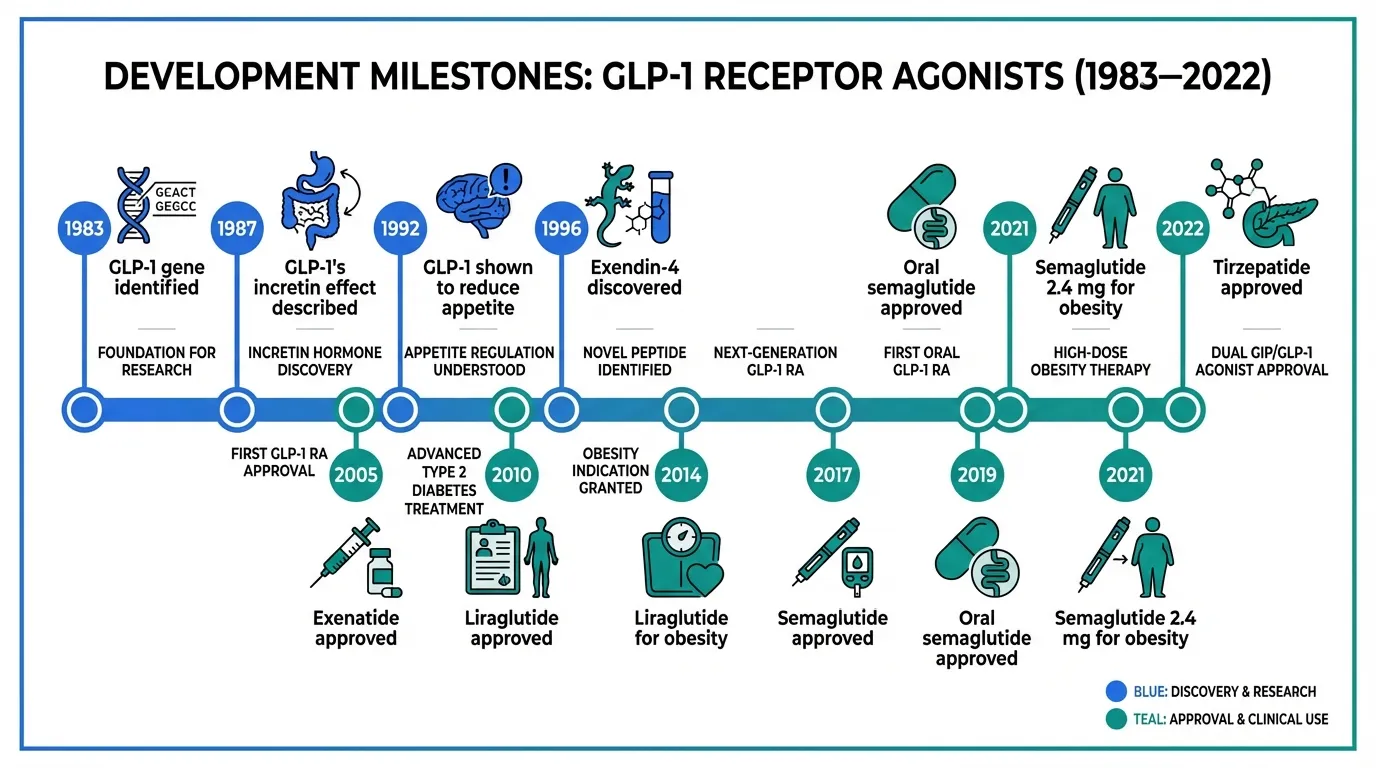
The development of GLP-1 receptor agonists illustrates the full arc of modern peptide therapeutics:
| Year | Milestone |
|---|---|
| 1983 | GLP-1 gene identified within the proglucagon gene |
| 1987 | GLP-1's incretin effect described -- stimulates insulin secretion in response to food |
| 1992 | GLP-1 shown to reduce appetite and food intake in human studies |
| 1996 | Exendin-4 discovered in Gila monster venom (naturally DPP-4 resistant) |
| 2005 | Exenatide (Byetta) approved -- first GLP-1 agonist (from Gila monster exendin-4) |
| 2010 | Liraglutide (Victoza) approved -- first human GLP-1 analog with fatty acid modification |
| 2014 | Liraglutide approved for obesity (Saxenda) |
| 2017 | Semaglutide (Ozempic) approved -- once-weekly dosing via albumin-binding fatty acid |
| 2019 | Oral semaglutide (Rybelsus) approved -- first oral GLP-1 agonist |
| 2021 | Semaglutide 2.4 mg (Wegovy) approved for obesity |
| 2022 | Tirzepatide (Mounjaro) approved -- first dual GLP-1/GIP agonist |
The progression from the discovery of a 2-minute half-life hormone to the development of a once-weekly injectable (and eventually oral) drug that produces 15-17% weight loss represents decades of iterative peptide engineering.
For a detailed explanation of semaglutide's mechanism, see our how semaglutide works guide.
Key Technical Advances#
Chemical Modification Strategies#
Several modification strategies developed over the decades now form the standard toolkit for peptide drug design:
| Modification | Purpose | Example |
|---|---|---|
| D-amino acid substitution | Protease resistance | GHRP-6, hexarelin |
| N-terminal acetylation / C-terminal amidation | Exopeptidase resistance | Many research peptides |
| PEGylation | Extended half-life, reduced immunogenicity | PEG-MGF |
| Fatty acid acylation | Albumin binding, extended half-life | Semaglutide (C18), liraglutide (C16) |
| Cyclization | Structural rigidity, protease resistance | Octreotide |
| Non-natural amino acid insertion | DPP-4 resistance | Semaglutide (Aib at position 8) |
Delivery Technology Advances#
Peptide delivery has evolved significantly:
- Depot injections: Microsphere and polymer-based slow-release formulations (e.g., Lupron Depot)
- Pen injectors: Pre-filled, easy-to-use injection devices (e.g., Ozempic pen)
- Nasal sprays: Intranasal delivery for peptides like desmopressin, calcitonin, and oxytocin
- Oral formulations: SNAC absorption enhancer enabling oral semaglutide (Rybelsus)
- Implants: Subcutaneous implants for sustained peptide delivery (e.g., histrelin implant)
The Modern Era (2020s-Present)#
The GLP-1 Revolution#
The 2020s have been defined by the explosive growth of GLP-1-based therapeutics. Semaglutide and tirzepatide have become among the highest-revenue pharmaceutical products globally, driven by their effectiveness for weight management and type 2 diabetes.
This era has also seen the emergence of multi-agonist peptides:
- Dual agonists: Tirzepatide (GLP-1/GIP), survodutide (GLP-1/glucagon)
- Triple agonists: Retatrutide (GLP-1/GIP/glucagon)
- Oral GLP-1 agonists: Non-peptide small molecules (orforglipron) that activate GLP-1 receptors
Expanding Indications#
Research is actively expanding the therapeutic applications of established peptides:
- Cardiovascular protection: Semaglutide's SELECT trial demonstrated 20% reduction in major cardiovascular events
- Kidney disease: GLP-1 agonists showing renal protective effects
- MASH/NASH: Multiple peptides in trials for metabolic liver disease
- Addiction: Early research on GLP-1 agonists reducing alcohol and substance use behaviors
- Neurodegeneration: Investigation of GLP-1 agonists for Alzheimer's and Parkinson's disease
The Compounding Controversy#
The modern era has also brought regulatory tension. The popularity of peptides like BPC-157, thymosin alpha-1, and others through compounding pharmacies led to FDA enforcement actions in 2024, with numerous peptides placed in Category 2 (banned from compounding). This regulatory landscape continues to evolve.
For the current regulatory status, see our FDA regulation guide and banned peptides list.
Timeline Summary#
| Era | Period | Key Advances |
|---|---|---|
| Discovery | 1921-1960s | Insulin, oxytocin, peptide hormone identification |
| Synthesis | 1953-1980s | First peptide synthesis, SPPS, recombinant DNA technology |
| Early therapeutics | 1980s-2000s | GnRH agonists, somatostatin analogs, first GLP-1 agonists |
| Engineering | 2000s-2010s | Fatty acid acylation, long-acting formulations, oral peptides |
| Modern revolution | 2020s-present | Multi-agonist peptides, expanded indications, regulatory evolution |
Key Takeaways#
-
Peptide research began with insulin in 1921 -- the discovery that transformed diabetes treatment and launched the field of peptide therapeutics.
-
Solid-phase peptide synthesis (1963) was the most transformative technical advance. Merrifield's method made peptide production practical and enabled the synthesis of increasingly complex molecules.
-
Each generation of peptide drugs built on previous advances. From extracting natural hormones to engineering modified analogs with optimized pharmacokinetics, the field progressed incrementally.
-
The GLP-1 agonist story exemplifies the full trajectory -- from hormone discovery in the 1980s to blockbuster drugs in the 2020s, spanning nearly 40 years of iterative development.
-
Multi-agonist peptides represent the current frontier. Dual and triple receptor agonists like tirzepatide and retatrutide target multiple pathways simultaneously for greater therapeutic effects.
-
Regulatory and commercial pressures now shape the field alongside scientific discovery, as the popularity of peptides has brought increased FDA scrutiny of compounding and research peptide markets.
To visualize how half-lives vary across different generations of peptide therapeutics, see the half-life comparison tool. For current FDA regulatory status, see our guide on FDA peptide regulation in 2026.
Related Peptide Profiles#
Learn more about the peptides discussed in this article:

Frequently Asked Questions About The History of Peptide Research: From Insulin to Modern Therapeutics
What does this article cover?
History of peptide research from insulin's 1921 discovery to modern GLP-1 agonists. Key milestones in synthesis and therapeutics. This research review is for educational purposes only and does not constitute medical advice.
Which peptides are discussed in this article?
This article covers Insulin, Semaglutide, Oxytocin. Key context: Insulin (The first peptide hormone discovered and the first used therapeutically, representing the birth o...); Semaglutide (Represents the modern pinnacle of peptide engineering, combining decades of GLP-1 research with a...); Oxytocin (The first peptide hormone to be chemically synthesized, a milestone achievement by Vincent du Vig...). Each peptide is discussed based on available research evidence.
What level of evidence does this research review cover?
This research review examines published preclinical and clinical studies related to the peptides discussed. Evidence quality varies between peptides and indications. The article distinguishes between FDA-approved uses and investigational applications where applicable.
What are the key takeaways from this article?
The main findings covered in this article include: The first peptide hormone discovered and the first used therapeutically, representing the birth o.... Represents the modern pinnacle of peptide engineering, combining decades of GLP-1 research with a.... The first peptide hormone to be chemically synthesized, a milestone achievement by Vincent du Vig.... These takeaways are based on the research data available at the time of publication.
What is Insulin and why is it significant?
Insulin is a peptide discussed in this article because: The first peptide hormone discovered and the first used therapeutically, representing the birth of peptide medicine in 1921. For a complete profile of Insulin, see the dedicated peptide page on this site.
Continue reading this research review
Free access to the complete analysis with citations and evidence ratings.
150+ peptide profiles · 30+ comparisons · 18 research tools
Medical Disclaimer
This website is for educational and informational purposes only. The information provided is not intended to diagnose, treat, cure, or prevent any disease. Always consult with a qualified healthcare professional before using any peptide or supplement.
Join 2,000+ researchers getting biweekly updates
Enjoyed this article?
The Research Briefing delivers deep-dives like this biweekly — plus new study breakdowns, safety updates, and tool announcements.
Free forever. No spam. Unsubscribe in one click.
Where to Find These Peptides
Continue Exploring
Peptide Profiles
Keep Reading

The Evolution of GLP-1 Receptor Agonists: From Single-Target to Multi-Receptor Metabolic Therapeutics
A research review tracing the evolution of GLP-1 receptor agonists from semaglutide through tirzepatide, retatrutide, and survodutide, examining how multi-receptor approaches have progressively expanded efficacy in obesity and metabolic disease.
Liraglutide Side Effects: 2026 Mid-Year Update
A mid-2026 review of liraglutide (Saxenda, Victoza) side effects covering GI tolerability, cardiovascular safety from LEADER, long-term post-marketing signals, and how the profile compares to semaglutide, tirzepatide, and retatrutide.

Retatrutide Canada Guide
Retatrutide in Canada: Everything You Need to Know — part of the Next-Gen Weight Loss content cluster.
You Might Also Like
Related content you may find interesting