Peptides for Women: 7 Research-Backed Options

Introduction#
Peptide research has historically underrepresented female-specific considerations. Many preclinical studies use exclusively male animal models, and early-phase clinical trials have sometimes enrolled predominantly male participants. However, the landscape is changing — particularly in metabolic, reproductive, and dermatological peptide research, where women represent significant or majority populations in clinical trials.
This guide examines seven peptides with substantial research relevance to women's health. The focus is on compounds where either the research population included significant female representation, the biological mechanisms are particularly relevant to female physiology, or the clinical applications address conditions that disproportionately affect women.
Important note: Peptide pharmacology can differ between sexes due to hormonal interactions, body composition differences, and sex-specific receptor expression patterns. Research findings from mixed-sex or male-only studies may not directly translate to female-specific outcomes.
1. Semaglutide#
Evidence Level: Extensive clinical data including large female cohorts Primary Relevance: Weight management, metabolic health, cardiovascular protection FDA Status: Approved (Ozempic, Wegovy, Rybelsus)
Semaglutide has the strongest clinical evidence base of any peptide relevant to women's health. The STEP clinical trial program enrolled substantial female populations — women comprised approximately 70% of STEP 1 participants. This provides robust sex-specific data.
Research Findings Relevant to Women#
In the STEP trials, women demonstrated significant weight loss with semaglutide (typically 14-16% body weight reduction over 68 weeks). Subgroup analyses have shown consistent efficacy across sexes, though some studies suggest slight differences in response patterns.
The SELECT cardiovascular outcomes trial demonstrated a 20% reduction in major adverse cardiovascular events. While cardiovascular disease has historically been underdiagnosed in women, the growing recognition of its burden makes semaglutide's cardiovascular protection particularly relevant.
Semaglutide is also being studied for its effects on polycystic ovary syndrome (PCOS), a condition affecting approximately 10% of women of reproductive age. Early research suggests GLP-1 agonists may improve insulin resistance, reduce androgen levels, and restore ovulatory function in PCOS — though these applications are not yet FDA-approved.
Specific Considerations for Women#
Semaglutide carries label warnings regarding thyroid C-cell tumors based on animal studies. Additionally, GLP-1 agonists are contraindicated during pregnancy due to insufficient safety data. Women of reproductive age should use effective contraception during treatment. The effects of semaglutide on fertility, pregnancy outcomes, and lactation have not been adequately studied.
2. Tirzepatide#
Evidence Level: Extensive clinical data with female-inclusive trials Primary Relevance: Weight management, type 2 diabetes, metabolic syndrome FDA Status: Approved (Mounjaro, Zepbound)
Tirzepatide, the first dual GIP/GLP-1 receptor agonist, has demonstrated the highest weight loss efficacy of any approved metabolic peptide. The SURMOUNT-1 trial showed up to 20.9% body weight reduction in participants with obesity.
Research Findings Relevant to Women#
Women comprised a substantial portion of tirzepatide's clinical trial populations. The dual mechanism (GIP + GLP-1 agonism) provides metabolic benefits that may be particularly relevant for women with insulin resistance, PCOS-related metabolic dysfunction, and post-menopausal metabolic changes.
Tirzepatide's effects on body composition are notable: studies suggest it promotes fat mass loss preferentially over lean mass loss, a distinction that is particularly important for women, who generally have lower baseline lean mass than men.
Specific Considerations for Women#
Like semaglutide, tirzepatide is contraindicated in pregnancy and carries thyroid C-cell tumor warnings. The GI side effect profile (nausea, vomiting, diarrhea) may differ in severity between sexes, though comprehensive sex-stratified side effect analyses are still being published.
3. GHK-Cu#
Evidence Level: Extensive in vitro data; limited clinical outcomes data Primary Relevance: Skin rejuvenation, anti-aging, wound healing FDA Status: Category 2 (injectable); available as topical cosmetic ingredient
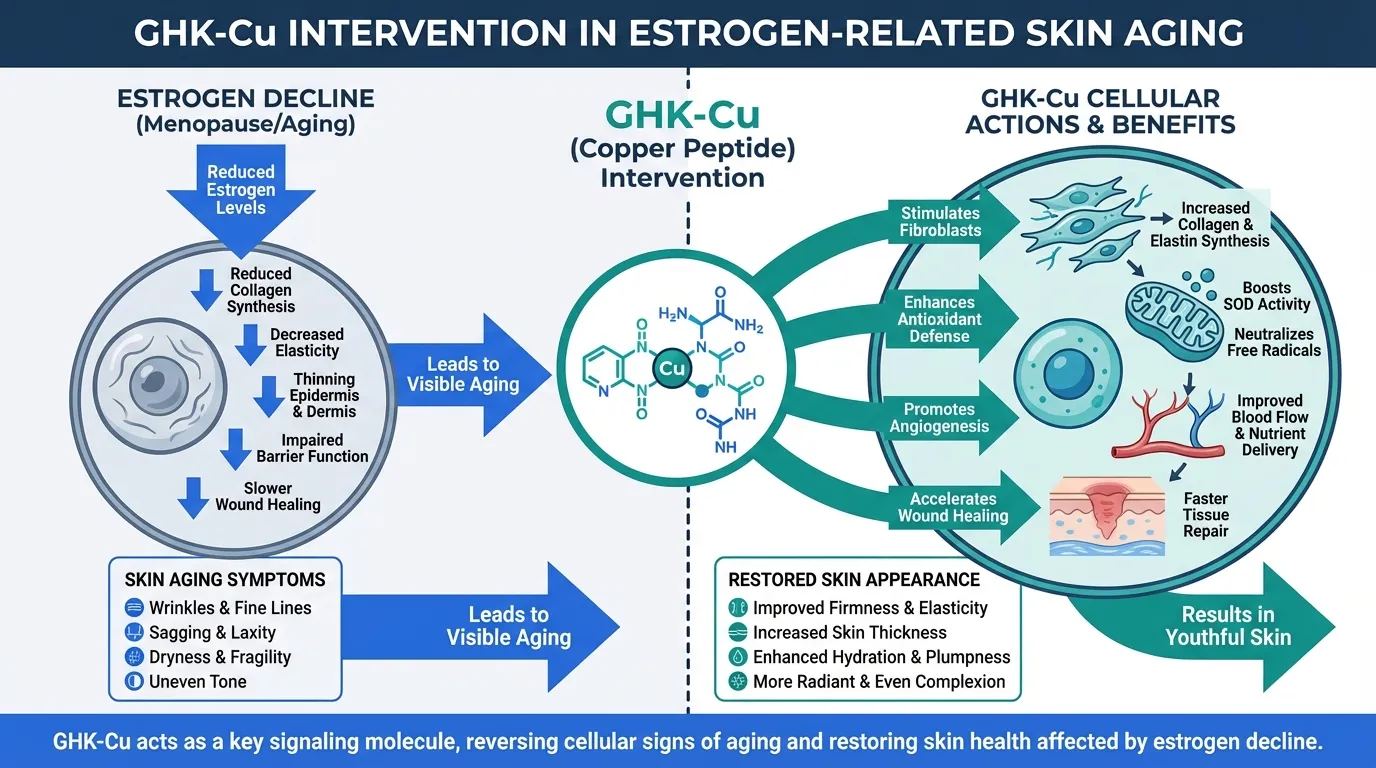
GHK-Cu is one of the most relevant peptides for women's dermatological health. Its ability to modulate over 4,000 genes involved in skin biology — including collagen synthesis, elastin production, and antioxidant defense — addresses many of the skin changes associated with estrogen decline during perimenopause and menopause.
Research Findings Relevant to Women#
Estrogen plays a critical role in maintaining skin thickness, hydration, and collagen content. The decline in estrogen during menopause is associated with accelerated skin aging — reduced collagen (approximately 2% per year post-menopause), decreased skin thickness, and impaired wound healing. GHK-Cu's gene expression profile addresses many of these same pathways.
Topical GHK-Cu formulations are widely used in women's skincare. Studies have reported improvements in skin firmness, fine line appearance, and overall skin quality with topical application, though these studies have been small and often industry-funded.
For more on skin peptides, see 8 Peptides for Skin Health.
4. BPC-157#
Evidence Level: Preclinical (animal studies); very limited human data Primary Relevance: Tissue healing, gut health, recovery FDA Status: Category 2 (banned from compounding)
BPC-157 has been studied for tissue repair across multiple systems. Its relevance to women's health centers on its potential applications in post-surgical recovery, gut health, and musculoskeletal healing.
Research Findings Relevant to Women#
BPC-157's gut healing properties may be particularly relevant for women, who are disproportionately affected by inflammatory bowel conditions and irritable bowel syndrome. Preclinical studies have demonstrated BPC-157's protective effects on gut mucosa and its ability to modulate the gut-brain axis.
Women undergo surgery more frequently than men in several categories (cesarean sections, gynecological surgeries), making tissue healing peptides broadly relevant. However, no human clinical trials have specifically studied BPC-157 in post-surgical female populations.
Specific Considerations for Women#
The effects of BPC-157 on reproductive hormones, pregnancy, and lactation have not been studied. Given the lack of human safety data, particular caution is warranted for women of reproductive age.
5. Kisspeptin#
Evidence Level: Clinical research for reproductive applications Primary Relevance: Fertility, reproductive hormone regulation, PCOS FDA Status: Investigational; not FDA-approved
Kisspeptin is a hypothalamic neuropeptide that serves as a master regulator of the reproductive hormone cascade. It triggers GnRH release, which in turn stimulates LH and FSH secretion from the pituitary. This makes kisspeptin one of the most directly relevant peptides for female reproductive health.
Research Findings Relevant to Women#
Clinical studies have explored kisspeptin for several female-specific applications:
- IVF protocols — kisspeptin has been studied as an alternative to hCG for triggering oocyte maturation in IVF, with the potential advantage of lower risk of ovarian hyperstimulation syndrome (OHSS)
- Hypothalamic amenorrhea — research suggests kisspeptin can restore pulsatile GnRH and LH secretion in women with hypothalamic amenorrhea (a condition common in female athletes and women with eating disorders)
- PCOS — studies are investigating kisspeptin's role in the dysregulated GnRH pulsatility that characterizes PCOS
A notable study demonstrated that kisspeptin-54 injection safely triggered egg maturation in women undergoing IVF without the OHSS risk associated with standard hCG triggers, suggesting a potentially safer approach for high-risk patients.
Specific Considerations for Women#
Kisspeptin research in reproductive health is one of the few peptide areas where the research is inherently female-focused. The peptide's effects are highly dependent on the hormonal milieu, and responses may vary across the menstrual cycle and between pre- and post-menopausal women.
6. Oxytocin#
Evidence Level: Extensive clinical data for established indications Primary Relevance: Labor induction, lactation, social bonding, mood FDA Status: Approved (Pitocin, for labor induction and postpartum hemorrhage)
Oxytocin is an endogenous peptide hormone with well-established roles in female reproductive physiology. Synthetic oxytocin (Pitocin) is one of the most commonly used medications in obstetric medicine.
Research Findings Relevant to Women#
Oxytocin has established clinical applications in women's health:
- Labor and delivery — synthetic oxytocin is used to induce labor and manage postpartum hemorrhage
- Lactation — oxytocin mediates the milk let-down reflex essential for breastfeeding
- Postpartum mood — research has explored intranasal oxytocin's effects on postpartum depression and maternal-infant bonding, though results have been mixed
Beyond obstetric applications, oxytocin research has expanded into areas including social anxiety, autism spectrum disorder, and stress resilience. The effects appear to be modulated by sex hormones — estrogen enhances oxytocin receptor expression, which may explain some sex differences in oxytocin responses.
Specific Considerations for Women#
Oxytocin for labor induction requires careful clinical monitoring due to the risk of uterine hyperstimulation. Intranasal oxytocin for mood and social applications is investigational, and self-administration outside of clinical oversight is not recommended.
7. Glutathione#
Evidence Level: Mixed clinical data for specific applications Primary Relevance: Antioxidant protection, skin health, hormonal detoxification FDA Status: Available as a supplement (GRAS)
Glutathione is the body's primary intracellular antioxidant, and several aspects of its biology are particularly relevant to women's health.
Research Findings Relevant to Women#
Glutathione is involved in estrogen metabolism through the conjugation pathways in the liver. Adequate glutathione levels support the Phase II detoxification enzymes (glutathione S-transferases) that help metabolize and excrete estrogen metabolites. This pathway is relevant for women concerned about estrogen-dominant conditions.
Glutathione's skin health applications — including skin brightening and photoprotection — are among the most commonly sought peptide-based interventions by women. Clinical studies on oral and IV glutathione for skin lightening have shown modest but inconsistent results.
For women undergoing cancer treatment, glutathione has been studied for its potential to reduce oxidative stress and support cellular recovery, though evidence is limited and supplementation during chemotherapy requires careful medical oversight.
Comparison Summary#
| Peptide | Primary Women's Health Application | Evidence Level | FDA Status |
|---|---|---|---|
| Semaglutide | Weight management, PCOS (investigational) | Extensive clinical | Approved |
| Tirzepatide | Weight management, metabolic health | Extensive clinical | Approved |
| GHK-Cu | Skin rejuvenation, anti-aging | In vitro extensive | Category 2/topical |
| BPC-157 | Tissue healing, gut health | Preclinical | Category 2 |
| Kisspeptin | Fertility, reproductive regulation | Clinical research | Investigational |
| Oxytocin | Labor, lactation, bonding | Extensive clinical | Approved (obstetric) |
| Glutathione | Antioxidant, skin, detoxification | Mixed clinical | GRAS (supplement) |
Conclusion#
Women's peptide research spans a wide range of applications — from FDA-approved metabolic therapies to investigational reproductive peptides to preclinical healing compounds. The strongest evidence exists for semaglutide and tirzepatide in weight management, oxytocin in obstetric medicine, and kisspeptin in reproductive endocrinology.
A critical gap in peptide research remains the underrepresentation of female-specific studies and sex-stratified analyses. As the field matures, more research focused on how peptides interact with female physiology — including menstrual cycle effects, pregnancy safety, and menopause-related changes — will be essential for evidence-based clinical application.
For dose calculations and further research tools, visit the Dosing Calculator, and review the Safety page for important quality and risk considerations.
Related Peptide Profiles#
Learn more about the peptides discussed in this article:
- BPC-157 Overview and Research Guide
- BPC-157 Dosing Protocols
- BPC-157 Side Effects and Safety
- Semaglutide Overview and Research Guide
- Semaglutide Dosing Protocols
- Semaglutide Side Effects and Safety
- Tirzepatide Overview and Research Guide
- Tirzepatide Dosing Protocols
- Tirzepatide Side Effects and Safety
- GHK-Cu Overview and Research Guide
- GHK-Cu Dosing Protocols
- GHK-Cu Side Effects and Safety
- Oxytocin Overview and Research Guide
- Oxytocin Dosing Protocols
- Oxytocin Side Effects and Safety
- Kisspeptin Overview and Research Guide
- Kisspeptin Dosing Protocols
- Kisspeptin Side Effects and Safety
- Glutathione Overview and Research Guide
- Glutathione Dosing Protocols
- Glutathione Side Effects and Safety

Frequently Asked Questions About Peptides for Women: 7 Research-Backed Options
What does this article cover?
Seven peptides relevant to women's health — covering weight management, skin rejuvenation, healing, and hormonal support with evidence. This guide is for educational purposes only and does not constitute medical advice.
Which peptides are discussed in this article?
This article covers BPC-157, Semaglutide, Tirzepatide, GHK-Cu, Oxytocin, Kisspeptin, Glutathione. Key context: BPC-157 (Healing peptide with broad tissue repair data relevant to postpartum and post-surgical recovery); Semaglutide (FDA-approved GLP-1 agonist with extensive clinical data in women for weight management); Tirzepatide (FDA-approved dual agonist with clinical trial data showing efficacy in female participants). Each peptide is discussed based on available research evidence.
Who is this guide written for?
This guide is written for researchers and individuals seeking an evidence-based overview of the topic covered in "Peptides for Women: 7 Research-Backed Options." It summarizes available research data without making treatment recommendations. Always consult a healthcare provider for medical decisions.
What are the key takeaways from this article?
The main findings covered in this article include: Healing peptide with broad tissue repair data relevant to postpartum and post-surgical recovery. FDA-approved GLP-1 agonist with extensive clinical data in women for weight management. FDA-approved dual agonist with clinical trial data showing efficacy in female participants. These takeaways are based on the research data available at the time of publication.
What is BPC-157 and why is it significant?
BPC-157 is a peptide discussed in this article because: Healing peptide with broad tissue repair data relevant to postpartum and post-surgical recovery. For a complete profile of BPC-157, see the dedicated peptide page on this site.
Continue reading this research review
Free access to the complete analysis with citations and evidence ratings.
150+ peptide profiles · 30+ comparisons · 18 research tools
Medical Disclaimer
This website is for educational and informational purposes only. The information provided is not intended to diagnose, treat, cure, or prevent any disease. Always consult with a qualified healthcare professional before using any peptide or supplement.
Join 2,000+ researchers getting biweekly updates
Enjoyed this article?
The Research Briefing delivers deep-dives like this biweekly — plus new study breakdowns, safety updates, and tool announcements.
Free forever. No spam. Unsubscribe in one click.
Where to Find These Peptides
Continue Exploring
Peptide Profiles
Keep Reading
Most Popular Therapeutic Peptides in 2026: 15 Ranked by Research Interest
The 15 most popular therapeutic peptides in 2026, ranked by clinical trial activity, search interest, and research community adoption. From semaglutide to BPC-157.

How Long Do Peptides Take to Work? Timelines by Category
How long peptides take to work: timelines for GLP-1 agonists, healing peptides, GH secretagogues, and factors influencing onset.

Peptides vs Proteins: What Is the Difference?
Key differences between peptides and proteins — size, structure, function, and why the distinction matters for therapeutic research.
You Might Also Like
Related content you may find interesting