Finnrick Analytics Review: Transparency Concerns and Conflicts of Interest (2026)

Key Takeaways
- Finnrick Analytics, a VC-backed peptide testing startup, lacks a formal conflict of interest disclosure despite generating revenue directly from the vendors it publicly rates.
- Their paid vendor programs (Premium registration, Launch, Grow, Private Testing) create structural conflicts that are never explicitly addressed in any published COI policy.
- Independent testing revealed a 15% potency discrepancy between labs Finnrick uses, and one lab initially misidentified a peptide entirely.
- The company has no public methodology for which test results are included or excluded from vendor ratings — if a vendor submits 30 samples, there is no way to verify whether all results are published.
- Their job listing for a Gray-Market Whisperer explicitly describes creating content styled like peer recommendations rather than corporate messaging, confirming community concerns about astroturfing.
- Legitimate testing organizations like ConsumerLab, NSF International, and USP all publish formal COI policies, use blind testing protocols, and maintain structural separation between funding and editorial decisions.
The peptide community has a trust problem. In an unregulated gray market where vendors can fabricate Certificates of Analysis, mislabel products, and sell entirely wrong compounds, the appeal of independent peptide testing is obvious. Gray market peptide testing has exploded in demand as consumers seek peptide quality and purity verification from sources other than the vendors themselves. Enter Finnrick Analytics — a venture-capital-backed startup that launched in March 2025, promising to bring "transparency and accountability to the health and wellness supply chains."
On paper, it sounds like exactly what the community needs. But is Finnrick legit? In practice, the questions outnumber the answers.
This article is not a hit piece. Finnrick has produced some genuinely useful data — including the finding that approximately 8% of tested peptide samples contained measurable endotoxin levels, a legitimate peptide safety concern. But the standards we apply to the organizations that claim to be watchdogs should be at least as rigorous as the standards they apply to the vendors they rate.
By those standards, Finnrick falls short in several critical areas.
The core issues at a glance:
- No formal conflict of interest disclosure despite generating revenue from rated vendors
- An economic model that requires either massive VC burn or substantial vendor revenue to sustain
- Vendor-paid testing programs without consistently clear sponsored content labeling
- Zero published methodology for which test results are included or excluded from ratings
- A 15% potency discrepancy documented between their testing labs on identical samples
- A public job listing for a "Gray-Market Whisperer" role focused on astroturfing peptide communities
Finnrick Analytics Conflict of Interest: The Missing Disclosure#
This is the single most important issue, and it is the most straightforward to verify.
As of February 2026, Finnrick Analytics does not publish a formal conflict of interest disclosure anywhere on their website. Their About page includes a section listing things they claim not to do — sell peptides, provide medical advice, publish vendor-supplied data, or accept payment to modify ratings. But a list of denials is not a conflict of interest policy.
A proper COI disclosure addresses the structural relationships that create potential for bias, regardless of whether that bias is acted upon. It answers questions like:
- Do vendors who pay for premium services receive any direct or indirect advantage in public ratings?
- How are testing labs selected, and do any labs have financial relationships with Finnrick or its investors?
- Do Finnrick's investors hold stakes in any peptide vendors, manufacturers, or related businesses?
- When a vendor participates in the paid "Launch with Finnrick" program, are those results treated identically to community-submitted samples?
None of these questions are addressed.
How Legitimate Organizations Handle This#
The absence is conspicuous when compared to industry standards. ConsumerLab, the supplement testing service with over 100,000 subscribers, publishes detailed disclosures explaining that it is fully owned by management with no outside investors who have product interests, accepts no advertising for reviewed products, and purchases all test products at retail through regular channels.
USP (United States Pharmacopeia) operates as a non-governmental, non-profit organization with strict conflict-of-interest regulations. Its expert volunteer committees must disclose conflicts, and it uses a multi-laboratory testing approach specifically designed to eliminate single-lab bias.
NSF International maintains non-profit status with ANSI accreditation, requiring annual retesting and facility inspections for ongoing certification — not one-time approval.
These organizations are not perfect. ConsumerLab has been criticized for shielding paying certification clients from having failures publicly named. But they at least have a policy that can be scrutinized and debated. Finnrick has no policy to scrutinize.
How Does Finnrick Analytics Make Money? The Revenue Problem#
Here is a basic question that deserves a clear answer: How does Finnrick pay for all of this?
Understanding the true HPLC peptide testing cost is essential to evaluating Finnrick's free model. A basic HPLC purity analysis costs $60–$200 per sample at competitive labs. Adding LC-MS identity confirmation (which is necessary to verify the sample actually contains the intended peptide, not just that it is pure) brings the cost to $200–$400 per sample. Finnrick claims to have tested over 5,300 samples. Even at bulk-negotiated rates, that represents a substantial ongoing expense.
Running an analytical lab — even outsourcing to third-party labs — involves significant fixed costs. Monthly operating expenses for an analytical lab run $10,000–$40,000. An LC-MS system alone costs $150,000–$500,000 new. ISO/IEC 17025 accreditation, the international standard for testing lab competence, takes 9+ months and costs six figures.
Finnrick offers free basic testing to US residents. They also offer a $110 endotoxin add-on. The free testing alone cannot sustain operations. So where does the money come from?
The Revenue Streams We Know About#
Finnrick's Vendor Support page reveals several paid programs:
| Program | Price | What It Includes |
|---|---|---|
| Vendor Registration Premium | $279/month | Custom logo, 10% discount on Launch orders |
| Launch with Finnrick | Paid (price not listed) | 4 samples submitted, 2 tested, results published |
| Private Testing | Paid, 10-unit minimum | Confidential branded COAs — results are NOT published |
| Grow with Finnrick | Paid | Vendors subsidize customer testing, co-branded assets |
| Endotoxin Add-On | $110 per test | Bacterial endotoxin screening |
They also received pre-seed venture capital from Kortschak Investments, with named investors including Naval Ravikant (AngelList founder) and Walter Kortschak (early investor in Lyft, Robinhood, and Palantir). The venture capital peptide industry investment signals that investors see a scalable business here — the question is what that business ultimately looks like.
The Structural Problem#
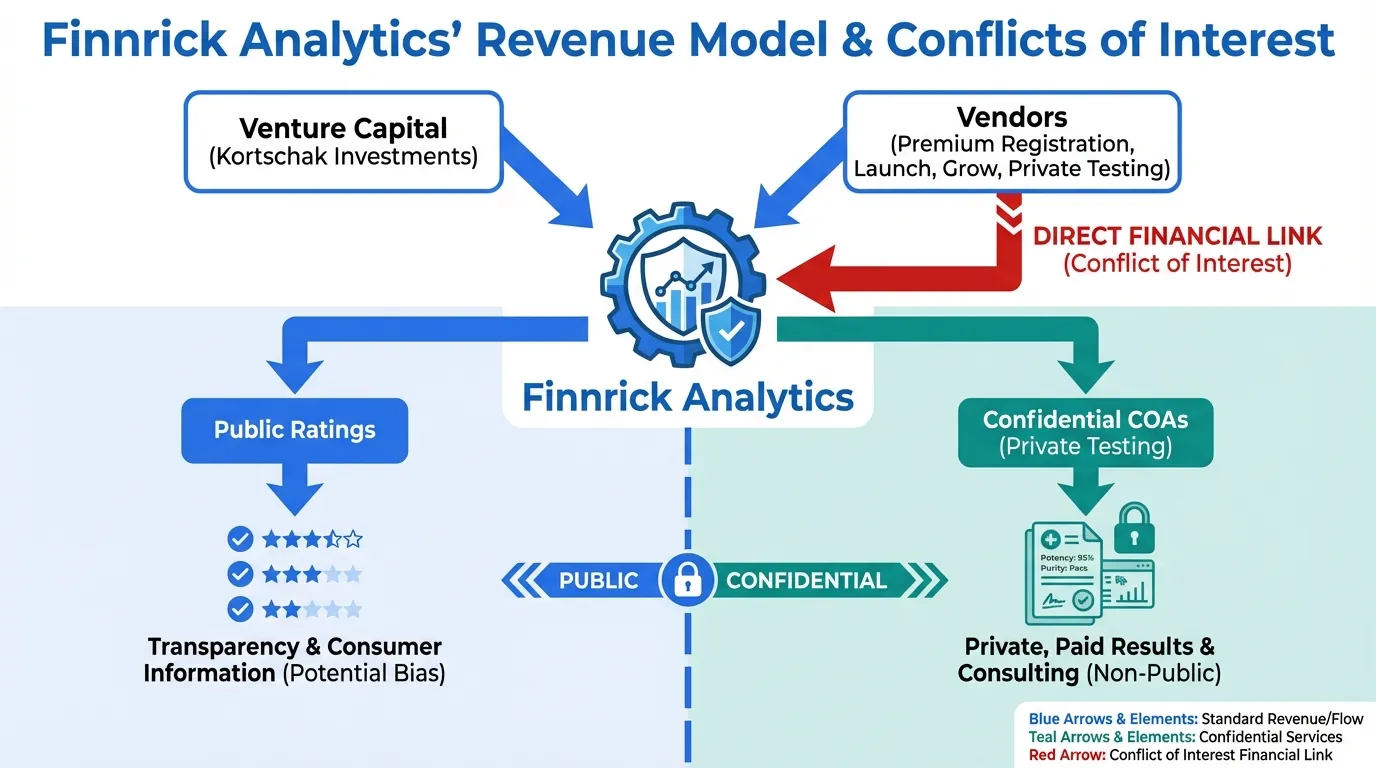
The conflict should be obvious: Finnrick generates revenue directly from the vendors whose products it publicly rates.
When a vendor pays $279/month for premium registration, pays for "Launch with Finnrick" testing, or participates in the "Grow with Finnrick" activation program, that vendor becomes a paying customer of the very organization assigning them a public letter grade.
This is not inherently disqualifying — NSF International also collects fees from manufacturers for certification. But NSF publishes its conflict management policies, maintains non-profit status, requires ANSI accreditation, and mandates annual retesting with ongoing facility inspections. The structural safeguards are visible and verifiable.
Finnrick offers none of these structural safeguards. There is no published policy explaining how paying vendors are treated versus non-paying vendors in the public rating system. There is no visible accreditation from any recognized body. And the existence of the Private Testing program — where vendors can get confidential results that are not published — creates an especially troubling dynamic.
A vendor could theoretically submit samples through the Private Testing program, receive unfavorable results that remain confidential, and still maintain a favorable public profile built only on community-submitted samples that happened to test well. There is no mechanism visible to the public that prevents this.
Finnrick Sponsored Content: Vendor-Paid Tests Without Clear Labels#
Finnrick's vendor programs include what amount to sponsored content opportunities. When a vendor pays for "Launch with Finnrick," they are paying to have test results published on the Finnrick platform. When they participate in "Grow with Finnrick," they receive "co-branded assets and monthly reporting."
The question is: Can a consumer browsing Finnrick's website distinguish between a test result that was organically submitted by an independent community member and one that was part of a paid vendor program?
If the answer is no — and based on our review of the platform, the labeling is not always clear — then this constitutes a form of sponsored content that, under FTC guidelines, requires "clear and conspicuous" disclosure of any material connection between an endorser and a business.
The FTC's Endorsement Guides define an endorsement as "any advertising, marketing, or promotional message for a product that consumers are likely to believe reflects the opinions, beliefs, findings, or experiences of a party other than the sponsoring advertiser." If a vendor pays Finnrick to test and publish results, and those results appear alongside independently submitted results without clear differentiation, this would likely meet the FTC's definition of an undisclosed material connection.
In August 2024, the FTC finalized rules banning fake and misleading reviews, with penalties of up to $51,744 per incident. This sits within a broader evolving regulatory landscape for peptides that is tightening requirements across the industry. Whether vendor-paid test results on a rating platform fall under this FTC supplement testing disclosure framework is a legal question, but the spirit of the regulation is clear: consumers deserve to know when the entity being rated has paid the entity doing the rating.
Finnrick Data Transparency: Which Peptide Test Results Get Published?#
Perhaps the most underappreciated concern is the total opacity around data selection.
Finnrick's rating system scores vendors on a 0–10 scale based on purity, potency, and batch labeling, then assigns letter grades (A through E) based on average scores, minimum scores, and test counts. This methodology is published on their Testing Methodology page, which is a positive step.
But the methodology page does not address a fundamental question: What happens to the data between sample submission and publication?
Consider a scenario:
- A vendor submits 30 samples across multiple products through various Finnrick programs
- 20 of those samples score well; 10 score poorly
- Only the 20 favorable results appear on the website
Is this happening? We genuinely do not know. And that is the problem — there is no published policy on data inclusion, exclusion, or selection.
Legitimate testing organizations address this explicitly:
- ConsumerLab purchases products independently at retail, ensuring manufacturers have no control over which specific units are tested
- USP uses pre-registered test methods with acceptance criteria defined before testing begins
- ISO 17025 requires documentation of all results, including outliers, with statistical methods for handling anomalies
Finnrick's model relies on a combination of community-submitted samples (where the submitter chooses what to send) and vendor-paid programs (where the vendor chooses what to test). In neither case does Finnrick independently and blindly purchase products from the market.
This means the sample pool is inherently non-random. The community may disproportionately test vendors they are suspicious of. Vendors may disproportionately submit products they are confident about. The resulting ratings reflect this selection bias — and there is no published correction for it.
The Vendor Objection Process#
Finnrick does allow vendors to file objections to test results — a form of peptide COA verification in reverse. In at least one documented case — Peptide Sciences' Retatrutide results — this process led to legitimate corrections. A counterfeit sample was identified and removed. A batch identifier error was corrected (changing a score from 6.3 to 8.3). A sample submitted in a quantity the vendor says they don't sell (60mg Tirzepatide) was removed.
These corrections may be entirely appropriate. But they also illustrate the dynamic: vendors have a mechanism to challenge and potentially remove unfavorable results, while there is no corresponding mechanism for consumers to ensure all results are included.
Finnrick Lab Discrepancies: 15% Potency Gap Between Testing Labs#
Independent journalist Rory, writing at Gray Market, conducted one of the most important investigations into Finnrick's testing reliability. The methodology was simple: submit four identical vials from the same Retatrutide batch to Finnrick for testing at different labs.
The results were concerning:
| Lab | Potency Result | Via |
|---|---|---|
| Janoshik (9 vials, vendor + customers) | ~30mg | Direct |
| Janoshik | ~30mg | Via Finnrick |
| Chromate | 30mg | Via Finnrick |
| Krause Laboratories | 26mg (both vials) | Via Finnrick |
Krause Laboratories returned results 15% lower than every other lab testing identical samples from the same batch. After Gray Market published these findings, "multiple people contacted pointing out further discrepancies between Krause Analytical and other companies' mass readings on COAs."
Additionally, Chromate initially identified samples as semaglutide when they actually contained cagrilintide — getting the peptide identity entirely wrong — before issuing corrected COAs.
A 15% potency discrepancy is not a rounding error. If a vendor receives an "A" grade based on Chromate and Janoshik results but a "C" based on Krause results, the rating a consumer sees depends entirely on which lab Finnrick happened to use — and there is no published policy explaining how labs are assigned to samples or how inter-lab discrepancies are handled.
For comparison, USP addresses this exact problem with a multi-laboratory testing approach, using statistical methods to identify and eliminate outlier results across labs. Finnrick has no comparable published methodology.
Finnrick Analytics Reddit and Forum Reviews: Community Concerns#
Online communities have not been kind to Finnrick. The criticism is widespread across multiple independent platforms.
The Iron Den Forum#
User johnjay06 (October 2025): "Finnrick is looked down upon in the grey community. Been suspected of taking donations from vendors to get good results, plus they supposedly data collect."
User CRC1276: "Stay away from Finnrick. Definitely cannot be trusted."
The community consensus on The Iron Den pointed to peptidetest and Janoshik Analytical as more trusted alternatives.
GLP-1 Forum#
The GLP-1 Forum thread on Finnrick contained sustained criticism:
- PeezyBanks: "Nothing in this world is free, could there be a different motive here?"
- chmuse: "Sending them a vial is a waste of product...gives them data to harvest."
- exploitedworkerbee: Predicted the venture capital model where "founders eventually monetize user data"
- desinr-gal: Referenced theories that the service aims to "destroy the grey market" or enable federal enforcement
Moderator zpped criticized Finnrick for using labs of questionable quality, specifically calling out "Vanguard which has been proven for just making things up" and unknown labs like Krause.
When user wkndworrier defended Finnrick by claiming personal connections to the CEO and a billionaire investor, zpped responded: "Thank you Random Internet Stranger for your compelling reasons we should trust the very well funded startup" — in an industry where astroturfing is a known and documented practice.
The User Experience Reports#
User AKC97 on the GLP-1 Forum free testing thread reported paying approximately $50 in shipping, receiving incomplete COAs, and facing nonresponsive customer service. Their verdict: "0 Stars - Do not recommend."
User pavlovs mentioned another user who received communications containing vendor recommendations rather than testing results — which, if accurate, would represent a direct monetization of the user relationship in a way that undermines the appearance of independence.
Derek Pruski's Analysis#
Derek Pruski, writing on Substack, provided one of the more detailed public critiques:
"I observed interviews — specifically from Finnrick — where the people behind these platforms couldn't clearly articulate a real business model."
"No transparent revenue stream. No clear explanation of how they sustain operations."
Pruski theorized what he called a potential "shakedown model": vendors see poor results published, then go directly to the testing platform to "verify" or get "certified" — paying for the privilege of improving their public scores.
Finnrick's "Gray-Market Whisperer" Job Listing: Astroturfing Confirmed?#
Perhaps the most revealing piece of evidence about Finnrick's community engagement strategy is not found on their testing platform — it is found on their job board.
Finnrick posted a listing for a "Community Engagement Lead - Gray-Market Whisperer" offering $85,125 annually with 0.3–0.6% equity. This was one of their first 10 hires, reporting directly to the founders.
The job description is remarkably candid about its purpose:
- Building Finnrick's "voice inside every peptide tribe"
- Creating "a cross-platform content engine that turns HPLC graphs into viral hooks"
- "Debunking vendors in 4chan threads" and "going live on TikTok"
- Building "a real-time intel dashboard tracking new peptide Telegram drops and Reddit ban waves"
- Developing email communication "styled like trusted peer recommendations rather than corporate messaging"
- Using "AI-assisted prompts with natural tone"
The application process required contacting @finnrick_tests on X with a meme. "Traditional resumes are explicitly discouraged."
Let that sink in. This is a paid corporate position whose explicit purpose is to make corporate messaging look like organic community participation. The emails should be "styled like trusted peer recommendations." The content should use "AI-assisted prompts with natural tone." The goal is to have a "voice inside every peptide tribe."
This is the textbook definition of astroturfing — and they published the job description publicly.
When GLP-1 Forum users expressed concerns about Finnrick employees posting as regular community members, they were dismissed as paranoid. This job listing validates those concerns entirely.
What Finnrick Analytics Gets Right: Credit Where Due#
In fairness, Finnrick is not without merit.
The endotoxin finding is important. Their data showing approximately 8% of tested peptide samples contain measurable endotoxin levels represents a genuine public health contribution. Endotoxins — bacterial fragments that can cause fever, chills, or septic shock — are a serious concern for injectable products, and this data point has been widely cited in media coverage.
Publishing any testing data is better than none. The gray market operates with almost zero accountability. Even imperfect testing creates some baseline incentive for vendors to maintain quality.
The vendor objection process has produced legitimate corrections. When Peptide Sciences challenged results and a counterfeit sample was identified, that represents the system working as intended.
The scoring methodology is at least published. Many competitors offer no explanation at all for how they arrive at ratings.
But "better than nothing" and "better than the worst alternatives" are low bars. The question is not whether Finnrick provides any value — it is whether the value they provide is trustworthy enough to base purchasing decisions on.
What Legitimate Independent Peptide Testing Should Look Like#
If Finnrick — or any testing organization — wanted to operate at a standard that the community could genuinely trust, here is what that would require:
1. A Formal Conflict of Interest Policy#
A published document disclosing all financial relationships between the testing organization, its investors, its staff, and any vendors or manufacturers whose products are tested. Updated annually. Reviewed by an independent advisory board.
2. Structural Separation of Revenue and Ratings#
If the organization collects fees from vendors, those fees must fund a structurally separate program from the public rating system. Staff involved in vendor revenue programs should not have influence over rating methodology or publication decisions.
3. Blind Testing Protocols#
Samples should be blinded before being sent to laboratories. Labs should not know which vendor or product they are testing. This eliminates the possibility of lab-level bias.
4. Complete Data Publication#
All test results — favorable and unfavorable — must be published. Pre-registered inclusion/exclusion criteria should be published before testing begins. Any exclusion of data should be documented with a specific reason.
5. Multi-Lab Validation#
Critical results should be confirmed across multiple laboratories. Inter-lab discrepancies should be flagged and addressed using statistical methods, following the USP model.
6. ISO 17025 Accreditation#
Testing labs should hold ISO/IEC 17025 accreditation, the internationally recognized standard for testing and calibration laboratory competence. This is not optional in regulated industries — and while the gray market is not regulated, a testing organization that holds itself out as an authority should meet the standards of one.
7. Independent Sample Procurement#
The gold standard, exemplified by ConsumerLab, is purchasing products independently at retail through normal channels. This eliminates manufacturer control over which specific units are tested and ensures the test pool represents what consumers actually receive.
8. Sponsored Content Labeling#
Any test results associated with vendor-paid programs must be clearly and conspicuously labeled as such, consistent with FTC endorsement guidelines.
Finnrick Analytics vs. Janoshik: How They Compare#
Since Janoshik Analytical is the most frequently cited alternative to Finnrick in community discussions, a direct comparison is useful:
| Criteria | Finnrick Analytics | Janoshik Analytical |
|---|---|---|
| Business model | VC-funded + vendor revenue programs | User-pays per test |
| COI disclosure | None published | N/A (no vendor rating system) |
| Vendor rating system | Yes (A–E letter grades) | No — delivers results to the submitter only |
| ISO 17025 accredited | No | No |
| Community trust | Contested — significant skepticism | High — years of consistent results |
| Blind testing | Not confirmed | N/A (no rating system to bias) |
| Revenue from rated vendors | Yes (Launch, Grow, Premium programs) | No — vendors are not rated |
| Data selection transparency | No published policy | N/A — all results go to the submitter |
| Astroturfing concerns | Yes (Gray-Market Whisperer listing) | Not documented |
| Endotoxin testing | Yes ($110 add-on) | Yes |
| Sample count | 5,300+ claimed | Tens of thousands (operating since ~2017) |
The comparison highlights a fundamental architectural difference: Janoshik's model has fewer structural conflicts because it does not operate a public rating system for vendors. When there is no rating to influence, the incentive to manipulate results disappears. This does not make Janoshik infallible — any single lab can have off days, equipment calibration issues, or analyst errors — but it makes their conflict profile far simpler and more transparent.
Red Flags to Watch For in Any Peptide Testing Service#
These concerns are not unique to Finnrick. When evaluating any third-party peptide testing organization, watch for:
- No formal conflict of interest disclosure — If the organization accepts revenue from the companies it rates and does not publish a COI policy, that is a structural red flag
- Revenue from rated entities — When the watchdog and the watched have a financial relationship, independence requires documented safeguards
- Selective data publication — If there is no published policy on which results are included or excluded, the ratings may not reflect reality
- No ISO 17025 accreditation — While not all useful testing requires accreditation, organizations positioning themselves as authoritative should meet the standards of authority
- Astroturfing or undisclosed community engagement — If an organization's employees participate in forums without disclosing their affiliation, treat all positive mentions with skepticism
- Single-technique testing — HPLC alone cannot confirm identity; peptide purity testing without mass spectrometry is incomplete. Check if both are used
- No raw data publication — If you cannot see chromatograms and spectra, you are trusting a summary rather than verifying the evidence yourself
For a deeper guide on evaluating peptide quality, see our peptide safety checklist.
The Bigger Picture: Why This Matters#
The peptide testing space is young, and its standards are still being set. What we accept now establishes the baseline for what comes next.
If the community accepts testing organizations that generate revenue from the companies they rate without formal conflict of interest disclosures, that becomes the norm. If we accept opaque data selection with no published inclusion/exclusion criteria, every future organization will follow suit. If we tolerate paid astroturfing disguised as organic community engagement, we lose the ability to distinguish authentic information from corporate messaging.
Janoshik Analytical, despite lacking ISO 17025 accreditation and operating with its own set of limitations, has earned community trust through years of consistent results and a fundamentally simpler business model — users pay for tests, results are delivered. There is no vendor rating system creating perverse incentives, no paid "Launch" programs, no "Gray-Market Whisperer" infiltrating forums.
That does not make Janoshik perfect. But it makes their conflicts visible and their incentives aligned with the people paying them.
Finnrick's conflicts are structural, their incentives are misaligned, and their transparency — the very thing they claim to provide — falls well short of the standards that legitimate testing organizations have established over decades.
The peptide community deserves better. And the first step toward getting it is asking the right questions about the organizations that claim to have the answers.
Should You Use Finnrick Analytics?#
This is the question most readers are here to answer, so we will be direct.
Finnrick's data is not worthless. If a vendor consistently receives low purity scores across multiple Finnrick tests, that signal should not be ignored — even if the scoring system has flaws, a pattern of poor results across many samples is meaningful.
However, Finnrick's data should never be your sole source of truth for peptide vendor ratings. The structural conflicts (vendor revenue without COI disclosure), documented lab discrepancies (15% potency gaps), opaque data selection (no published inclusion/exclusion criteria), and active astroturfing strategy (the Gray-Market Whisperer role) all reduce the reliability of their ratings below the threshold of authoritative.
Our recommendation:
- Treat Finnrick data as one signal among many. Cross-reference with Janoshik Analytical results, community reports on independent forums, and vendor-published COAs
- Never make purchasing decisions based solely on Finnrick ratings. The absence of data transparency means you cannot verify what you are seeing
- If you submit samples to Finnrick, also send identical samples to an independent lab. This is the only way to verify Finnrick's results for your specific vendor
- Demand better. If enough community members ask Finnrick to publish a COI policy, accredit their labs, and document their data selection methodology, they may eventually do so. Market pressure works
The gray market needs independent testing — genuinely independent testing, with published conflicts, blind protocols, and complete data. Finnrick is not there yet. Whether they get there depends in part on whether the community holds them to the standard they claim to represent.
Summary: Four Core Finnrick Analytics Concerns#
-
No conflict of interest disclosure. Finnrick generates revenue from vendors it publicly rates and has no published COI policy addressing this structural conflict. Legitimate organizations like ConsumerLab, USP, and NSF International all publish formal COI policies.
-
Economically unsustainable without vendor revenue. Testing 5,300+ samples at $200–$400 each is a $1–2 million undertaking. The free testing model requires either massive VC burn or substantial vendor revenue — and if it is the latter, the conflict of interest question becomes even more urgent.
-
Sponsored content without clear labeling. Vendor-paid programs (Launch, Grow, Private Testing) produce results that appear on the same platform as community-submitted tests. The distinction is not always clearly communicated to consumers.
-
No transparency on data selection. There is no published policy on which test results are included in or excluded from vendor ratings. If a vendor submits 30 samples, the public has no way to verify whether all 30 results are reflected in the rating or only the favorable ones.
These are not abstract concerns. They are the same questions that any competent regulatory framework, journalism ethics board, or scientific peer review process would ask of any organization claiming to serve as an independent watchdog.
Finnrick may yet address these concerns. Until they do, their ratings should be treated as one data point among many — not as an authoritative source of truth.
Disclosure: Peptide Protocol Wiki has no financial relationship with Finnrick Analytics, Janoshik Analytical, or any testing laboratory mentioned in this article. We do not accept payment from vendors or labs for editorial coverage. All research was conducted using publicly available sources including company websites, public job listings, community forums, and independent journalism.

Frequently Asked Questions About Finnrick Analytics Review: Transparency Concerns and Conflicts of Interest (2026)
Does Finnrick Analytics have a conflict of interest statement?
No. As of February 2026, Finnrick Analytics does not publish a formal conflict of interest disclosure on their website. Their About page lists things they claim not to do (sell peptides, modify ratings for payment), but there is no structured COI policy addressing the relationship between their paid vendor programs and public ratings, investor relationships, or lab selection processes.
How does Finnrick Analytics make money?
Finnrick generates revenue through several paid services: Vendor Registration Premium ($279/month), Launch with Finnrick (paid new vendor onboarding), Private Testing (confidential paid testing with 10-unit minimums), Grow with Finnrick (vendor-subsidized customer testing), and $110 endotoxin test add-ons. They also received pre-seed venture capital funding from investors including Naval Ravikant and Walter Kortschak.
Is Finnrick Analytics trustworthy for peptide testing?
There are documented transparency concerns that warrant caution before relying solely on Finnrick for peptide testing decisions. Independent testing by Gray Market's Rory documented a 15% potency discrepancy between labs Finnrick uses (Krause Analytical vs. Janoshik/Chromate) on identical samples. Community forums including GLP-1 Forum and The Iron Den have raised concerns about potential vendor pay-for-play, data harvesting, and astroturfing. The company also actively recruits for community infiltration roles (their Gray-Market Whisperer job listing). These issues don't necessarily mean all their data is wrong, but they warrant caution and independent verification.
Does Finnrick Analytics sell vendor data or harvest user information?
Multiple community members on GLP-1 Forum and The Iron Den have raised concerns about data harvesting. Submitting samples to Finnrick requires providing mailing addresses and vendor information. While Finnrick has not been proven to sell data, forum users have reported receiving vendor recommendations rather than testing results, and the company's VC-backed business model raises questions about long-term data monetization plans. No clearly visible privacy policy addressing how submitted data is used, retained, or shared has been documented.
What are better alternatives to Finnrick for peptide testing?
Community consensus points to Janoshik Analytical as the gold standard for independent peptide testing, despite lacking ISO 17025 accreditation. For higher assurance, ISO 17025-accredited labs offer the most rigorous testing. Organizations like ConsumerLab (subscription-funded, purchases products independently) and NSF International (non-profit, manufacturer- pays certification with ongoing audits) represent models with stronger transparency frameworks.
How much does peptide testing actually cost?
Basic HPLC purity testing costs $60-$200 per sample at competitive labs. Adding LC-MS identity confirmation brings the total to $200-$400 per sample. Full pharmaceutical-grade characterization can cost $800-$5,000. Running an analytical lab costs $10,000-$40,000 per month in operating expenses alone, with equipment (LC-MS systems) costing $150,000-$500,000. This is why the question of how a free testing service sustains itself financially is not trivial.
Is Finnrick Analytics accredited or ISO 17025 certified?
No. As of February 2026, Finnrick Analytics does not hold ISO/IEC 17025 accreditation, the international standard for testing and calibration laboratory competence. Their testing labs include Krause Analytical and Chromate, neither of which has documented ISO 17025 accreditation for the specific peptide assays performed. Community-trusted alternatives like Janoshik Analytical also lack this accreditation, but the distinction matters for an organization positioning itself as an authoritative public rating platform.
Has Finnrick Analytics been caught astroturfing?
Finnrick published a job listing for a "Gray-Market Whisperer" at $85,125/year whose responsibilities included creating content "styled like trusted peer recommendations rather than corporate messaging" and building their "voice inside every peptide tribe." This listing was discovered by community members on GLP-1 Forum and discussed on Reddit, validating earlier suspicions about Finnrick employees posting as regular community members. The listing explicitly described using "AI-assisted prompts with natural tone" to make corporate messaging appear organic.
Continue reading this research review
Free access to the complete analysis with citations and evidence ratings.
150+ peptide profiles · 30+ comparisons · 18 research tools
Medical Disclaimer
This website is for educational and informational purposes only. The information provided is not intended to diagnose, treat, cure, or prevent any disease. Always consult with a qualified healthcare professional before using any peptide or supplement.
Join 2,000+ researchers getting biweekly updates
Enjoyed this article?
The Research Briefing delivers deep-dives like this biweekly — plus new study breakdowns, safety updates, and tool announcements.
Free forever. No spam. Unsubscribe in one click.
Where to Find These Peptides
Continue Exploring
Peptide Profiles
Keep Reading
Is Prescott Bio Canada Legit? Independent 2026 Review
Is Prescott Bio Canada legit? Independent 2026 review of the Calgary-based Canadian research peptide supplier: Richmond BC fulfillment, HPLC and mass spectrometry testing, plain CAD pricing, 2-4 day domestic shipping, Stripe card checkout, and community reputation.

Janoshik Analytical Review: The Story Behind the Gray Market's Most Trusted Peptide Testing Lab
Who is Janoshik? We profile the Czech lab behind the gold standard in peptide testing. Founder Peter Magic, pricing, controversies, and community trust.

Preserving Muscle Mass on GLP-1 Medications: Research and Strategies
A research review of lean mass loss during GLP-1 treatment, with DEXA data from STEP and SURMOUNT trials, and emerging strategies including bimagrumab, resistance training, and high-protein diets.
You Might Also Like
Related content you may find interesting