Peptides vs Proteins: What Is the Difference?

Introduction#
Peptides and proteins are both made of amino acids linked together by peptide bonds, yet they are distinct classes of molecules with different properties, functions, and therapeutic implications. Understanding the difference between peptides and proteins is foundational for anyone studying peptide science.
The distinction is not purely academic. The size and structural complexity of a molecule determines how it behaves in the body -- how it is absorbed, distributed, metabolized, and eliminated. These pharmacokinetic properties directly influence how peptides and proteins are developed as therapeutics.
For a broader introduction to peptide biology, visit our What Are Peptides learn page.
The Size Distinction#
The most basic difference between peptides and proteins is the number of amino acids in the chain:
| Category | Amino Acid Count | Molecular Weight | Examples |
|---|---|---|---|
| Amino acid | 1 | ~75-204 Da | Glycine, leucine, tryptophan |
| Dipeptide | 2 | ~150-400 Da | Carnosine |
| Oligopeptide | 2-20 | ~200-2,500 Da | GHK-Cu (3 aa), BPC-157 (15 aa), KPV (3 aa) |
| Polypeptide | 21-50 | ~2,500-5,500 Da | Insulin (51 aa), glucagon (29 aa) |
| Protein | 50+ | >5,500 Da | Growth hormone (191 aa), albumin (585 aa) |
The conventional boundary between peptides and proteins is typically drawn at approximately 50 amino acids, though some sources use 40 or 100 as the cutoff. There is no universally agreed-upon threshold -- the distinction is a continuum rather than a bright line.
Molecular weight provides another way to think about the distinction. Peptides generally have molecular weights below approximately 5,000-6,000 Daltons (Da), while proteins are larger.
Structural Differences#
Primary Structure#
Both peptides and proteins have a primary structure -- the linear sequence of amino acids connected by peptide bonds. This sequence is determined by DNA and is the foundation of all higher-level structure.
Secondary, Tertiary, and Quaternary Structure#
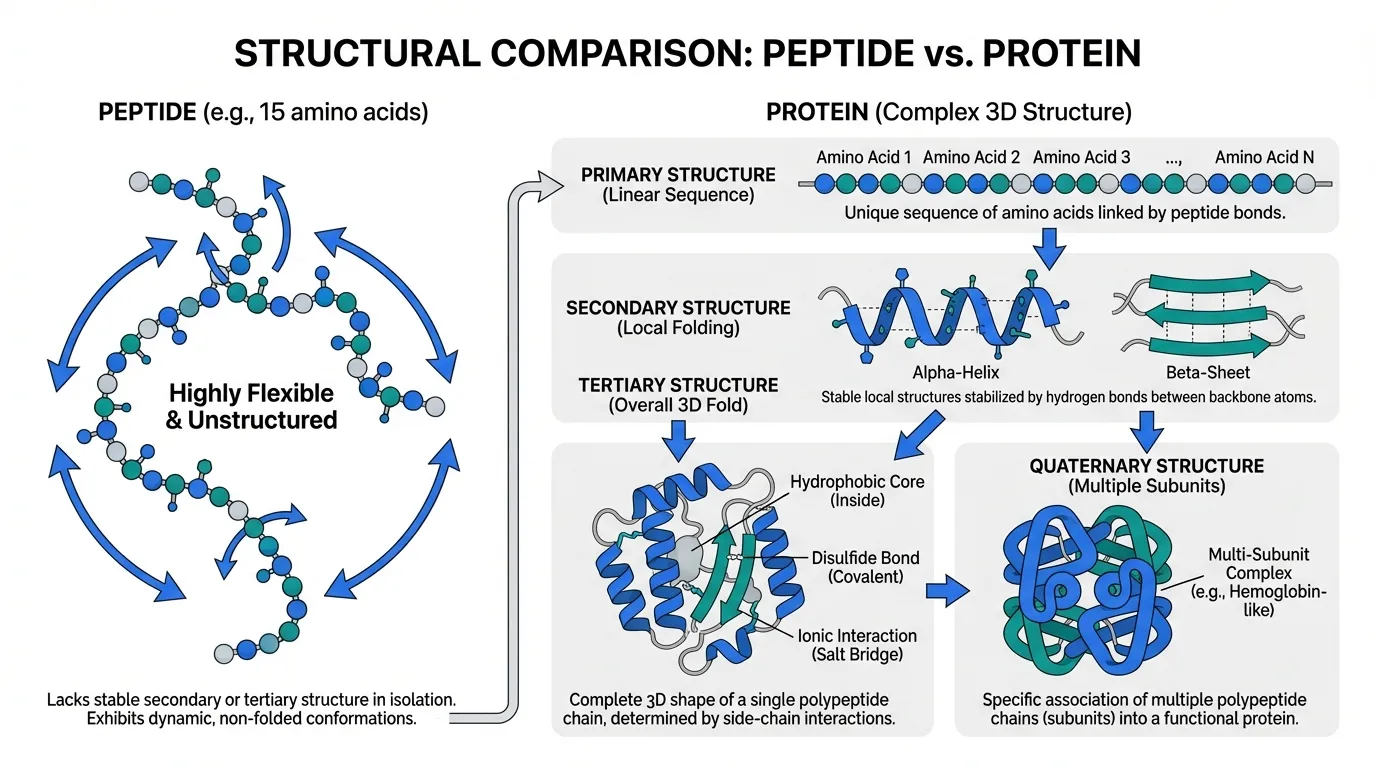
This is where peptides and proteins diverge most significantly:
Peptides (especially short ones under 20 amino acids) generally lack stable three-dimensional structure in solution. They are flexible chains that sample many conformations. Some medium-length peptides can adopt transient secondary structures (alpha-helices, beta-turns) but do not maintain them stably.
Proteins fold into defined three-dimensional structures stabilized by hydrophobic interactions, hydrogen bonds, disulfide bridges, and electrostatic interactions. These structures include:
- Secondary structure: Alpha-helices and beta-sheets
- Tertiary structure: The overall 3D fold of a single polypeptide chain
- Quaternary structure: The arrangement of multiple polypeptide chains into a functional complex
The defined 3D structure of proteins is critical to their biological function. When a protein unfolds (denatures), it typically loses its activity. Peptides, lacking stable 3D structure, are generally more resistant to denaturation -- though they remain susceptible to chemical degradation.
Functional Differences#
How Peptides Work#
Peptides typically function as signaling molecules. They bind to receptors on cell surfaces, triggering intracellular signaling cascades. Their small size allows them to act quickly and be cleared rapidly from the body.
Examples of peptide functions:
- Hormones: Insulin, glucagon, oxytocin, somatostatin
- Neurotransmitters: Endorphins, enkephalins, substance P
- Growth factors: IGF-1, EGF (border cases -- some are small proteins)
- Antimicrobials: Defensins, LL-37, KPV
How Proteins Work#
Proteins serve a much broader range of functions due to their structural complexity:
- Enzymes: Catalyzing biochemical reactions (proteases, kinases)
- Structural components: Collagen, keratin, elastin
- Transport: Hemoglobin (oxygen transport), albumin (carrier protein)
- Immune function: Antibodies (immunoglobulins)
- Receptors: Cell surface receptors that peptide hormones bind to
Why the Distinction Matters for Therapeutics#
Absorption and Bioavailability#
Peptides can sometimes be absorbed through mucosal membranes (intranasal, sublingual) and a few can survive oral administration with special formulation (e.g., semaglutide with SNAC absorption enhancer). Their smaller size makes them somewhat more amenable to diverse delivery routes.
Proteins are almost exclusively administered by injection because they are too large to cross biological membranes and are rapidly degraded by digestive enzymes if taken orally.
Stability#
Peptides are generally less stable than proteins in terms of shelf life but more resistant to physical denaturation (unfolding). Their primary degradation pathways are chemical (hydrolysis, oxidation).
Proteins can be physically denatured by heat, agitation, and surface interactions. They are more prone to aggregation. However, their folded structure can protect internal residues from chemical degradation.
Manufacturing#
Peptides up to approximately 50 amino acids can be efficiently produced by solid-phase peptide synthesis (SPPS), a chemical manufacturing process. This allows for precise control of the sequence and incorporation of non-natural amino acids.
Proteins are typically produced by recombinant DNA technology -- expressing the protein in bacteria, yeast, or mammalian cell lines. This biological manufacturing process is more complex and expensive but is the only practical approach for large molecules.
Immunogenicity#
Peptides are generally less immunogenic (less likely to trigger an immune response) than proteins because they are too small to be recognized by the immune system as foreign. However, some peptides can become immunogenic when they aggregate or are modified.
Proteins are more likely to trigger immune responses, including the formation of anti-drug antibodies that can reduce efficacy or cause adverse reactions. This is a significant consideration in protein therapeutic development.
The Gray Area: Polypeptides#
Some molecules fall in the gray area between peptides and proteins:
| Molecule | Amino Acids | Classification |
|---|---|---|
| Oxytocin | 9 | Peptide |
| BPC-157 | 15 | Peptide |
| Thymosin Alpha-1 | 28 | Peptide |
| Thymosin Beta-4 | 43 | Large peptide / small polypeptide |
| Insulin | 51 (two chains) | Polypeptide / small protein |
| Growth hormone | 191 | Protein |
| Follistatin | 288-315 | Protein |
Insulin is a particularly interesting case -- it has 51 amino acids (two chains connected by disulfide bonds) and is sometimes called a peptide, sometimes a protein. In pharmaceutical contexts, it is often referred to as a peptide hormone.
Peptides vs Proteins in Research#
The distinction has practical implications for research:
- Peptide research often focuses on receptor pharmacology, signaling pathways, and structure-activity relationships. Peptides are easier to synthesize, modify, and screen.
- Protein research often involves structural biology, enzyme kinetics, and protein engineering. Proteins require more complex production and characterization methods.
In the peptide therapy field, the focus is primarily on molecules under 50 amino acids that can be chemically synthesized and administered relatively simply. The peptide profiles on this site cover molecules in this range.
For an overview of how peptides function at the molecular level, see our How Peptides Work learn page.
Key Takeaways#
-
Peptides are short chains of amino acids (typically under 50), while proteins are longer chains (typically over 50) with defined 3D structures.
-
The distinction is a continuum, not a hard boundary. Molecules like insulin sit at the border between peptide and protein classification.
-
Peptides generally lack stable 3D structure, making them more flexible but also more susceptible to chemical degradation. Proteins depend on their folded structure for function.
-
For therapeutics, size determines delivery options. Peptides can sometimes use non-injection routes; proteins almost always require injection.
-
Peptides are chemically synthesized; proteins are biologically produced. This affects manufacturing cost, complexity, and the ability to incorporate modifications.
-
Peptides are generally less immunogenic than proteins, which is advantageous for therapeutic development.
Related Peptide Profiles#
Learn more about the peptides discussed in this article:
- BPC-157 Overview and Research Guide
- BPC-157 Dosing Protocols
- BPC-157 Side Effects and Safety
- Semaglutide Overview and Research Guide
- Semaglutide Dosing Protocols
- Semaglutide Side Effects and Safety
- Follistatin Overview and Research Guide
- Follistatin Dosing Protocols
- Follistatin Side Effects and Safety
- GHK-Cu Overview and Research Guide
- GHK-Cu Dosing Protocols
- GHK-Cu Side Effects and Safety
- KPV Overview and Research Guide
- KPV Dosing Protocols
- KPV Side Effects and Safety
- Insulin Overview and Research Guide
- Insulin Dosing Protocols
- Insulin Side Effects and Safety
- Oxytocin Overview and Research Guide
- Oxytocin Dosing Protocols
- Oxytocin Side Effects and Safety

Frequently Asked Questions About Peptides vs Proteins: What Is the Difference?
What does this article cover?
Key differences between peptides and proteins — size, structure, function, and why the distinction matters for therapeutic research. This guide is for educational purposes only and does not constitute medical advice.
Which peptides are discussed in this article?
This article covers BPC-157, Semaglutide, Follistatin, GHK-Cu, KPV, Insulin, Oxytocin. Key context: BPC-157 (); Semaglutide (); Follistatin (). Each peptide is discussed based on available research evidence.
Who is this guide written for?
This guide is written for researchers and individuals seeking an evidence-based overview of the topic covered in "Peptides vs Proteins: What Is the Difference?." It summarizes available research data without making treatment recommendations. Always consult a healthcare provider for medical decisions.
What are the key takeaways from this article?
The main findings covered in this article include: . These takeaways are based on the research data available at the time of publication.
Continue reading this research review
Free access to the complete analysis with citations and evidence ratings.
150+ peptide profiles · 30+ comparisons · 18 research tools
Medical Disclaimer
This website is for educational and informational purposes only. The information provided is not intended to diagnose, treat, cure, or prevent any disease. Always consult with a qualified healthcare professional before using any peptide or supplement.
Join 2,000+ researchers getting biweekly updates
Enjoyed this article?
The Research Briefing delivers deep-dives like this biweekly — plus new study breakdowns, safety updates, and tool announcements.
Free forever. No spam. Unsubscribe in one click.
Where to Find These Peptides
Continue Exploring
Peptide Profiles
Keep Reading
Most Popular Therapeutic Peptides in 2026: 15 Ranked by Research Interest
The 15 most popular therapeutic peptides in 2026, ranked by clinical trial activity, search interest, and research community adoption. From semaglutide to BPC-157.

Peptides for Women: 7 Research-Backed Options
Seven peptides relevant to women's health — covering weight management, skin rejuvenation, healing, and hormonal support with evidence.

The History of Peptide Research: From Insulin to Modern Therapeutics
History of peptide research from insulin's 1921 discovery to modern GLP-1 agonists. Key milestones in synthesis and therapeutics.
You Might Also Like
Related content you may find interesting