Preserving Muscle Mass on GLP-1 Medications: Research and Strategies

Introduction#
The GLP-1 revolution in obesity treatment has delivered unprecedented weight loss results. Semaglutide produces ~15% body weight reduction, Tirzepatide achieves ~21%, and investigational agents like Retatrutide are pushing toward 29%. But these headline numbers conceal a critical detail: not all of the weight lost is fat.
Across major clinical trials, 25-40% of the weight lost on GLP-1 receptor agonists and related drugs comes from lean mass -- primarily skeletal muscle. For patients losing 15-25 kg over 68-72 weeks, this translates to 4-7 kg of lean tissue lost. The implications for metabolic health, physical function, and long-term outcomes are significant.
This article reviews the body composition data from the major weight loss peptide trials, examines why lean mass loss occurs, and evaluates the emerging pharmacological and behavioral strategies for preserving muscle during treatment.
The Scope of the Problem: What DEXA Data Shows#
Dual-energy X-ray absorptiometry (DEXA) provides the most reliable body composition measurements in clinical trials. Several major obesity trials have included DEXA substudies, giving us a detailed picture of what happens to lean mass during incretin-based weight loss.
STEP 1: Semaglutide Body Composition#
An exploratory analysis of 140 participants from the STEP 1 trial (95 on semaglutide, 45 on placebo) underwent DEXA at baseline and 68 weeks.
- Total body weight change: -15.0% with semaglutide vs -3.6% with placebo
- Total fat mass change: -19.3% (placebo-corrected)
- Total lean mass change: -9.7%
- Visceral fat mass change: -27.4%
The fraction of weight lost from lean mass was approximately 39% in the semaglutide group. However, the proportion of lean mass relative to total body mass actually increased by 3.0 percentage points, and the lean-to-fat mass ratio improved -- meaning the body composition shifted toward a healthier distribution even as absolute lean mass decreased.
SURMOUNT-1: Tirzepatide Body Composition#
A DEXA substudy of 160 participants from SURMOUNT-1 (124 on pooled tirzepatide doses, 36 on placebo) was published in 2025.
- Total body weight change: -21.3% with tirzepatide vs -5.3% with placebo
- Total fat mass change: -33.9% vs -8.2%
- Total lean mass change: -10.9% vs -2.6%
- Absolute fat mass lost: 15.9 kg (tirzepatide) vs 3.6 kg (placebo)
- Absolute lean mass lost: 5.6 kg (tirzepatide) vs 1.2 kg (placebo)
Approximately 75% of weight lost was fat mass and 25% was lean mass -- a more favorable ratio than that seen with semaglutide in STEP 1.
Head-to-Head Comparison#
| Metric | Semaglutide (STEP 1) | Tirzepatide (SURMOUNT-1) |
|---|---|---|
| Total weight loss | -15.0% | -21.3% |
| Lean mass as % of weight lost | ~39% | ~25% |
| Absolute lean mass loss | ~5.4 kg | ~5.6 kg |
| Fat mass as % of weight lost | ~61% | ~75% |
A key observation: although tirzepatide produced greater total weight loss, the absolute amount of lean mass lost was similar to semaglutide. The additional weight loss with tirzepatide came predominantly from fat mass. This suggests the GIP component of tirzepatide may contribute to relatively better lean mass preservation, though the exact mechanism is not established.
A 2025 network meta-analysis confirmed this pattern, finding that while both semaglutide 2.4 mg and tirzepatide 15 mg were among the most effective for total weight reduction, the proportion of lean mass lost varied between agents.
Why Lean Mass Loss Occurs#
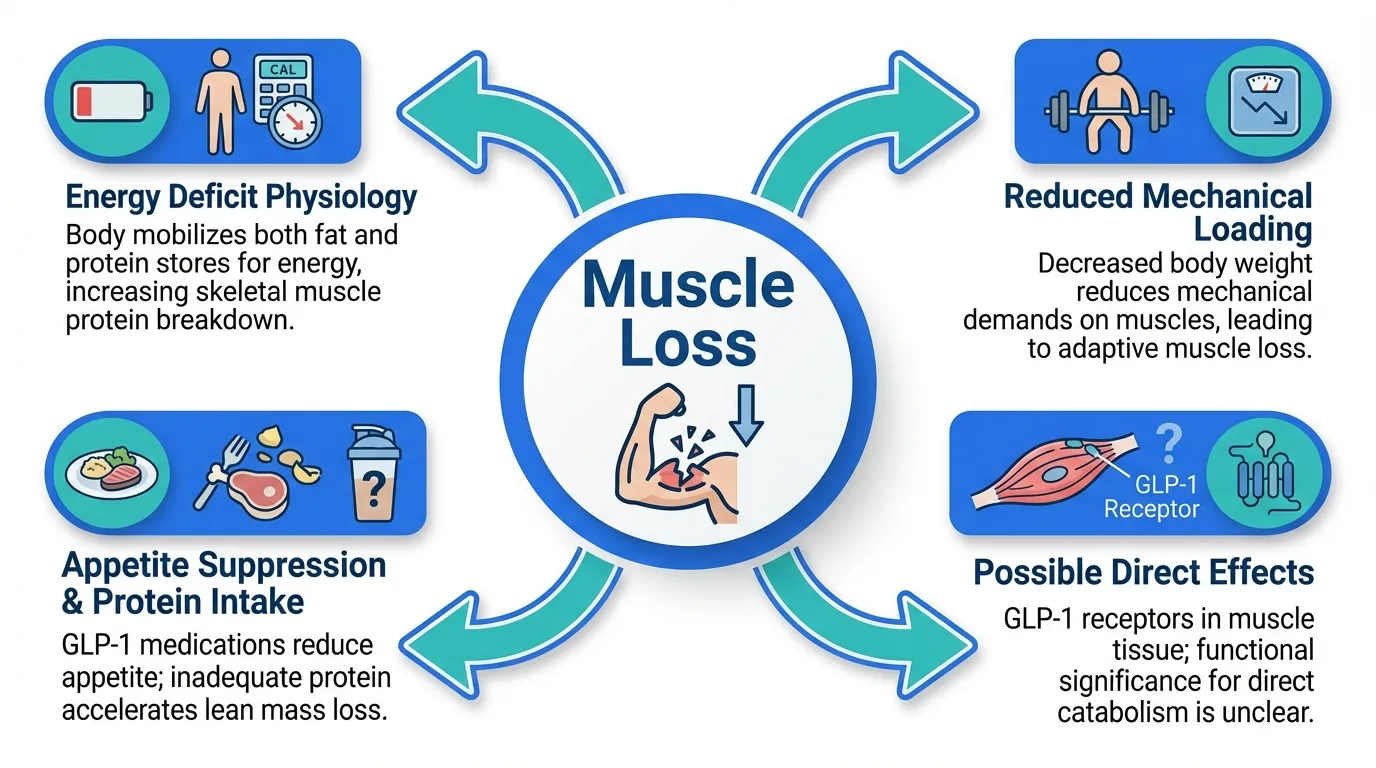
Lean mass loss during weight reduction is not unique to GLP-1 medications. It occurs with all forms of weight loss -- diet, exercise, bariatric surgery, and pharmacotherapy. Several mechanisms contribute:
Energy deficit physiology: When the body is in a caloric deficit, it mobilizes both fat and protein stores for energy. Skeletal muscle protein is broken down at increased rates. This is a fundamental metabolic response, not a drug-specific side effect.
Reduced mechanical loading: As body weight decreases, the mechanical demands on muscles that support and move the body decrease proportionally. This reduced stimulus leads to adaptive muscle loss -- the body downregulates muscle mass to match its new lower weight, similar to how astronauts lose muscle in microgravity.
Appetite suppression and protein intake: GLP-1 medications dramatically reduce appetite. If patients do not intentionally maintain adequate protein intake, the resulting protein deficit accelerates lean mass loss. Many patients on these medications report eating significantly less overall, and protein is often disproportionately reduced.
Possible direct effects: Some research has explored whether GLP-1 receptor agonists have direct effects on muscle tissue. GLP-1 receptors are expressed in skeletal muscle, though the functional significance is unclear. Current evidence does not conclusively demonstrate that GLP-1 drugs directly cause muscle catabolism independent of weight loss.
Pharmacological Strategies: Bimagrumab#
The BELIEVE Trial#
The most significant pharmacological development for addressing GLP-1-associated lean mass loss is Bimagrumab, a monoclonal antibody that blocks activin type II receptors (ActRII). By blocking these receptors, bimagrumab inhibits the signaling of myostatin and activin A -- two proteins that naturally limit muscle growth.
The BELIEVE trial, presented at ADA 2025, tested bimagrumab combined with semaglutide in 507 adults with overweight or obesity. The results were striking:
Body composition quality:
- In the semaglutide-alone arm, 71.8% of weight lost was fat mass
- In the high-dose bimagrumab + semaglutide arm, 92.8% of weight lost was fat mass
Lean mass preservation:
- Lean mass decreased by 7.9% from baseline with semaglutide alone
- Lean mass decreased by only 2.6% with high-dose bimagrumab + semaglutide
Visceral fat reduction:
- Visceral fat decreased by 36% with semaglutide alone
- Visceral fat decreased by 58% with the combination
Total weight loss:
- The high-dose combination produced 22% weight loss at 72 weeks
The safety profile was consistent with the known effects of both drugs. Bimagrumab's most common side effects were muscle spasms, diarrhea, and acne.
What Bimagrumab Means for the Field#
The BELIEVE results represent a potential paradigm shift. Rather than accepting lean mass loss as an inevitable cost of pharmacological weight loss, the combination approach transforms the quality of weight loss -- making it overwhelmingly from fat mass while largely preserving muscle.
Bimagrumab is currently in development by Eli Lilly (which acquired the program). It is not yet FDA-approved for this indication, and larger confirmatory trials will be needed. However, the concept of combining an anti-obesity drug with a muscle-preserving agent has moved from theoretical to demonstrated in a well-powered clinical trial.
Behavioral Strategies: What the Evidence Supports#
While bimagrumab is not yet available, behavioral interventions for lean mass preservation can be implemented now.
Resistance Training#
Resistance exercise is the most potent stimulus for muscle protein synthesis and the most effective non-pharmacological strategy for preserving lean mass during weight loss. A 2025 case series of patients on GLP-1 and GLP-1/GIP agonists demonstrated that structured resistance training can dramatically alter body composition outcomes:
- One patient lost 33% of body weight with only 6.9% of weight lost from lean mass
- Two patients actually increased lean soft tissue while losing total body weight
- All patients engaged in resistance training 3-5 days per week
These are individual cases, not controlled trial data, but they align with the broader exercise physiology literature showing that resistance training during caloric restriction preserves lean mass.
Practical recommendations based on current evidence:
- Resistance training at least 2-3 sessions per week, targeting all major muscle groups
- Progressive overload (gradually increasing weight, reps, or sets over time)
- Compound movements that recruit multiple muscle groups (squats, deadlifts, rows, presses)
- Beginning or maintaining a resistance program before or at the start of medication, not waiting until significant weight loss has occurred
Protein Intake#
Adequate protein intake is essential for muscle preservation during weight loss. The challenge with GLP-1 medications is that suppressed appetite often leads to reduced total food intake, and protein can be disproportionately affected.
Evidence-based targets:
- General recommendation during weight loss: 1.2-1.6 g protein per kg of body weight per day
- The case series of patients on GLP-1 agonists who preserved lean mass reported intakes of 0.7-1.7 g/kg/day, with better outcomes at the higher end
- Distributing protein across multiple meals (rather than one large serving) maximizes muscle protein synthesis
Practical considerations:
- Prioritize protein at each meal, especially given reduced appetite and smaller meal sizes
- Consider protein-dense foods or supplementation if meeting targets through food alone is difficult
- Track intake during the early phase of treatment when appetite suppression is most pronounced
Combined Approach#
The most effective behavioral strategy is combining resistance training with adequate protein intake. These interventions target different aspects of muscle preservation: resistance training provides the mechanical stimulus that signals the body to maintain muscle, while protein provides the building blocks needed for muscle repair and maintenance.
Emerging Agents and Body Composition#
Retatrutide#
Retatrutide adds glucagon receptor agonism to the GIP/GLP-1 combination. Glucagon increases energy expenditure and promotes hepatic fat oxidation, which could theoretically shift the proportion of weight lost toward fat. However, detailed DEXA body composition data from the Phase 3 TRIUMPH program has not yet been published. Given that glucagon can also promote protein catabolism, the net effect on lean mass remains an important open question.
CagriSema#
CagriSema combines Cagrilintide (amylin analog) with Semaglutide. The REDEFINE trials demonstrated 20.4% weight loss at 68 weeks. Detailed body composition data from REDEFINE will be important for understanding whether the amylin pathway has different effects on lean mass compared to GLP-1 alone. Amylin reduces appetite through brain pathways distinct from GLP-1, but whether this translates to a different lean-to-fat mass ratio during weight loss is unknown.
The Combination Future#
The BELIEVE trial results suggest that the future of obesity pharmacotherapy may involve pairing an anti-obesity agent (for weight/fat loss) with a muscle-preserving agent (for body composition quality). Other myostatin pathway inhibitors and anabolic agents are in development that could serve this role. The concept of optimizing body composition -- not just body weight -- represents a maturation of the field.
Clinical Implications#
Who Is Most at Risk?#
Lean mass loss during GLP-1 treatment is a concern for all patients, but certain groups face elevated risk:
- Older adults (65+): Age-related sarcopenia means they start with less muscle reserve. Further lean mass loss can impair mobility, increase fall risk, and reduce independence.
- Patients with very large weight loss (>20%): Greater total weight loss generally means greater absolute lean mass loss, even if the proportion remains constant.
- Sedentary patients: Without resistance exercise, there is no mechanical stimulus to signal muscle preservation.
- Patients with low protein intake: Inadequate protein during a caloric deficit accelerates muscle catabolism.
Monitoring Body Composition#
Weight on a scale does not distinguish between fat and lean mass. For patients concerned about muscle preservation, periodic body composition assessment can provide actionable data:
- DEXA scan: The gold standard for body composition measurement. Provides total and regional fat mass, lean mass, and bone mineral density.
- Bioelectrical impedance analysis (BIA): Less accurate than DEXA but more accessible and affordable. Useful for tracking trends over time.
- Functional assessments: Grip strength, sit-to-stand tests, and walking speed can provide practical measures of whether muscle function is being maintained.
Key Takeaways#
-
Lean mass loss is real and significant. Across major trials, 25-40% of weight lost on GLP-1 medications comes from lean mass. This is not unique to these drugs but is a consequence of weight loss itself.
-
Tirzepatide may have an advantage. DEXA data suggests ~75% of weight lost on tirzepatide is fat mass versus ~61% with semaglutide, though direct comparison is limited by different study populations.
-
Bimagrumab is a potential game-changer. The BELIEVE trial showed that combining bimagrumab with semaglutide shifted weight loss to 92.8% from fat mass while reducing lean mass loss from 7.9% to 2.6%.
-
Resistance training works now. Structured resistance exercise 2-3 times per week is the most effective currently available strategy for preserving lean mass.
-
Protein matters. Aiming for 1.2-1.6 g/kg/day of protein, distributed across meals, supports muscle preservation during treatment.
-
The field is evolving. Body composition quality -- not just total weight loss -- is increasingly recognized as a critical endpoint. Future treatments will likely combine anti-obesity and muscle-preserving agents by design.
References#
Related Peptide Profiles#
Learn more about the peptides discussed in this article:
- Bimagrumab Overview and Research Guide
- Bimagrumab Dosing Protocols
- Bimagrumab Side Effects and Safety
- Cagrilintide Overview and Research Guide
- Cagrilintide Dosing Protocols
- Cagrilintide Side Effects and Safety
- Retatrutide Overview and Research Guide
- Retatrutide Dosing Protocols
- Retatrutide Side Effects and Safety
- Semaglutide Overview and Research Guide
- Semaglutide Dosing Protocols
- Semaglutide Side Effects and Safety
- Tirzepatide Overview and Research Guide
- Tirzepatide Dosing Protocols
- Tirzepatide Side Effects and Safety

Frequently Asked Questions About Preserving Muscle Mass on GLP-1 Medications: Research and Strategies
What does this article cover?
A research review of lean mass loss during GLP-1 treatment, with DEXA data from STEP and SURMOUNT trials, and emerging strategies including bimagrumab, resistance training, and high-protein diets. This research review is for educational purposes only and does not constitute medical advice.
Which peptides are discussed in this article?
This article covers Bimagrumab, Cagrilintide, Retatrutide, Semaglutide, Tirzepatide. Key context: Bimagrumab (Anti-activin type II receptor antibody that preserves lean mass when combined with semaglutide in...); Cagrilintide (Amylin analog combined with semaglutide in CagriSema with body composition data pending); Retatrutide (Triple agonist with glucagon component that may influence body composition differently than GLP-1...). Each peptide is discussed based on available research evidence.
What level of evidence does this research review cover?
This research review examines published preclinical and clinical studies related to the peptides discussed. Evidence quality varies between peptides and indications. The article distinguishes between FDA-approved uses and investigational applications where applicable.
What are the key takeaways from this article?
The main findings covered in this article include: Anti-activin type II receptor antibody that preserves lean mass when combined with semaglutide in.... Amylin analog combined with semaglutide in CagriSema with body composition data pending. Triple agonist with glucagon component that may influence body composition differently than GLP-1.... These takeaways are based on the research data available at the time of publication.
What is Bimagrumab and why is it significant?
Bimagrumab is a peptide discussed in this article because: Anti-activin type II receptor antibody that preserves lean mass when combined with semaglutide in the BELIEVE trial. For a complete profile of Bimagrumab, see the dedicated peptide page on this site.
Continue reading this research review
Free access to the complete analysis with citations and evidence ratings.
150+ peptide profiles · 30+ comparisons · 18 research tools
Medical Disclaimer
This website is for educational and informational purposes only. The information provided is not intended to diagnose, treat, cure, or prevent any disease. Always consult with a qualified healthcare professional before using any peptide or supplement.
Join 2,000+ researchers getting biweekly updates
Enjoyed this article?
The Research Briefing delivers deep-dives like this biweekly — plus new study breakdowns, safety updates, and tool announcements.
Free forever. No spam. Unsubscribe in one click.
Where to Find These Peptides
Continue Exploring
Peptide Profiles
Keep Reading

Finnrick Analytics Review: Transparency Concerns and Conflicts of Interest (2026)
Is Finnrick Analytics trustworthy? We examine COI gaps, vendor pay-for-play, 15% lab discrepancies, and their astroturfing job listing. Full analysis.

The Evolution of GLP-1 Receptor Agonists: From Single-Target to Multi-Receptor Metabolic Therapeutics
A research review tracing the evolution of GLP-1 receptor agonists from semaglutide through tirzepatide, retatrutide, and survodutide, examining how multi-receptor approaches have progressively expanded efficacy in obesity and metabolic disease.

Weight Loss Peptides for Beginners: Understanding Your Options in 2026
A beginner-friendly guide to weight loss peptides in 2026, covering GLP-1 agonists, dual and triple agonists, non-GLP-1 alternatives, and how to evaluate the evidence behind each option.
You Might Also Like
Related content you may find interesting