Peptides for Bone Health: PTH Analogs, Growth Factors, and Beyond

Introduction#
Bone is one of the most peptide-responsive tissues in the body. The entire cycle of bone remodeling -- the balance between osteoblast-mediated bone formation and osteoclast-mediated bone resorption -- is regulated by peptide hormones, growth factors, and signaling molecules. It is therefore fitting that some of the most successful peptide therapeutics in clinical medicine are those that target bone metabolism.
This guide examines peptides with established or investigational roles in bone health, ranging from FDA-approved osteoanabolic agents (teriparatide and abaloparatide) to preclinical compounds with bone-healing properties. Bone health peptides occupy a unique position in the peptide landscape because the two leading compounds have the highest level of regulatory validation -- full FDA approval with extensive phase 3 data and years of post-marketing experience.
Key distinction: Unlike most peptide categories covered on this site, bone health peptides include two FDA-approved medications that represent standard of care in osteoporosis management.
1. Teriparatide (Forteo)#
Evidence Level: FDA-approved (2002); extensive clinical trial and post-marketing data Primary Mechanism: PTH(1-34) analog; stimulates osteoblast activity and bone formation FDA Status: Approved for osteoporosis in postmenopausal women, men at high fracture risk, and glucocorticoid-induced osteoporosis
Teriparatide is a recombinant form of the first 34 amino acids of human parathyroid hormone (PTH). It was the first osteoanabolic agent approved for osteoporosis and remains a cornerstone of bone health therapeutics. Unlike bisphosphonates and denosumab, which reduce bone loss by inhibiting resorption, teriparatide actively stimulates new bone formation.
Mechanism of Action#
Teriparatide binds to the PTH1 receptor (PTHR1) on osteoblasts, activating both the cAMP/PKA and PLC/PKC signaling cascades. When administered intermittently (once daily by injection), it preferentially stimulates osteoblast activity over osteoclast activation, producing a net anabolic effect on bone. Continuous PTH exposure has the opposite effect (catabolic), which is why intermittent dosing is critical.
Key downstream effects include:
- Increased osteoblast proliferation and differentiation
- Reduced osteoblast apoptosis
- Enhanced bone matrix synthesis (type I collagen, osteocalcin)
- Improved bone microarchitecture (trabecular thickness, connectivity)
- Increased cortical bone porosity (a known limitation)
Clinical Evidence#
The pivotal Fracture Prevention Trial demonstrated that teriparatide 20 mcg/day reduced vertebral fractures by 65% and nonvertebral fractures by 53% compared to placebo over a median 21 months of treatment. Subsequent studies have confirmed:
- Significant increases in lumbar spine BMD (9-13% over 2 years)
- Significant increases in femoral neck BMD (3-6% over 2 years)
- Improved bone quality and microarchitecture on biopsy
- Efficacy in glucocorticoid-induced osteoporosis
- Effectiveness in male osteoporosis
Dosing and Administration#
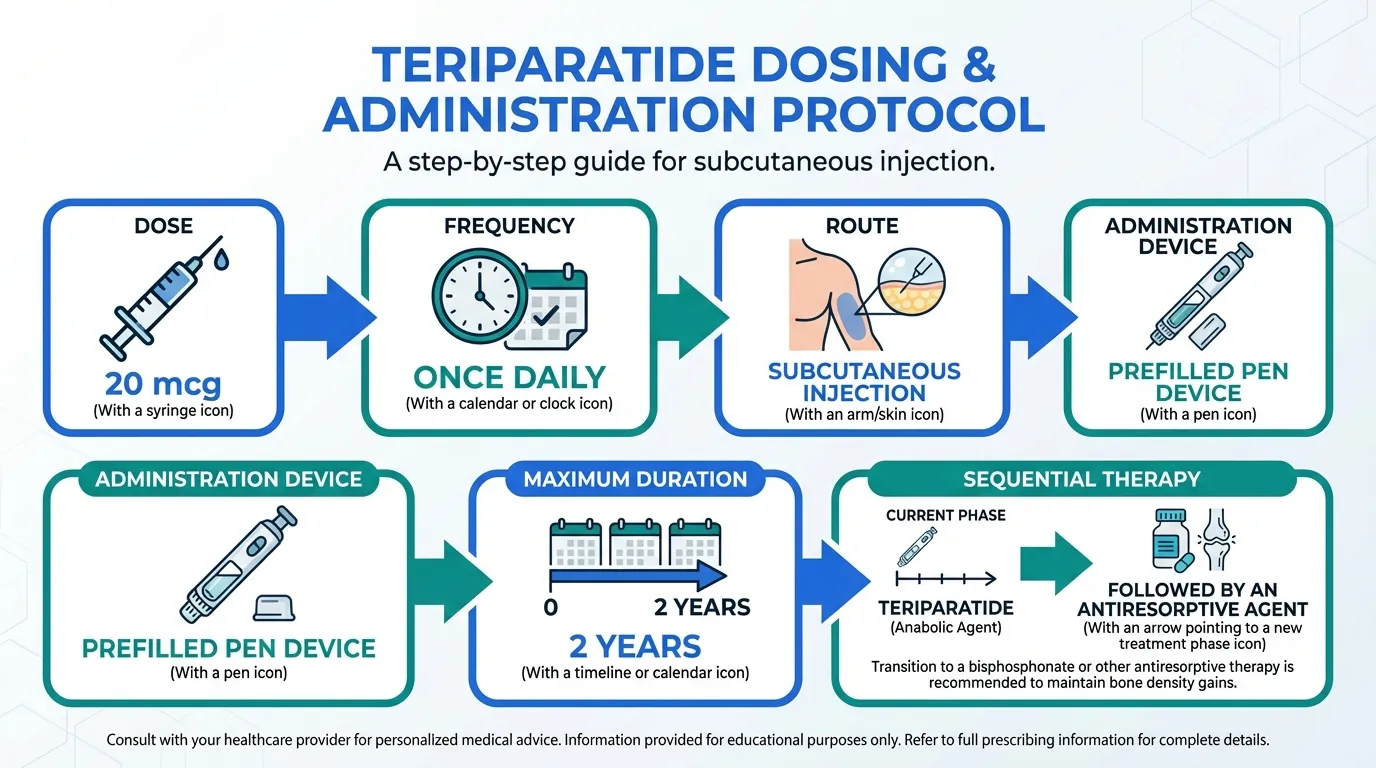
- Dose: 20 mcg subcutaneous injection once daily
- Duration: Maximum 2 years of treatment (FDA label; extended to 2 years from original 18 months)
- Administration: Self-administered via prefilled pen device
- Sequential therapy: Typically followed by an antiresorptive agent (bisphosphonate or denosumab) to maintain gains
Side Effects#
- Hypercalcemia: Mild, transient elevations in serum calcium (common)
- Orthostatic hypotension: Dizziness upon standing, particularly with initial doses
- Nausea and headache: Mild, usually transient
- Injection site reactions: Mild erythema and pain
- Leg cramps: Reported in clinical trials
- Black box warning: Osteosarcoma risk based on rat studies with very high doses and prolonged exposure. This risk has not been confirmed in human post-marketing surveillance
2. Abaloparatide (Tymlos)#
Evidence Level: FDA-approved (2017); phase 3 clinical trial data Primary Mechanism: PTHrP(1-34) analog; selective PTHR1 signaling favoring bone formation FDA Status: Approved for postmenopausal osteoporosis in women at high fracture risk
Abaloparatide is a synthetic analog of parathyroid hormone-related protein (PTHrP) that acts on the same PTHR1 receptor as teriparatide but with distinct signaling properties. It represents a second-generation approach to osteoanabolic therapy with potential advantages over teriparatide.
Mechanism of Action#
Abaloparatide preferentially binds the RG conformation of the PTHR1 receptor (the G-protein coupled, signaling-active state) rather than the R0 conformation (the G-protein independent state). This selective binding produces:
- Shorter duration of intracellular signaling compared to teriparatide
- Reduced stimulation of bone resorption
- Lower calcemic response (less hypercalcemia)
- Maintained or improved anabolic effect on bone formation
- Greater benefit on cortical bone (vs. teriparatide's cortical porosity)
Clinical Evidence#
The ACTIVE trial (Abaloparatide Comparator Trial In Vertebral Endpoints) compared abaloparatide 80 mcg/day to placebo and open-label teriparatide 20 mcg/day in 2463 postmenopausal women with osteoporosis over 18 months:
- Vertebral fractures reduced by 86% vs. placebo
- Nonvertebral fractures reduced by 43% vs. placebo
- Significantly lower rates of hypercalcemia compared to teriparatide
- Comparable or superior BMD increases at lumbar spine and femoral neck
- Hip fracture reduction achieved statistical significance vs. placebo (unlike the teriparatide pivotal trial)
Real-world comparative effectiveness analyses have shown lower rates of hip and nonvertebral fractures with abaloparatide compared to teriparatide.
Dosing and Administration#
- Dose: 80 mcg subcutaneous injection once daily
- Duration: Maximum 2 years of treatment
- Administration: Self-administered via prefilled pen device
- Sequential therapy: Followed by antiresorptive therapy to maintain bone density gains
Side Effects#
- Hypercalcemia: Less frequent than teriparatide (key advantage)
- Dizziness and tachycardia: Reported, usually transient
- Nausea: Mild, usually resolves with continued use
- Injection site reactions: Erythema and edema
- Black box warning: Same osteosarcoma warning as teriparatide (based on rat studies, not confirmed in humans)
3. BPC-157#
Evidence Level: Preclinical only for bone; extensive animal data for tissue healing Primary Mechanism: Angiogenesis promotion, growth factor modulation at fracture sites FDA Status: Not approved; Category 2 (banned from compounding)
BPC-157 is best known for its preclinical tissue-healing properties across tendons, ligaments, and muscle, but it also has a smaller body of animal data suggesting effects on bone healing. The gastric pentadecapeptide's broad tissue repair mechanisms may extend to skeletal tissue.
Research Findings#
BPC-157's bone-relevant preclinical data includes:
- Fracture healing: Accelerated bone callus formation and fracture consolidation in rat models
- Segmental bone defects: Enhanced healing of critical-size bone defects in animal studies
- Pseudoarthrosis: Improved healing of nonunion fractures in preclinical models
- Angiogenesis: Promotion of blood vessel formation at fracture sites (critical for bone healing)
- Growth factor modulation: Enhanced expression of growth factors involved in bone regeneration
Important Considerations#
All bone-related BPC-157 data is from animal models. No human studies have evaluated BPC-157 for fracture healing or bone density. The mechanism of bone repair likely involves BPC-157's general tissue-repair pathways (VEGF upregulation, FAK/paxillin signaling) rather than bone-specific osteoanabolic activity. BPC-157 is not a substitute for established osteoporosis treatments. For a broader review of BPC-157's healing properties, see Best Healing Peptides.
4. GHK-Cu#
Evidence Level: Preclinical; in vitro and animal studies Primary Mechanism: Copper-binding tripeptide that stimulates osteoblast differentiation and collagen synthesis FDA Status: Not approved for bone indications; used in cosmetic formulations
GHK-Cu is a naturally occurring copper-binding tripeptide (glycyl-L-histidyl-L-lysine) that declines with age. While primarily known for skin rejuvenation applications, GHK-Cu has preclinical data suggesting relevance to bone health through its effects on osteoblast biology.
Research Findings#
- Osteoblast stimulation: GHK-Cu promotes osteoblast differentiation and proliferation in cell culture studies
- Collagen synthesis: Enhances production of type I collagen, the primary organic component of bone matrix
- Gene expression: Upregulates genes involved in bone formation and remodeling
- Copper delivery: The copper ion in GHK-Cu may support lysyl oxidase activity, an enzyme critical for collagen cross-linking in bone
- Anti-inflammatory: Reduces inflammatory cytokines that promote bone resorption
Important Considerations#
GHK-Cu's bone research is primarily in vitro. No clinical trials have evaluated GHK-Cu for osteoporosis or fracture healing. The peptide's primary clinical application remains skin health, and any bone benefits are extrapolated from cell culture work. Systemic delivery at bone-active doses has not been characterized.
5. IGF-1 and Growth Hormone Secretagogues#
Evidence Level: Well-established bone biology; clinical data in growth hormone deficiency Primary Mechanism: Osteoblast proliferation and differentiation via IGF-1 receptor signaling FDA Status: IGF-1 approved for growth hormone insensitivity; GH secretagogues not approved for bone indications
IGF-1 (insulin-like growth factor 1) is a key mediator of growth hormone's effects on bone. The GH/IGF-1 axis is one of the primary determinants of bone mass, and IGF-1 deficiency is associated with osteoporosis and fracture risk. Several peptides in the growth hormone secretagogue class indirectly affect bone through IGF-1 elevation.
Research Findings#
- Direct osteoblast effects: IGF-1 stimulates osteoblast proliferation, differentiation, and matrix synthesis
- GH deficiency replacement: Patients with GH deficiency who receive GH replacement show significant increases in bone mineral density over 12-24 months
- Age-related decline: Serum IGF-1 levels decline with age, correlating with age-related bone loss
- Fracture healing: Animal studies show IGF-1 accelerates fracture repair
- GH secretagogues: Compounds like ipamorelin, sermorelin, and CJC-1295 indirectly support bone metabolism through GH/IGF-1 axis stimulation
Important Considerations#
Direct IGF-1 therapy for bone health is not standard practice due to concerns about potential side effects (hypoglycemia, cancer risk) and the availability of more targeted alternatives (teriparatide, abaloparatide). GH secretagogues may support bone health as part of their broader metabolic effects, but they have not been studied in clinical trials specifically for osteoporosis. The bone benefits of GH/IGF-1 elevation are better characterized in GH-deficient populations than in age-related osteoporosis.
Comparison Summary#
| Peptide | Primary Bone Effect | Evidence Level | FDA Status | Mechanism |
|---|---|---|---|---|
| Teriparatide | Osteoanabolic (bone formation) | Phase 3 + post-marketing | Approved (2002) | PTH(1-34) receptor agonist |
| Abaloparatide | Osteoanabolic (formation > resorption) | Phase 3 + post-marketing | Approved (2017) | PTHrP(1-34) selective agonist |
| BPC-157 | Fracture healing support | Preclinical only | Not approved | Angiogenesis, growth factors |
| GHK-Cu | Osteoblast stimulation | In vitro primarily | Not approved | Copper delivery, collagen |
| IGF-1/GH secretagogues | Bone metabolism support | Clinical (GH deficiency) | Not for bone | GH/IGF-1 axis |
Key Takeaways#
For established osteoporosis treatment: Teriparatide and abaloparatide are the evidence-based choices, with full FDA approval and extensive clinical data demonstrating fracture risk reduction. Abaloparatide may offer advantages over teriparatide in lower hypercalcemia rates and better cortical bone effects.
For fracture healing research: BPC-157 has intriguing preclinical data on accelerated fracture consolidation, but no human evidence. It is not a substitute for established medical care.
For bone metabolism support: The GH/IGF-1 axis plays a well-documented role in bone health, and GH secretagogues may provide indirect bone support, but they are not studied or approved for osteoporosis.
Conclusion#
Bone health peptides span the full evidence spectrum -- from FDA-approved osteoanabolic agents with robust fracture reduction data to preclinical compounds with promising but unvalidated mechanisms. Teriparatide and abaloparatide represent the gold standard of peptide therapeutics: rigorously tested, FDA-approved, and integrated into clinical guidelines as first-line treatments for high-risk osteoporosis.
The presence of two FDA-approved peptide drugs in this category distinguishes bone health from most other peptide applications, where evidence levels remain preclinical or early clinical. For anyone considering peptides for bone health, the approved PTH/PTHrP analogs should be the starting point, with emerging research compounds viewed as potential future additions rather than current alternatives.
For protocol planning with bone health peptides, the Dosing Calculator can assist with reconstitution and dosing calculations, and the Evidence Explorer provides a comprehensive view of research status across all peptides.
Related Peptide Profiles#
Learn more about the peptides discussed in this article:
- Teriparatide Overview and Research Guide
- Teriparatide Dosing Protocols
- Teriparatide Side Effects and Safety
- Abaloparatide Overview and Research Guide
- Abaloparatide Dosing Protocols
- Abaloparatide Side Effects and Safety
- BPC-157 Overview and Research Guide
- BPC-157 Dosing Protocols
- BPC-157 Side Effects and Safety
- GHK-Cu Overview and Research Guide
- GHK-Cu Dosing Protocols
- GHK-Cu Side Effects and Safety
- IGF-1 LR3 Overview and Research Guide
- IGF-1 LR3 Dosing Protocols
- IGF-1 LR3 Side Effects and Safety

Frequently Asked Questions About Peptides for Bone Health: PTH Analogs, Growth Factors, and Beyond
What does this article cover?
Peptides for bone health -- teriparatide, abaloparatide, BPC-157, and GHK-Cu reviewed with mechanisms, evidence levels, FDA approval status, and key research findings for osteoporosis and bone healing. This guide is for educational purposes only and does not constitute medical advice.
Which peptides are discussed in this article?
This article covers Teriparatide, Abaloparatide, BPC-157, GHK-Cu, IGF-1 LR3. Key context: Teriparatide (FDA-approved PTH(1-34) analog and the first osteoanabolic agent for osteoporosis treatment, with ...); Abaloparatide (FDA-approved PTHrP analog with selective receptor signaling that reduces fracture risk with lower...); BPC-157 (Preclinical healing peptide with animal data on accelerated bone fracture healing and callus form...). Each peptide is discussed based on available research evidence.
Who is this guide written for?
This guide is written for researchers and individuals seeking an evidence-based overview of the topic covered in "Peptides for Bone Health: PTH Analogs, Growth Factors, and Beyond." It summarizes available research data without making treatment recommendations. Always consult a healthcare provider for medical decisions.
What are the key takeaways from this article?
The main findings covered in this article include: FDA-approved PTH(1-34) analog and the first osteoanabolic agent for osteoporosis treatment, with .... FDA-approved PTHrP analog with selective receptor signaling that reduces fracture risk with lower.... Preclinical healing peptide with animal data on accelerated bone fracture healing and callus form.... These takeaways are based on the research data available at the time of publication.
What is Teriparatide and why is it significant?
Teriparatide is a peptide discussed in this article because: FDA-approved PTH(1-34) analog and the first osteoanabolic agent for osteoporosis treatment, with extensive clinical trial data. For a complete profile of Teriparatide, see the dedicated peptide page on this site.
Continue reading this research review
Free access to the complete analysis with citations and evidence ratings.
150+ peptide profiles · 30+ comparisons · 18 research tools
Medical Disclaimer
This website is for educational and informational purposes only. The information provided is not intended to diagnose, treat, cure, or prevent any disease. Always consult with a qualified healthcare professional before using any peptide or supplement.
Join 2,000+ researchers getting biweekly updates
Enjoyed this article?
The Research Briefing delivers deep-dives like this biweekly — plus new study breakdowns, safety updates, and tool announcements.
Free forever. No spam. Unsubscribe in one click.
Where to Find These Peptides
Continue Exploring
Peptide Profiles
Keep Reading
Best Peptides for Tendon Repair and Recovery: Research Guide
An evidence-based review of peptides with the strongest preclinical and clinical data for tendon repair, including BPC-157, TB-500, GHK-Cu, and IGF-1 LR3 — covering mechanisms, research findings, and protocol considerations.

Best Peptides for Menopause Symptoms: 2026 Research Guide
Research guide covering peptides studied for menopause symptoms including hot flashes, bone loss, cognitive changes, skin aging, sleep disruption, and hormonal regulation.

BPC-157 + TB-500 Blend: The Research Behind the 'Wolverine Stack'
An evidence-based review of the BPC-157 and TB-500 (thymosin beta-4) peptide blend, examining the research behind their complementary healing mechanisms, preclinical evidence, and important limitations.
You Might Also Like
Related content you may find interesting