Bioregulator Peptides for Aging: Epitalon, Vilon, Thymalin, and Pinealon

Introduction#
Bioregulator peptides represent a distinct school of peptide-based anti-aging research developed primarily at the Saint Petersburg Institute of Bioregulation and Gerontology under the leadership of Professor Vladimir Khavinson. Over four decades of research, Khavinson's group has characterized a class of short peptides (2-4 amino acids) that they propose regulate gene expression in specific target tissues, offering a targeted approach to age-related functional decline.
This guide covers the four key bioregulators in aging research: Epitalon (pineal gland), Vilon (thymus), Thymalin (thymus/immune system), and Pinealon (brain). For a broader overview of anti-aging peptides, see Best Anti-Aging Peptides in 2026. For how bioregulators fit into the hallmarks of aging framework, see The Hallmarks of Aging: Which Peptides Target Which?.
Important note: Bioregulator peptides are not FDA-approved. Most evidence comes from Russian research institutions with limited independent Western replication. This article is for educational and research purposes only.
Vladimir Khavinson and the Bioregulator Paradigm#
Professor Vladimir Khavinson began studying organ-specific peptide extracts in the 1970s at the Military Medical Academy in Leningrad (now Saint Petersburg). His foundational observation was that peptide extracts from specific organs -- pineal gland, thymus, brain, prostate, retina -- could restore age-related functional decline in the corresponding tissue when administered to aged animals or humans.
The initial research used crude organ extracts (cytomedins): epithalamin from pineal gland, thymalin from thymus, cortexin from brain cortex. When these extracts showed biological activity, Khavinson's group systematically identified the shortest active peptide sequences responsible for the effects, creating synthetic analogs -- Epitalon from epithalamin, Vilon as a thymic dipeptide, Pinealon as a brain-targeted tripeptide.
The Core Theory#
Khavinson's bioregulation theory proposes that short peptides (2-4 amino acids) regulate gene expression by interacting directly with DNA. The proposed mechanism involves:
- DNA binding: Short peptides bind in the major or minor groove of DNA at specific nucleotide sequences complementary to their amino acid structure
- Chromatin remodeling: Peptide binding alters local chromatin accessibility, either activating or repressing gene transcription
- Tissue specificity: Different peptide sequences preferentially bind different DNA sequences, explaining organ-specific effects
- Age-related depletion: Endogenous short peptide pools decline with aging, contributing to gene silencing and functional decline
- Restoration: Exogenous administration of the correct peptide sequence restores youthful gene expression patterns
This theory has been supported by molecular modeling studies from the Khavinson group showing theoretical peptide-DNA interactions, and by gene expression studies showing that bioregulator peptides alter transcription of specific gene sets. However, the proposed mechanism of direct DNA binding by 2-4 amino acid peptides remains controversial and has not been independently validated using modern structural biology techniques (cryo-EM, X-ray crystallography of peptide-DNA complexes).
Evidence Limitations#
Before examining each bioregulator, several important caveats apply to the entire field:
- Single-group dominance: The vast majority of bioregulator research originates from Khavinson's institute and collaborating Russian institutions
- Limited independent replication: Few Western laboratories have attempted to reproduce the findings
- Publication venues: Much of the clinical data appears in Russian-language journals or lower-impact international journals
- Study design: Many studies lack the rigorous double-blind, placebo-controlled design expected by Western regulatory standards
- Mechanistic validation: The proposed DNA-binding mechanism requires independent structural validation
These limitations do not invalidate the research, but they mandate caution in interpreting the results.
Epitalon (Pineal Gland Bioregulator)#
Sequence: Ala-Glu-Asp-Gly (tetrapeptide, MW 390.3 Da) Target tissue: Pineal gland Derived from: Epithalamin (bovine pineal extract) FDA Status: Category 2 (banned from compounding)
Mechanism#
Epitalon is the most studied bioregulator peptide. It was developed as a synthetic replacement for epithalamin, a polypeptide extract from bovine pineal glands that showed anti-aging properties in early Khavinson research. Epitalon's primary documented effects include:
- Telomerase activation: Upregulation of hTERT gene expression in human fibroblasts and pulmonary cells, with treated cells exceeding the Hayflick limit by approximately 10 population doublings
- Melatonin restoration: Restoration of nocturnal melatonin secretion rhythms in aged animals toward youthful patterns
- Antioxidant effects: Increased expression of superoxide dismutase and other antioxidant enzymes
- Circadian regulation: Normalization of age-disrupted circadian gene expression
Key Research#
- Lifespan extension: SHR mice treated with epitalon showed 12-13% increases in mean lifespan. Similar results were reported in Drosophila (11-16% extension) and other rodent strains
- Telomere studies: Multiple in vitro studies confirmed telomerase activation and measurable telomere elongation in human somatic cells. A 2025 study expanded these findings across additional cell lines
- Cancer incidence: Long-term animal studies reported reduced spontaneous tumor formation in epitalon-treated groups, partially addressing the theoretical concern that telomerase activation could promote malignancy
- Human observations: Khavinson reported improved clinical outcomes in elderly cohorts receiving epithalamin (the precursor extract) over multi-year observation periods, including reduced cardiovascular mortality, though these were not rigorously controlled trials
Evidence Assessment#
Epitalon has the broadest evidence base of any bioregulator, with consistent results across decades of study. The primary limitation remains the concentration of research within Khavinson's group. The 2025 independent telomere confirmation represents an important step toward validation. For comparison with other anti-aging approaches, see Epitalon vs NAD+ and Epitalon vs FOXO4-DRI.
Thymalin (Thymus Bioregulator -- Extract)#
Type: Polypeptide extract from bovine thymus Target tissue: Thymus / immune system FDA Status: Not approved (registered as a pharmaceutical in Russia)
Mechanism#
Thymalin is the original thymic bioregulator -- a complex polypeptide extract from calf thymus glands, not a single synthetic peptide. It contains a mixture of thymic peptides that collectively target the immune system's age-related decline (immunosenescence). The thymus involutes after puberty, progressively shrinking and losing its ability to generate naive T cells. By age 60, thymic output is reduced by over 95%, contributing to impaired adaptive immunity, increased infection susceptibility, and reduced vaccine responses.
Thymalin's documented effects include:
- T-cell restoration: Increased CD4+ and CD8+ T-cell counts, improved CD4/CD8 ratios in aged subjects
- Thymic regeneration: Histological evidence of thymic tissue restoration in aged animals
- NK cell activity: Enhanced natural killer cell cytotoxicity
- Cytokine modulation: Normalization of Th1/Th2 balance in aged immune systems
Key Research#
- Clinical observations in Russia: Thymalin has been used clinically in Russia since the 1980s for immunodeficiency states, post-surgical recovery, and age-related immune decline. Khavinson's group reported improved immune parameters and reduced respiratory infection rates in elderly cohorts receiving thymalin over 6-8 year observation periods
- Longevity data: A 15-year observational study of elderly patients receiving thymalin and epithalamin reported reduced mortality compared to untreated controls, with significant reductions in cardiovascular, cancer, and infectious disease mortality
- COVID-19 observations: During the pandemic, Khavinson's group published observations suggesting improved outcomes in elderly COVID-19 patients receiving thymalin, though these were not randomized controlled trials
Evidence Assessment#
Thymalin has the longest clinical history of any bioregulator, with decades of use in Russian medicine. However, as a crude extract, it raises standardization concerns -- batch-to-batch consistency is difficult to guarantee. The observational clinical data, while extensive, lacks the rigor of Western RCTs. Thymalin's mechanism is more conventional than the short-peptide DNA-binding theory, as thymic peptide extracts have well-characterized immunomodulatory properties recognized internationally (thymosin alpha-1, for example, is a single thymic peptide with global clinical use).
Vilon (Thymus Bioregulator -- Synthetic)#
Sequence: Lys-Glu (dipeptide, MW 275.3 Da) Target tissue: Thymus / immune system Derived from: Identified as the minimal active sequence from thymic peptide studies FDA Status: Not approved
Mechanism#
Vilon represents the synthetic bioregulator approach to thymic restoration. Where thymalin is a complex extract, vilon is a defined dipeptide (Lys-Glu) identified by Khavinson's group as the shortest sequence capable of reproducing thymalin's core immunomodulatory effects. This represents the bioregulator paradigm in its purest form -- a two-amino-acid peptide proposed to regulate gene expression in thymic tissue.
Vilon's documented effects include:
- Gene expression modulation: Studies reported that vilon altered expression of immune-related genes in lymphocyte cultures, including upregulation of IL-2 and IFN-gamma
- Thymic tissue effects: In aged animal models, vilon treatment was associated with partial thymic regeneration and increased thymocyte proliferation
- T-cell subpopulations: Restoration of naive T-cell proportions in aged animals following vilon administration
- Epigenetic interaction: Molecular modeling studies suggested vilon interacts with specific DNA sequences in the promoter regions of immune regulatory genes
Key Research#
- Immunosenescence reversal: Aged rats treated with vilon showed improved T-cell diversity and restored thymic architecture compared to untreated controls
- Gene expression studies: Microarray analyses showed that vilon altered expression of approximately 36 genes in human fibroblast cultures, with enrichment in immune and cell cycle pathways
- Comparative studies: Some studies compared vilon to thymalin, suggesting comparable immunomodulatory effects from the synthetic dipeptide versus the complex extract
Evidence Assessment#
Vilon exemplifies both the promise and controversy of bioregulator research. The concept that a dipeptide can meaningfully regulate gene expression in a tissue-specific manner is extraordinary and, if validated, would represent a fundamental advance in peptide biology. However, the evidence base is thin by international standards -- limited to the Khavinson group, not replicated independently, and lacking rigorous clinical trials. The mechanism by which two amino acids achieve tissue-specific gene regulation has not been validated using structural biology methods.
Pinealon (Brain Bioregulator)#
Sequence: Glu-Asp-Arg (tripeptide, MW 390.4 Da) Target tissue: Brain / central nervous system Derived from: Identified from cortexin (bovine brain cortex extract) studies FDA Status: Not approved
Mechanism#
Pinealon is a synthetic tripeptide bioregulator targeting the brain. Despite its name (which references the pineal gland), pinealon was derived from studies of cortexin, a brain cortex extract, and its primary documented effects are on neuronal function rather than pineal-specific activity. Pinealon is proposed to regulate gene expression in neural tissue, with effects including:
- Neuroprotection: Reduced neuronal apoptosis under oxidative stress conditions in cell culture
- Cognitive support: Improved memory and learning performance in aged animal models
- Gene regulation: Altered expression of genes involved in neuronal survival, synaptic plasticity, and neurotransmitter metabolism
- Antioxidant activity: Reduced oxidative stress markers in brain tissue of aged animals
Key Research#
- Neuronal cell culture: Pinealon treatment protected neurons against glutamate excitotoxicity and oxidative stress-induced apoptosis, with effects attributed to modulation of apoptosis-related gene expression
- Aged animal cognition: Rats treated with pinealon showed improved performance in Morris water maze and passive avoidance tests compared to age-matched controls
- Gene expression: Studies reported that pinealon altered expression of genes involved in serotonin and dopamine metabolism in brain tissue, potentially relevant to age-related neurotransmitter decline
- Molecular modeling: Computational studies suggested pinealon (Glu-Asp-Arg) interacts with specific DNA sequences in neural gene promoters
Evidence Assessment#
Pinealon has the least extensive evidence base of the four bioregulators covered here. The research is exclusively from Khavinson's group and allied Russian institutions. Neuroprotective effects in cell culture are suggestive but common among many peptides and small molecules. The cognitive improvement data in aged animals is of interest but lacks independent replication. No human clinical studies have been published.
Bioregulator Comparison#
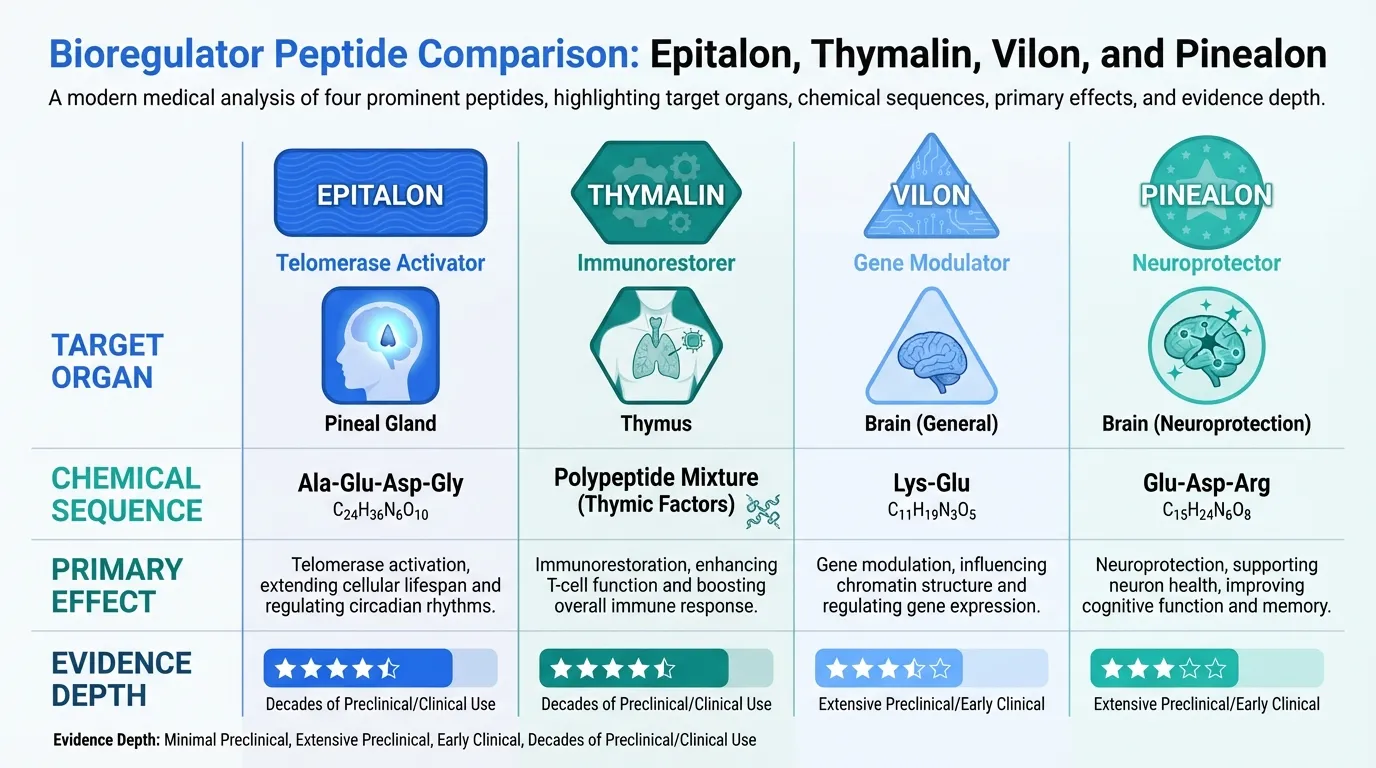
| Feature | Epitalon | Thymalin | Vilon | Pinealon |
|---|---|---|---|---|
| Type | Synthetic tetrapeptide | Natural extract | Synthetic dipeptide | Synthetic tripeptide |
| Sequence | Ala-Glu-Asp-Gly | Polypeptide mixture | Lys-Glu | Glu-Asp-Arg |
| Target | Pineal gland | Thymus/immune | Thymus/immune | Brain/CNS |
| Primary effect | Telomerase activation | Immunorestoration | Gene modulation | Neuroprotection |
| Evidence depth | Decades of preclinical | Decades of clinical use (Russia) | Limited preclinical | Minimal preclinical |
| Independent validation | Partial (2025 telomere study) | Limited | None | None |
| Human data | Observational (epithalamin) | Observational (Russia) | None | None |
| Clinical use | None (FDA Category 2) | Registered in Russia | None | None |
How Bioregulators Differ from Other Peptides#
Bioregulator peptides occupy a unique position in the peptide landscape. Unlike most therapeutic peptides, which work through receptor binding, enzyme inhibition, or protein-protein interaction disruption, bioregulators are proposed to work through direct gene regulation. This distinction has several implications:
Size: Bioregulators are exceptionally small (2-4 amino acids, MW 200-400 Da). Most therapeutic peptides are 10-50+ amino acids. This small size theoretically enhances oral bioavailability and tissue penetration but raises questions about binding specificity.
Mechanism: The proposed DNA-binding mechanism is fundamentally different from conventional peptide pharmacology. If validated, it would represent a new class of gene regulators distinct from transcription factors, microRNAs, and epigenetic modifiers.
Tissue specificity: Each bioregulator targets a specific organ, which the Khavinson group attributes to preferential binding at tissue-specific gene promoters. This specificity, if real, would be remarkable for such small molecules.
Dosing philosophy: Bioregulators are used in cycles (similar to epitalon's 10-20 day protocols) rather than continuously, based on the theory that brief gene expression "reprogramming" has sustained effects.
These distinguishing features are also the primary source of scientific skepticism. The field needs modern structural biology validation (cryo-EM or X-ray crystallography showing peptide-DNA complexes), independent replication by Western laboratories, and randomized controlled trials meeting international standards.
Practical Considerations#
Availability#
Bioregulator peptides have variable availability:
- Thymalin is registered as a pharmaceutical product in Russia and available through Russian pharmacies
- Epitalon was available as a research peptide from compounding pharmacies in the US until 2024, when it was placed on FDA Category 2 (banned from compounding)
- Vilon and Pinealon are less commercially available, primarily sourced through specialized research peptide suppliers
Administration Routes#
- Epitalon: Typically subcutaneous injection in research protocols
- Thymalin: Intramuscular injection (standard Russian medical protocol)
- Vilon: Subcutaneous injection or intranasal (limited data on oral bioavailability)
- Pinealon: Intranasal or sublingual delivery proposed for CNS targeting, subcutaneous injection in animal studies
Safety Profile#
Bioregulator peptides have generally favorable safety profiles in published research:
- No significant adverse effects reported across decades of study
- Small molecular size reduces immunogenicity risk
- Cyclic dosing limits cumulative exposure
- Thymalin has the longest safety track record through decades of Russian clinical use
- Theoretical concern about unintended gene regulation effects, though no evidence of this has been reported
Conclusion#
The Khavinson bioregulator peptides represent one of the most ambitious and controversial areas of anti-aging research. The idea that 2-4 amino acid peptides can regulate tissue-specific gene expression is extraordinary -- and extraordinary claims require extraordinary evidence. The current evidence base, while extensive within the Russian research ecosystem, falls short of international standards for independent validation and rigorous clinical proof.
That said, dismissing the bioregulator paradigm entirely would be premature. Epitalon's telomerase activation data have gained partial independent confirmation. Thymalin's decades of clinical use in Russia represent real-world experience, even if not meeting Western RCT standards. The fundamental concept that short peptide sequences can influence gene expression is not implausible and warrants serious scientific investigation.
For researchers evaluating bioregulators, the priority should be independent replication of the key findings -- particularly epitalon's telomerase activation, vilon's immune modulation, and the proposed DNA-binding mechanism. Until such validation occurs, bioregulators remain a promising but unconfirmed approach to age-related decline.
For related reading, see The Hallmarks of Aging: Which Peptides Target Which?, Best Anti-Aging Peptides in 2026, and Peptides for Cellular Longevity.
Related Peptide Profiles#
Learn more about the peptides discussed in this article:
- Epitalon Overview and Research Guide
- Epitalon Dosing Protocols
- Epitalon Side Effects and Safety
- Pinealon Overview and Research Guide
- Pinealon Dosing Protocols
- Pinealon Side Effects and Safety
- Thymalin Overview and Research Guide
- Thymalin Dosing Protocols
- Thymalin Side Effects and Safety
- Vilon Overview and Research Guide
- Vilon Dosing Protocols
- Vilon Side Effects and Safety

Frequently Asked Questions About Bioregulator Peptides for Aging: Epitalon, Vilon, Thymalin, and Pinealon
Is Epitalon FDA approved?
No. Epitalon (epithalon, AEDG) is not FDA approved, not EMA approved, and not authorized for human use by any Western regulatory agency. It is available only as a research chemical. All clinical data comes from Russian studies conducted by the Khavinson lab, with no independent Western replication in randomized controlled trials.
Are Khavinson bioregulator peptides proven to work?
The evidence is limited and geographically concentrated. Most published data comes from Vladimir Khavinson''s St. Petersburg Institute of Bioregulation and Gerontology. While Russian studies report positive results for Epitalon, Thymalin, and Vilon, no independent Western RCTs have been published. No bioregulator peptide appears on ClinicalTrials.gov for active trials as of 2026.
What are the four main Khavinson bioregulator peptides?
The four primary bioregulator peptides covered in aging research are Epitalon (AEDG, targeting pineal gland and telomerase), Thymalin (polypeptide extract targeting thymus and immune restoration), Vilon (KE dipeptide targeting thymic T-cell function), and Pinealon (EDR tripeptide targeting brain tissue and neuroprotection). All were developed by Vladimir Khavinson''s research group in St. Petersburg.
What is the difference between Epitalon and Epithalamin?
Epithalamin is a crude polypeptide extract from bovine pineal glands used in Khavinson''s early research. Epitalon (Ala-Glu-Asp-Gly) is the synthetic tetrapeptide identified as the shortest active sequence responsible for epithalamin''s observed biological effects, including telomerase activation in cell culture studies. Epitalon was developed as a standardized, reproducible alternative to the variable animal extract.
Continue reading this research review
Free access to the complete analysis with citations and evidence ratings.
150+ peptide profiles · 30+ comparisons · 18 research tools
Medical Disclaimer
This website is for educational and informational purposes only. The information provided is not intended to diagnose, treat, cure, or prevent any disease. Always consult with a qualified healthcare professional before using any peptide or supplement.
Join 2,000+ researchers getting biweekly updates
Enjoyed this article?
The Research Briefing delivers deep-dives like this biweekly — plus new study breakdowns, safety updates, and tool announcements.
Free forever. No spam. Unsubscribe in one click.
Where to Find These Peptides
Continue Exploring
Peptide Profiles
Keep Reading

13 Best Anti-Aging Peptides (2026): Ranked by Clinical Evidence
From senolytic FOXO4-DRI to mitochondrial SS-31, we ranked 13 anti-aging peptides by clinical trial evidence across 6 mechanisms. See which have human data vs. animal-only studies.

Anti-Aging Peptides by Mechanism: Senolytics, Telomeres, Mitochondria, and Hormones
Research review of anti-aging peptides organized by mechanism of action including senolytic peptides (FOXO4-DRI), telomere peptides (epitalon), mitochondrial peptides (SS-31, MOTS-c), tissue remodelers (GHK-Cu), and bioregulators (pinealon, thymalin). Evidence quality assessment for each approach.

Peptides for Better Sleep: DSIP, Epitalon, and Growth Hormone Peptides Explained
A deep dive into peptides that influence sleep architecture and nocturnal recovery, including DSIP, epitalon, pinealon, and growth hormone secretagogues like ipamorelin and sermorelin. Mechanisms, evidence levels, and research status explained.
You Might Also Like
Related content you may find interesting