Mazdutide vs Tirzepatide: GLP-1/Glucagon vs GIP/GLP-1 Dual Agonists
Mazdutide vs tirzepatide: GLP-1/glucagon vs GIP/GLP-1 dual agonist strategies compared — mechanisms, weight loss data, and trials.
Verdict at a Glance
Mazdutide and tirzepatide are both next-generation dual agonists that improve on GLP-1 monotherapy, but through different receptor combinations. Tirzepatide has the stronger clinical evidence with FDA approval, the SURPASS and SURMOUNT trial programs, and the highest published weight loss data (20.9%) of any approved obesity therapeutic. Mazdutide is approved in China with strong Phase 3 data (20.1% weight loss) and a differentiated glucagon component that may offer unique advantages for hepatic fat reduction and energy expenditure. Tirzepatide is the current evidence leader; mazdutide represents an alternative dual agonist approach with a different mechanistic portfolio.
| Best for | Pick | Why |
|---|---|---|
| Obesity treatment with maximum clinical evidence | Tirzepatide | FDA-approved as Zepbound; SURMOUNT-1 showed 20.9% weight loss at highest dose; most extensive Phase 3 evidence of any dual agonist |
| Type 2 diabetes with weight management | Tirzepatide | FDA-approved as Mounjaro with up to 2.58% HbA1c reduction; head-to-head superiority over semaglutide 1 mg in SURPASS-2 |
| Hepatic fat reduction focus | Mazdutide | Glucagon receptor agonism directly promotes hepatic fat oxidation and reduces steatosis; mechanistically suited for MASH-related metabolic goals |
| Patients in Chinese/Asian markets | Mazdutide | Approved and available in China (June 2025); Phase 3 data from Chinese population; may offer first-mover availability in Asian markets |
| Category | Mazdutide | Tirzepatide | Advantage |
|---|---|---|---|
| Mechanism of Action | Dual GLP-1R/GCGR agonist (oxyntomodulin analog); 33 amino acids with C20 fatty diacid; combines GLP-1 appetite suppression with glucagon-mediated energy expenditure and hepatic fat oxidation | Dual GIP/GLP-1R agonist; 39 amino acids with C20 fatty diacid; combines GIP-mediated insulin sensitization and adipose tissue effects with GLP-1 appetite suppression and glucose-dependent insulin secretion | Comparable |
| Research Evidence | Approved in China (June 2025) for obesity; Phase 3 trials showing up to 20.1% body weight reduction at 9 mg; Phase 3 T2D trials ongoing; no FDA approval | FDA-approved as Mounjaro (T2D, 2022) and Zepbound (obesity, 2023); SURPASS (7 trials) and SURMOUNT (4+ trials) Phase 3 programs; up to 20.9% weight loss in SURMOUNT-1 | Tirzepatide |
| Side Effect Profile | GI side effects consistent with GLP-1 class (nausea, diarrhea, vomiting); glucagon component may raise hepatic glucose output; safety database primarily from Chinese population trials | Well-characterized GI side effects (nausea, diarrhea, vomiting, constipation); thyroid C-cell tumor boxed warning; pancreatitis risk; extensive safety database across diverse global populations | Tirzepatide |
| Weight Loss Efficacy | Phase 3 data showing 20.1% body weight reduction at 9 mg dose over 60 weeks; dose-dependent response across 3, 6, and 9 mg arms | SURMOUNT-1 demonstrated 20.9% body weight reduction at 15 mg over 72 weeks; 15%, 19.5%, and 20.9% at 5, 10, and 15 mg respectively | Tirzepatide |
| Metabolic Breadth | Glucagon component targets hepatic fat oxidation, energy expenditure, and lipid mobilization; potential MASH/NASH utility; T2D HbA1c reduction up to 2.15% | GIP component enhances insulin sensitivity, improves adipose tissue function, and may have direct CNS appetite effects; T2D HbA1c reduction up to 2.58% (SURPASS-2 vs semaglutide) | Comparable |

Introduction#
Mazdutide and tirzepatide are both dual incretin agonists that surpass GLP-1 monotherapy for weight loss, but they employ different receptor combinations to achieve their effects. Tirzepatide pairs GIP with GLP-1 signaling, while mazdutide pairs glucagon with GLP-1 signaling. This fundamental mechanistic difference has implications for metabolic effects, hepatic fat handling, and potentially which patient populations benefit most. Comparing these two defines the current frontier of multi-receptor obesity pharmacology.
Quick Comparison#
| Feature | Mazdutide | Tirzepatide |
|---|---|---|
| Receptor Targets | GLP-1R + Glucagon receptor | GIP receptor + GLP-1R |
| Structure | 33 amino acids, 4.6 kDa | 39 amino acids, 4.8 kDa |
| Fatty Acid | C20 fatty diacid | C20 fatty diacid |
| Developer | Innovent Biologics / Eli Lilly | Eli Lilly |
| Regulatory Status | Approved in China (June 2025) | FDA-approved (Mounjaro/Zepbound) |
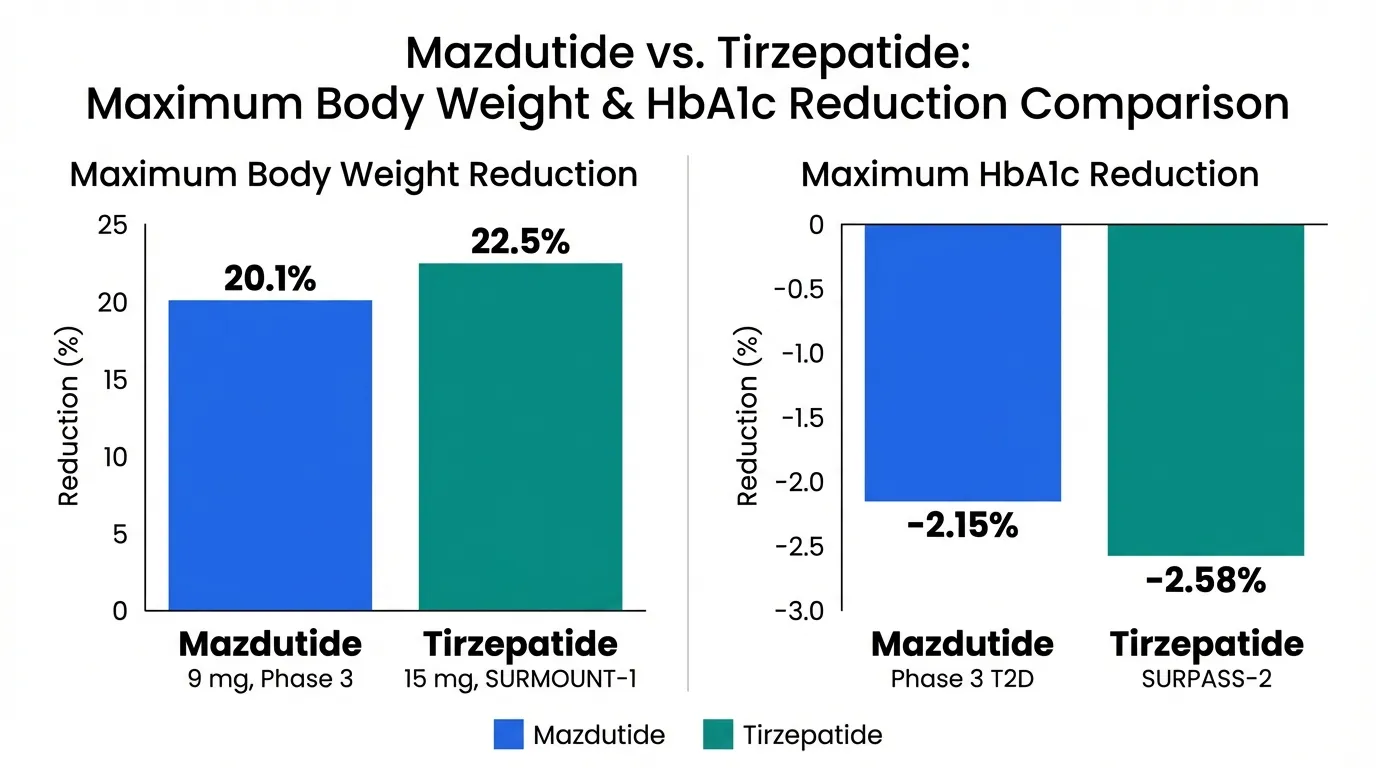
| Max Weight Loss | 20.1% (Phase 3, 9 mg) | 20.9% (SURMOUNT-1, 15 mg) |
| Dosing | Once weekly SC | Once weekly SC |
| T2D HbA1c | Up to -2.15% vs placebo | Up to -2.58% (SURPASS-2) |
| Brand Names | IBI362 | Mounjaro, Zepbound |
Mechanism of Action Comparison#
Mazdutide#
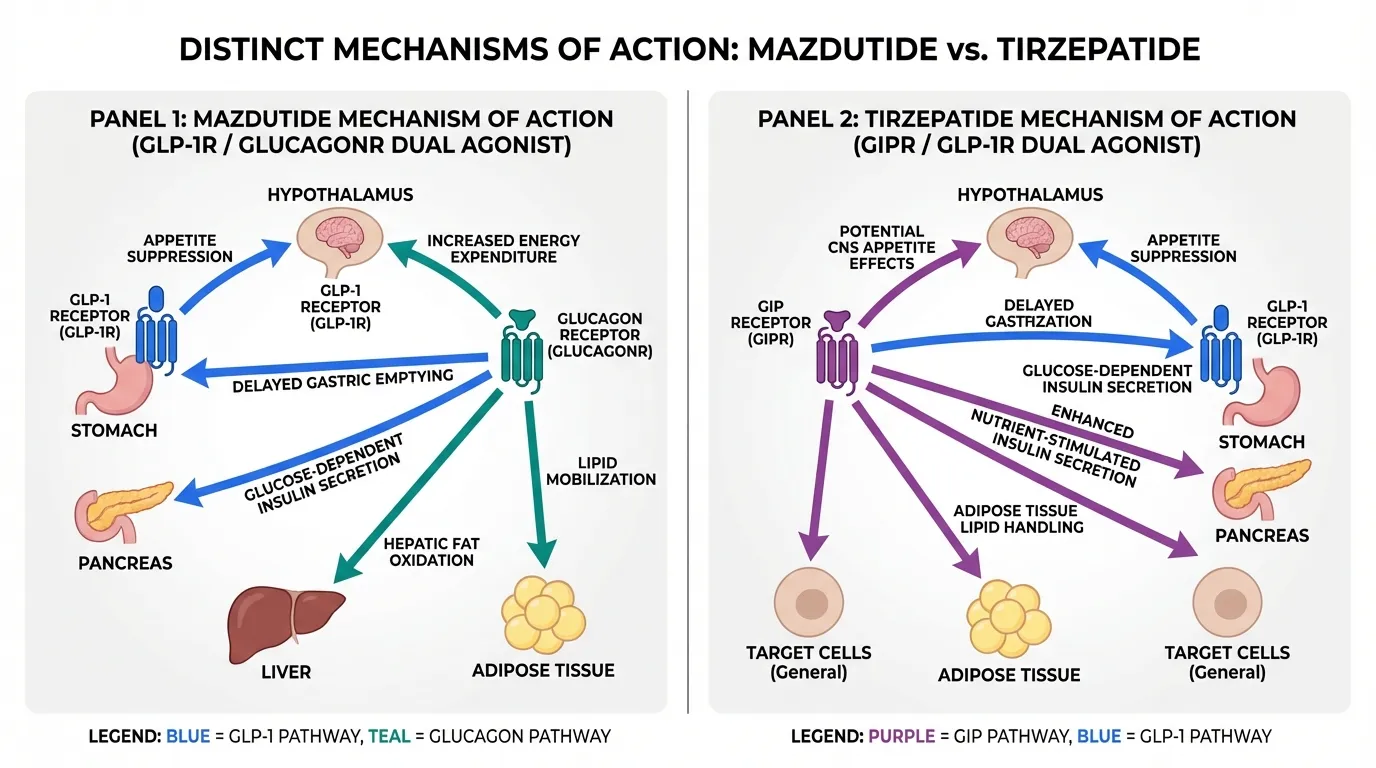
Mazdutide (IBI362/LY3305677) is a synthetic oxyntomodulin analog that activates both the GLP-1 receptor and the glucagon receptor. The 33-amino acid peptide includes an Aib substitution at position 2 for DPP-4 resistance and a C20 fatty diacid at lysine-20 for albumin binding and once-weekly pharmacokinetics.
The GLP-1 receptor component provides appetite suppression through hypothalamic satiety circuits, delayed gastric emptying, and glucose-dependent insulin secretion. The glucagon receptor component adds energy expenditure enhancement through hepatic thermogenesis, direct hepatic fat oxidation through fatty acid beta-oxidation, and lipid mobilization from both hepatic and adipose tissue. The GLP-1-mediated glucose lowering offsets the hyperglycemic tendency of glucagon receptor activation.
This glucagon component is particularly relevant for metabolic liver disease. Glucagon receptor agonism directly promotes hepatic fat clearance, making mazdutide mechanistically suited for MASH/NASH-related metabolic goals beyond weight loss alone.
Tirzepatide#
Tirzepatide is a 39-amino acid synthetic peptide that activates both the GIP receptor (GIPR) and the GLP-1 receptor. Like mazdutide, it uses a C20 fatty diacid for albumin binding and weekly pharmacokinetics, but the second receptor target is GIP rather than glucagon.
GIP receptor agonism provides insulin sensitization in adipose tissue, enhanced nutrient-stimulated insulin secretion (complementing the GLP-1 component), potential direct CNS effects on appetite regulation, and improved adipose tissue lipid handling and metabolism. The GLP-1 component provides the same appetite suppression, gastric emptying delay, and glucose-dependent insulinotropic effects as in semaglutide and mazdutide.
The GIP/GLP-1 combination was counterintuitive when first proposed, as GIP was traditionally associated with fat storage and obesity. However, pharmacological GIP receptor agonism at high doses appears to produce weight loss rather than gain, possibly through desensitization of adipocyte GIP signaling or through central appetite effects. The SURMOUNT-1 trial validated this approach with 20.9% body weight reduction.
Evidence and Research Comparison#
Mazdutide Research#
Mazdutide was approved in China in June 2025 for weight management, making it the first GLP-1/glucagon dual agonist to receive regulatory approval anywhere:
- Phase 3 obesity (China): Up to 20.1% body weight reduction at the 9 mg dose over 60 weeks; dose-dependent response across 3, 6, and 9 mg arms
- Phase 3 T2D: HbA1c reductions up to 2.15% versus placebo in Chinese population trials
- Phase 1b/2 data: Earlier dose-finding studies establishing the efficacy and tolerability profile
- Global development: Ongoing clinical trials outside China, but no FDA approval or submission as of early 2026
- Limitation: Primary clinical data from Chinese population; cross-ethnic generalizability to be confirmed in global trials
Tirzepatide Research#
Tirzepatide has the most comprehensive Phase 3 program of any dual agonist:
- SURPASS program: Seven Phase 3 trials in type 2 diabetes; SURPASS-2 showed superiority over semaglutide 1 mg for HbA1c reduction and weight loss
- SURMOUNT program: Multiple Phase 3 trials in obesity; SURMOUNT-1 demonstrated 15%, 19.5%, and 20.9% body weight reduction at 5, 10, and 15 mg respectively over 72 weeks
- FDA approvals: Mounjaro (T2D, May 2022) and Zepbound (obesity, November 2023)
- Cardiovascular outcomes: SURPASS-CVOT in progress to evaluate cardiovascular safety and efficacy
- Global availability: Approved in US, EU, and numerous international markets
Side Effects and Safety Comparison#
Mazdutide Side Effects#
- GI effects: Nausea, diarrhea, and vomiting consistent with GLP-1 class; dose-dependent frequency
- Glucagon-specific considerations: Potential for hepatic glucose output increase, particularly relevant in diabetic populations; mitigated by the GLP-1 component
- Safety database: Primarily from Chinese Phase 3 trials; real-world post-marketing data accumulating since June 2025 approval
- Limitation: Limited data on long-term safety, rare adverse events, and cross-ethnic safety profile
Tirzepatide Side Effects#
- GI effects: Nausea (12-24% depending on dose), diarrhea, vomiting, constipation; typically most prominent during dose escalation
- Serious risks: Thyroid C-cell tumor boxed warning (rodent studies); pancreatitis risk; gallbladder events
- Safety database: Large, diverse population across SURPASS and SURMOUNT programs; growing real-world safety data from millions of prescriptions
- Dose escalation: Gradual monthly increases (2.5 mg starting dose) help manage GI tolerability
Dosing and Administration Comparison#
Mazdutide Dosing#
| Parameter | Details |
|---|---|
| Route | Subcutaneous weekly |
| Doses | 3 mg, 6 mg, 9 mg |
| Escalation | Gradual increase from 3 mg to target dose |
| Formulation | Pre-filled injection device |
| Half-life | Extended via C20 fatty diacid albumin binding |
| Availability | China (approved); global trials ongoing |
Tirzepatide Dosing#
| Parameter | Details |
|---|---|
| Route | Subcutaneous weekly |
| Doses | 2.5, 5, 7.5, 10, 12.5, 15 mg |
| Escalation | Start 2.5 mg, increase monthly by 2.5 mg |
| Formulation | Pre-filled pen (Mounjaro/Zepbound) |
| Half-life | ~5 days via C20 fatty diacid albumin binding |
| Availability | US, EU, and expanding global markets |
Use Case Recommendations#
Choose Mazdutide When:#
- Hepatic fat reduction is a specific metabolic goal, where glucagon-mediated fat oxidation provides a differentiated mechanism
- Chinese/Asian market access is relevant, as mazdutide is approved and available in China
- GLP-1/glucagon dual mechanism is preferred for patients who may benefit from energy expenditure enhancement alongside appetite suppression
- MASH/metabolic liver disease is a co-occurring condition alongside obesity
Choose Tirzepatide When:#
- Maximum evidence-based weight loss is the goal, with 20.9% demonstrated in SURMOUNT-1
- Type 2 diabetes management requires proven glycemic control, with superiority over semaglutide in SURPASS-2
- FDA-approved treatment is needed in the US or EU markets
- Comprehensive dose flexibility is desired across six dose levels for individualized titration
Can They Be Combined?#
Combining mazdutide with tirzepatide is not rational, as both contain GLP-1R agonist activity. The redundant GLP-1 stimulation would likely increase GI side effects without proportional benefit. The different second-receptor components (glucagon vs GIP) make the combination pharmacologically complex with no theoretical or preclinical rationale.
The more relevant research question is whether triple receptor agonism (GIP + GLP-1 + glucagon) combining elements of both approaches could outperform either dual agonist. Retatrutide, a triple agonist targeting all three receptors, is being investigated to address this question, with early data suggesting weight loss of up to 24% in Phase 2.
For other metabolic comparisons, see mazdutide vs semaglutide and semaglutide vs survodutide. Explore our GLP-1 saturation calculator for metabolic peptide pharmacokinetic modeling.
Verdict#
Tirzepatide is the current evidence leader among dual agonists with FDA approval, the highest published weight loss data of any approved obesity therapeutic (20.9% in SURMOUNT-1), and a comprehensive global clinical program. Mazdutide represents an alternative dual agonist strategy using glucagon rather than GIP as the second receptor target, offering a differentiated mechanism for hepatic fat reduction and energy expenditure enhancement.
Tirzepatide's advantages are clear in evidence volume, global regulatory status, and demonstrated weight loss magnitude. Mazdutide's potential advantages lie in its glucagon component, which directly targets hepatic steatosis and may prove particularly valuable for patients with MASH or metabolic liver disease. Both represent significant advances over GLP-1 monotherapy. The question is not which dual agonist approach is universally better, but which second-receptor mechanism best serves specific patient populations and metabolic goals.
Further Reading#

Which Is Better For...
Obesity treatment with maximum clinical evidence
Tirzepatide
FDA-approved as Zepbound; SURMOUNT-1 showed 20.9% weight loss at highest dose; most extensive Phase 3 evidence of any dual agonist
Type 2 diabetes with weight management
Tirzepatide
FDA-approved as Mounjaro with up to 2.58% HbA1c reduction; head-to-head superiority over semaglutide 1 mg in SURPASS-2
Hepatic fat reduction focus
Mazdutide
Glucagon receptor agonism directly promotes hepatic fat oxidation and reduces steatosis; mechanistically suited for MASH-related metabolic goals
Patients in Chinese/Asian markets
Mazdutide
Approved and available in China (June 2025); Phase 3 data from Chinese population; may offer first-mover availability in Asian markets
Continue Your Research
Get comparison updates
We publish new head-to-head comparisons regularly. Subscribe to see them first.
Frequently Asked Questions About Mazdutide vs Tirzepatide: GLP-1/Glucagon vs GIP/GLP-1 Dual Agonists
Which is better, Mazdutide or Tirzepatide?
Mazdutide and tirzepatide are both next-generation dual agonists that improve on GLP-1 monotherapy, but through different receptor combinations. Tirzepatide has the stronger clinical evidence with FDA approval, the SURPASS and SURMOUNT trial programs, and the highest published weight loss data (20.9%) of any approved obesity therapeutic. Mazdutide is approved in China with strong Phase 3 data (20.1% weight loss) and a differentiated glucagon component that may offer unique advantages for hepa... Individual responses may vary, and this comparison is based on available research data, not a treatment recommendation.
What are the key differences between Mazdutide and Tirzepatide?
The main differences across comparison categories are: Mechanism of Action: advantage goes to neither (tie); Research Evidence: advantage goes to Tirzepatide; Side Effect Profile: advantage goes to Tirzepatide. 2 additional categories are analyzed in the full comparison. Each category evaluates a different dimension of the two peptides.
When should I consider Tirzepatide over Mazdutide?
For the scenario of "Obesity treatment with maximum clinical evidence," research data suggests Tirzepatide may be more relevant. FDA-approved as Zepbound; SURMOUNT-1 showed 20.9% weight loss at highest dose; most extensive Phase 3 evidence of any dual agonist. This is based on currently available evidence and individual circumstances may differ.
How do Mazdutide and Tirzepatide differ in their mechanisms of action?
Mazdutide: Dual GLP-1R/GCGR agonist (oxyntomodulin analog); 33 amino acids with C20 fatty diacid; combines GLP-1 appetite suppression with glucagon-mediated energy expenditure and hepatic fat oxidation. Tirzepatide: Dual GIP/GLP-1R agonist; 39 amino acids with C20 fatty diacid; combines GIP-mediated insulin sensitization and adipose tissue effects with GLP-1 appetite suppression and glucose-dependent insulin s....
Which has fewer side effects, Mazdutide or Tirzepatide?
In terms of side effects and tolerability, the advantage goes to Tirzepatide. Mazdutide: GI side effects consistent with GLP-1 class (nausea, diarrhea, vomiting); glucagon component may raise hepatic glucose output; safety database prim.... Tirzepatide: Well-characterized GI side effects (nausea, diarrhea, vomiting, constipation); thyroid C-cell tumor boxed warning; pancreatitis risk; extensive saf....
Medical Disclaimer
This website is for educational and informational purposes only. The information provided is not intended to diagnose, treat, cure, or prevent any disease. Always consult with a qualified healthcare professional before using any peptide or supplement.