Mazdutide vs Survodutide: GLP-1/Glucagon Dual Agonist Comparison
Evidence-based comparison of mazdutide and survodutide, two GLP-1/glucagon dual receptor agonists for obesity, type 2 diabetes, and MASH based on Phase 2-3 clinical trial data.
Verdict at a Glance
Mazdutide and survodutide are both GLP-1/glucagon dual agonists with similar mechanisms but divergent development strategies. Mazdutide has the more mature clinical program with Phase 3 completion, regulatory approval in China, and a head-to-head win over semaglutide. Its weight loss data (20.1% at 60 weeks) also exceeds survodutide's Phase 2 results (18.7% at 46 weeks). However, survodutide has carved out a distinct position in MASH treatment with FDA Breakthrough Therapy Designation and dedicated Phase 3 MASH trials. Survodutide is being developed for global markets by Boehringer Ingelheim, while mazdutide is focused on China.
| Best for | Pick | Why |
|---|---|---|
| Weight Loss Efficacy | Mazdutide | Phase 3 GLORY-2 demonstrated 20.1% weight loss at 60 weeks, exceeding survodutide's Phase 2 on-treatment result of 18.7%. Mazdutide also has head-to-head superiority data over semaglutide. |
| MASH Treatment | Survodutide | FDA Breakthrough Therapy Designation for MASH with Phase 2 data showing 62% MASH resolution. Dedicated Phase 3 MASH trials (LIVERAGE) ongoing. Most advanced MASH-specific development of any dual agonist. |
| Clinical Evidence Maturity | Mazdutide | Seven Phase 3 trials, regulatory approval in China for T2D, and the only dual agonist with head-to-head Phase 3 data vs semaglutide. |
| Global Market Development | Survodutide | Developed by Boehringer Ingelheim for global markets with Phase 3 SYNCHRONIZE trials enrolling patients internationally. Mazdutide is primarily developed for the Chinese market. |
| Category | Mazdutide | Survodutide | Advantage |
|---|---|---|---|
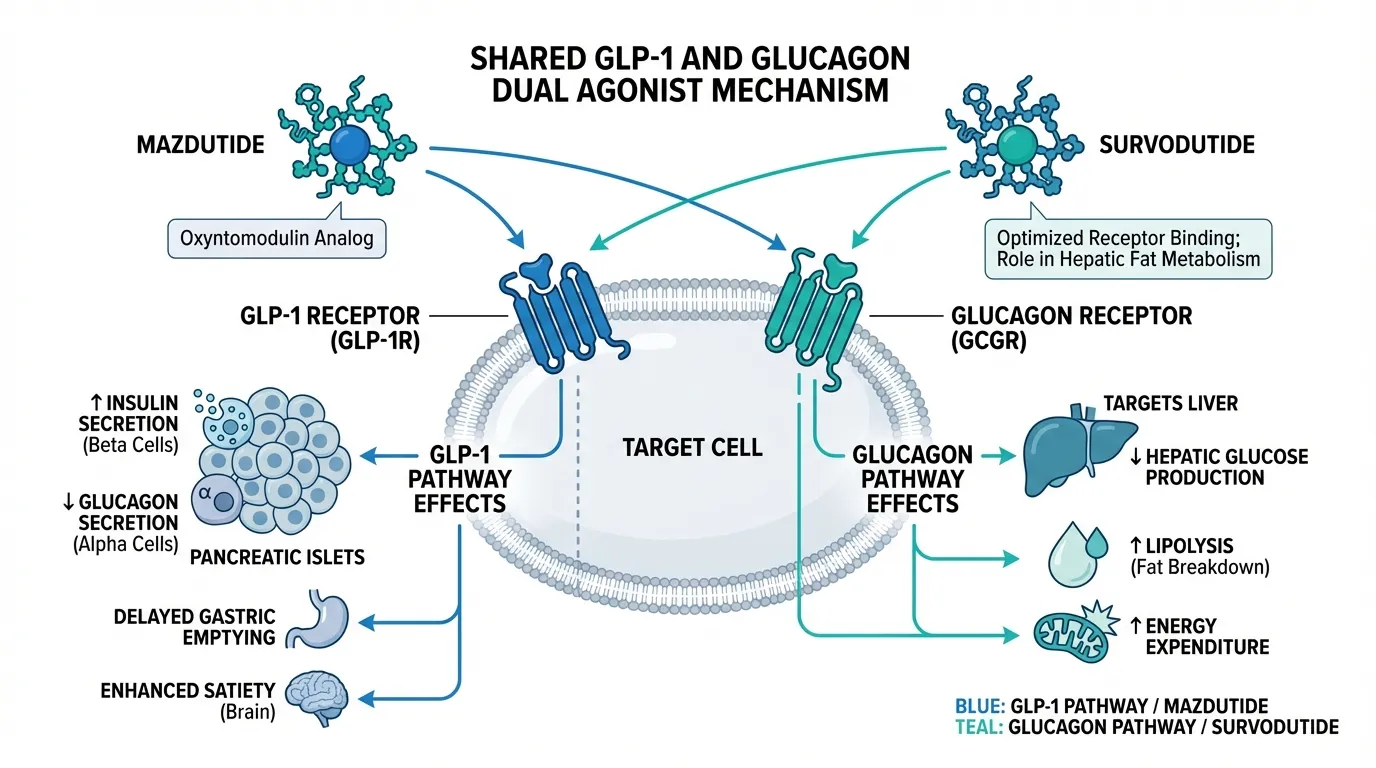
| Mechanism of Action | GLP-1/glucagon dual receptor agonist designed as an oxyntomodulin analog. Combines GLP-1-mediated appetite suppression and insulin secretion with glucagon-mediated increases in energy expenditure and hepatic fat oxidation. | GLP-1/glucagon dual receptor agonist. Combines GLP-1-mediated appetite suppression with glucagon-mediated energy expenditure and hepatic lipid metabolism. Licensed from Zealand Pharma's peptide platform. | Comparable |
| Weight Loss Efficacy | Phase 3 GLORY-2 demonstrated 20.1% mean weight loss at 60 weeks with 9 mg dose. GLORY-1 showed 12.6% at 32 weeks with 6 mg. DREAMS-3 head-to-head showed superiority over semaglutide 1 mg with 10.3% vs 6.0% at 32 weeks. | Phase 2 demonstrated up to 18.7% mean weight loss at 46 weeks with 4.8 mg dose (on-treatment analysis). In planned treatment analysis, 14.9% weight loss at 4.8 mg dose. Phase 3 SYNCHRONIZE results pending. | Mazdutide |
| MASH / Liver Disease | No dedicated MASH clinical trials published. Glucagon receptor agonism provides a mechanistic rationale for hepatic benefit, but liver-specific efficacy data is limited. | Phase 2 MASH trial (NEJM 2024) showed 62% MASH resolution at 4.8 mg vs 14% placebo. FDA Breakthrough Therapy Designation and PRIME scheme for MASH. Phase 3 LIVERAGE trials ongoing for MASH with fibrosis. | Survodutide |
| Research Evidence | Seven Phase 3 trials completed or ongoing (GLORY and DREAMS programs). Head-to-head Phase 3 superiority over semaglutide 1 mg in DREAMS-3. Approved in China for T2D (2024). Published in NEJM and Nature. | Phase 2 completed for obesity (Lancet 2024) and MASH (NEJM 2024). Phase 3 SYNCHRONIZE trials for obesity fully enrolled (results expected H1 2026). Phase 3 LIVERAGE trials for MASH ongoing. FDA Breakthrough Therapy and Fast Track designations. | Mazdutide |
| Side Effect Profile | Consistent safety profile across Phase 3 trials. GI adverse events (nausea, diarrhea, vomiting) mostly mild to moderate. No new safety signals in head-to-head comparison with semaglutide. | GI adverse events in 75% of survodutide vs 42% placebo in Phase 2. Rapid dose escalation protocol may have contributed to high rates. Phase 3 employing slower titration expected to improve tolerability. | Mazdutide |

Introduction#
Mazdutide and survodutide are the two most clinically advanced GLP-1/glucagon dual receptor agonists in development. Both share the same fundamental mechanism -- combining GLP-1 and glucagon receptor activation -- but are developed by different companies for different primary markets and indications.
Mazdutide (IBI362), developed by Innovent Biologics with Eli Lilly China, is an oxyntomodulin analog that has progressed through seven Phase 3 trials and gained regulatory approval in China for type 2 diabetes. Its Phase 3 GLORY-2 trial showed 20.1% weight loss at 60 weeks, and the DREAMS-3 trial demonstrated head-to-head superiority over semaglutide 1 mg.
Survodutide (BI 456906), developed by Boehringer Ingelheim and Zealand Pharma, has completed Phase 2 trials for both obesity (up to 18.7% weight loss at 46 weeks) and MASH (62% MASH resolution), earning FDA Breakthrough Therapy Designation for MASH. Phase 3 SYNCHRONIZE trials for obesity and LIVERAGE trials for MASH are ongoing.
Mechanism of Action Comparison#
Mazdutide#
Mazdutide is designed as an analog of oxyntomodulin, a naturally occurring gut hormone that activates both GLP-1 and glucagon receptors. This endogenous peptide is released postprandially and contributes to satiety and energy balance. Mazdutide's pharmacology mimics and amplifies these natural effects through extended-duration receptor activation.
Survodutide#
Survodutide was developed from Zealand Pharma's peptide platform with optimized receptor binding profiles. It activates both GLP-1 and glucagon receptors, with the glucagon component being particularly relevant for hepatic fat metabolism -- a key differentiator that has driven its MASH development program.
Both drugs share the same dual-agonist mechanism, differing primarily in their peptide chemistry, pharmacokinetic profiles, and clinical development strategies rather than fundamental pharmacology.
Dosing Comparison#
Mazdutide Dosing#
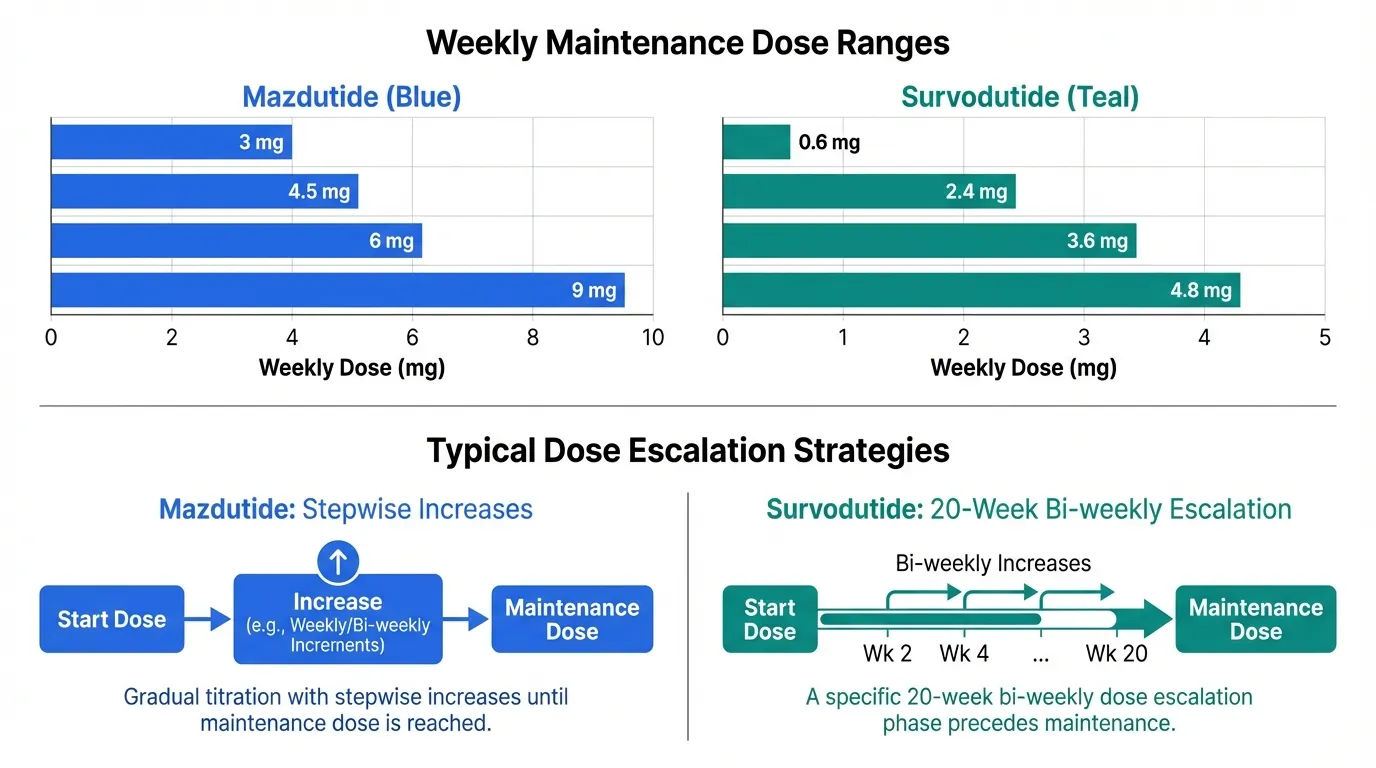
Mazdutide has been tested at 3 mg, 4.5 mg, 6 mg, and 9 mg once-weekly doses. The GLORY-1 trial used 4 mg and 6 mg over 48 weeks, while GLORY-2 tested 9 mg over 60 weeks. Dose escalation follows stepwise increases similar to other GLP-1-based therapies.
Survodutide Dosing#
Survodutide Phase 2 tested doses of 0.6, 2.4, 3.6, and 4.8 mg once weekly over 46 weeks. A 20-week bi-weekly dose escalation phase preceded maintenance dosing. Phase 3 SYNCHRONIZE trials are using optimized titration schedules expected to improve tolerability.
Side Effects Comparison#
Both drugs share the characteristic GI side effect profile of the GLP-1 agonist class. Mazdutide's Phase 3 safety database is substantially larger, showing mostly mild to moderate GI events with no new safety signals when compared head-to-head with semaglutide in DREAMS-3. Survodutide's Phase 2 data showed GI events in 75% of treated patients, which may partly reflect the rapid dose escalation used in early trials. Phase 3 protocols with slower titration are expected to improve tolerability.
Research Evidence Comparison#
Mazdutide Research#
Mazdutide has the largest Phase 3 evidence base of any GLP-1/glucagon dual agonist, with seven trials across the GLORY (obesity) and DREAMS (T2D) programs. The DREAMS-3 head-to-head trial demonstrated superiority over semaglutide 1 mg in both glycemic control (HbA1c: -2.03% vs -1.84%) and weight loss (10.3% vs 6.0%) at 32 weeks. Mazdutide is approved in China for T2D with GLORY results published in NEJM and DREAMS results in Nature.
Survodutide Research#
Survodutide has two published Phase 2 trials: the obesity trial (Lancet Diabetes & Endocrinology, 2024) showing 18.7% weight loss at 46 weeks, and the MASH trial (NEJM, 2024) showing 62% MASH resolution. Phase 3 obesity trials (SYNCHRONIZE-1 and SYNCHRONIZE-2) are fully enrolled with results expected H1 2026. Phase 3 MASH trials (LIVERAGE) are ongoing.
Key Differences Summary#
- Same mechanism, different development: Both are GLP-1/glucagon dual agonists, but mazdutide is developed for the Chinese market and survodutide for global markets.
- Weight loss: Mazdutide showed 20.1% at 60 weeks (Phase 3) versus survodutide's 18.7% at 46 weeks (Phase 2 on-treatment).
- MASH: Survodutide has the most advanced MASH program with Breakthrough Therapy Designation and dedicated Phase 3 trials.
- Head-to-head data: Mazdutide is the only dual agonist with Phase 3 head-to-head data vs semaglutide. Survodutide has no head-to-head comparisons.
- Regulatory approval: Mazdutide is approved in China for T2D; survodutide is not yet approved anywhere.
- Developer: Mazdutide by Innovent/Lilly China; survodutide by Boehringer Ingelheim/Zealand Pharma.
Conclusion#
Mazdutide and survodutide share the same GLP-1/glucagon dual-agonist mechanism but have followed distinct development paths. Mazdutide leads in overall clinical evidence maturity with Phase 3 completion, regulatory approval, and head-to-head superiority data versus semaglutide. Survodutide has differentiated itself through a dedicated MASH program with FDA Breakthrough Therapy Designation, positioning it for a potentially unique role in liver disease treatment alongside obesity.
Their geographic focus also differs: mazdutide primarily serves the Chinese market, while survodutide targets global regulatory approval. Together, they demonstrate the clinical viability of the GLP-1/glucagon dual-agonist concept and suggest that this mechanism class will be a significant addition to the metabolic disease treatment landscape alongside tirzepatide and emerging triple agonists like retatrutide.
Detailed Category Analysis#
Mechanism of Action#
Mazdutide: GLP-1/glucagon dual receptor agonist designed as an oxyntomodulin analog. Combines GLP-1-mediated appetite suppression and insulin secretion with glucagon-mediated increases in energy expenditure and hepatic fat oxidation.
Survodutide: GLP-1/glucagon dual receptor agonist. Combines GLP-1-mediated appetite suppression with glucagon-mediated energy expenditure and hepatic lipid metabolism. Licensed from Zealand Pharma's peptide platform.
Advantage: Neither (tie)
Weight Loss Efficacy#
Mazdutide: Phase 3 GLORY-2 demonstrated 20.1% mean weight loss at 60 weeks with 9 mg dose. GLORY-1 showed 12.6% at 32 weeks with 6 mg. DREAMS-3 head-to-head showed superiority over semaglutide 1 mg with 10.3% vs 6.0% at 32 weeks.
Survodutide: Phase 2 demonstrated up to 18.7% mean weight loss at 46 weeks with 4.8 mg dose (on-treatment analysis). In planned treatment analysis, 14.9% weight loss at 4.8 mg dose. Phase 3 SYNCHRONIZE results pending.
Advantage: Mazdutide
MASH / Liver Disease#
Mazdutide: No dedicated MASH clinical trials published. Glucagon receptor agonism provides a mechanistic rationale for hepatic benefit, but liver-specific efficacy data is limited.
Survodutide: Phase 2 MASH trial (NEJM 2024) showed 62% MASH resolution at 4.8 mg vs 14% placebo. FDA Breakthrough Therapy Designation and PRIME scheme for MASH. Phase 3 LIVERAGE trials ongoing for MASH with fibrosis.
Advantage: Survodutide
Research Evidence#
Mazdutide: Seven Phase 3 trials completed or ongoing (GLORY and DREAMS programs). Head-to-head Phase 3 superiority over semaglutide 1 mg in DREAMS-3. Approved in China for T2D (2024). Published in NEJM and Nature.
Survodutide: Phase 2 completed for obesity (Lancet 2024) and MASH (NEJM 2024). Phase 3 SYNCHRONIZE trials for obesity fully enrolled (results expected H1 2026). Phase 3 LIVERAGE trials for MASH ongoing. FDA Breakthrough Therapy and Fast Track designations.
Advantage: Mazdutide
Side Effect Profile#
Mazdutide: Consistent safety profile across Phase 3 trials. GI adverse events (nausea, diarrhea, vomiting) mostly mild to moderate. No new safety signals in head-to-head comparison with semaglutide.
Survodutide: GI adverse events in 75% of survodutide vs 42% placebo in Phase 2. Rapid dose escalation protocol may have contributed to high rates. Phase 3 employing slower titration expected to improve tolerability.
Advantage: Mazdutide
Summary and Verdict#
Mazdutide and survodutide are both GLP-1/glucagon dual agonists with similar mechanisms but divergent development strategies. Mazdutide has the more mature clinical program with Phase 3 completion, regulatory approval in China, and a head-to-head win over semaglutide. Its weight loss data (20.1% at 60 weeks) also exceeds survodutide's Phase 2 results (18.7% at 46 weeks). However, survodutide has carved out a distinct position in MASH treatment with FDA Breakthrough Therapy Designation and dedicated Phase 3 MASH trials. Survodutide is being developed for global markets by Boehringer Ingelheim, while mazdutide is focused on China.
Best For Recommendations#
Weight Loss Efficacy#
Recommendation: Mazdutide
Reason: Phase 3 GLORY-2 demonstrated 20.1% weight loss at 60 weeks, exceeding survodutide's Phase 2 on-treatment result of 18.7%. Mazdutide also has head-to-head superiority data over semaglutide.
MASH Treatment#
Recommendation: Survodutide
Reason: FDA Breakthrough Therapy Designation for MASH with Phase 2 data showing 62% MASH resolution. Dedicated Phase 3 MASH trials (LIVERAGE) ongoing. Most advanced MASH-specific development of any dual agonist.
Clinical Evidence Maturity#
Recommendation: Mazdutide
Reason: Seven Phase 3 trials, regulatory approval in China for T2D, and the only dual agonist with head-to-head Phase 3 data vs semaglutide.
Global Market Development#
Recommendation: Survodutide
Reason: Developed by Boehringer Ingelheim for global markets with Phase 3 SYNCHRONIZE trials enrolling patients internationally. Mazdutide is primarily developed for the Chinese market.
Further Reading#

Which Is Better For...
Weight Loss Efficacy
Mazdutide
Phase 3 GLORY-2 demonstrated 20.1% weight loss at 60 weeks, exceeding survodutide's Phase 2 on-treatment result of 18.7%. Mazdutide also has head-to-head superiority data over semaglutide.
MASH Treatment
Survodutide
FDA Breakthrough Therapy Designation for MASH with Phase 2 data showing 62% MASH resolution. Dedicated Phase 3 MASH trials (LIVERAGE) ongoing. Most advanced MASH-specific development of any dual agonist.
Clinical Evidence Maturity
Mazdutide
Seven Phase 3 trials, regulatory approval in China for T2D, and the only dual agonist with head-to-head Phase 3 data vs semaglutide.
Global Market Development
Survodutide
Developed by Boehringer Ingelheim for global markets with Phase 3 SYNCHRONIZE trials enrolling patients internationally. Mazdutide is primarily developed for the Chinese market.
Continue Your Research
Get comparison updates
We publish new head-to-head comparisons regularly. Subscribe to see them first.
Frequently Asked Questions About Mazdutide vs Survodutide: GLP-1/Glucagon Dual Agonist Comparison
Which is better, Mazdutide or Survodutide?
Mazdutide and survodutide are both GLP-1/glucagon dual agonists with similar mechanisms but divergent development strategies. Mazdutide has the more mature clinical program with Phase 3 completion, regulatory approval in China, and a head-to-head win over semaglutide. Its weight loss data (20.1% at 60 weeks) also exceeds survodutide's Phase 2 results (18.7% at 46 weeks). However, survodutide has carved out a distinct position in MASH treatment with FDA Breakthrough Therapy Designation and ded... Individual responses may vary, and this comparison is based on available research data, not a treatment recommendation.
What are the key differences between Mazdutide and Survodutide?
The main differences across comparison categories are: Mechanism of Action: advantage goes to neither (tie); Weight Loss Efficacy: advantage goes to Mazdutide; MASH / Liver Disease: advantage goes to Survodutide. 2 additional categories are analyzed in the full comparison. Each category evaluates a different dimension of the two peptides.
When should I consider Mazdutide over Survodutide?
For the scenario of "Weight Loss Efficacy," research data suggests Mazdutide may be more relevant. Phase 3 GLORY-2 demonstrated 20.1% weight loss at 60 weeks, exceeding survodutide's Phase 2 on-treatment result of 18.7%. Mazdutide also has head-to-head superiority data over semaglutide.. This is based on currently available evidence and individual circumstances may differ.
How do Mazdutide and Survodutide differ in their mechanisms of action?
Mazdutide: GLP-1/glucagon dual receptor agonist designed as an oxyntomodulin analog. Combines GLP-1-mediated appetite suppression and insulin secretion with glucagon-mediated increases in energy expenditure a.... Survodutide: GLP-1/glucagon dual receptor agonist. Combines GLP-1-mediated appetite suppression with glucagon-mediated energy expenditure and hepatic lipid metabolism. Licensed from Zealand Pharma's peptide pla....
Which has fewer side effects, Mazdutide or Survodutide?
In terms of side effects and tolerability, the advantage goes to Mazdutide. Mazdutide: Consistent safety profile across Phase 3 trials. GI adverse events (nausea, diarrhea, vomiting) mostly mild to moderate. No new safety signals in h.... Survodutide: GI adverse events in 75% of survodutide vs 42% placebo in Phase 2. Rapid dose escalation protocol may have contributed to high rates. Phase 3 emplo....
Medical Disclaimer
This website is for educational and informational purposes only. The information provided is not intended to diagnose, treat, cure, or prevent any disease. Always consult with a qualified healthcare professional before using any peptide or supplement.