Mazdutide vs Retatrutide: Dual vs Triple Agonist Comparison for Obesity
Evidence-based comparison of mazdutide (GLP-1/glucagon dual agonist) and retatrutide (GIP/GLP-1/glucagon triple agonist) for weight loss and type 2 diabetes based on Phase 2-3 clinical trial data.
Verdict at a Glance
Retatrutide achieved greater peak weight loss (28.7% at 68 weeks in Phase 3 TRIUMPH-4; 24.2% at 48 weeks in Phase 2) compared to mazdutide's Phase 3 results (20.1% at 60 weeks), likely due to its additional GIP receptor agonism. However, mazdutide is significantly further along in clinical development, with multiple completed Phase 3 trials, regulatory approval in China for T2D, and a head-to-head Phase 3 win over semaglutide. Mazdutide's development is primarily focused on Chinese populations, while retatrutide targets global markets. Both represent meaningful advances over single-target GLP-1 agonists.
| Best for | Pick | Why |
|---|---|---|
| Maximum Weight Loss | Retatrutide | Phase 3 TRIUMPH-4 showed 28.7% mean weight loss at 68 weeks (Phase 2 showed 24.2% at 48 weeks), exceeding mazdutide's 20.1% at 60 weeks in GLORY-2. The triple-agonist mechanism provides inherently greater metabolic effects. |
| Clinical Maturity and Approval | Mazdutide | Already approved in China for T2D, with seven Phase 3 trials completed or ongoing and a head-to-head Phase 3 superiority win over semaglutide. Far more mature clinical evidence base. |
| Head-to-Head Evidence vs Semaglutide | Mazdutide | DREAMS-3 is the only Phase 3 head-to-head trial demonstrating superiority of a dual agonist over semaglutide 1 mg in both glycemic control and weight loss. |
| Global Market Access | Retatrutide | Developed by Eli Lilly for global markets including US and EU. Mazdutide is primarily developed for the Chinese market by Innovent Biologics with Lilly partnership. |
| Category | Mazdutide | Retatrutide | Advantage |
|---|---|---|---|
| Mechanism of Action | GLP-1/glucagon dual receptor agonist. An oxyntomodulin analog that combines GLP-1-mediated appetite suppression with glucagon-mediated increases in energy expenditure and hepatic fat oxidation. | GIP/GLP-1/glucagon triple receptor agonist. The only agent activating all three incretin and glucagon pathways simultaneously, producing synergistic metabolic effects through complementary mechanisms. | Retatrutide |
| Weight Loss Efficacy | Phase 3 GLORY-2 demonstrated 20.1% mean weight loss at 60 weeks with 9 mg dose in Chinese adults with obesity. GLORY-1 showed 12.6% at 32 weeks with 6 mg. Head-to-head DREAMS-3 showed 10.3% weight loss at 32 weeks vs 6.0% with semaglutide 1 mg. | Phase 3 TRIUMPH-4 demonstrated 28.7% mean weight loss at 68 weeks with 12 mg dose (Phase 2 showed 24.2% at 48 weeks). 100% of patients on 12 mg achieved 5% or more weight loss in Phase 2, and 83% achieved 15% or more. | Retatrutide |
| Research Evidence | Multiple Phase 3 trials completed or ongoing (GLORY-1, GLORY-2, DREAMS series). Head-to-head Phase 3 superiority over semaglutide 1 mg demonstrated in DREAMS-3. Approved in China for T2D (2024). Seven Phase 3 studies conducted. | Phase 2 completed for obesity (NEJM 2023) and MASH. Phase 3 TRIUMPH program ongoing with TRIUMPH-4 results reported (28.7% weight loss at 68 weeks). No approved indications yet. | Mazdutide |
| Side Effect Profile | GI adverse events are the most common. Safety profile consistent across Phase 3 trials with mostly mild to moderate GI events. No new safety signals identified in DREAMS-3 vs semaglutide. | GI adverse events dose-dependent. Nausea 16-46%, diarrhea 16-26%, vomiting 8-22% across dose groups. Higher rates at 12 mg but manageable with escalation. Phase 2 data only. | Mazdutide |
| Regulatory Status | Approved in China for type 2 diabetes (2024). Phase 3 obesity trials completed in China. Not yet approved in US, EU, or other major markets. Developed by Innovent Biologics/Eli Lilly China. | Not approved in any market. Phase 3 trials initiated by Eli Lilly. No regulatory submissions yet. | Mazdutide |

Introduction#
Mazdutide and retatrutide are both multi-receptor agonists that go beyond single-target GLP-1 therapy for obesity and diabetes. They share glucagon receptor agonism as a key differentiator from pure GLP-1 drugs like semaglutide, but differ in the number of receptor targets and their clinical development trajectories.
Mazdutide (IBI362), developed by Innovent Biologics in partnership with Eli Lilly China, is a GLP-1/glucagon dual receptor agonist designed as an oxyntomodulin analog. It has the most advanced clinical program of any dual agonist, with multiple Phase 3 trials completed, regulatory approval in China for type 2 diabetes, and a head-to-head Phase 3 trial (DREAMS-3) demonstrating superiority over semaglutide.
Retatrutide (LY3437943), developed by Eli Lilly, is the first triple GIP/GLP-1/glucagon receptor agonist in advanced clinical development. Its Phase 3 TRIUMPH-4 trial reported 28.7% mean weight loss at 68 weeks with the 12 mg dose, confirming the exceptional Phase 2 results (24.2% at 48 weeks; Jastreboff et al., NEJM 2023). Retatrutide has produced the highest weight loss of any single anti-obesity agent in clinical trials.
Mechanism of Action Comparison#
Mazdutide#
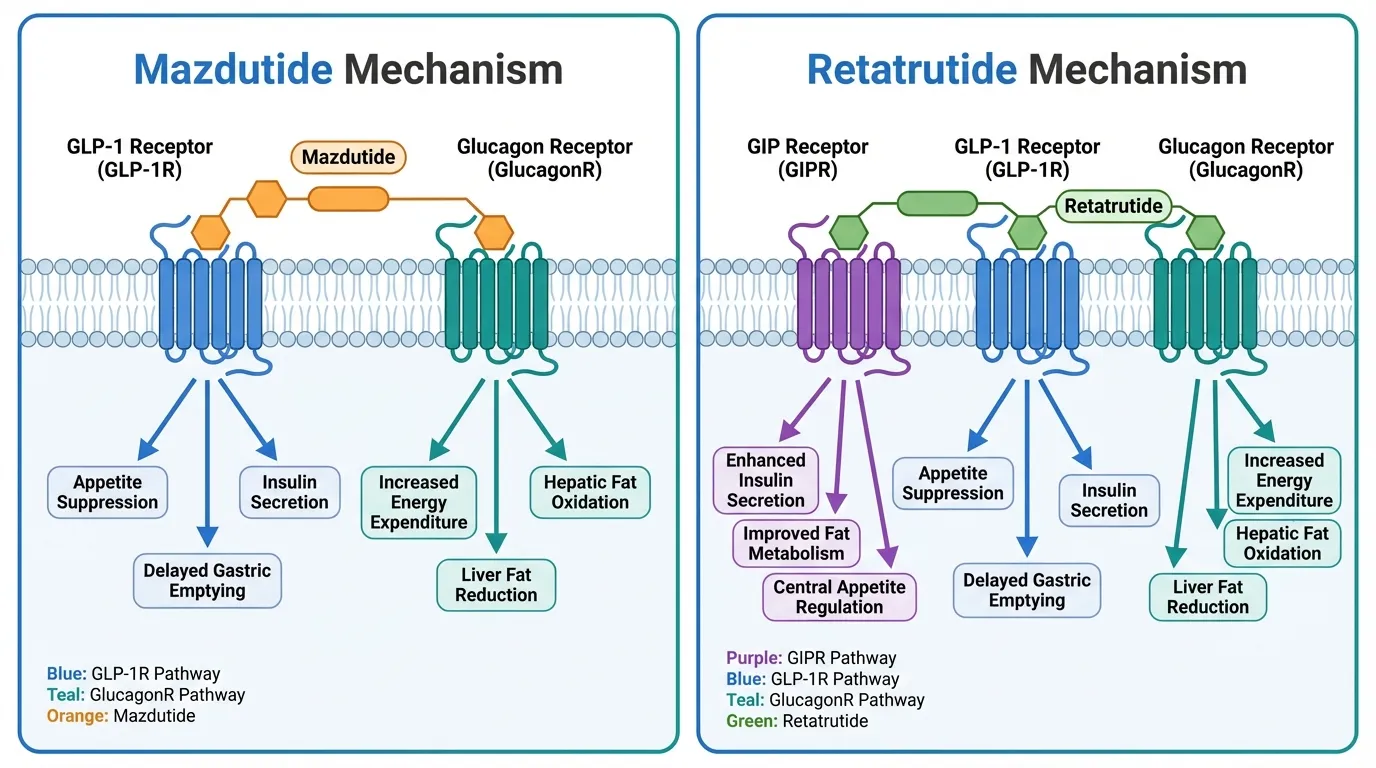
Mazdutide is an oxyntomodulin analog that activates both GLP-1 and glucagon receptors. GLP-1 receptor activation suppresses appetite, enhances glucose-dependent insulin secretion, and delays gastric emptying. Glucagon receptor activation increases energy expenditure through thermogenesis and promotes hepatic fat oxidation, potentially offering advantages over pure GLP-1 agonists for liver fat reduction.
Retatrutide#
Retatrutide activates three receptors simultaneously: GIP, GLP-1, and glucagon receptors. It shares the GLP-1/glucagon dual agonism of mazdutide but adds GIP receptor activation, which enhances insulin secretion, may improve fat metabolism and distribution, and contributes to central appetite regulation through mechanisms complementary to GLP-1R signaling. This triple mechanism produced greater weight loss than any dual agonist in Phase 2 trials.
| Feature | Mazdutide | Retatrutide |
|---|---|---|
| Receptor targets | GLP-1 + Glucagon | GIP + GLP-1 + Glucagon |
| GIP receptor | No | Yes |
| Design basis | Oxyntomodulin analog | Novel triple agonist |
| Dosing | Once weekly SC | Once weekly SC |
| Developer | Innovent / Lilly China | Eli Lilly |
Dosing Comparison#
Mazdutide Dosing#
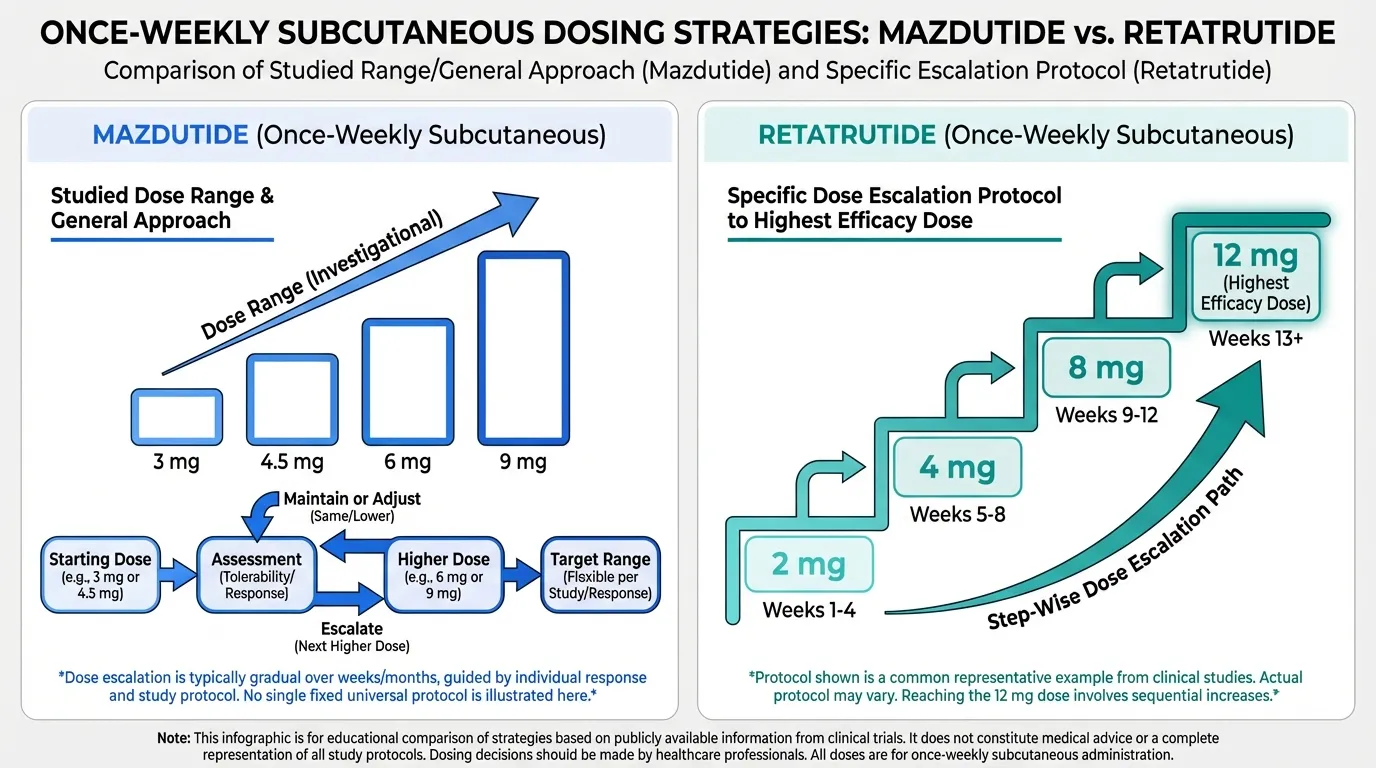
Mazdutide has been studied at 3 mg, 4.5 mg, 6 mg, and 9 mg once-weekly doses across Phase 3 trials. GLORY-1 tested 4 mg and 6 mg over 48 weeks, while GLORY-2 tested 9 mg over 60 weeks. Dose escalation protocols are used with stepwise increases.
Retatrutide Dosing#
Retatrutide was studied at doses from 0.5 mg to 12 mg once weekly in Phase 2. The 12 mg dose (with escalation from 2 to 4 to 8 mg) showed the greatest efficacy over 48 weeks. Phase 3 dose selection will refine optimal dosing.
Side Effects Comparison#
Both drugs share the GI adverse event profile common to GLP-1-based therapies. Mazdutide's Phase 3 safety data from thousands of patients shows mostly mild to moderate GI events (nausea, diarrhea, vomiting) consistent with the drug class. Retatrutide's Phase 2 data showed dose-dependent GI events with nausea in up to 46% at the highest dose, though events were generally manageable with dose escalation.
Mazdutide has the advantage of a larger safety database from multiple Phase 3 trials and post-approval monitoring in China. Retatrutide's safety profile will be better characterized when Phase 3 data becomes available.
Research Evidence Comparison#
Mazdutide Research#
Mazdutide has the most extensive clinical evidence base of any GLP-1/glucagon dual agonist. Key trials include GLORY-1 (Phase 3, NEJM, obesity, 12.6% weight loss at 32 weeks with 6 mg), GLORY-2 (Phase 3, obesity, 20.1% weight loss at 60 weeks with 9 mg), DREAMS-1 and DREAMS-2 (Phase 3, T2D), and DREAMS-3 (Phase 3, head-to-head vs semaglutide 1 mg, demonstrating superiority in both HbA1c reduction and weight loss). Approved in China for T2D. Evidence level is high based on multiple Phase 3 programs.
Retatrutide Research#
Retatrutide's evidence base includes the pivotal Phase 2 trial (Jastreboff et al., NEJM 2023) with 338 adults showing 24.2% weight loss at 48 weeks, Phase 3 TRIUMPH-4 confirming 28.7% weight loss at 68 weeks, and a Phase 2a MASH study showing significant liver fat reduction. Evidence level is high based on confirmed Phase 3 data.
Key Differences Summary#
- Receptor targets: Mazdutide targets two receptors (GLP-1 + glucagon), while retatrutide targets three (GIP + GLP-1 + glucagon).
- Weight loss: Retatrutide showed greater peak weight loss (28.7% at 68 weeks in Phase 3 TRIUMPH-4) compared to mazdutide (20.1% at 60 weeks), though trials differ in design and population.
- Clinical maturity: Mazdutide has seven Phase 3 trials, regulatory approval in China, and a head-to-head win over semaglutide. Retatrutide has Phase 3 data from TRIUMPH-4 with additional readouts expected in 2026.
- Geographic focus: Mazdutide is primarily developed for the Chinese market; retatrutide targets global markets.
- Developer: Both involve Eli Lilly -- mazdutide through the Innovent/Lilly China partnership, retatrutide directly by Lilly.
Conclusion#
Mazdutide and retatrutide represent the two leading approaches to multi-receptor metabolic therapy beyond single-target GLP-1 agonism. Retatrutide's triple-agonist mechanism produced the highest weight loss of any anti-obesity agent in clinical trials (28.7% at 68 weeks in Phase 3 TRIUMPH-4), confirming that adding GIP receptor activation on top of GLP-1/glucagon provides substantial incremental metabolic benefit. Mazdutide has the advantage of more completed Phase 3 trials, regulatory approval in China, and a head-to-head Phase 3 trial demonstrating superiority over semaglutide.
Cross-trial comparisons between the two drugs are limited by different populations (Chinese vs global), trial durations, and dose escalation protocols. A direct head-to-head comparison would be needed to definitively determine whether the additional GIP receptor component of retatrutide translates to clinically meaningful advantages over mazdutide's dual mechanism. Both drugs are positioned to meaningfully advance metabolic disease treatment beyond the current standard of care.
Detailed Category Analysis#
Mechanism of Action#
Mazdutide: GLP-1/glucagon dual receptor agonist. An oxyntomodulin analog that combines GLP-1-mediated appetite suppression with glucagon-mediated increases in energy expenditure and hepatic fat oxidation.
Retatrutide: GIP/GLP-1/glucagon triple receptor agonist. The only agent activating all three incretin and glucagon pathways simultaneously, producing synergistic metabolic effects through complementary mechanisms.
Advantage: Retatrutide
Weight Loss Efficacy#
Mazdutide: Phase 3 GLORY-2 demonstrated 20.1% mean weight loss at 60 weeks with 9 mg dose in Chinese adults with obesity. GLORY-1 showed 12.6% at 32 weeks with 6 mg. Head-to-head DREAMS-3 showed 10.3% weight loss at 32 weeks vs 6.0% with semaglutide 1 mg.
Retatrutide: Phase 3 TRIUMPH-4 demonstrated 28.7% mean weight loss at 68 weeks with 12 mg dose (Phase 2 showed 24.2% at 48 weeks). 100% of patients on 12 mg achieved 5% or more weight loss in Phase 2, and 83% achieved 15% or more.
Advantage: Retatrutide
Research Evidence#
Mazdutide: Multiple Phase 3 trials completed or ongoing (GLORY-1, GLORY-2, DREAMS series). Head-to-head Phase 3 superiority over semaglutide 1 mg demonstrated in DREAMS-3. Approved in China for T2D (2024). Seven Phase 3 studies conducted.
Retatrutide: Phase 2 completed for obesity (NEJM 2023) and MASH. Phase 3 TRIUMPH program ongoing with TRIUMPH-4 results reported (28.7% weight loss at 68 weeks). No approved indications yet.
Advantage: Mazdutide
Side Effect Profile#
Mazdutide: GI adverse events are the most common. Safety profile consistent across Phase 3 trials with mostly mild to moderate GI events. No new safety signals identified in DREAMS-3 vs semaglutide.
Retatrutide: GI adverse events dose-dependent. Nausea 16-46%, diarrhea 16-26%, vomiting 8-22% across dose groups. Higher rates at 12 mg but manageable with escalation. Phase 2 data only.
Advantage: Mazdutide
Regulatory Status#
Mazdutide: Approved in China for type 2 diabetes (2024). Phase 3 obesity trials completed in China. Not yet approved in US, EU, or other major markets. Developed by Innovent Biologics/Eli Lilly China.
Retatrutide: Not approved in any market. Phase 3 trials initiated by Eli Lilly. No regulatory submissions yet.
Advantage: Mazdutide
Summary and Verdict#
Retatrutide achieved greater peak weight loss (28.7% at 68 weeks in Phase 3 TRIUMPH-4; 24.2% at 48 weeks in Phase 2) compared to mazdutide's Phase 3 results (20.1% at 60 weeks), likely due to its additional GIP receptor agonism. However, mazdutide is significantly further along in clinical development, with multiple completed Phase 3 trials, regulatory approval in China for T2D, and a head-to-head Phase 3 win over semaglutide. Mazdutide's development is primarily focused on Chinese populations, while retatrutide targets global markets. Both represent meaningful advances over single-target GLP-1 agonists.
Best For Recommendations#
Maximum Weight Loss#
Recommendation: Retatrutide
Reason: Phase 3 TRIUMPH-4 showed 28.7% mean weight loss at 68 weeks (Phase 2 showed 24.2% at 48 weeks), exceeding mazdutide's 20.1% at 60 weeks in GLORY-2. The triple-agonist mechanism provides inherently greater metabolic effects.
Clinical Maturity and Approval#
Recommendation: Mazdutide
Reason: Already approved in China for T2D, with seven Phase 3 trials completed or ongoing and a head-to-head Phase 3 superiority win over semaglutide. Far more mature clinical evidence base.
Head-to-Head Evidence vs Semaglutide#
Recommendation: Mazdutide
Reason: DREAMS-3 is the only Phase 3 head-to-head trial demonstrating superiority of a dual agonist over semaglutide 1 mg in both glycemic control and weight loss.
Global Market Access#
Recommendation: Retatrutide
Reason: Developed by Eli Lilly for global markets including US and EU. Mazdutide is primarily developed for the Chinese market by Innovent Biologics with Lilly partnership.
Further Reading#

Which Is Better For...
Maximum Weight Loss
Retatrutide
Phase 3 TRIUMPH-4 showed 28.7% mean weight loss at 68 weeks (Phase 2 showed 24.2% at 48 weeks), exceeding mazdutide's 20.1% at 60 weeks in GLORY-2. The triple-agonist mechanism provides inherently greater metabolic effects.
Clinical Maturity and Approval
Mazdutide
Already approved in China for T2D, with seven Phase 3 trials completed or ongoing and a head-to-head Phase 3 superiority win over semaglutide. Far more mature clinical evidence base.
Head-to-Head Evidence vs Semaglutide
Mazdutide
DREAMS-3 is the only Phase 3 head-to-head trial demonstrating superiority of a dual agonist over semaglutide 1 mg in both glycemic control and weight loss.
Global Market Access
Retatrutide
Developed by Eli Lilly for global markets including US and EU. Mazdutide is primarily developed for the Chinese market by Innovent Biologics with Lilly partnership.
Continue Your Research
Get comparison updates
We publish new head-to-head comparisons regularly. Subscribe to see them first.
Frequently Asked Questions About Mazdutide vs Retatrutide: Dual vs Triple Agonist Comparison for Obesity
Which is better, Mazdutide or Retatrutide?
Retatrutide achieved greater peak weight loss (28.7% at 68 weeks in Phase 3 TRIUMPH-4; 24.2% at 48 weeks in Phase 2) compared to mazdutide's Phase 3 results (20.1% at 60 weeks), likely due to its additional GIP receptor agonism. However, mazdutide is significantly further along in clinical development, with multiple completed Phase 3 trials, regulatory approval in China for T2D, and a head-to-head Phase 3 win over semaglutide. Mazdutide's development is primarily focused on Chinese population... Individual responses may vary, and this comparison is based on available research data, not a treatment recommendation.
What are the key differences between Mazdutide and Retatrutide?
The main differences across comparison categories are: Mechanism of Action: advantage goes to Retatrutide; Weight Loss Efficacy: advantage goes to Retatrutide; Research Evidence: advantage goes to Mazdutide. 2 additional categories are analyzed in the full comparison. Each category evaluates a different dimension of the two peptides.
When should I consider Retatrutide over Mazdutide?
For the scenario of "Maximum Weight Loss," research data suggests Retatrutide may be more relevant. Phase 3 TRIUMPH-4 showed 28.7% mean weight loss at 68 weeks (Phase 2 showed 24.2% at 48 weeks), exceeding mazdutide's 20.1% at 60 weeks in GLORY-2. The triple-agonist mechanism provides inherently .... This is based on currently available evidence and individual circumstances may differ.
How do Mazdutide and Retatrutide differ in their mechanisms of action?
Mazdutide: GLP-1/glucagon dual receptor agonist. An oxyntomodulin analog that combines GLP-1-mediated appetite suppression with glucagon-mediated increases in energy expenditure and hepatic fat oxidation.. Retatrutide: GIP/GLP-1/glucagon triple receptor agonist. The only agent activating all three incretin and glucagon pathways simultaneously, producing synergistic metabolic effects through complementary mechanisms..
Which has fewer side effects, Mazdutide or Retatrutide?
In terms of side effects and tolerability, the advantage goes to Mazdutide. Mazdutide: GI adverse events are the most common. Safety profile consistent across Phase 3 trials with mostly mild to moderate GI events. No new safety signal.... Retatrutide: GI adverse events dose-dependent. Nausea 16-46%, diarrhea 16-26%, vomiting 8-22% across dose groups. Higher rates at 12 mg but manageable with esca....
Medical Disclaimer
This website is for educational and informational purposes only. The information provided is not intended to diagnose, treat, cure, or prevent any disease. Always consult with a qualified healthcare professional before using any peptide or supplement.