TB-500 vs GHK-Cu: Healing Peptides Compared
Comparing TB-500 (Thymosin Beta-4) and GHK-Cu for tissue repair, covering mechanisms of action, wound healing evidence, and clinical applications.
Verdict at a Glance
GHK-Cu for surface tissue repair, skin rejuvenation, and accessible topical use; TB-500 for deeper systemic healing, cardiac repair, and musculoskeletal injuries
| Best for | Pick | Why |
|---|---|---|
| Skin Anti-Aging and Rejuvenation | GHK-Cu | GHK-Cu stimulates collagen and elastin synthesis, is commercially available in topical formulations, and has human data supporting skin improvements |
| Wound Healing (Topical) | GHK-Cu | GHK-Cu can be applied directly to wounds without injection, making it practical for surface tissue repair |
| Cardiac Repair Research | TB-500 | TB-500 has demonstrated cardioprotective effects in preclinical models of myocardial infarction, promoting cardiomyocyte survival and neovascularization |
| Musculoskeletal Injury | TB-500 | TB-500 promotes cell migration and tissue repair through actin regulation, with broader systemic distribution suited for deep tissue healing |
| Corneal Injury Research | TB-500 | Phase II clinical trials (as RGN-259) investigated TB-500 for corneal wound healing, representing its most advanced clinical application |
| Hair Growth | GHK-Cu | GHK-Cu has demonstrated ability to stimulate hair follicle growth and increase hair follicle size in research studies |
| Category | GHK-Cu | TB-500 | Advantage |
|---|---|---|---|
| Mechanism of Action | Copper-chelating tripeptide modulating ~4,000 genes; stimulates collagen synthesis, TGF-beta/BMP pathways, and metalloenzyme activation | 43-amino acid peptide sequestering G-actin; promotes cell migration, angiogenesis, and cytoskeletal reorganization for tissue repair | Comparable |
| Research Evidence | 50+ studies with human skin trials; commercially used in cosmetics; limited injectable clinical data | Phase II trials for dermal wounds, corneal injuries, and cardiac repair; extensive preclinical data across multiple tissue types | TB-500 |
| Side Effect Profile | Well-tolerated topically; low irritation; rare copper sensitivity reactions; minimal systemic concerns at standard doses | Generally well-tolerated in clinical trials; injection site reactions possible; limited long-term safety data | GHK-Cu |
| Scope of Applications | Skin rejuvenation, wound healing, hair growth, anti-aging; primarily surface and dermal tissue applications | Cardiac repair, corneal healing, dermal wounds, musculoskeletal repair, neuroprotection; broad systemic tissue applications | TB-500 |
| Administration Routes | Topical (creams, serums), subcutaneous injection, iontophoresis; accessible non-injection options available | Subcutaneous or intramuscular injection; no topical formulation; requires reconstitution from lyophilized powder | GHK-Cu |

Introduction#
GHK-Cu and TB-500 (Thymosin Beta-4) represent two distinct approaches to peptide-mediated tissue repair. GHK-Cu, a naturally occurring copper-binding tripeptide, works through metal-mediated gene modulation and extracellular matrix remodeling, with practical applications in dermatology and cosmetics. TB-500, a synthetic version of the 43-amino acid thymosin beta-4, promotes healing through actin cytoskeletal regulation and cell migration, with clinical investigations spanning cardiac, corneal, and dermal repair.
Despite both being classified as healing peptides, they differ substantially in molecular size, mechanism, route of administration, tissue targets, and clinical development stage. This comparison helps researchers and clinicians evaluate which peptide best fits their specific healing application.
Quick Comparison Table#
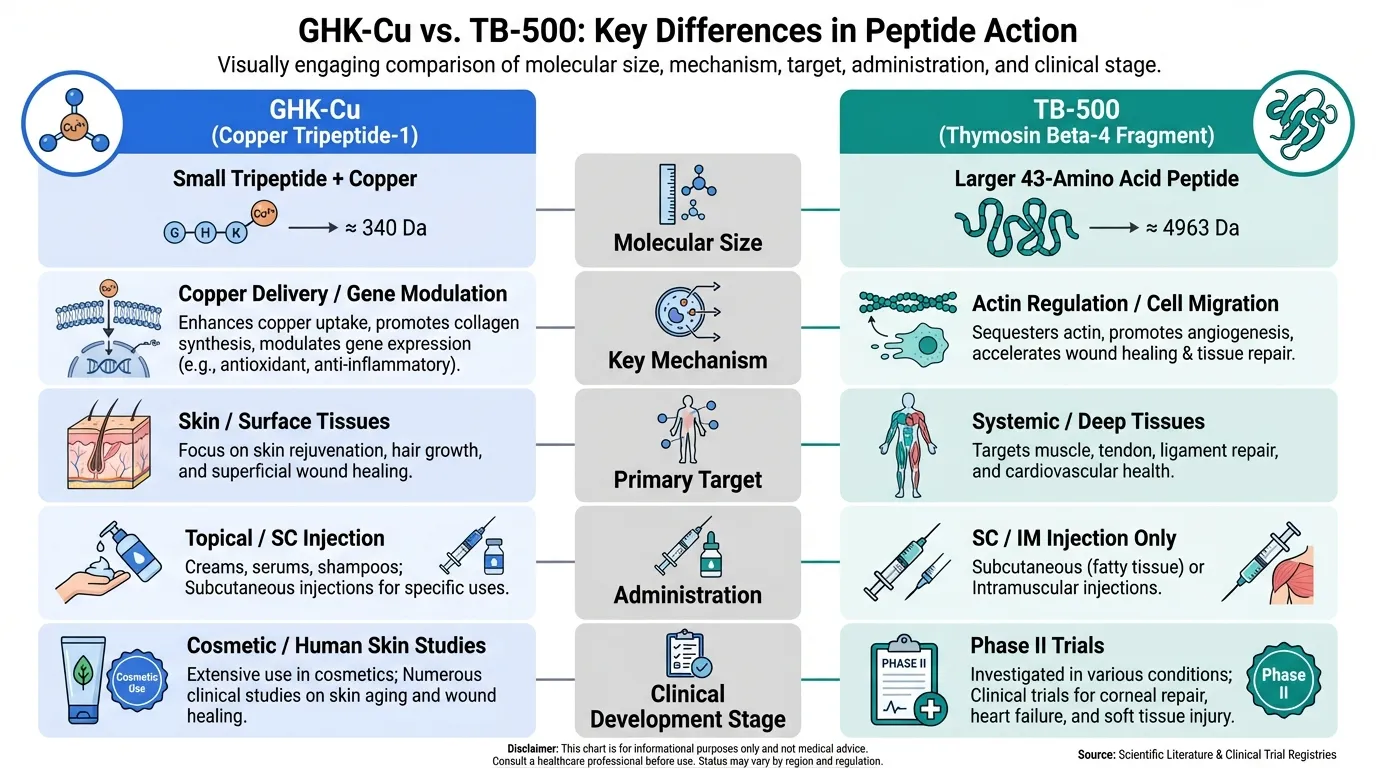
| Feature | GHK-Cu | TB-500 |
|---|---|---|
| Size | Tripeptide + copper (403.93 Da) | 43 amino acids (4963.44 Da) |
| Key mechanism | Copper delivery, gene modulation | G-actin sequestration, cell migration |
| Primary target | Skin, surface tissues | Systemic, deep tissues |
| Administration | Topical, SC injection | SC/IM injection only |
| Clinical trials | Human skin studies, cosmetic use | Phase II (dermal, corneal, cardiac) |
| Commercial availability | Widely available in cosmetics | Research compound |
| Regulatory status | Cosmetic ingredient; not a drug | Investigational |
Mechanism of Action Comparison#
GHK-Cu#
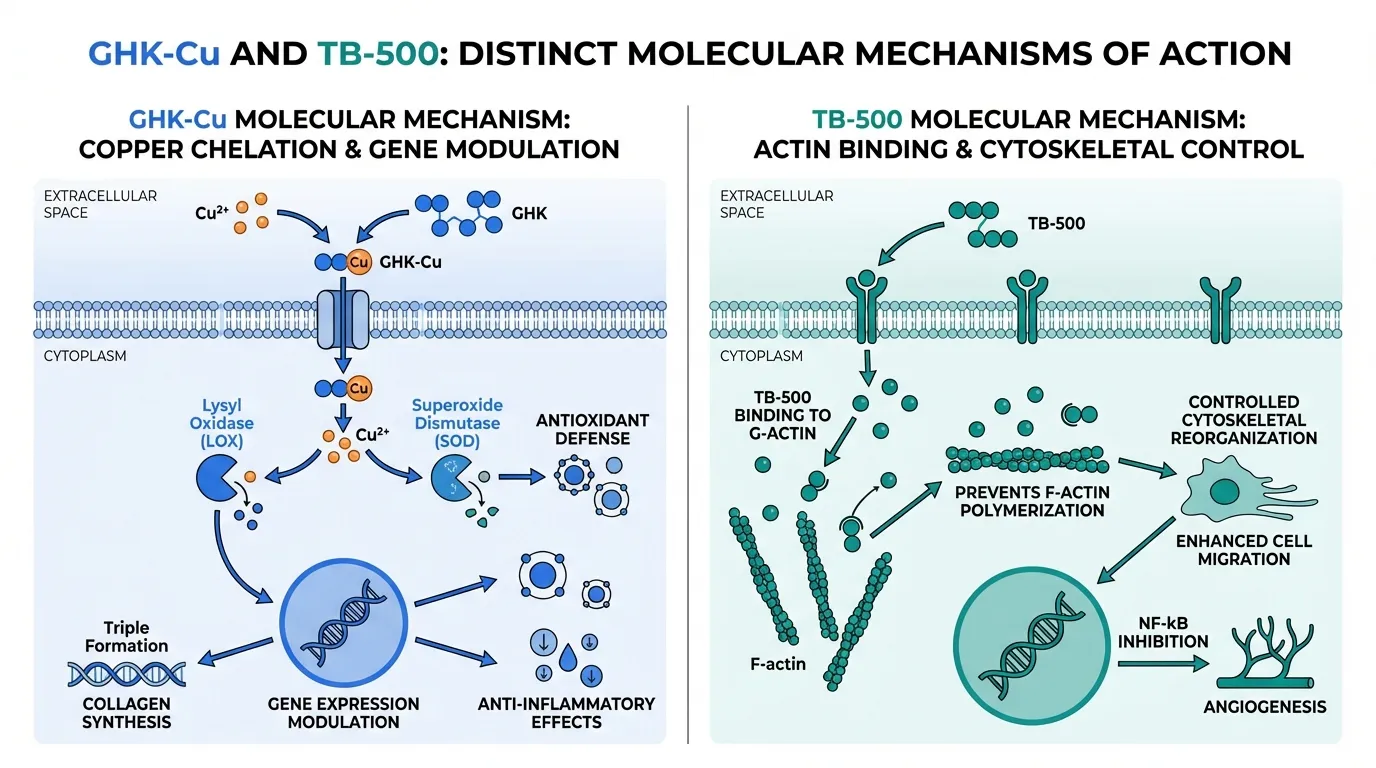
GHK-Cu (glycyl-L-histidyl-L-lysine:copper(II)) operates primarily through copper-mediated enzymatic activation and broad gene expression modulation. The tripeptide chelates copper(II) ions, delivering them to tissues where copper serves as an essential cofactor for lysyl oxidase (collagen cross-linking), superoxide dismutase (antioxidant defense), and cytochrome c oxidase (mitochondrial energy production).
Research has identified that GHK-Cu modulates approximately 4,000 human genes, many involved in tissue remodeling, inflammation, and cellular defense. It stimulates synthesis of collagen types I, III, and V, glycosaminoglycans, and decorin through TGF-beta superfamily and BMP pathway activation.
TB-500#
TB-500 (synthetic Thymosin Beta-4) functions through a fundamentally different mechanism centered on actin cytoskeletal regulation. The peptide sequesters G-actin monomers, preventing their premature polymerization into F-actin filaments. This regulatory function enables controlled cytoskeletal reorganization essential for cell migration, a critical step in wound healing.
Beyond actin regulation, TB-500 promotes angiogenesis, reduces inflammation through NF-kB inhibition, and supports cell survival signaling. Its central LKKTETQ active domain mediates most of its therapeutic effects, including promoting endothelial cell migration and tube formation for new blood vessel development.
Evidence and Research Comparison#
GHK-Cu Research#
GHK-Cu benefits from a long history of research and commercial application:
- Wound healing: Accelerated wound closure demonstrated in animal models and small human studies
- Skin rejuvenation: Human studies showing improved skin thickness, elasticity, and collagen density with topical application comparable to tretinoin
- Hair growth: Research demonstrating increased hair follicle size and proliferation
- Gene modulation: Comprehensive genomic studies mapping effects on approximately 4,000 genes
- Commercial validation: Decades of use in cosmetic formulations providing real-world safety data
TB-500 Research#
TB-500 has progressed further in formal clinical development:
- Corneal healing (RGN-259): Phase II clinical trials for neurotrophic keratopathy and dry eye disease
- Dermal wounds: Phase II investigations for chronic wound healing
- Cardiac repair: Preclinical models showing improved outcomes after myocardial infarction, including reduced infarct size and improved ejection fraction
- Neuroprotection: Preclinical evidence for nerve regeneration and spinal cord injury models
- Anti-inflammatory: Demonstrated NF-kB inhibition and reduced inflammatory cytokine production
Side Effects and Safety Comparison#
GHK-Cu Safety#
GHK-Cu has an established safety record, particularly for topical use:
- Topical formulations are generally well-tolerated with low irritation potential
- Allergic reactions are rare, primarily in individuals with copper sensitivity
- Injection site reactions (redness, swelling) can occur with subcutaneous administration
- No significant systemic side effects reported at standard research doses
- Extensive commercial use provides broad real-world safety validation
TB-500 Safety#
TB-500 safety data comes primarily from clinical trials and preclinical studies:
- Generally well-tolerated in Phase II clinical trials for ophthalmic and dermal applications
- Injection site reactions are the most common adverse event
- Theoretical concern regarding promotion of existing malignancies (not demonstrated in clinical data)
- Limited long-term human safety data
- No serious adverse events reported in completed clinical trials
Dosing and Administration Comparison#
GHK-Cu Dosing#
- Topical: 1-3% concentration in creams and serums; applied once or twice daily
- Subcutaneous: Research doses typically 100-200 mcg locally
- Microneedling combination: Topical application with microneedling for enhanced delivery
- No reconstitution needed for topical formulations
TB-500 Dosing#
- Subcutaneous/intramuscular injection: Typical research protocols use 2-5 mg doses
- Loading phase: Higher frequency dosing (2-3 times weekly) for initial period
- Maintenance: Reduced frequency after loading period
- Reconstitution required: Lyophilized powder reconstituted with bacteriostatic water
Can They Be Combined?#
GHK-Cu and TB-500 operate through entirely complementary mechanisms with no overlapping receptor targets, making combination use theoretically rational. GHK-Cu could address surface tissue repair and extracellular matrix remodeling while TB-500 promotes deeper cell migration and angiogenesis. Some researchers have explored this pairing alongside BPC-157 in multi-peptide healing protocols, though formal combination studies are lacking.
Verdict#
GHK-Cu is the practical choice for surface tissue applications -- skin rejuvenation, topical wound care, hair growth, and anti-aging -- where its topical availability, established safety profile, and commercial accessibility provide clear advantages. It requires no injection and has decades of real-world cosmetic use.
TB-500 is better positioned for systemic and deep tissue repair research, particularly cardiac protection, corneal healing, and musculoskeletal injuries, where its cell migration-promoting and angiogenic properties are most relevant. Its Phase II clinical trial program represents more advanced formal clinical development than GHK-Cu for therapeutic indications.
The choice between them depends primarily on tissue target: surface versus deep, accessible versus systemic.
Explore the full profiles of GHK-Cu and TB-500, or see how they compare to BPC-157 in our BPC-157 vs GHK-Cu and BPC-157 vs TB-500 comparisons. Use the Dosing Calculator for research protocol planning.
Detailed Category Analysis#
Mechanism of Action#
GHK-Cu: Copper-chelating tripeptide modulating ~4,000 genes; stimulates collagen synthesis, TGF-beta/BMP pathways, and metalloenzyme activation
TB-500: 43-amino acid peptide sequestering G-actin; promotes cell migration, angiogenesis, and cytoskeletal reorganization for tissue repair
Advantage: Neither (tie)
Research Evidence#
GHK-Cu: 50+ studies with human skin trials; commercially used in cosmetics; limited injectable clinical data
TB-500: Phase II trials for dermal wounds, corneal injuries, and cardiac repair; extensive preclinical data across multiple tissue types
Advantage: TB-500
Side Effect Profile#
GHK-Cu: Well-tolerated topically; low irritation; rare copper sensitivity reactions; minimal systemic concerns at standard doses
TB-500: Generally well-tolerated in clinical trials; injection site reactions possible; limited long-term safety data
Advantage: GHK-Cu
Scope of Applications#
GHK-Cu: Skin rejuvenation, wound healing, hair growth, anti-aging; primarily surface and dermal tissue applications
TB-500: Cardiac repair, corneal healing, dermal wounds, musculoskeletal repair, neuroprotection; broad systemic tissue applications
Advantage: TB-500
Administration Routes#
GHK-Cu: Topical (creams, serums), subcutaneous injection, iontophoresis; accessible non-injection options available
TB-500: Subcutaneous or intramuscular injection; no topical formulation; requires reconstitution from lyophilized powder
Advantage: GHK-Cu
Summary and Verdict#
GHK-Cu for surface tissue repair, skin rejuvenation, and accessible topical use; TB-500 for deeper systemic healing, cardiac repair, and musculoskeletal injuries
Best For Recommendations#
Skin Anti-Aging and Rejuvenation#
Recommendation: GHK-Cu
Reason: GHK-Cu stimulates collagen and elastin synthesis, is commercially available in topical formulations, and has human data supporting skin improvements
Wound Healing (Topical)#
Recommendation: GHK-Cu
Reason: GHK-Cu can be applied directly to wounds without injection, making it practical for surface tissue repair
Cardiac Repair Research#
Recommendation: TB-500
Reason: TB-500 has demonstrated cardioprotective effects in preclinical models of myocardial infarction, promoting cardiomyocyte survival and neovascularization
Musculoskeletal Injury#
Recommendation: TB-500
Reason: TB-500 promotes cell migration and tissue repair through actin regulation, with broader systemic distribution suited for deep tissue healing
Corneal Injury Research#
Recommendation: TB-500
Reason: Phase II clinical trials (as RGN-259) investigated TB-500 for corneal wound healing, representing its most advanced clinical application
Hair Growth#
Recommendation: GHK-Cu
Reason: GHK-Cu has demonstrated ability to stimulate hair follicle growth and increase hair follicle size in research studies
Further Reading#

Which Is Better For...
Skin Anti-Aging and Rejuvenation
GHK-Cu
GHK-Cu stimulates collagen and elastin synthesis, is commercially available in topical formulations, and has human data supporting skin improvements
Wound Healing (Topical)
GHK-Cu
GHK-Cu can be applied directly to wounds without injection, making it practical for surface tissue repair
Cardiac Repair Research
TB-500
TB-500 has demonstrated cardioprotective effects in preclinical models of myocardial infarction, promoting cardiomyocyte survival and neovascularization
Musculoskeletal Injury
TB-500
TB-500 promotes cell migration and tissue repair through actin regulation, with broader systemic distribution suited for deep tissue healing
Corneal Injury Research
TB-500
Phase II clinical trials (as RGN-259) investigated TB-500 for corneal wound healing, representing its most advanced clinical application
Hair Growth
GHK-Cu
GHK-Cu has demonstrated ability to stimulate hair follicle growth and increase hair follicle size in research studies
Continue Your Research
Get comparison updates
We publish new head-to-head comparisons regularly. Subscribe to see them first.
Frequently Asked Questions About TB-500 vs GHK-Cu: Healing Peptides Compared
What are the key differences between GHK-Cu and TB-500?
The main differences across comparison categories are: Mechanism of Action: advantage goes to neither (tie); Research Evidence: advantage goes to TB-500; Side Effect Profile: advantage goes to GHK-Cu. 2 additional categories are analyzed in the full comparison. Each category evaluates a different dimension of the two peptides.
When should I consider GHK-Cu over TB-500?
For the scenario of "Skin Anti-Aging and Rejuvenation," research data suggests GHK-Cu may be more relevant. GHK-Cu stimulates collagen and elastin synthesis, is commercially available in topical formulations, and has human data supporting skin improvements. This is based on currently available evidence and individual circumstances may differ.
How do GHK-Cu and TB-500 differ in their mechanisms of action?
GHK-Cu: Copper-chelating tripeptide modulating ~4,000 genes; stimulates collagen synthesis, TGF-beta/BMP pathways, and metalloenzyme activation. TB-500: 43-amino acid peptide sequestering G-actin; promotes cell migration, angiogenesis, and cytoskeletal reorganization for tissue repair.
Which has fewer side effects, GHK-Cu or TB-500?
In terms of side effects and tolerability, the advantage goes to GHK-Cu. GHK-Cu: Well-tolerated topically; low irritation; rare copper sensitivity reactions; minimal systemic concerns at standard doses. TB-500: Generally well-tolerated in clinical trials; injection site reactions possible; limited long-term safety data.
Medical Disclaimer
This website is for educational and informational purposes only. The information provided is not intended to diagnose, treat, cure, or prevent any disease. Always consult with a qualified healthcare professional before using any peptide or supplement.