Understanding Peptide Research: From Animal Studies to Human Trials

Introduction#
Every peptide on this site carries a research status badge -- preclinical, Phase 1, Phase 2, Phase 3, or approved. These badges represent fundamentally different levels of evidence confidence, but without understanding what each stage means, it is easy to overestimate the significance of early-stage research or underappreciate the rigor behind approved therapies.
This guide explains the complete peptide research pipeline, from the first laboratory experiment to FDA approval and beyond. Using real peptide examples at each stage, it provides the context needed to evaluate claims, set realistic expectations, and make informed decisions about any peptide you encounter.
For foundational information about peptides themselves, see What Are Peptides. For guidance on reading specific research papers, see Reading Research.
The Research Pipeline: An Overview#
The path from laboratory discovery to FDA-approved medication is long, expensive, and has a very high failure rate. Understanding this pipeline is essential context for evaluating any peptide.
| Stage | Duration | Purpose | Success Rate to Next Stage |
|---|---|---|---|
| Discovery and Preclinical | 3-6 years | Identify candidates, test in lab and animals | ~10% enter clinical trials |
| Phase 1 | 1-2 years | Safety and dosing in small human groups | ~70% advance |
| Phase 2 | 2-3 years | Efficacy signal in targeted populations | ~33% advance |
| Phase 3 | 3-4 years | Definitive efficacy in large trials | ~25-30% advance |
| FDA Review | 0.5-2 years | Regulatory evaluation of complete data package | ~85% approved |
| Post-Market Surveillance | Ongoing | Real-world safety monitoring | Ongoing |
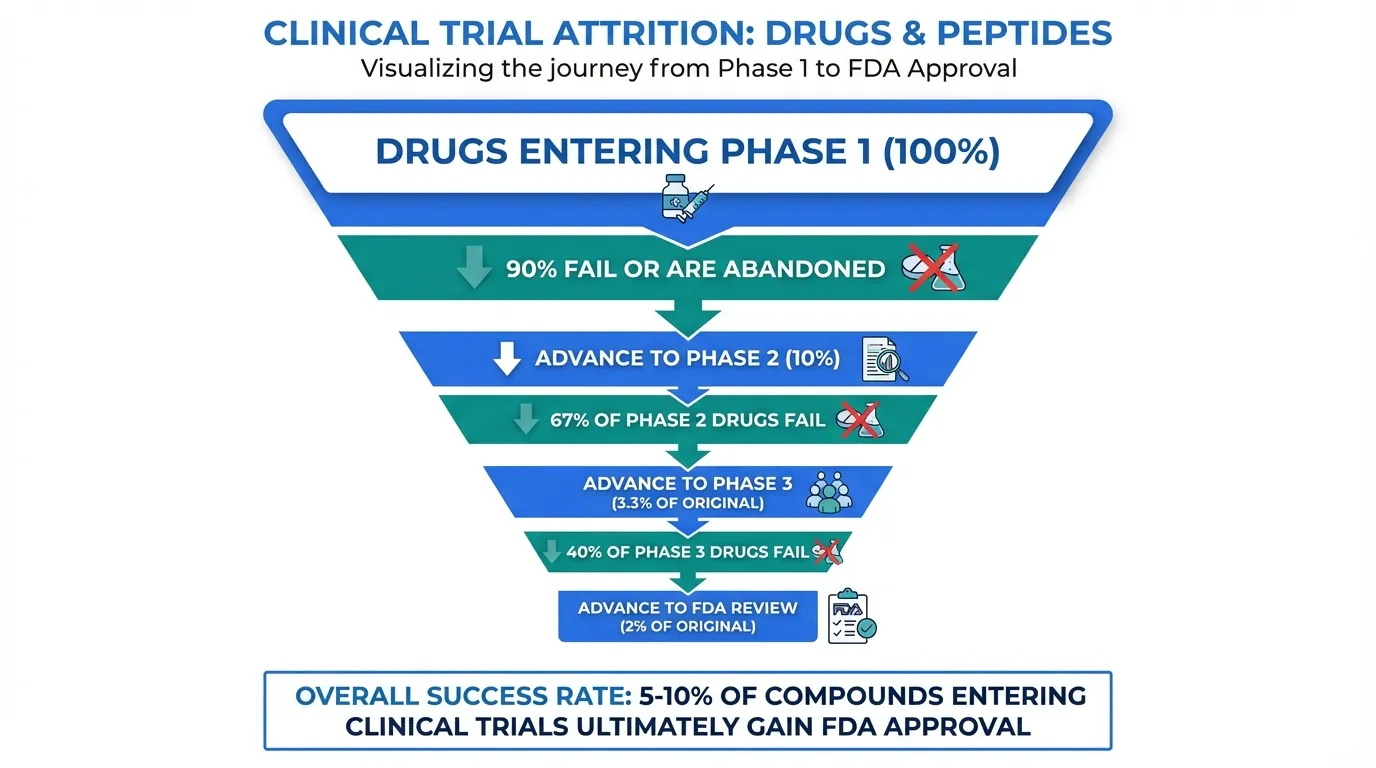
Total timeline: 10-15+ years from discovery to approval Total cost: $1-3 billion per approved drug (including failed candidates) Overall success rate: Approximately 5-10% of compounds entering clinical trials ultimately gain FDA approval
Stage 1: Preclinical Research#
What It Means#
Preclinical research encompasses everything that happens before a compound is tested in humans. This includes:
- In vitro studies -- Testing in cell cultures, tissue samples, or biochemical assays. These reveal whether a peptide has a biological effect at the molecular level.
- In vivo animal studies -- Testing in living organisms (typically mice, rats, or rabbits). These provide data on pharmacokinetics (how the body processes the peptide), pharmacodynamics (what the peptide does to the body), dosing ranges, and preliminary safety.
What Preclinical Data Can Tell You#
- The peptide has a measurable biological effect in controlled conditions
- Preliminary safety profile in one or more animal species
- Approximate dose ranges that produce effects
- How the peptide is absorbed, distributed, metabolized, and eliminated (in animals)
- Potential mechanisms of action
What Preclinical Data Cannot Tell You#
- Whether the peptide will work in humans
- What the correct human dose is (use the HED Calculator for rough translation)
- Whether it will be safe at therapeutic doses in humans
- How it will interact with human diseases or medications
- Long-term safety in humans
Example: BPC-157#
BPC-157 is perhaps the most instructive example of a preclinical peptide with enormous public interest. The research landscape includes:
- Over 100 published animal studies spanning tendon healing, ligament repair, muscle recovery, gastrointestinal protection, and neuroprotection
- Consistent positive results across multiple research groups and animal models
- Well-characterized mechanisms including upregulation of growth factor receptors, NO pathway modulation, and angiogenesis promotion
Despite this extensive preclinical dossier, BPC-157 has no completed human clinical trials published in peer-reviewed journals. This means all of the "BPC-157 heals tendons" or "BPC-157 repairs gut lining" claims are based entirely on animal data that has not been confirmed in humans.
This is not to say BPC-157 is ineffective in humans -- it may well be. But the honest assessment is that we do not know, because the necessary studies have not been completed and published.
Key lesson: Extensive preclinical data, even from multiple independent labs, does not substitute for human clinical evidence.
Example: FOXO4-DRI#
FOXO4-DRI demonstrates how a single compelling preclinical study can generate enormous interest. A 2017 study in Cell by Baar et al. showed that FOXO4-DRI selectively induced apoptosis in senescent cells in aged mice, leading to restored fitness, fur density, and renal function.
This study was rigorous, published in a top-tier journal, and demonstrated a novel mechanism. However:
- It has been tested in only one published animal study
- No human pharmacokinetic data exists
- The dose required was very high relative to body weight
- The peptide is large (28 amino acids), raising questions about stability and delivery
- No clinical trials have been initiated
FOXO4-DRI illustrates how even high-quality preclinical research represents just the first step in a long validation process.
Stage 2: Phase 1 Clinical Trials#
What It Means#
Phase 1 trials are the first time a compound is tested in humans. They typically involve:
- 20-80 healthy volunteers (sometimes patients with the target condition)
- Primary goal: Safety -- determining the maximum tolerated dose, identifying side effects, and characterizing pharmacokinetics in humans
- Not designed to measure efficacy -- any therapeutic effects observed are incidental
What Phase 1 Data Tells You#
- The peptide has been administered to humans under medical supervision
- Basic human safety profile at specific doses
- How the human body absorbs, processes, and eliminates the peptide
- Whether the preclinical safety signals translate to humans
What Phase 1 Data Does Not Tell You#
- Whether the peptide actually works for its intended purpose
- The optimal dose for therapeutic effect
- Long-term safety
- How it performs compared to existing treatments
Why Phase 1 Matters for Peptides#
Many peptides stall at or before Phase 1 because:
- Bioavailability challenges -- Peptides are often rapidly degraded by proteases, making systemic delivery difficult
- Short half-lives -- Many peptides have half-lives of minutes, requiring frequent dosing or special formulations
- Immunogenicity -- Some peptides trigger immune responses, limiting repeated use
- Manufacturing complexity -- Scaling up GMP-grade peptide production for clinical trials is expensive
Stage 3: Phase 2 Clinical Trials#
What It Means#
Phase 2 trials are the first real test of whether a peptide works in humans. They typically involve:
- 100-300 patients with the target condition
- Primary goal: Efficacy signal -- does the peptide produce a measurable therapeutic effect?
- Dose-ranging -- testing multiple doses to identify the optimal balance of efficacy and safety
- Often randomized and placebo-controlled but not always at the scale needed for definitive conclusions
What Phase 2 Data Tells You#
- Preliminary evidence that the peptide works in humans for a specific condition
- Which dose ranges appear most effective
- More detailed safety information in patients (not just healthy volunteers)
- Whether proceeding to large Phase 3 trials is justified
Phase 2 Limitations#
- Sample sizes are too small for definitive conclusions
- Positive Phase 2 results frequently do not replicate in Phase 3
- Publication bias means negative Phase 2 results may not be published
Example: Retatrutide Phase 2#
Retatrutide, a triple GLP-1/GIP/glucagon receptor agonist, provides a vivid example of Phase 2 data. The Phase 2 trial (published in The New England Journal of Medicine in 2023) showed:
- 338 participants with obesity
- 24-week treatment period
- The highest dose group (12 mg) achieved 24.2% mean body weight loss at 48 weeks
- Gastrointestinal side effects were the most common adverse events
These are striking results, but they come from a Phase 2 study -- moderate sample size, shorter duration than a typical Phase 3, and without the diversity of patient populations needed for broad conclusions. Retatrutide has now advanced to Phase 3 trials, where these results will be tested at much larger scale (see our retatrutide Phase 3 update for the latest data).
Stage 4: Phase 3 Clinical Trials#
What It Means#
Phase 3 trials are the definitive test of a drug's efficacy and safety. They feature:
- 1,000-10,000+ patients across multiple sites and countries
- Randomized, double-blind, placebo-controlled design (the gold standard)
- Primary goal: Definitive evidence of efficacy and safety sufficient for regulatory approval
- Diverse patient populations including different ages, ethnicities, and comorbidities
- Longer duration to capture both efficacy and safety signals over time
What Phase 3 Data Tells You#
- Whether the peptide works reliably across diverse populations
- Comprehensive safety profile including rare side effects
- How the peptide compares to placebo (and sometimes to existing treatments)
- Effect size and clinical significance (not just statistical significance)
Example: Semaglutide STEP Trials#
Semaglutide illustrates the scale and rigor of Phase 3 research. The STEP (Semaglutide Treatment Effect in People with Obesity) program included:
- STEP 1: 1,961 participants, 68 weeks, 14.9% mean weight loss vs 2.4% placebo
- STEP 2: 1,210 participants with type 2 diabetes, 9.6% weight loss vs 3.4% placebo
- STEP 3: 611 participants with intensive behavioral therapy, 16.0% weight loss vs 5.7% placebo
- STEP 4: 902 participants, withdrawal design showing weight regain after stopping treatment
This multi-trial program, involving thousands of patients across different clinical scenarios, provides the comprehensive evidence base that supports FDA approval. The contrast with BPC-157's animal-only data illustrates the enormous gap between preclinical promise and Phase 3 validation.
Stage 5: FDA Approval and Beyond#
What FDA Approval Means#
FDA approval indicates that:
- The drug has demonstrated efficacy in well-designed clinical trials
- The benefit-risk profile is favorable for the approved indication
- Manufacturing processes meet Good Manufacturing Practice (GMP) standards
- The drug will be subject to ongoing post-market surveillance
What FDA Approval Does Not Mean#
- The drug is perfectly safe (all drugs have side effects)
- It works for conditions outside its approved indication
- It is the best option for every patient
- Post-market safety issues will not emerge
Post-Market Surveillance (Phase 4)#
After approval, drugs enter ongoing monitoring:
- Adverse event reporting through FDA's MedWatch system
- Post-marketing studies often required by FDA as a condition of approval
- Real-world evidence from electronic health records and insurance claims data
- Label updates as new safety or efficacy information emerges
Semaglutide's post-market experience illustrates this process: after widespread use, additional data emerged regarding potential thyroid effects, pancreatitis risk, and gastrointestinal side effects that refined the understanding of its safety profile beyond what trials showed.
How to Read Research Status Badges on This Site#
Every peptide profile on this site includes a research status badge. Here is what each means:
| Badge | What It Means | Your Confidence Level |
|---|---|---|
| Preclinical | Only animal or cell culture studies | Low -- interesting but unproven in humans |
| Phase 1 | Human safety data only | Low-Moderate -- safe at tested doses but unproven efficacy |
| Phase 2 | Preliminary human efficacy data | Moderate -- promising but not definitive |
| Phase 3 | Large-scale human trial data | High -- robust evidence if trials are positive |
| Approved | FDA-approved for specific indications | Highest -- validated by comprehensive review |
Important Nuances#
- "Approved" applies to specific indications. Semaglutide is approved for weight management and type 2 diabetes, not for healing or neuroprotection. Using an approved peptide for an unapproved purpose (off-label) reverts the evidence level to whatever exists for that specific use.
- International approvals differ. Thymosin alpha-1 is approved in 35+ countries but not in the US. Selank is approved in Russia. These approvals may not meet FDA standards but still represent meaningful clinical evidence.
- Research status can change. Peptides can advance (retatrutide moving from Phase 2 to Phase 3) or be discontinued (multiple peptides have failed in clinical trials).
Why Most Preclinical Peptides Never Reach Approval#
Understanding the attrition rate helps calibrate expectations:
Scientific Reasons#
- Species differences: Mouse metabolism, immune function, and pharmacokinetics differ substantially from humans. A dose that heals a rat tendon may not produce the same effect in human tissue.
- Dose translation challenges: Converting animal doses to human-equivalent doses involves substantial uncertainty. The HED Calculator provides estimates, but these are approximations.
- Complexity of human disease: Animal models of disease are simplified representations. Human conditions involve genetic variation, comorbidities, medications, and lifestyle factors that animals do not replicate.
Practical Reasons#
- Cost: Taking a peptide through Phase 3 trials can cost hundreds of millions of dollars. Many peptide research groups are academic labs without commercial backing.
- Patent challenges: Short peptides (under 10 amino acids) are difficult to patent, reducing the commercial incentive to invest in clinical development. BPC-157, a 15-amino-acid peptide derived from a natural protein, faces exactly this challenge.
- Regulatory burden: The FDA requires extensive safety and manufacturing data. Research-grade peptides do not meet GMP standards, requiring significant investment to scale up production.
Historical Attrition Rates#
Across all drug classes (not just peptides), approximately:
- 90% of drugs entering Phase 1 never reach approval
- 67% of drugs entering Phase 2 fail or are abandoned
- 40% of drugs entering Phase 3 fail to gain approval
For peptides specifically, the attrition rate may be higher due to bioavailability and stability challenges.
Practical Guide: Evaluating Peptide Claims#
When you encounter a claim about a peptide -- whether in a research paper, a vendor description, or a forum post -- ask these questions:
1. What Type of Study Supports This Claim?#
- Cell culture study? Interesting mechanism, but no whole-organism relevance yet.
- Animal study? Promising preliminary data, but cannot confirm human effects.
- Phase 1 trial? Safe in humans at tested doses, but efficacy unproven.
- Phase 2 or 3 trial? The best available evidence for human effects.
2. Has the Finding Been Replicated?#
- A single study, even in a top journal, is a preliminary finding
- Replication by independent research groups substantially strengthens the evidence
- Be especially cautious of findings from a single laboratory
3. What Was the Study Design?#
- Randomized controlled trial (RCT) -- the gold standard for efficacy
- Observational study -- can show associations but not causation
- Case report or case series -- anecdotal evidence, the weakest form of clinical data
4. Are the Results Clinically Meaningful?#
- Statistical significance does not equal clinical importance
- A peptide that reduces pain scores by 0.5 points on a 10-point scale may be statistically significant in a large trial but clinically irrelevant
- Look for effect sizes, not just p-values
Using the Evidence Explorer Tool#
The Evidence Explorer on this site allows you to:
- Filter peptides by research phase -- see all approved, Phase 3, Phase 2, or preclinical peptides at a glance
- Sort by evidence quality -- prioritize compounds with the strongest clinical backing
- Compare evidence across categories -- understand which goal categories have the strongest evidence base
- Export data -- download peptide evidence summaries for reference
This tool is particularly useful for comparing the evidence landscape across different health goals and identifying which areas have FDA-approved options versus those relying primarily on preclinical data.
Key Takeaways#
-
The research pipeline has five main stages -- preclinical, Phase 1, Phase 2, Phase 3, and FDA approval -- each representing a fundamentally different level of evidence confidence.
-
Most peptides are preclinical. The majority of peptides discussed in online communities have only animal or cell culture data. This is interesting research but does not confirm human efficacy.
-
The gap between animal studies and human approval is enormous. Approximately 90% of compounds that enter clinical trials never gain FDA approval. Extensive animal data (like BPC-157's 100+ studies) is not a substitute for human trials.
-
FDA-approved peptides exist. Semaglutide, tirzepatide, PT-141, and others have completed the full pipeline. These represent the highest-confidence options for their approved indications. See our peptide clinical trials 2026 article for what is currently in the pipeline.
-
Research status badges on this site reflect the highest level of evidence available for each peptide. Use the Evidence Explorer to compare across the full peptide database.
-
Evaluating evidence is a skill that improves with practice. Start by asking: what type of study, has it been replicated, and is the effect clinically meaningful?
This article is for educational and informational purposes only. It does not constitute medical advice, diagnosis, or treatment recommendations. Research status and clinical trial data are subject to change. Always consult a qualified healthcare provider before making decisions about peptide therapy. For guidance on reading individual research papers, see Reading Research. For a complete history of how peptide research evolved, read our history of peptide research guide. If you are deciding which peptide to try first, see how to choose your first peptide.

Frequently Asked Questions About Understanding Peptide Research: From Animal Studies to Human Trials
What does "preclinical" mean for a peptide?
Preclinical means a peptide has been studied in laboratory settings -- either in cell cultures (in vitro) or animal models (in vivo) -- but has not yet entered formal human clinical trials. Many popular peptides like BPC-157 are at this stage. Preclinical data cannot confirm that a peptide will work or be safe in humans, as animal results frequently fail to translate to human outcomes.
Why do most promising preclinical peptides never get FDA approved?
Approximately 90% of drugs that enter clinical trials never receive FDA approval. Common reasons include failure to demonstrate efficacy in humans despite animal success, unexpected side effects at human doses, inability to find the right dosing regimen, commercial viability concerns, and the high cost of running Phase 3 trials (often hundreds of millions of dollars). Short peptides can also face patent challenges that reduce commercial incentive.
How can I check a peptide's current research status?
Every peptide profile on this site includes a research status badge (preclinical, Phase 1, Phase 2, Phase 3, or approved). You can also use the Evidence Explorer tool to filter and sort all peptides by research phase. For the most current trial information, search ClinicalTrials.gov for active studies.
Are animal study results reliable for predicting human outcomes?
Animal studies provide valuable preliminary data about mechanisms and potential effects, but they have significant limitations. Differences in metabolism, immune function, and pharmacokinetics between species mean that many compounds showing promise in animals fail in humans. The historical translation rate from animal models to successful human therapeutics is approximately 10-15%.
Continue reading this research review
Free access to the complete analysis with citations and evidence ratings.
150+ peptide profiles · 30+ comparisons · 18 research tools
Medical Disclaimer
This website is for educational and informational purposes only. The information provided is not intended to diagnose, treat, cure, or prevent any disease. Always consult with a qualified healthcare professional before using any peptide or supplement.
Join 2,000+ researchers getting biweekly updates
Enjoyed this article?
The Research Briefing delivers deep-dives like this biweekly — plus new study breakdowns, safety updates, and tool announcements.
Free forever. No spam. Unsubscribe in one click.
Where to Find These Peptides
Continue Exploring
Peptide Profiles
Keep Reading
Best Canadian Peptide Vendors 2026: Reviews, Testing & Comparison
Comprehensive comparison of 12 Canadian peptide vendors ranked by our 8-dimension scoring system. Covers COA testing practices, pricing, shipping speed, and red flags to help researchers select reliable suppliers.
Most Popular Therapeutic Peptides in 2026: 15 Ranked by Research Interest
The 15 most popular therapeutic peptides in 2026, ranked by clinical trial activity, search interest, and research community adoption. From semaglutide to BPC-157.

What Is Peptide Therapy? A Complete Guide to Peptide-Based Treatments
Peptide therapy uses short-chain amino acids to target specific biological pathways. Learn how peptide treatments work, FDA-approved options, clinical applications, and what the research shows.
You Might Also Like
Related content you may find interesting