FDA Peptide Categories Explained: Category 1 vs Category 2 (2026)
Introduction#
The FDA's peptide categorization system determines whether compounding pharmacies can legally prepare a given peptide. For researchers, clinicians, and patients, understanding these categories is essential for navigating the current regulatory landscape.
This guide explains the three FDA categories, how peptides move between them, and what the 2024-2026 regulatory changes mean in practice. For the full list of FDA-approved peptide drugs, see our complete list of FDA-approved peptides. For details on which peptides have been restricted, see our guide to FDA-banned peptides.
The FDA's Bulk Drug Substance Evaluation Process#
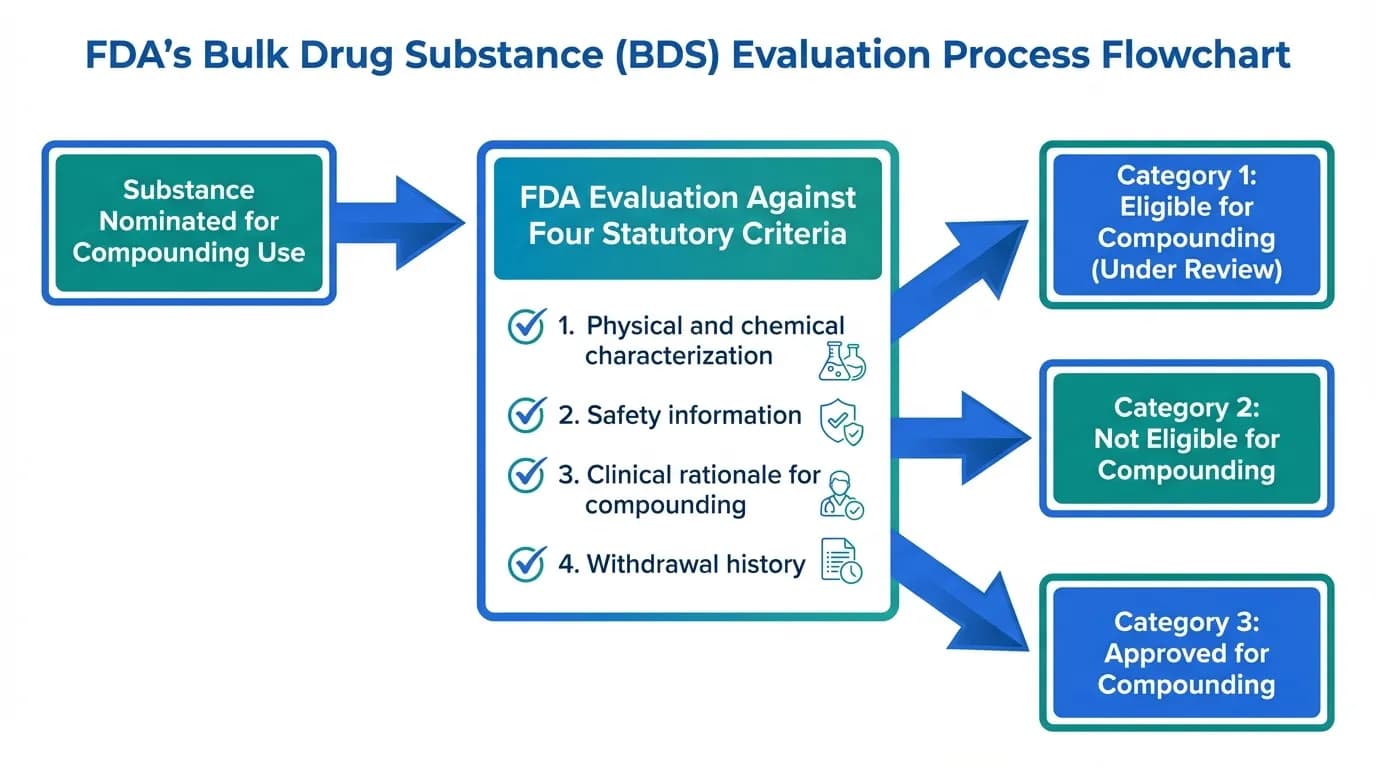
The FDA evaluates substances nominated for use in compounding under the bulk drug substance (BDS) evaluation process. This applies to substances that are not components of FDA-approved drugs but that compounding pharmacies want to use as active ingredients.
The FDA evaluates each substance against four statutory criteria:
- Physical and chemical characterization -- Can the substance be reliably identified and tested for purity?
- Safety information -- Is there adequate published safety data?
- Clinical rationale for compounding -- Is there evidence of legitimate medical need that cannot be met by approved drugs?
- Withdrawal history -- Has the substance been previously withdrawn from the market for safety or efficacy reasons?
Based on this review, each substance is placed into one of three categories.
Category 1: Eligible for Compounding (Under Review)#
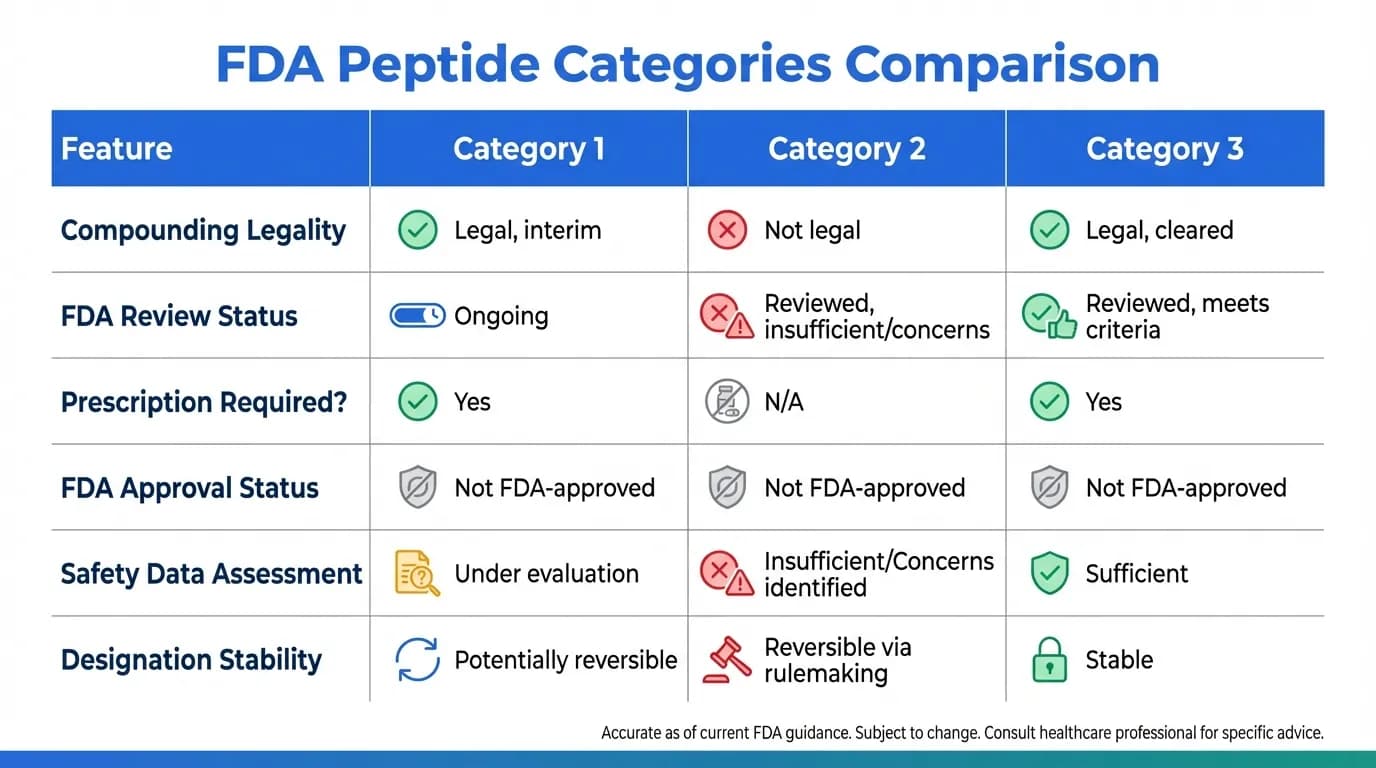
Category 1 substances are those the FDA is still evaluating but has determined can be compounded in the interim. Licensed 503A (traditional) and 503B (outsourcing facility) compounding pharmacies can legally prepare these peptides under a physician's prescription.
Category 1 status means:
- Compounding pharmacies can legally use the substance
- FDA evaluation is ongoing -- the substance may later move to Category 2 or Category 3
- A physician prescription is required
- The substance is not FDA-approved -- it has not completed full clinical trials
- Compounding pharmacies must follow USP quality standards
As of March 2026, the 14 peptides reclassified by the RFK Jr. announcement are in this category, including BPC-157, Thymosin Alpha-1, AOD-9604, Semax, Selank, GHK-Cu, Epitalon, MOTS-c, KPV, Kisspeptin-10, DSIP, Ipamorelin, CJC-1295 (no DAC), and TB-500.
Category 2: Not Eligible for Compounding#
Category 2 substances have been reviewed and the FDA has determined they should not be used by compounding pharmacies. This is effectively a ban from the legal compounding supply chain.
Category 2 status means:
- Compounding pharmacies cannot legally use the substance
- The FDA found insufficient safety data or identified specific safety concerns
- The substance may still be available for legitimate research purposes (not for human administration)
- The designation can be reversed through the formal FDA rulemaking process
As of March 2026, approximately 5 peptides remain on Category 2: Melanotan II, GHRP-2, GHRP-6, CJC-1295 with DAC, and LL-37 (Cathelicidin).
Category 3: Approved for Compounding#
Category 3 substances have completed FDA review and been determined to meet all four statutory criteria. They are fully cleared for compounding use.
Category 3 is the most stable designation. Substances in this category have sufficient published safety and characterization data and an established clinical rationale for compounding.
What Changed in 2024-2025#
The regulatory landscape for peptides shifted significantly beginning in 2023:
- 2023-2024: The FDA placed 19 peptides on the Category 2 restricted list through the bulk drug substance evaluation process. This included widely used compounds such as BPC-157, Thymosin Alpha-1, and AOD-9604.
- 2024: Multiple compounding pharmacy organizations and patient advocacy groups challenged the decisions, arguing the FDA had not followed proper notice-and-comment rulemaking procedures.
- Late 2024-2025: The incoming administration signaled a different approach to peptide regulation, with HHS leadership expressing support for broader compounding access.
The February 2026 Reclassification#
On February 27, 2026, HHS Secretary Robert F. Kennedy Jr. announced that 14 of the 19 peptides on the Category 2 list would be moved back to Category 1. The announcement was made publicly on the Joe Rogan Experience podcast.
This reclassification:
- Restores compounding access for 14 previously restricted peptides
- Requires formal FDA rulemaking to take legal effect (still pending as of March 2026)
- Does not grant FDA approval -- these remain unapproved substances available only through compounding
- Keeps 5 peptides on Category 2 due to stronger safety concerns
Impact on Compounding Pharmacies#
For compounding pharmacies, the category system has direct operational consequences:
- 503A pharmacies (traditional compounding): Can compound Category 1 and 3 substances for individual patients with a prescription
- 503B outsourcing facilities: Can compound Category 1 and 3 substances in larger batches without patient-specific prescriptions
- Neither type can legally compound Category 2 substances
The reclassification means pharmacies that had to stop compounding these 14 peptides in 2024 can resume once the formal rule change is published.
Key Distinctions to Understand#
| Term | Meaning |
|---|---|
| FDA-Approved | Completed full clinical trials and NDA/BLA process; available as brand-name drug |
| Category 1 | Eligible for compounding while under review; requires prescription |
| Category 2 | Not eligible for compounding; effectively banned from pharmacy preparation |
| Category 3 | Fully cleared for compounding after completed review |
| Research chemical | Sold for laboratory research only; not legally intended for human use |
The most common point of confusion is between FDA approval and Category 1 status. An FDA-approved peptide (like semaglutide) has completed Phase 1-3 trials and received formal approval. A Category 1 peptide (like BPC-157) can be compounded by pharmacies but has not undergone the full approval process.
Frequently Asked Questions#
Frequently Asked Questions About FDA Peptide Categories Explained: Category 1 vs Category 2 (2026)
What is a Category 1 peptide?
A Category 1 peptide is a bulk drug substance that the FDA has determined is eligible for compounding by licensed pharmacies under sections 503A and 503B of the Federal Food, Drug, and Cosmetic Act. This means compounding pharmacies can legally prepare these peptides under a physician prescription while FDA evaluation continues. Category 1 does not mean FDA approved.
What is a Category 2 peptide?
A Category 2 peptide is a bulk drug substance that the FDA has reviewed and determined should not be used by compounding pharmacies. This effectively bans the substance from the legal compounding supply chain. Category 2 designation does not make it illegal to possess for legitimate research purposes.
What is a Category 3 peptide?
Category 3 substances are those the FDA has determined can be used in compounding, typically because they have sufficient safety data and meet the statutory criteria. Category 3 is the most permissive classification for compounding eligibility.
How many peptides were reclassified in 2026?
On February 27, 2026, HHS Secretary Robert F. Kennedy Jr. announced that 14 of 19 peptides on the FDA Category 2 restricted list would be moved back to Category 1. Approximately 5 peptides, including Melanotan II, GHRP-2, GHRP-6, CJC-1295 with DAC, and LL-37, remain on Category 2.
Continue reading this research review
Free access to the complete analysis with citations and evidence ratings.
150+ peptide profiles · 30+ comparisons · 18 research tools
Medical Disclaimer
This website is for educational and informational purposes only. The information provided is not intended to diagnose, treat, cure, or prevent any disease. Always consult with a qualified healthcare professional before using any peptide or supplement.
Join 2,000+ researchers getting biweekly updates
Enjoyed this article?
The Research Briefing delivers deep-dives like this biweekly — plus new study breakdowns, safety updates, and tool announcements.
Free forever. No spam. Unsubscribe in one click.
Where to Find These Peptides
Continue Exploring
Peptide Profiles
Keep Reading
Peptide Stacking Guide 2026: Best Combinations by Goal
The definitive 2026 guide to peptide stacking organized by goal. Fat loss, muscle growth, healing, anti-aging, and cognitive stacks with evidence levels, dosing timing, and safety considerations.
Most Popular Therapeutic Peptides in 2026: 15 Ranked by Research Interest
The 15 most popular therapeutic peptides in 2026, ranked by clinical trial activity, search interest, and research community adoption. From semaglutide to BPC-157.

Best Peptides for Menopause Symptoms: 2026 Research Guide
Research guide covering peptides studied for menopause symptoms including hot flashes, bone loss, cognitive changes, skin aging, sleep disruption, and hormonal regulation.
You Might Also Like
Related content you may find interesting