CagriSema vs Retatrutide: Amylin/GLP-1 Combination vs Triple Agonist Comparison
Evidence-based comparison of CagriSema (cagrilintide + semaglutide amylin/GLP-1 combination) and retatrutide (GIP/GLP-1/glucagon triple agonist) for weight loss and metabolic disease based on Phase 2-3 clinical trial data.
Verdict at a Glance
CagriSema and retatrutide represent two fundamentally different approaches to next-generation obesity treatment. CagriSema combines two proven mechanisms (amylin + GLP-1) in a fixed-dose injection, achieving 20.4% weight loss in Phase 3, with an NDA already filed and the advantage of building on the well-characterized semaglutide platform. Retatrutide's novel triple-agonist approach produced 28.7% weight loss in Phase 3 TRIUMPH-4 (confirming 24.2% in Phase 2) by adding glucagon and GIP receptor activation. CagriSema is likely to reach market sooner, but retatrutide offers the greatest peak efficacy of any single anti-obesity agent.
| Best for | Pick | Why |
|---|---|---|
| Maximum Weight Loss | Retatrutide | Phase 3 TRIUMPH-4 showed 28.7% weight loss at 68 weeks, substantially exceeding CagriSema's 20.4% at 68 weeks. Retatrutide offers the greatest single-agent weight loss of any anti-obesity drug in clinical trials. |
| Nearer-Term Availability | CagriSema | NDA filed with FDA based on completed Phase 3 REDEFINE program. Likely to reach market before retatrutide, which is still in Phase 3 trials. |
| Established Safety Profile | CagriSema | Builds on semaglutide's 7+ year post-marketing safety record and over 25,000 clinical trial participants. The semaglutide component has proven cardiovascular benefit from SELECT trial. |
| Liver and Metabolic Disease | Retatrutide | The glucagon receptor agonism provides direct hepatic fat-reducing effects. Phase 2a MASH data showed up to 82% liver fat reduction. CagriSema lacks glucagon receptor activity. |
| Category | CagriSema | Retatrutide | Advantage |
|---|---|---|---|
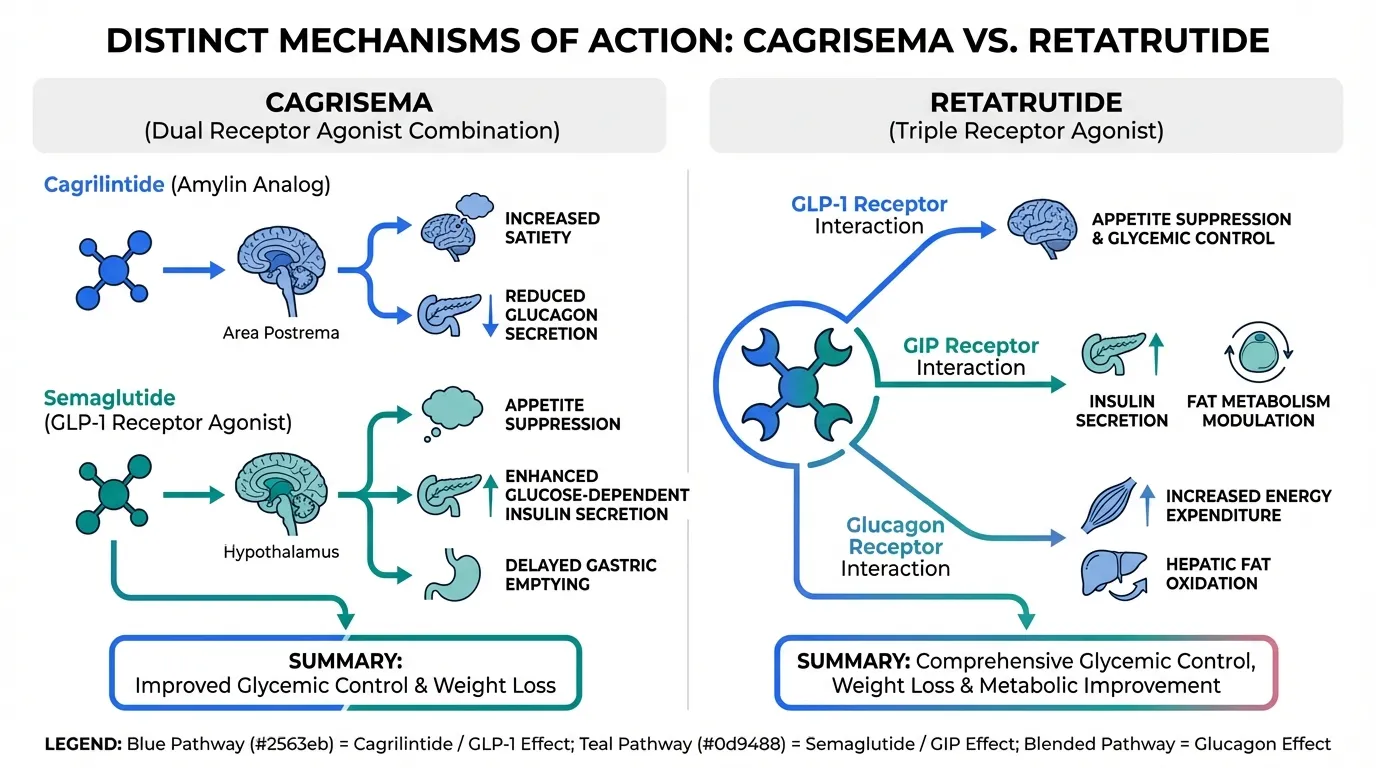
| Mechanism of Action | Fixed-dose combination of cagrilintide (long-acting amylin analog) and semaglutide (GLP-1 receptor agonist). Two separate mechanisms in one injection -- amylin reduces appetite via area postrema and GLP-1 enhances insulin secretion and central satiety signaling. | Single-molecule triple agonist targeting GIP, GLP-1, and glucagon receptors simultaneously. Glucagon component increases energy expenditure and hepatic fat oxidation, while GIP enhances insulin secretion and fat metabolism. | Comparable |
| Weight Loss Efficacy | REDEFINE 1 Phase 3 demonstrated 20.4% mean weight loss at 68 weeks. 60% of patients achieved 20% or more weight loss, and 23% achieved 30% or more. REDEFINE 2 showed 13.7% in T2D patients at 68 weeks. | Phase 3 TRIUMPH-4 demonstrated 28.7% mean weight loss at 68 weeks with 12 mg dose (Phase 2 showed 24.2% at 48 weeks). 100% achieved 5% or more, 93% achieved 10% or more, and 83% achieved 15% or more in Phase 2. | Retatrutide |
| Research Evidence | Phase 3 REDEFINE program completed with 3,417 participants in REDEFINE 1 and 1,200 in REDEFINE 2. NDA filed with FDA. Published in NEJM. Built on proven semaglutide platform with extensive existing safety data. | Phase 2 completed for obesity (NEJM 2023, 338 patients) and Phase 2a for MASH. Phase 3 TRIUMPH program ongoing with TRIUMPH-4 results reported (28.7% weight loss at 68 weeks). No regulatory submissions yet. | CagriSema |
| Side Effect Profile | GI adverse events in 79.6% of CagriSema group vs 39.9% placebo in REDEFINE 1. Nausea, vomiting, diarrhea, constipation, and abdominal pain were mainly transient and mild to moderate. Built on well-characterized semaglutide safety profile. | GI adverse events dose-dependent. Nausea 16-46%, diarrhea 16-26%, vomiting 8-22%. Phase 2 only -- less safety data available. Novel triple mechanism means less predictability of long-term safety. | CagriSema |
| Regulatory and Approval Status | NDA filed with FDA for weight management. Based on proven semaglutide and cagrilintide components. Novo Nordisk developing. If approved, would be first amylin/GLP-1 combination treatment. | Not yet submitted for regulatory approval. Phase 3 TRIUMPH trials ongoing. Eli Lilly developing. Regulatory submission dependent on Phase 3 results. | CagriSema |
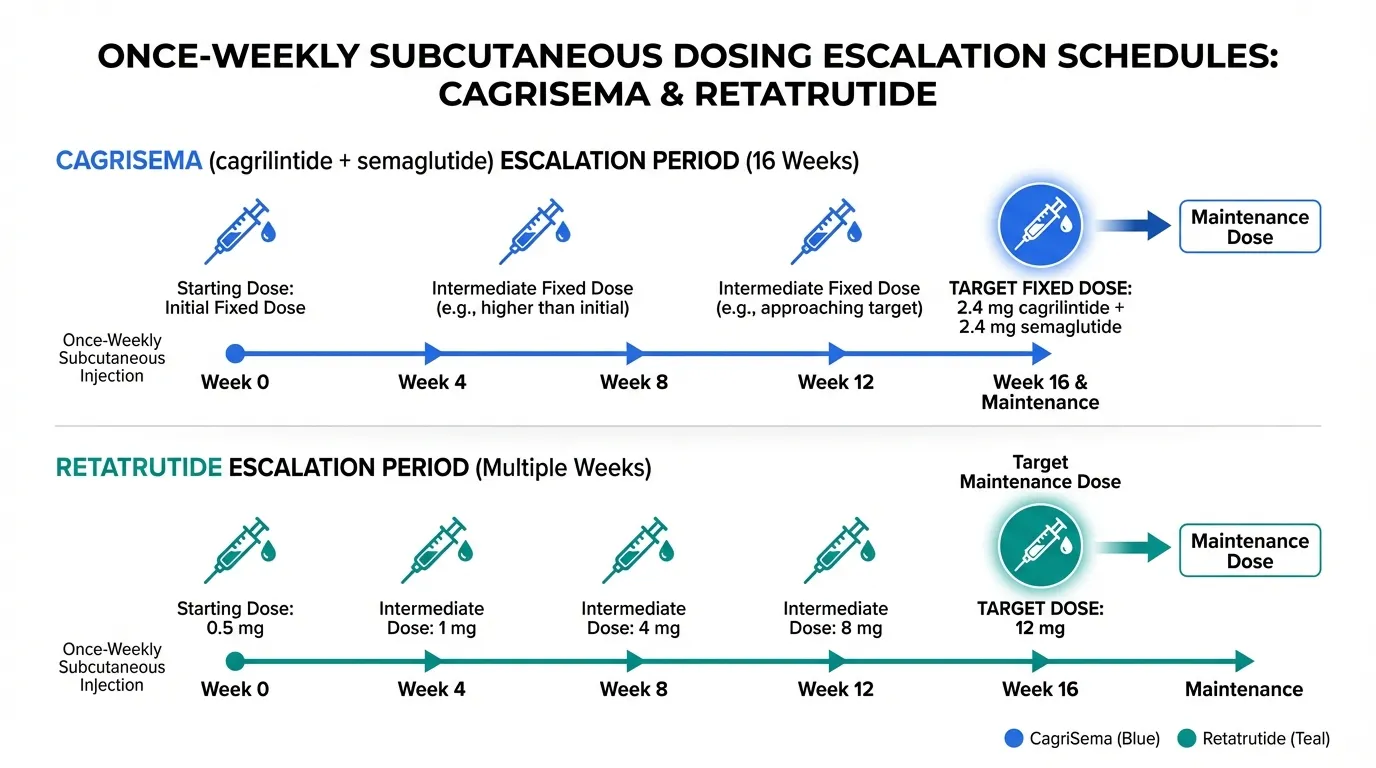
| Dosing Convenience | Once-weekly subcutaneous injection of fixed-dose combination (2.4 mg cagrilintide + 2.4 mg semaglutide). Familiar semaglutide dosing platform. Dose escalation over 16 weeks. | Once-weekly subcutaneous injection. Dose escalation from 0.5 mg to 12 mg over multiple weeks. Multiple dose levels may be needed to optimize. | CagriSema |

Introduction#
CagriSema and retatrutide represent two of the most anticipated next-generation obesity treatments, each taking a fundamentally different multi-target approach to weight management. Their comparison illustrates the two dominant strategies in modern obesity pharmacotherapy: combination therapy with proven agents versus novel single-molecule multi-agonism.
CagriSema, developed by Novo Nordisk, is a fixed-dose combination of cagrilintide (a long-acting amylin analog) and semaglutide (a GLP-1 receptor agonist). The REDEFINE 1 Phase 3 trial demonstrated 20.4% mean weight loss at 68 weeks in 3,417 participants, and Novo Nordisk has filed an NDA with the FDA.
Retatrutide (LY3437943), developed by Eli Lilly, is a first-in-class triple GIP/GLP-1/glucagon receptor agonist. Phase 3 TRIUMPH-4 demonstrated 28.7% mean weight loss at 68 weeks with the 12 mg dose, confirming the exceptional Phase 2 results (24.2% at 48 weeks; Jastreboff et al., NEJM 2023). Retatrutide has produced the highest weight loss of any single anti-obesity agent in clinical trials.
Mechanism of Action Comparison#
CagriSema#
CagriSema combines two distinct peptide mechanisms in a single injection. Cagrilintide is a long-acting analog of amylin, a pancreatic hormone co-secreted with insulin that promotes satiety through the area postrema and reduces glucagon secretion. Semaglutide activates GLP-1 receptors to enhance glucose-dependent insulin secretion, suppress appetite through hypothalamic signaling, and delay gastric emptying. Together, these two mechanisms provide complementary appetite suppression through different neural pathways.
Retatrutide#
Retatrutide is a single molecule that simultaneously activates three receptors: GIP, GLP-1, and glucagon receptors. The GLP-1 component provides appetite suppression and glycemic control. The GIP component enhances insulin secretion and may improve fat metabolism. The glucagon component -- absent in CagriSema -- increases energy expenditure through thermogenesis and promotes hepatic fat oxidation. This third pathway (glucagon) differentiates retatrutide from combination approaches like CagriSema.
Key Mechanistic Differences#
| Feature | CagriSema | Retatrutide |
|---|---|---|
| Approach | Fixed-dose combination (two peptides) | Single-molecule triple agonist |
| Amylin pathway | Yes (cagrilintide) | No |
| GLP-1 pathway | Yes (semaglutide) | Yes |
| GIP pathway | No | Yes |
| Glucagon pathway | No | Yes |
| Energy expenditure component | Minimal | Yes (glucagon) |
| Developer | Novo Nordisk | Eli Lilly |
Dosing Comparison#
CagriSema Dosing#
CagriSema is administered as a once-weekly subcutaneous injection at a target fixed dose of 2.4 mg cagrilintide + 2.4 mg semaglutide. The dose is escalated over approximately 16 weeks following a protocol similar to Wegovy's escalation schedule. The fixed-dose format simplifies prescribing.
Retatrutide Dosing#
Retatrutide is administered as once-weekly subcutaneous injections with escalation from 0.5 mg to the target dose of 12 mg over multiple weeks. Multiple dose levels (1, 4, 8, 12 mg) were tested in Phase 2, with the Phase 3 dose selection to be refined based on efficacy-tolerability balance.
Side Effects Comparison#
CagriSema Side Effects#
GI adverse events occurred in 79.6% of CagriSema recipients versus 39.9% on placebo in REDEFINE 1. Nausea, vomiting, diarrhea, constipation, and abdominal pain were the most common, mostly transient and mild to moderate. The semaglutide component has an established safety profile from over 7 years of post-marketing experience.
Retatrutide Side Effects#
GI events were dose-dependent in Phase 2, with nausea in 16-46%, diarrhea in 16-26%, and vomiting in 8-22%. The addition of glucagon receptor agonism introduces theoretical concerns about hepatic glucose output, though no clinically significant hyperglycemia was observed. The novel triple-agonist mechanism means less long-term safety data is available.
Research Evidence Comparison#
CagriSema Research#
The REDEFINE Phase 3 program provides robust evidence: REDEFINE 1 (3,417 participants, 20.4% weight loss at 68 weeks) and REDEFINE 2 (1,200 T2D participants, 13.7% weight loss). An NDA has been filed with the FDA. The semaglutide component benefits from the extensive SUSTAIN, STEP, and SELECT trial databases. Evidence level is high.
Retatrutide Research#
The pivotal Phase 2 trial (338 participants, NEJM 2023) showed 24.2% weight loss at 48 weeks. Phase 3 TRIUMPH-4 confirmed 28.7% weight loss at 68 weeks. Phase 2a MASH data showed significant liver fat reduction. Additional Phase 3 readouts expected in 2026. Evidence level is high based on confirmed Phase 3 data.
Key Differences Summary#
- Strategy: CagriSema uses two proven peptides in combination; retatrutide uses a single novel molecule targeting three receptors.
- Weight loss: Retatrutide showed 28.7% at 68 weeks (Phase 3 TRIUMPH-4) versus CagriSema's 20.4% at 68 weeks (Phase 3 REDEFINE 1), though cross-trial comparisons are limited.
- Unique pathways: CagriSema activates amylin receptors (absent in retatrutide); retatrutide activates glucagon and GIP receptors (absent in CagriSema).
- Energy expenditure: Retatrutide's glucagon component directly increases energy expenditure; CagriSema primarily works through appetite suppression.
- Regulatory status: CagriSema has an NDA filed; retatrutide has Phase 3 data but no regulatory submission yet.
- Safety data: CagriSema builds on semaglutide's 7+ year track record; retatrutide's novel mechanism has only Phase 2 safety data.
- Developer competition: CagriSema (Novo Nordisk) versus retatrutide (Eli Lilly) represents the central competitive axis in next-generation obesity therapeutics.
Conclusion#
CagriSema and retatrutide each represent a compelling approach to next-generation obesity treatment. CagriSema's strategy of combining two proven mechanisms (amylin and GLP-1) in a single injection has produced strong Phase 3 results (20.4% weight loss), builds on the established semaglutide safety record, and is closest to market with an NDA filed. Retatrutide's triple-agonist approach produced even greater weight loss, with Phase 3 TRIUMPH-4 confirming 28.7% at 68 weeks.
The mechanistic comparison is particularly interesting: CagriSema adds amylin signaling to GLP-1, while retatrutide adds glucagon and GIP signaling. These are complementary strategies that address weight through different biological pathways -- CagriSema through dual appetite suppression mechanisms, retatrutide through appetite suppression plus increased energy expenditure. The TRIUMPH-4 data confirm that retatrutide achieves greater peak weight loss, but CagriSema's nearer-term availability and established semaglutide safety record may make it the first to reach patients.
Detailed Category Analysis#
Mechanism of Action#
CagriSema: Fixed-dose combination of cagrilintide (long-acting amylin analog) and semaglutide (GLP-1 receptor agonist). Two separate mechanisms in one injection -- amylin reduces appetite via area postrema and GLP-1 enhances insulin secretion and central satiety signaling.
Retatrutide: Single-molecule triple agonist targeting GIP, GLP-1, and glucagon receptors simultaneously. Glucagon component increases energy expenditure and hepatic fat oxidation, while GIP enhances insulin secretion and fat metabolism.
Advantage: Neither (tie)
Weight Loss Efficacy#
CagriSema: REDEFINE 1 Phase 3 demonstrated 20.4% mean weight loss at 68 weeks. 60% of patients achieved 20% or more weight loss, and 23% achieved 30% or more. REDEFINE 2 showed 13.7% in T2D patients at 68 weeks.
Retatrutide: Phase 3 TRIUMPH-4 demonstrated 28.7% mean weight loss at 68 weeks with 12 mg dose (Phase 2 showed 24.2% at 48 weeks). 100% achieved 5% or more, 93% achieved 10% or more, and 83% achieved 15% or more in Phase 2.
Advantage: Retatrutide
Research Evidence#
CagriSema: Phase 3 REDEFINE program completed with 3,417 participants in REDEFINE 1 and 1,200 in REDEFINE 2. NDA filed with FDA. Published in NEJM. Built on proven semaglutide platform with extensive existing safety data.
Retatrutide: Phase 2 completed for obesity (NEJM 2023, 338 patients) and Phase 2a for MASH. Phase 3 TRIUMPH program ongoing with TRIUMPH-4 results reported (28.7% weight loss at 68 weeks). No regulatory submissions yet.
Advantage: CagriSema
Side Effect Profile#
CagriSema: GI adverse events in 79.6% of CagriSema group vs 39.9% placebo in REDEFINE 1. Nausea, vomiting, diarrhea, constipation, and abdominal pain were mainly transient and mild to moderate. Built on well-characterized semaglutide safety profile.
Retatrutide: GI adverse events dose-dependent. Nausea 16-46%, diarrhea 16-26%, vomiting 8-22%. Phase 2 only -- less safety data available. Novel triple mechanism means less predictability of long-term safety.
Advantage: CagriSema
Regulatory and Approval Status#
CagriSema: NDA filed with FDA for weight management. Based on proven semaglutide and cagrilintide components. Novo Nordisk developing. If approved, would be first amylin/GLP-1 combination treatment.
Retatrutide: Not yet submitted for regulatory approval. Phase 3 TRIUMPH trials ongoing. Eli Lilly developing. Regulatory submission dependent on Phase 3 results.
Advantage: CagriSema
Dosing Convenience#
CagriSema: Once-weekly subcutaneous injection of fixed-dose combination (2.4 mg cagrilintide + 2.4 mg semaglutide). Familiar semaglutide dosing platform. Dose escalation over 16 weeks.
Retatrutide: Once-weekly subcutaneous injection. Dose escalation from 0.5 mg to 12 mg over multiple weeks. Multiple dose levels may be needed to optimize.
Advantage: CagriSema
Summary and Verdict#
CagriSema and retatrutide represent two fundamentally different approaches to next-generation obesity treatment. CagriSema combines two proven mechanisms (amylin + GLP-1) in a fixed-dose injection, achieving 20.4% weight loss in Phase 3, with an NDA already filed and the advantage of building on the well-characterized semaglutide platform. Retatrutide's novel triple-agonist approach produced 28.7% weight loss in Phase 3 TRIUMPH-4 (confirming 24.2% in Phase 2) by adding glucagon and GIP receptor activation. CagriSema is likely to reach market sooner, but retatrutide offers the greatest peak efficacy of any single anti-obesity agent.
Best For Recommendations#
Maximum Weight Loss#
Recommendation: Retatrutide
Reason: Phase 3 TRIUMPH-4 showed 28.7% weight loss at 68 weeks, substantially exceeding CagriSema's 20.4% at 68 weeks. Retatrutide offers the greatest single-agent weight loss of any anti-obesity drug in clinical trials.
Nearer-Term Availability#
Recommendation: CagriSema
Reason: NDA filed with FDA based on completed Phase 3 REDEFINE program. Likely to reach market before retatrutide, which is still in Phase 3 trials.
Established Safety Profile#
Recommendation: CagriSema
Reason: Builds on semaglutide's 7+ year post-marketing safety record and over 25,000 clinical trial participants. The semaglutide component has proven cardiovascular benefit from SELECT trial.
Liver and Metabolic Disease#
Recommendation: Retatrutide
Reason: The glucagon receptor agonism provides direct hepatic fat-reducing effects. Phase 2a MASH data showed up to 82% liver fat reduction. CagriSema lacks glucagon receptor activity.
Further Reading#

Which Is Better For...
Maximum Weight Loss
Retatrutide
Phase 3 TRIUMPH-4 showed 28.7% weight loss at 68 weeks, substantially exceeding CagriSema's 20.4% at 68 weeks. Retatrutide offers the greatest single-agent weight loss of any anti-obesity drug in clinical trials.
Nearer-Term Availability
CagriSema
NDA filed with FDA based on completed Phase 3 REDEFINE program. Likely to reach market before retatrutide, which is still in Phase 3 trials.
Established Safety Profile
CagriSema
Builds on semaglutide's 7+ year post-marketing safety record and over 25,000 clinical trial participants. The semaglutide component has proven cardiovascular benefit from SELECT trial.
Liver and Metabolic Disease
Retatrutide
The glucagon receptor agonism provides direct hepatic fat-reducing effects. Phase 2a MASH data showed up to 82% liver fat reduction. CagriSema lacks glucagon receptor activity.
Continue Your Research
Get comparison updates
We publish new head-to-head comparisons regularly. Subscribe to see them first.
Frequently Asked Questions About CagriSema vs Retatrutide: Amylin/GLP-1 Combination vs Triple Agonist Comparison
Which is better, CagriSema or Retatrutide?
CagriSema and retatrutide represent two fundamentally different approaches to next-generation obesity treatment. CagriSema combines two proven mechanisms (amylin + GLP-1) in a fixed-dose injection, achieving 20.4% weight loss in Phase 3, with an NDA already filed and the advantage of building on the well-characterized semaglutide platform. Retatrutide's novel triple-agonist approach produced 28.7% weight loss in Phase 3 TRIUMPH-4 (confirming 24.2% in Phase 2) by adding glucagon and GIP recept... Individual responses may vary, and this comparison is based on available research data, not a treatment recommendation.
What are the key differences between CagriSema and Retatrutide?
The main differences across comparison categories are: Mechanism of Action: advantage goes to neither (tie); Weight Loss Efficacy: advantage goes to Retatrutide; Research Evidence: advantage goes to CagriSema. 3 additional categories are analyzed in the full comparison. Each category evaluates a different dimension of the two peptides.
When should I consider Retatrutide over CagriSema?
For the scenario of "Maximum Weight Loss," research data suggests Retatrutide may be more relevant. Phase 3 TRIUMPH-4 showed 28.7% weight loss at 68 weeks, substantially exceeding CagriSema's 20.4% at 68 weeks. Retatrutide offers the greatest single-agent weight loss of any anti-obesity drug in c.... This is based on currently available evidence and individual circumstances may differ.
How do CagriSema and Retatrutide differ in their mechanisms of action?
CagriSema: Fixed-dose combination of cagrilintide (long-acting amylin analog) and semaglutide (GLP-1 receptor agonist). Two separate mechanisms in one injection -- amylin reduces appetite via area postrema an.... Retatrutide: Single-molecule triple agonist targeting GIP, GLP-1, and glucagon receptors simultaneously. Glucagon component increases energy expenditure and hepatic fat oxidation, while GIP enhances insulin sec....
Which has fewer side effects, CagriSema or Retatrutide?
In terms of side effects and tolerability, the advantage goes to CagriSema. CagriSema: GI adverse events in 79.6% of CagriSema group vs 39.9% placebo in REDEFINE 1. Nausea, vomiting, diarrhea, constipation, and abdominal pain were mai.... Retatrutide: GI adverse events dose-dependent. Nausea 16-46%, diarrhea 16-26%, vomiting 8-22%. Phase 2 only -- less safety data available. Novel triple mechanis....
Medical Disclaimer
This website is for educational and informational purposes only. The information provided is not intended to diagnose, treat, cure, or prevent any disease. Always consult with a qualified healthcare professional before using any peptide or supplement.