Collagen-Boosting Peptides for Skin: From GHK-Cu to Matrixyl

Introduction#
Collagen is the most abundant structural protein in human skin, comprising approximately 75-80% of the skin's dry weight. The dermal extracellular matrix is predominantly composed of collagen types I (80-85%) and III (10-15%), organized into a fibrillar network that provides tensile strength, elasticity, and structural integrity. Beginning in the mid-20s, collagen production declines by approximately 1-1.5% per year, and UV exposure accelerates this degradation through matrix metalloproteinase (MMP) activation.
Several peptides have been studied for their ability to stimulate collagen synthesis, either directly by signaling fibroblasts to increase production or indirectly by modulating the gene expression pathways that govern extracellular matrix biology. This review examines the research behind the most studied collagen-relevant peptides, including the copper peptide GHK-Cu, the signal peptide Matrixyl, and the wound healing peptide BPC-157, with additional context from the neuromuscular peptide SNAP-8 for comparative purposes.
GHK-Cu: Broad-Spectrum Collagen and Gene Modulation#
Molecular Profile#
GHK-Cu (glycyl-L-histidyl-L-lysine:copper(II)) is a naturally occurring copper-binding tripeptide with a molecular weight of approximately 404 Da. First identified in human plasma by Loren Pickart in 1973, it is present in blood, saliva, and urine at concentrations that decline significantly with age — from approximately 200 ng/mL at age 20 to 80 ng/mL by age 60.
This age-related decline in endogenous GHK-Cu is significant because it correlates temporally with the progressive loss of skin regenerative capacity observed in aging.
Collagen-Relevant Gene Expression Data#
A landmark 2015 gene expression study demonstrated that GHK modulates the activity of over 4,000 human genes when applied to cultured human cells. Among the collagen-relevant findings:
- Collagen type I and III upregulation — direct stimulation of the genes encoding the primary structural collagens in skin
- Elastin gene activation — increased expression of tropoelastin, the precursor to mature elastin fibers
- Decorin stimulation — upregulation of the proteoglycan that organizes collagen fibril assembly and spacing
- Glycosaminoglycan synthesis — increased production of hyaluronic acid and other hydrating molecules that fill the spaces between collagen fibers
- MMP suppression — downregulation of several matrix metalloproteinases that degrade collagen and elastin
Additionally, GHK-Cu delivers copper(II) ions that serve as essential cofactors for lysyl oxidase, the enzyme responsible for collagen and elastin cross-linking. Without adequate copper, newly synthesized collagen cannot be properly cross-linked into mature, mechanically functional fibers.
Clinical Evidence for Skin Collagen Effects#
Several human studies have evaluated topical GHK-Cu for skin outcomes related to collagen:
Collagen production study: After one month of topical GHK-Cu application, collagen production increased in 70% of treated women, compared to 50% with vitamin C cream and 40% with retinoic acid. This study is notable because it compared GHK-Cu against two established collagen-stimulating treatments.
Facial study (67-71 women, 12 weeks): Twice-daily GHK-Cu cream application improved skin laxity, clarity, and firmness; reduced fine lines, coarse wrinkles, and mottled pigmentation; and increased skin density and thickness. The improvements in skin thickness and density are consistent with increased dermal collagen content.
Head-to-head vs Matrixyl 3000: In a randomized, double-blind clinical trial, GHK-Cu reduced wrinkle volume 55.8% more than control serum and 31.6% more than Matrixyl 3000. Wrinkle depth was reduced 32.8% versus control.
Limitations and Regulatory Status#
The gap between GHK-Cu's gene expression data and clinical outcomes remains significant. Modulating the expression of collagen genes in cell culture does not guarantee proportional increases in functional collagen deposition in human skin. The gene expression studies provide mechanistic plausibility but not clinical proof.
GHK-Cu was placed in FDA Category 2 in 2024, restricting compounding of injectable forms. Topical cosmetic formulations are not affected. Formulation challenges include copper ion reactivity, incompatibility with strong acids and vitamin C at low pH, and a narrow optimal pH range of 5.0-6.5.
Matrixyl: Collagen Signaling Through Matrikine Mimicry#
Molecular Profile and Mechanism#
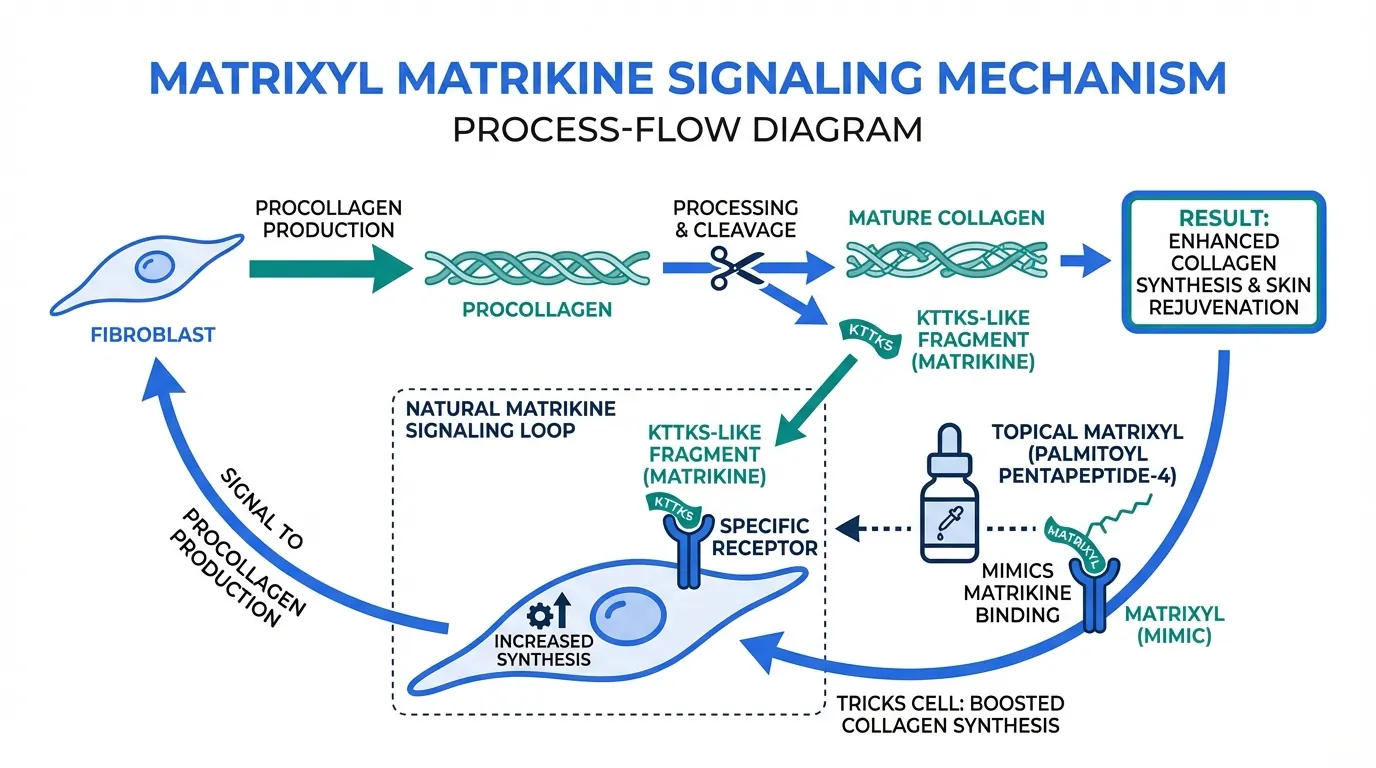
Matrixyl (palmitoyl pentapeptide-4, pal-KTTKS) is a synthetic lipopeptide with a molecular weight of approximately 802 Da. The KTTKS pentapeptide sequence is derived from the C-terminal propeptide of type I procollagen — the fragment that is cleaved off when procollagen is processed into mature collagen.
This fragment operates through a biological feedback system called matrikine signaling. When collagen is being actively turned over (synthesized and processed), KTTKS-like fragments are released as byproducts. Fibroblasts detect these fragments and interpret them as a signal that collagen production is needed, upregulating their synthesis of new collagen and other extracellular matrix components.
By applying synthetic KTTKS topically, Matrixyl effectively mimics this turnover signal, tricking fibroblasts into increasing collagen production even in the absence of elevated natural collagen processing.
The palmitoyl modification serves a critical delivery function. Unmodified KTTKS peptide is hydrophilic and poorly absorbed through the lipophilic stratum corneum. Conjugation with palmitic acid (a 16-carbon saturated fatty acid) dramatically increases lipophilicity, facilitating penetration through the skin barrier.
In Vitro Collagen Data#
Cell culture studies have demonstrated that Matrixyl stimulates fibroblast production of:
- Collagen type I — the predominant structural collagen in skin (80-85% of dermal collagen)
- Collagen type III — the secondary structural collagen (10-15% of dermal collagen)
- Collagen type IV — a component of the basement membrane at the dermal-epidermal junction
- Fibronectin — a glycoprotein critical for cell adhesion and extracellular matrix organization
The stimulation of multiple collagen types, plus fibronectin, suggests that Matrixyl activates a broad fibroblast biosynthetic response rather than selectively upregulating a single matrix component.
Clinical Evidence#
Matrixyl has the strongest placebo-controlled clinical evidence among collagen-stimulating cosmeceutical peptides:
Robinson et al. double-blind RCT (93 subjects, 12 weeks): This split-face study remains the largest and most rigorous clinical trial for a topical cosmeceutical peptide. Subjects applied pal-KTTKS to one side of the face and vehicle control to the other. Both quantitative imaging measurements and expert grader assessments showed significant wrinkle and fine line improvement with pal-KTTKS versus placebo.
Periorbital study (28 days): Application of 0.005% Matrixyl cream twice daily to the periorbital area produced:
- 18% reduction in fold depth
- 37% reduction in fold thickness
- 21% improvement in skin firmness
These results are consistent with increased dermal collagen deposition, as improved fold thickness and firmness both reflect enhanced structural support in the dermis.
Safety data: Matrixyl has been tested at concentrations up to 3% and found to be non-irritating and non-sensitizing across all skin types, including sensitive and acne-prone skin. This tolerability profile is significantly better than retinoid-based collagen stimulators, which commonly cause dryness, peeling, and irritation.
Matrixyl Variants and Collagen Targeting#
The original Matrixyl has spawned several variants with expanded collagen-relevant targets:
Matrixyl 3000 combines palmitoyl tripeptide-1 (pal-GHK) and palmitoyl tetrapeptide-7 (pal-GQPR). Pal-GHK stimulates collagen synthesis while pal-GQPR reduces inflammatory cytokines (particularly IL-6) that accelerate collagen degradation. This dual approach addresses both the production and destruction sides of collagen homeostasis.
Matrixyl Synthe'6 contains palmitoyl tripeptide-38, which stimulates six major structural components of the skin: collagen I, collagen III, collagen IV, fibronectin, hyaluronic acid, and laminin-5. By targeting the complete set of dermal-epidermal junction components, it aims for more comprehensive matrix repair.
Limitations#
While Matrixyl has a comparatively strong evidence base for a cosmeceutical peptide, limitations remain. The Robinson et al. study, though well-designed, was a 12-week trial — the long-term effects of sustained Matrixyl use on collagen density have not been measured using gold-standard techniques like skin biopsy with histological collagen quantification. Most outcome measures are indirect (wrinkle depth, skin firmness) rather than direct collagen measurements.
BPC-157: Wound Healing and Skin Repair#
Relevance to Skin Collagen#
BPC-157 (Body Protection Compound-157) is primarily studied as a healing peptide rather than a cosmetic anti-aging ingredient. However, its tissue repair mechanisms have direct relevance to skin collagen biology, and it warrants discussion in a collagen-focused review.
Mechanism of Action in Skin#
BPC-157 promotes tissue repair through several pathways relevant to collagen deposition:
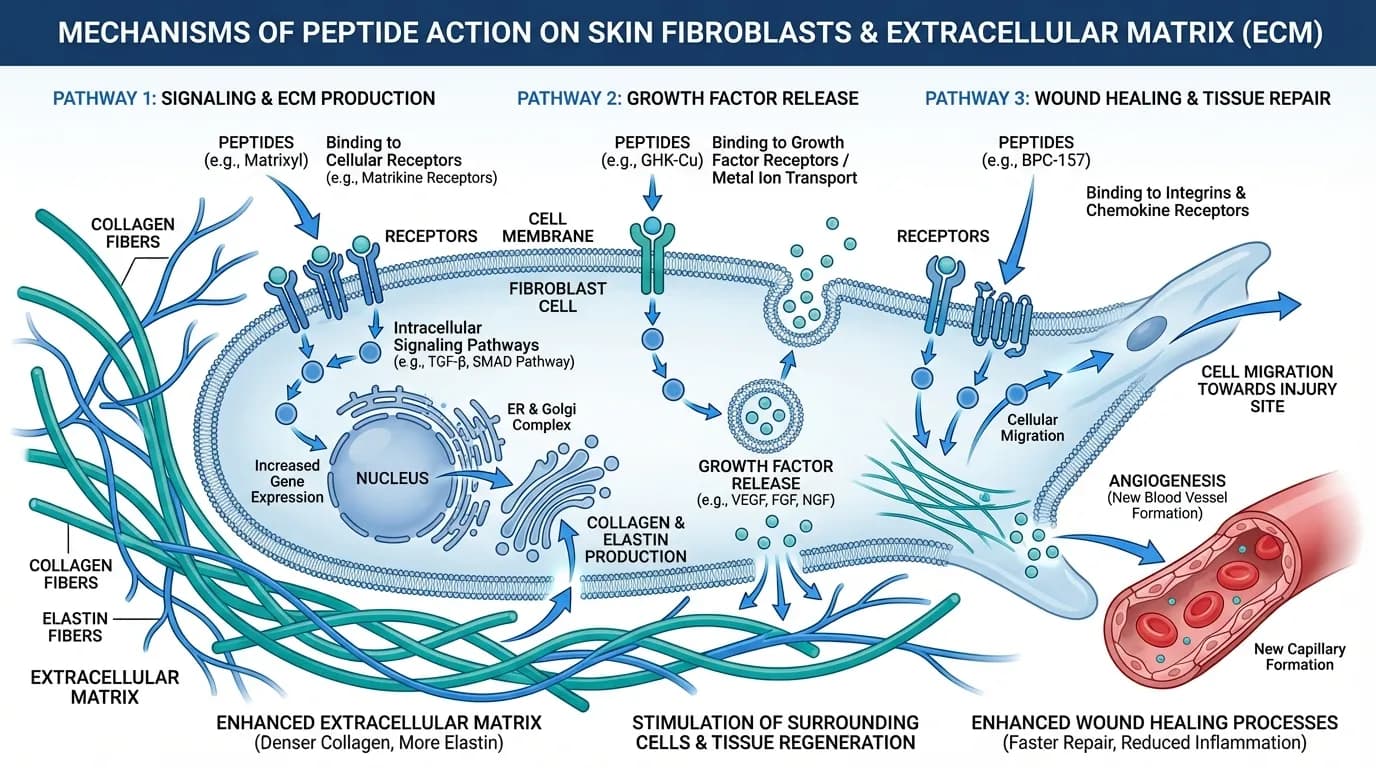
- Angiogenesis — BPC-157 stimulates new blood vessel formation through VEGF upregulation. Adequate vascular supply is essential for delivering the amino acid substrates (proline, glycine, hydroxyproline) and cofactors (vitamin C, iron, copper) required for collagen synthesis.
- Growth factor modulation — Upregulation of EGF (epidermal growth factor) and FGF (fibroblast growth factor), both of which stimulate fibroblast proliferation and collagen production.
- Collagen deposition — Animal wound healing studies have demonstrated increased collagen deposition at wound sites following BPC-157 administration.
- Nitric oxide system — BPC-157 modulates the NO system, which plays roles in wound healing, blood flow regulation, and inflammatory resolution.
Preclinical Wound Healing Data#
The skin-relevant evidence for BPC-157 comes primarily from animal studies:
Wound closure studies: BPC-157 has demonstrated accelerated wound closure rates in multiple animal models, including incisional wounds, excisional wounds, and burn injuries. The mechanism involves enhanced re-epithelialization and granulation tissue formation, both of which require collagen deposition.
Burn models: In burn injury studies, BPC-157 accelerated recovery with increased collagen deposition at the healing site. The vasculogenic properties — new blood vessel formation — appear to be particularly important for burn healing, where vascular damage is a primary barrier to tissue repair.
Tendon and ligament repair: While not directly skin-related, BPC-157's tendon healing data is relevant because tendons are collagen-dense tissues. Accelerated tendon healing with improved mechanical properties suggests enhanced collagen synthesis and organization.
Topical vs Injectable Delivery for Skin#
Most BPC-157 skin repair studies have used injectable administration (intraperitoneal or subcutaneous). The question of whether topical BPC-157 can achieve meaningful concentrations in the skin is largely unanswered. BPC-157 is a 15-amino-acid peptide (molecular weight ~1,419 Da), which places it above the typical penetration threshold for passive transdermal absorption (~500 Da).
However, BPC-157's stability in acidic conditions (it is derived from gastric juice) and resistance to degradation may offer advantages for topical formulation development. Research into enhanced delivery systems (liposomes, nanoparticles, microneedling) for BPC-157 in skin applications is limited but represents a potential area of future investigation.
Limitations#
All skin-relevant BPC-157 data is preclinical. No human clinical trials have evaluated BPC-157 specifically for cosmetic skin improvement or collagen enhancement. BPC-157 was placed in FDA Category 2 in 2024, restricting its compounding. The translation from animal wound healing to human cosmetic skin rejuvenation has not been established.
Topical Delivery: The Central Challenge#
A critical issue that applies to all collagen-stimulating peptides is the challenge of topical delivery. The stratum corneum — the outermost layer of the skin — is designed to be a barrier. It effectively blocks the penetration of most hydrophilic molecules larger than approximately 500 Da.
Peptide Penetration Data#
| Peptide | Molecular Weight | Lipophilic Modification | Penetration Evidence |
|---|---|---|---|
| GHK-Cu | ~404 Da | None (copper complex) | Below 500 Da threshold; some penetration data |
| Matrixyl | ~802 Da | Palmitoyl chain | Enhanced penetration via lipophilic modification |
| Argireline | ~889 Da | None | Limited penetration data; target is deep |
| SNAP-8 | ~1,075 Da | None | Limited penetration data; target is deep |
| BPC-157 | ~1,419 Da | None | No topical penetration data |
GHK-Cu has the inherent advantage of small molecular size, falling below the conventional 500 Da penetration threshold. The copper complex may also facilitate uptake through skin appendages (hair follicles, sweat ducts).
Matrixyl addresses the penetration problem through its palmitoyl modification, which significantly improves absorption through the lipid-rich stratum corneum. This pharmaceutical design approach is one reason Matrixyl has shown relatively consistent clinical results.
SNAP-8 and Argireline face a double challenge: they are both above the penetration threshold and their target (the neuromuscular junction) lies deeper than the dermis. Even partial penetration to the upper dermis may not bring these peptides into contact with their molecular target.
Delivery Enhancement Strategies#
Emerging approaches to improve topical peptide delivery include:
- Liposomal encapsulation — wrapping peptides in lipid vesicles that can fuse with the stratum corneum
- Nanoparticle carriers — using polymer or lipid nanoparticles to shuttle peptides through the skin barrier
- Microneedling — creating transient microchannels that bypass the stratum corneum entirely
- Chemical penetration enhancers — dimethyl sulfoxide (DMSO), oleic acid, and other compounds that temporarily disrupt the lipid barrier
- Iontophoresis — using electrical current to drive charged peptides through the skin
These technologies are actively being developed but are not yet standard in most commercial cosmeceutical products.
Comparing Collagen-Stimulating Approaches#
Direct Comparison#
| Feature | GHK-Cu | Matrixyl | BPC-157 |
|---|---|---|---|
| Primary mechanism | Gene modulation (4,000+ genes) | Matrikine signaling (collagen fragment mimicry) | Growth factor upregulation and angiogenesis |
| Collagen types stimulated | I, III, elastin, decorin | I, III, IV, fibronectin | Demonstrated in wound models |
| Additional benefits | Antioxidant, anti-inflammatory, wound healing | Limited to ECM stimulation | Wound healing, vascular repair |
| Human clinical data | Multiple studies (topical) | Multiple studies including RCT | None for skin (preclinical only) |
| Topical penetration | Favorable (small MW) | Favorable (palmitoyl modification) | Uncertain (large MW) |
| Formulation ease | Challenging (pH, copper reactivity) | Excellent (broad compatibility) | Unknown for cosmetic use |
| Regulatory status | Category 2 (injectable); cosmetic topical OK | Cosmetic ingredient | Category 2 |
Complementary Use#
Because these peptides work through different mechanisms, they can be considered complementary rather than competitive:
- GHK-Cu provides the broadest gene-level stimulation, upregulating not just collagen but the full suite of extracellular matrix components, antioxidant enzymes, and growth factors. It acts as a "master switch" for tissue remodeling.
- Matrixyl provides targeted matrikine signaling that specifically drives fibroblast collagen production. Its signal peptide mechanism is distinct from GHK-Cu's gene modulation approach.
- BPC-157 adds the dimension of vascular repair and growth factor upregulation, which could theoretically improve nutrient delivery to fibroblasts and support the collagen synthesis stimulated by other peptides.
For a detailed head-to-head analysis of the two most established collagen-stimulating peptides, see our GHK-Cu vs Matrixyl comparison.
Context: How Peptides Compare to Established Collagen Treatments#
It is important to place cosmeceutical peptides in the context of established dermatological treatments for collagen stimulation:
Tretinoin (retinoic acid): The gold standard topical for collagen stimulation. FDA-approved for photoaging with decades of clinical data. Stimulates collagen I and III production, inhibits MMPs, and normalizes keratinocyte differentiation. Side effects include dryness, peeling, and photosensitivity.
Vitamin C (L-ascorbic acid): Essential cofactor for prolyl and lysyl hydroxylase enzymes that stabilize the collagen triple helix. Well-studied topically at 10-20% concentration, with evidence for photoprotection and collagen stimulation. Formulation stability is challenging.
Dermal fillers (hyaluronic acid): Injectable HA fillers provide immediate volume restoration and may stimulate some collagen production through mechanical stretching of fibroblasts. Effects last 6-18 months depending on product.
Microneedling: Creates controlled micro-injuries that trigger wound healing and collagen deposition. Well-supported by clinical evidence for scar improvement and skin rejuvenation. Can be combined with topical peptides for enhanced delivery.
Cosmeceutical peptides generally produce more modest effects than these established treatments but with superior safety profiles and the convenience of topical, at-home application. They are best viewed as part of a comprehensive approach rather than as standalone replacements for proven therapies.
Conclusion#
The evidence for collagen-stimulating peptides in skin rejuvenation is growing but remains at an early stage compared to established dermatological treatments. GHK-Cu stands out for the breadth of its gene expression data and its clinical evidence for wrinkle reduction and collagen stimulation. Matrixyl offers the strongest placebo-controlled clinical evidence among dedicated cosmeceutical peptides, with a well-characterized matrikine signaling mechanism. BPC-157 provides compelling preclinical wound healing data but lacks human clinical evidence for cosmetic skin applications.
The fundamental challenge for all topical peptides remains delivery — ensuring that sufficient quantities of active peptide reach their target cells in the dermis. Advances in lipophilic modification (as with Matrixyl's palmitoyl group), nanoparticle delivery, and microneedling-assisted application may progressively address this limitation.
For a broader guide to the full range of anti-wrinkle peptides including neurotoxin-like peptides, see our anti-wrinkle peptides guide. For more on the full spectrum of skin health peptides, see 8 Peptides for Skin Health.
Related Peptide Profiles#
Learn more about the peptides discussed in this article:
- BPC-157 Overview and Research Guide
- BPC-157 Dosing Protocols
- BPC-157 Side Effects and Safety
- GHK-Cu Overview and Research Guide
- GHK-Cu Dosing Protocols
- GHK-Cu Side Effects and Safety
- Matrixyl Overview and Research Guide
- Matrixyl Dosing Protocols
- Matrixyl Side Effects and Safety
- SNAP-8 Overview and Research Guide
- SNAP-8 Dosing Protocols
- SNAP-8 Side Effects and Safety

Frequently Asked Questions About Collagen-Boosting Peptides for Skin: From GHK-Cu to Matrixyl
What does this article cover?
Research review of collagen-stimulating peptides for skin rejuvenation including GHK-Cu, Matrixyl, SNAP-8, and BPC-157 wound healing data. This research review is for educational purposes only and does not constitute medical advice.
Which peptides are discussed in this article?
This article covers BPC-157, GHK-Cu, Matrixyl, SNAP-8. Key context: BPC-157 (Healing peptide with preclinical wound repair and angiogenesis data relevant to skin tissue regen...); GHK-Cu (Copper tripeptide that modulates 4,000+ genes including collagen and elastin synthesis pathways); Matrixyl (Signal peptide that mimics collagen fragments to stimulate fibroblast collagen production via mat...). Each peptide is discussed based on available research evidence.
What level of evidence does this research review cover?
This research review examines published preclinical and clinical studies related to the peptides discussed. Evidence quality varies between peptides and indications. The article distinguishes between FDA-approved uses and investigational applications where applicable.
What are the key takeaways from this article?
The main findings covered in this article include: Healing peptide with preclinical wound repair and angiogenesis data relevant to skin tissue regen.... Copper tripeptide that modulates 4,000+ genes including collagen and elastin synthesis pathways. Signal peptide that mimics collagen fragments to stimulate fibroblast collagen production via mat.... These takeaways are based on the research data available at the time of publication.
What is BPC-157 and why is it significant?
BPC-157 is a peptide discussed in this article because: Healing peptide with preclinical wound repair and angiogenesis data relevant to skin tissue regeneration. For a complete profile of BPC-157, see the dedicated peptide page on this site.
Continue reading this research review
Free access to the complete analysis with citations and evidence ratings.
150+ peptide profiles · 30+ comparisons · 18 research tools
Medical Disclaimer
This website is for educational and informational purposes only. The information provided is not intended to diagnose, treat, cure, or prevent any disease. Always consult with a qualified healthcare professional before using any peptide or supplement.
Join 2,000+ researchers getting biweekly updates
Enjoyed this article?
The Research Briefing delivers deep-dives like this biweekly — plus new study breakdowns, safety updates, and tool announcements.
Free forever. No spam. Unsubscribe in one click.
Where to Find These Peptides
Continue Exploring
Peptide Profiles
Keep Reading
Best Peptides for Hair, Skin & Nails: Evidence-Based Guide (2026)
Which peptides actually improve hair growth, skin quality, and nail strength? Evidence-based review of GHK-Cu, copper peptides, Matrixyl, BPC-157, and popular peptide blends.

Anti-Wrinkle Peptides: SNAP-8, Argireline, Matrixyl, and Leuphasyl Compared
Evidence-based guide to cosmeceutical anti-wrinkle peptides including SNAP-8, Argireline, Matrixyl, and GHK-Cu — mechanisms, clinical data, and formulation.

8 Peptides for Skin Health and Rejuvenation: Research Guide
Peptides for skin health — GHK-Cu, SNAP-8, Melanotan-1, BPC-157, and Glutathione reviewed with evidence levels and mechanisms of action.
You Might Also Like
Related content you may find interesting