GHK-Cu vs Matrixyl: Anti-Aging Skin Peptides Compared
Evidence-based comparison of GHK-Cu (copper peptide) and Matrixyl (palmitoyl pentapeptide-4) for anti-aging skincare, including wrinkle reduction data, collagen stimulation, and clinical study results.
Verdict at a Glance
GHK-Cu is the more potent and versatile anti-aging peptide with broader biological activity, stronger clinical evidence for wrinkle reduction, and additional benefits for wound healing, inflammation, and tissue remodeling. In a direct head-to-head comparison, GHK-Cu reduced wrinkle volume 31.6% more than Matrixyl 3000. However, Matrixyl is better tolerated, easier to formulate, more widely available in commercial products, and more compatible with other skincare actives. For maximum anti-aging effect, GHK-Cu is superior. For everyday cosmetic use with minimal formulation concerns, Matrixyl is the more practical choice. The two peptides can also be combined synergistically.
| Best for | Pick | Why |
|---|---|---|
| Maximum Wrinkle Reduction | GHK-Cu | Head-to-head clinical data showed GHK-Cu reduced wrinkle volume 31.6% more than Matrixyl 3000 and 55.8% vs control serum. Multiple studies confirm superior anti-wrinkle efficacy. |
| Wound Healing and Tissue Repair | GHK-Cu | GHK-Cu has extensive evidence for wound healing, tissue remodeling, and anti-inflammatory activity. Matrixyl does not have wound healing applications. |
| Sensitive Skin | Matrixyl | Clinical studies confirm Matrixyl is non-irritating and non-sensitizing at therapeutic concentrations. GHK-Cu's copper component can cause irritation in sensitive individuals. |
| Combination with Other Actives | Matrixyl | Matrixyl is compatible with retinol, vitamin C, niacinamide, and hyaluronic acid. GHK-Cu is incompatible with strong acids and vitamin C at low pH, limiting layering options. |
| Comprehensive Anti-Aging Program | Both (combined) | GHK-Cu and Matrixyl work through complementary mechanisms and can be used together for enhanced collagen production and tissue remodeling. Apply GHK-Cu serum first, then Matrixyl-containing products. |
| Budget-Friendly Anti-Aging | Matrixyl | Matrixyl is widely available in affordable commercial skincare products. GHK-Cu products tend to be more expensive due to copper peptide sourcing and formulation complexity. |
| Category | GHK-Cu | Matrixyl | Advantage |
|---|---|---|---|
| Mechanism of Action | GHK-Cu is a naturally occurring copper-binding tripeptide (glycyl-L-histidyl-L-lysine) that modulates gene expression across multiple pathways. It upregulates collagen and elastin synthesis, promotes wound healing, reduces inflammation, stimulates glycosaminoglycan production, and activates over 4,000 genes involved in tissue remodeling. Its copper ion is essential for enzymatic processes including superoxide dismutase and lysyl oxidase activity. | Matrixyl (palmitoyl pentapeptide-4, pal-KTTKS) is a synthetic signal peptide that mimics a collagen fragment to stimulate new collagen synthesis. The KTTKS sequence is derived from the procollagen I C-propeptide and signals fibroblasts to produce more collagen types I and III. The palmitoyl group enhances skin penetration. | GHK-Cu |
| Research Evidence | GHK-Cu has been studied since 1973 (Pickart). Multiple clinical trials demonstrate wrinkle reduction, increased skin thickness, and improved firmness. A head-to-head study showed GHK-Cu reduced wrinkle volume 31.6% more than Matrixyl 3000 and 55.8% more than control. Gene expression studies show modulation of over 4,000 human genes. | Matrixyl has clinical evidence from a 93-subject double-blind placebo-controlled trial showing significant wrinkle reduction at 12 weeks. A 28-day periorbital study found 18% reduction in fold depth and 37% in fold thickness. More limited evidence base compared to GHK-Cu but includes placebo-controlled designs. | GHK-Cu |
| Side Effect Profile | GHK-Cu is generally well-tolerated. The copper component can cause skin irritation or greenish discoloration at high concentrations. Rare reports of contact dermatitis. Not recommended with strong acids (vitamin C at low pH, AHAs) as copper can be destabilized. | Matrixyl is exceptionally well-tolerated. Clinical studies at 3% concentration confirmed it is non-irritating and non-sensitizing, suitable for all skin types including sensitive and acne-prone skin. No significant adverse effects reported. | Matrixyl |
| Versatility | GHK-Cu is highly versatile, addressing wrinkles, skin firmness, wound healing, inflammation, hair growth, and tissue remodeling. Available in topical creams, serums, injectable formulations, and microneedling solutions. Can be used systemically or topically. | Matrixyl is primarily a topical anti-wrinkle ingredient used in serums and creams. It is focused on collagen stimulation and wrinkle reduction. Not used systemically. Available in cosmetic formulations only, often combined with other peptides. | GHK-Cu |
| Formulation and Stability | GHK-Cu requires careful formulation due to copper ion reactivity. Incompatible with strong acids and certain active ingredients. Copper can oxidize and change product color. Requires specific pH range (5.0-6.5) for stability. More complex to formulate. | Matrixyl is highly stable and easily formulated into cosmetic products. Compatible with most active ingredients including retinol, hyaluronic acid, and niacinamide. The palmitoyl modification enhances both stability and skin penetration. Widely available in commercial skincare products. | Matrixyl |

Introduction#
GHK-Cu (copper peptide) and Matrixyl (palmitoyl pentapeptide-4) are two of the most widely used peptides in anti-aging skincare, both targeting collagen production and wrinkle reduction but through fundamentally different mechanisms. GHK-Cu is a naturally occurring tripeptide discovered in 1973 that has broad biological activity extending well beyond cosmetic applications, while Matrixyl is a synthetic signal peptide specifically designed to mimic a collagen fragment and trigger new collagen synthesis.
Both peptides have clinical evidence supporting their anti-wrinkle effects, and a head-to-head clinical comparison has directly measured their relative efficacy. This comparison examines the scientific evidence, mechanisms, practical considerations, and best-use scenarios for each peptide.
Mechanism of Action Comparison#
GHK-Cu#
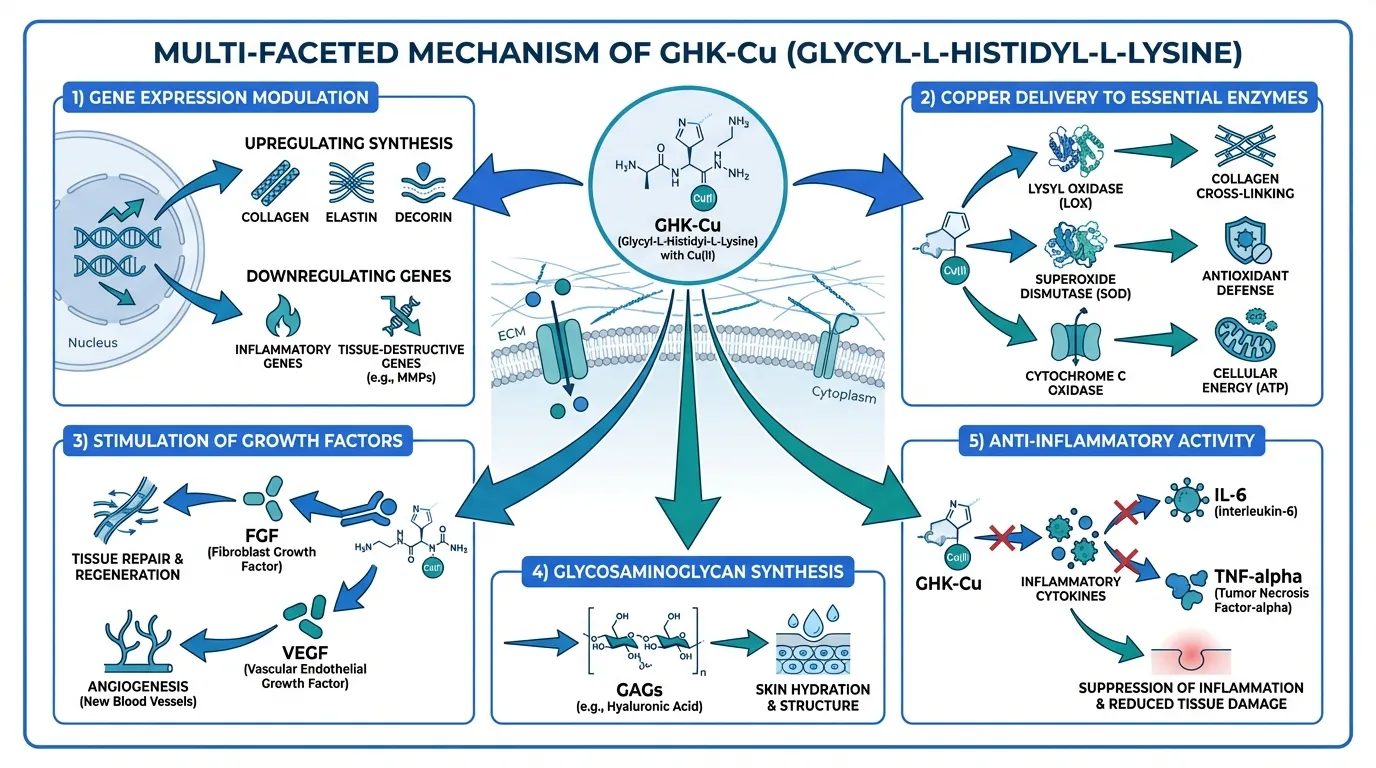
GHK-Cu (glycyl-L-histidyl-L-lysine:copper(II)) is a naturally occurring tripeptide with high affinity for copper(II) ions. Discovered by Loren Pickart in 1973 from human plasma, it is present at approximately 200 ng/mL at age 20 but declines to 80 ng/mL by age 60, coinciding with reduced regenerative capacity.
GHK-Cu operates through multiple mechanisms:
- Gene expression modulation: Regulates over 4,000 human genes, including upregulation of collagen, elastin, and decorin synthesis, and downregulation of inflammatory and tissue-destructive genes
- Copper delivery: The copper ion is essential for lysyl oxidase (collagen cross-linking), superoxide dismutase (antioxidant defense), and cytochrome c oxidase (cellular energy)
- Growth factor stimulation: Increases production of FGF, VEGF, and other growth factors involved in tissue repair
- Glycosaminoglycan synthesis: Stimulates production of proteoglycans and glycosaminoglycans for skin hydration and structure
- Anti-inflammatory activity: Suppresses inflammatory cytokines including IL-6 and TNF-alpha
Matrixyl#
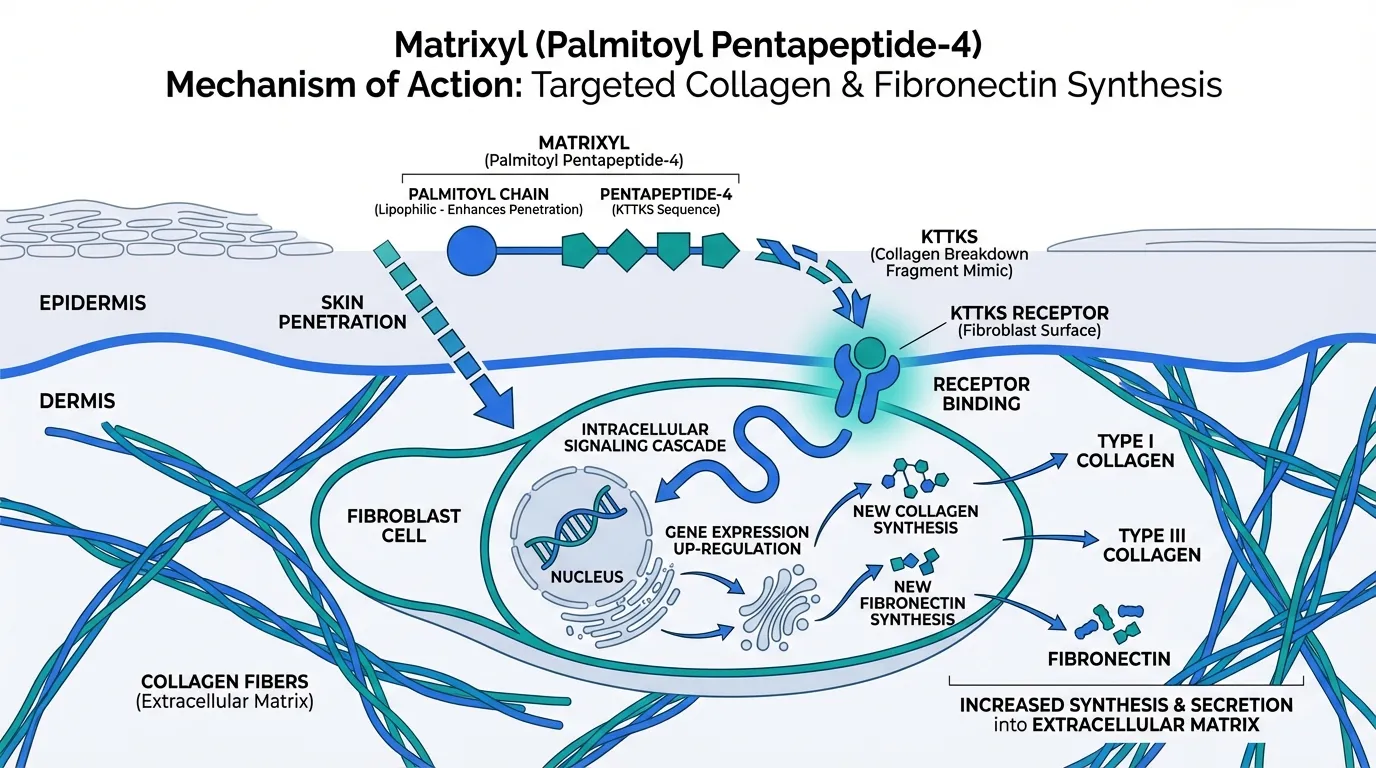
Matrixyl (pal-KTTKS, palmitoyl pentapeptide-4) is a synthetic peptide consisting of five amino acids (Lys-Thr-Thr-Lys-Ser) conjugated to a palmitic acid chain. The KTTKS sequence is derived from the C-terminal propeptide of type I procollagen and acts as a matrikine -- a peptide fragment that signals cells to produce new extracellular matrix components.
Matrixyl's mechanism is more targeted:
- Collagen signaling: The KTTKS sequence mimics a collagen breakdown fragment, signaling fibroblasts that collagen repair is needed
- Collagen types I and III: Stimulates production of the primary structural collagens in skin
- Fibronectin production: Enhances production of fibronectin, a key extracellular matrix glycoprotein
- Palmitoyl enhancement: The lipophilic palmitoyl chain improves skin penetration and receptor binding
Mechanistic Comparison#
| Feature | GHK-Cu | Matrixyl |
|---|---|---|
| Type | Natural copper-binding tripeptide | Synthetic signal peptide |
| Molecular weight | ~403 Da (without copper) | ~803 Da |
| Mechanism | Multi-pathway gene modulation | Collagen signal mimicry |
| Genes affected | >4,000 | Primarily collagen/ECM genes |
| Collagen stimulation | Yes (multiple types) | Yes (types I and III) |
| Anti-inflammatory | Yes | Minimal |
| Wound healing | Yes | No |
| Metal ion required | Yes (copper II) | No |
| Natural occurrence | Endogenous (declines with age) | Synthetic (derived from procollagen) |
Clinical Evidence Comparison#
GHK-Cu Clinical Studies#
GHK-Cu has multiple clinical studies supporting its anti-aging effects:
Pickart facial study (67-71 women, 12 weeks): GHK-Cu cream applied twice daily improved skin laxity, clarity, and firmness; reduced fine lines, coarse wrinkles, and mottled pigmentation; and increased skin density and thickness in women aged 50-59 with mild to advanced photodamage.
Head-to-head vs Matrixyl 3000: In a randomized, double-blind clinical trial, GHK-Cu reduced wrinkle volume 31.6% more than Matrixyl 3000 and 55.8% more than control serum. Wrinkle depth was reduced 32.8% compared to control.
Collagen production study: After one month of topical application, GHK-Cu increased collagen production in 70% of treated women, compared to 50% with vitamin C cream and 40% with retinoic acid.
Matrixyl Clinical Studies#
Robinson et al. (93 subjects, 12 weeks): A double-blind, placebo-controlled, split-face study showed that pal-KTTKS provided significant improvement versus placebo for wrinkle and fine line reduction by both quantitative technical measurement and expert grader analysis.
Periorbital study (28 days): Palmitoyl pentapeptide-4 cream (0.005%) applied twice daily to the periorbital area decreased fold depth by 18%, fold thickness by 37%, and improved skin firmness by 21%.
Safety study: At 3% concentration, Matrixyl was proven non-irritating and non-sensitizing, tolerated by all skin types.
Evidence Comparison Table#
| Study Feature | GHK-Cu | Matrixyl |
|---|---|---|
| Wrinkle volume reduction | 55.8% vs control | Significant vs placebo (not quantified %) |
| Head-to-head winner | GHK-Cu (+31.6% vs Matrixyl 3000) | -- |
| Collagen stimulation | 70% of subjects (1 month) | Significant (type I and III, in vitro) |
| Placebo-controlled RCTs | Limited | Yes (93-subject split-face) |
| Study quality | Moderate (some unblinded) | Moderate (double-blind available) |
| Gene expression data | Yes (>4,000 genes, Broad Institute) | No |
Dosing and Application Comparison#
GHK-Cu Application#
| Parameter | Details |
|---|---|
| Topical concentration | 0.01-1% in serums and creams |
| Application frequency | Once or twice daily |
| Best applied | On clean skin before heavier products |
| pH requirements | 5.0-6.5 (copper stability) |
| Incompatible with | Strong acids, vitamin C (low pH), AHAs, BHAs |
| Injectable use | Yes (mesotherapy, microneedling) |
| Systemic use | Subcutaneous injection (200-600 mcg) |
Matrixyl Application#
| Parameter | Details |
|---|---|
| Topical concentration | 0.001-3% in serums and creams |
| Application frequency | Twice daily |
| Best applied | After cleansing, before moisturizer |
| pH requirements | Broad range (stable) |
| Compatible with | Retinol, vitamin C, niacinamide, hyaluronic acid |
| Injectable use | No |
| Systemic use | No |
Side Effects Comparison#
GHK-Cu Side Effects#
- Skin irritation at high concentrations (>1%)
- Greenish discoloration of product or skin (copper oxidation)
- Rare contact dermatitis
- Potential pro-oxidant effects if copper is destabilized
- Not recommended during pregnancy (insufficient data)
Matrixyl Side Effects#
- Non-irritating at concentrations up to 3%
- Non-sensitizing in clinical testing
- Suitable for all skin types including sensitive skin
- No significant adverse effects reported in clinical studies
Key Differences Summary#
- Potency: GHK-Cu demonstrated 31.6% greater wrinkle volume reduction than Matrixyl 3000 in head-to-head testing.
- Breadth of action: GHK-Cu modulates >4,000 genes across wound healing, inflammation, and tissue remodeling. Matrixyl is focused on collagen signaling.
- Tolerability: Matrixyl is better tolerated, especially for sensitive skin and in combination with other actives.
- Formulation: Matrixyl is easier to formulate and more compatible with common skincare ingredients.
- Availability: Both are widely available. Matrixyl is found in more affordable commercial products; GHK-Cu products tend to be premium-priced.
- Systemic use: GHK-Cu can be used topically or by injection; Matrixyl is topical only.
- Natural origin: GHK-Cu is endogenous and declines with age; Matrixyl is synthetic.
Conclusion#
GHK-Cu and Matrixyl are both effective anti-aging peptides, but they occupy different niches. GHK-Cu is the more scientifically impressive molecule -- a naturally occurring tripeptide that modulates thousands of genes, outperforms Matrixyl in head-to-head wrinkle studies, and offers additional benefits for wound healing and inflammation. For those seeking maximum anti-aging efficacy and willing to work within its formulation constraints, GHK-Cu is the stronger choice.
Matrixyl excels in practicality. It is well-tolerated by all skin types, compatible with nearly every skincare active, widely available in affordable products, and backed by clean placebo-controlled data. For consumers who want a simple, effective anti-wrinkle peptide that integrates easily into any routine, Matrixyl is the more accessible option.
The two peptides are not mutually exclusive. Because they work through different mechanisms -- GHK-Cu through broad gene modulation and copper-dependent enzymatic activity, Matrixyl through collagen signal mimicry -- they can be combined for synergistic anti-aging benefits. A routine using GHK-Cu serum followed by a Matrixyl-containing moisturizer leverages the strengths of both peptides.
Further Reading#

Which Is Better For...
Maximum Wrinkle Reduction
GHK-Cu
Head-to-head clinical data showed GHK-Cu reduced wrinkle volume 31.6% more than Matrixyl 3000 and 55.8% vs control serum. Multiple studies confirm superior anti-wrinkle efficacy.
Wound Healing and Tissue Repair
GHK-Cu
GHK-Cu has extensive evidence for wound healing, tissue remodeling, and anti-inflammatory activity. Matrixyl does not have wound healing applications.
Sensitive Skin
Matrixyl
Clinical studies confirm Matrixyl is non-irritating and non-sensitizing at therapeutic concentrations. GHK-Cu's copper component can cause irritation in sensitive individuals.
Combination with Other Actives
Matrixyl
Matrixyl is compatible with retinol, vitamin C, niacinamide, and hyaluronic acid. GHK-Cu is incompatible with strong acids and vitamin C at low pH, limiting layering options.
Comprehensive Anti-Aging Program
Both (combined)
GHK-Cu and Matrixyl work through complementary mechanisms and can be used together for enhanced collagen production and tissue remodeling. Apply GHK-Cu serum first, then Matrixyl-containing products.
Budget-Friendly Anti-Aging
Matrixyl
Matrixyl is widely available in affordable commercial skincare products. GHK-Cu products tend to be more expensive due to copper peptide sourcing and formulation complexity.
Continue Your Research
Get comparison updates
We publish new head-to-head comparisons regularly. Subscribe to see them first.
Frequently Asked Questions About GHK-Cu vs Matrixyl: Anti-Aging Skin Peptides Compared
Which is better, GHK-Cu or Matrixyl?
GHK-Cu is the more potent and versatile anti-aging peptide with broader biological activity, stronger clinical evidence for wrinkle reduction, and additional benefits for wound healing, inflammation, and tissue remodeling. In a direct head-to-head comparison, GHK-Cu reduced wrinkle volume 31.6% more than Matrixyl 3000. However, Matrixyl is better tolerated, easier to formulate, more widely available in commercial products, and more compatible with other skincare actives. For maximum anti-agin... Individual responses may vary, and this comparison is based on available research data, not a treatment recommendation.
What are the key differences between GHK-Cu and Matrixyl?
The main differences across comparison categories are: Mechanism of Action: advantage goes to GHK-Cu; Research Evidence: advantage goes to GHK-Cu; Side Effect Profile: advantage goes to Matrixyl. 2 additional categories are analyzed in the full comparison. Each category evaluates a different dimension of the two peptides.
When should I consider GHK-Cu over Matrixyl?
For the scenario of "Maximum Wrinkle Reduction," research data suggests GHK-Cu may be more relevant. Head-to-head clinical data showed GHK-Cu reduced wrinkle volume 31.6% more than Matrixyl 3000 and 55.8% vs control serum. Multiple studies confirm superior anti-wrinkle efficacy.. This is based on currently available evidence and individual circumstances may differ.
How do GHK-Cu and Matrixyl differ in their mechanisms of action?
GHK-Cu: GHK-Cu is a naturally occurring copper-binding tripeptide (glycyl-L-histidyl-L-lysine) that modulates gene expression across multiple pathways. It upregulates collagen and elastin synthesis, promot.... Matrixyl: Matrixyl (palmitoyl pentapeptide-4, pal-KTTKS) is a synthetic signal peptide that mimics a collagen fragment to stimulate new collagen synthesis. The KTTKS sequence is derived from the procollagen ....
Which has fewer side effects, GHK-Cu or Matrixyl?
In terms of side effects and tolerability, the advantage goes to Matrixyl. GHK-Cu: GHK-Cu is generally well-tolerated. The copper component can cause skin irritation or greenish discoloration at high concentrations. Rare reports o.... Matrixyl: Matrixyl is exceptionally well-tolerated. Clinical studies at 3% concentration confirmed it is non-irritating and non-sensitizing, suitable for all....
Medical Disclaimer
This website is for educational and informational purposes only. The information provided is not intended to diagnose, treat, cure, or prevent any disease. Always consult with a qualified healthcare professional before using any peptide or supplement.