BPC-157 Mechanisms of Action: What Research Reveals About the Body Protection Compound

Introduction#
BPC-157 (Body Protection Compound-157) is a synthetic 15-amino-acid peptide with the sequence Gly-Glu-Pro-Pro-Pro-Gly-Lys-Pro-Ala-Asp-Asp-Ala-Gly-Leu-Val, derived from a larger protective protein found in human gastric juice. The name "Body Protection Compound" reflects the peptide's origin story: it was isolated from a gastric protein that appeared to protect the stomach lining from damage, and subsequent research revealed an unexpectedly broad range of tissue-protective effects.
Since its initial characterization in the early 1990s, BPC-157 has been studied in over 100 animal studies spanning gastrointestinal healing, tendon and ligament repair, muscle regeneration, bone healing, neuroprotection, and cardioprotection. What makes BPC-157 unusual among peptides is not any single mechanism but rather its pleiotropic activity -- it appears to engage multiple signaling pathways simultaneously, suggesting it acts as an upstream modulator rather than a single-target drug.
This review examines BPC-157's known molecular mechanisms in detail, organized by signaling pathway. For each mechanism, we present the supporting evidence and its strength. We conclude with an honest assessment of the critical limitation that dominates BPC-157 research: the near-complete absence of human clinical data.
Regulatory Note: BPC-157 was placed in FDA Category 2 (restricted from compounding) in 2024. It is not FDA-approved for any indication and is prohibited by WADA.
VEGF-Mediated Angiogenesis#
The most well-characterized mechanism of BPC-157 is promotion of angiogenesis -- the formation of new blood vessels -- through the vascular endothelial growth factor (VEGF) signaling axis.
The VEGFR2-Akt-eNOS Pathway#
BPC-157 upregulates expression of VEGF-A and its primary receptor VEGFR2 (also known as KDR/Flk-1). Upon VEGF-A binding, VEGFR2 undergoes rapid phosphorylation and internalization, triggering a downstream signaling cascade through phosphatidylinositol 3-kinase (PI3K) to Akt (protein kinase B), which in turn activates endothelial nitric oxide synthase (eNOS). The resulting nitric oxide production promotes vasodilation, endothelial cell survival, and capillary tube formation 1.
In a rat cutaneous wound model, BPC-157 treatment increased VEGF-A expression by approximately 140% compared to vehicle controls, with corresponding increases in capillary density at the wound site measured by CD34 immunostaining. Importantly, the angiogenic effect was blocked by a VEGFR2 inhibitor (SU5416), confirming that VEGFR2 activation is required for BPC-157's vascular effects 1.
Functional Angiogenesis Studies#
Beyond gene expression changes, BPC-157 has demonstrated functional angiogenic effects in several experimental paradigms:
- Chicken chorioallantoic membrane (CAM) assay: BPC-157 promoted new vessel formation in a dose-dependent manner, with the effect comparable to VEGF-A positive control 2.
- Femoral artery ligation model: BPC-157 promoted rapid collateral vessel recruitment after arterial occlusion, restoring perfusion to ischemic limbs faster than controls 3.
- Vascular anastomosis models: BPC-157 improved outcomes following experimental abdominal aorta and common iliac artery anastomosis by promoting re-endothelialization and reducing thrombosis.
Significance for Tissue Repair#
Angiogenesis is the rate-limiting step in healing of most tissue types. Without adequate blood supply, wounds cannot transition from the inflammatory phase to the proliferative phase. BPC-157's ability to promote new vessel formation provides a mechanistic explanation for its broad tissue healing effects -- from tendon and muscle to skin and gut mucosa. Any tissue that depends on vascular supply for healing could theoretically benefit from enhanced angiogenesis.
Nitric Oxide System Modulation#
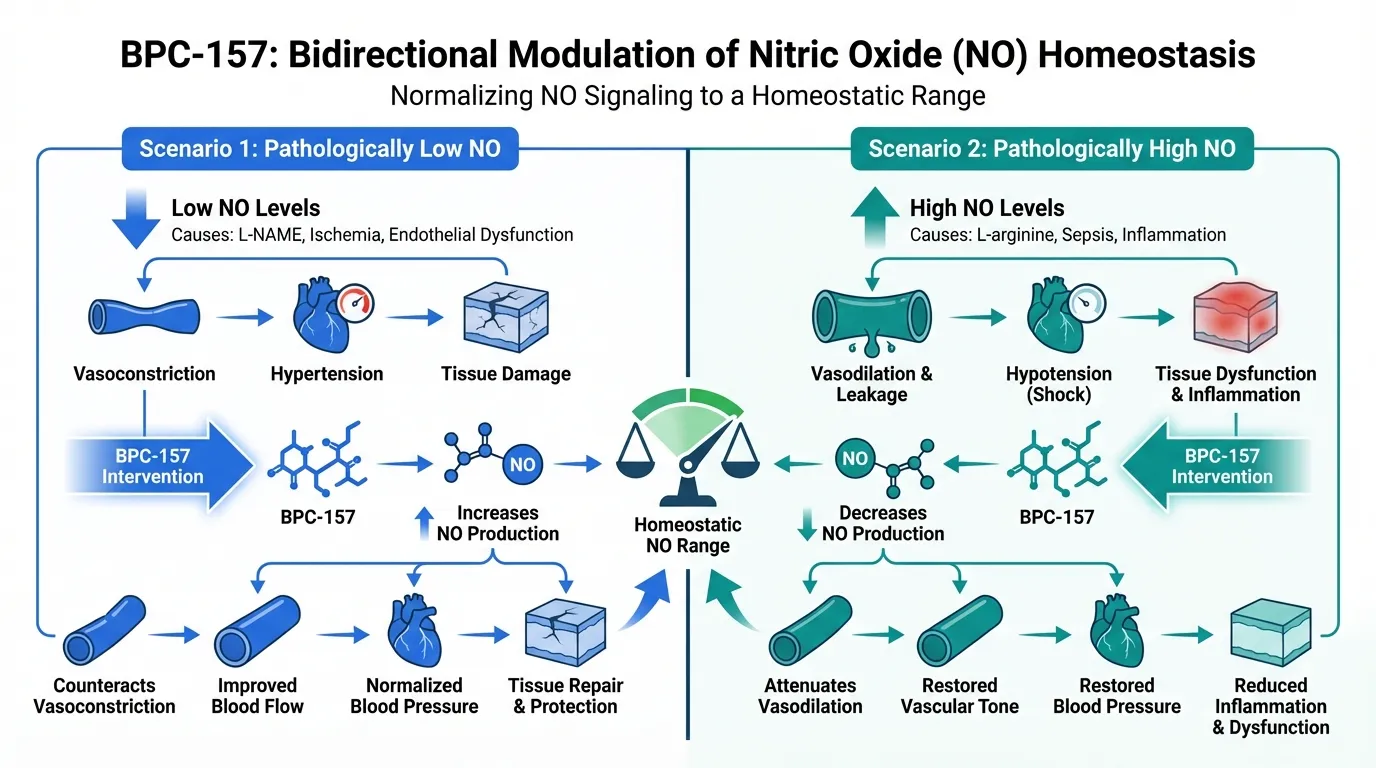
BPC-157's interaction with the nitric oxide (NO) system is perhaps its most distinctive mechanistic feature. Unlike drugs that simply increase or decrease NO levels, BPC-157 demonstrates bidirectional modulation -- normalizing NO signaling regardless of the direction of the perturbation.
Bidirectional NO Regulation#
In experiments using the NOS inhibitor L-NAME (which depletes NO), BPC-157 counteracted the resulting vasoconstriction, hypertension, and tissue damage. Conversely, when NO levels were pathologically elevated using L-arginine (the NOS substrate), BPC-157 attenuated the resulting hypotension and tissue dysfunction. This bidirectional activity has been demonstrated across vascular, GI, and cardiac models 3.
The Src-Caveolin-1-eNOS Axis#
A second NO-related pathway involves the Src-Caveolin-1-eNOS signaling complex. Caveolin-1 is a scaffolding protein in endothelial cell caveolae that tonically inhibits eNOS. When Src kinase phosphorylates Caveolin-1, eNOS is released from inhibition, producing a controlled burst of NO. BPC-157 appears to modulate this Src-Caveolin-1-eNOS axis to fine-tune vasomotor tone, promoting collateral vessel recruitment without causing systemic hypotension 4.
Implications#
The bidirectional NO modulation helps explain why BPC-157 appears to be protective in diverse pathological contexts -- whether the problem is too little NO (ischemia) or too much NO (sepsis, inflammation). It also provides a mechanism for BPC-157's effects on vascular occlusion models, where rapid collateral development depends on coordinated NO signaling in pre-existing arterioles.
FAK-Paxillin Pathway and Tendon Healing#
The FAK-paxillin signaling pathway is the primary mechanism through which BPC-157 promotes musculoskeletal tissue repair, particularly in tendon and ligament healing.
Focal Adhesion Kinase Activation#
Focal adhesion kinase (FAK) is a cytoplasmic tyrosine kinase that integrates signals from integrins (cell-matrix adhesion receptors) to regulate cell migration, proliferation, and survival. When BPC-157 is present in the local tissue environment, it promotes FAK phosphorylation at tyrosine 397 (the autophosphorylation site), which creates a binding site for Src family kinases. The resulting FAK-Src complex phosphorylates paxillin, a scaffold protein at focal adhesions 5.
Paxillin and Cell Migration#
Phosphorylated paxillin promotes focal adhesion turnover -- the dynamic assembly and disassembly of cell-matrix connections that is required for cell migration. In tendon healing, fibroblast migration into the wound gap is the rate-limiting step, and BPC-157's activation of the FAK-paxillin pathway directly accelerates this process.
Chang and colleagues demonstrated that BPC-157 significantly increased tendon fibroblast outgrowth in an ex vivo explant model, and this effect was blocked by FAK inhibitors, confirming FAK dependency. BPC-157-treated tendon explants showed increased phosphorylated FAK and paxillin by Western blot analysis 5.
Growth Hormone Receptor Upregulation#
In addition to FAK-paxillin, BPC-157 upregulates growth hormone receptor (GHR) expression in tendon fibroblasts. This makes the cells more responsive to circulating growth hormone, amplifying the endogenous repair signal. The GHR upregulation was demonstrated at both mRNA and protein levels, and it represents an indirect mechanism by which BPC-157 enhances the body's native repair capacity rather than substituting for it 6.
Tendon-Specific Evidence#
The tendon healing evidence for BPC-157 is among the most robust in its preclinical portfolio:
- Achilles tendon transection: Multiple studies show improved biomechanical properties (maximum force, stiffness) and accelerated histological healing.
- MCL transection: BPC-157 improved ligament healing with functional outcomes approaching normal values.
- Rotator cuff models: Improved tendon-to-bone healing interface and reduced re-tear rates in animal models 7.
For comparison, TB-500 promotes tendon cell migration through a different mechanism -- G-actin release enabling actin polymerization at the leading cell edge -- while GHK-Cu influences tendon healing primarily through collagen synthesis and extracellular matrix remodeling at the gene expression level.
Cytoprotective Effects on Gastric Mucosa#
Given its origin from gastric juice protein, BPC-157's cytoprotective effects on the GI tract are well-studied and mechanistically coherent.
Gastric Mucosal Protection#
BPC-157 protects against gastric mucosal damage induced by a range of insults: ethanol, NSAIDs, stress, ischemia-reperfusion, and corrosive agents. The protection is multifactorial, involving maintenance of mucosal blood flow (via the angiogenic and NO pathways described above), preservation of epithelial tight junctions, and modulation of prostaglandin production 8.
In NSAID-induced gastropathy models, BPC-157 not only prevented mucosal erosions when given prophylactically but also accelerated healing of established lesions when given therapeutically. The magnitude of gastroprotection was comparable to or exceeding that of proton pump inhibitors in several comparative studies 8.
Intestinal Healing#
BPC-157's GI effects extend beyond the stomach to the intestinal tract:
- Anastomotic healing: BPC-157 improved the strength and integrity of intestinal anastomoses (surgical reconnections) and reduced leak rates in rat models.
- Fistula closure: Multiple studies show accelerated closure of enterocutaneous and colocutaneous fistulas, which are notoriously difficult to heal clinically.
- Colitis models: BPC-157 reduced mucosal inflammation and accelerated healing in TNBS-induced colitis, with histological improvement in crypt architecture and reduced inflammatory cell infiltration.
- Short bowel syndrome: BPC-157 promoted compensatory intestinal adaptation after massive small bowel resection 8.
The Gastric Juice Connection#
The fact that BPC-157 is derived from a gastric protein is more than coincidence. The peptide appears to represent an active fragment of the stomach's intrinsic protective mechanism -- the "gastric pentadecapeptide" that contributes to the stomach's remarkable ability to resist autodigestion. This context explains both the peptide's GI specificity and its stability in acidic environments, which enables oral administration.
Gut-Brain Axis Interactions#
An emerging area of BPC-157 research is its effects on the gut-brain axis -- the bidirectional communication network between the gastrointestinal tract and the central nervous system.
Dopamine System Modulation#
BPC-157 has been shown to modulate dopaminergic signaling in several experimental paradigms. It counteracted dopamine-related behaviors induced by amphetamine, haloperidol, and dopamine receptor agonists/antagonists in rats. Importantly, BPC-157's effects were again bidirectional: it attenuated both dopamine excess (amphetamine-induced hyperactivity) and dopamine deficiency states (haloperidol-induced catalepsy) 9.
Serotonin System Effects#
Similar bidirectional modulation has been observed with serotonin. BPC-157 counteracted both the behavioral effects of serotonin depletion (produced by parachlorophenylalanine) and serotonin excess (produced by L-tryptophan or serotonin syndrome induction). This dual activity suggests BPC-157 acts upstream of individual neurotransmitter systems, potentially through effects on neurotransmitter release, reuptake, or receptor sensitivity 9.
Proposed Mechanism#
The gut-brain interactions of BPC-157 are hypothesized to involve its effects on the vagal nerve and enteric nervous system. BPC-157 may modulate afferent vagal signaling from the gut to the brainstem, influencing central neurotransmitter tone. This hypothesis is supported by the fact that vagotomy partially blocks some of BPC-157's central effects, though the evidence for this specific mechanism remains incomplete.
Neuroprotective Properties#
BPC-157 has demonstrated neuroprotective effects across several preclinical models of CNS injury and neurotoxicity.
Spinal Cord Injury#
In rat spinal cord injury models, BPC-157 administered after experimental spinal cord compression reduced histological damage, preserved motor neuron numbers, and improved functional recovery (measured by BBB locomotor scoring). The neuroprotective effect is attributed to a combination of reduced inflammation, maintained vascular supply (via the angiogenic mechanism), and direct cytoprotection 10.
Traumatic Brain Injury#
BPC-157 reduced brain edema, inflammatory cytokine levels, and neuronal apoptosis in rat models of traumatic brain injury. Treated animals showed improved performance on neurobehavioral testing compared to vehicle controls.
Peripheral Nerve Repair#
In sciatic nerve crush and transection models, BPC-157 accelerated functional nerve regeneration, with faster return of sensorimotor function and improved nerve conduction parameters. The mechanism may involve both direct effects on Schwann cell proliferation and indirect effects through improved vascular supply to regenerating nerve fibers 10.
Limitations of Neuroprotection Data#
All neuroprotection data for BPC-157 comes from rodent models. The translation gap from rodent to human CNS is particularly wide -- hundreds of neuroprotective compounds have shown efficacy in rodent models and failed in human clinical trials. This history demands caution in extrapolating BPC-157's preclinical CNS findings.
The "No Direct Receptor Binding" Puzzle#
One of the most intriguing aspects of BPC-157's pharmacology is the apparent absence of direct receptor binding at classical neurotransmitter and hormone receptors. A broad receptor binding screen tested BPC-157 against panels of receptors including adrenergic, cholinergic, dopaminergic, serotonergic, GABAergic, opioid, and peptide receptors. No significant binding was detected at any receptor tested 9.
This negative finding is actually informative. It suggests that BPC-157 does not work as a conventional agonist or antagonist at specific receptors. Instead, its pleiotropic effects likely arise from modulation of upstream signaling events -- perhaps influencing receptor trafficking, expression, or sensitivity rather than directly activating or blocking receptors. This upstream modulatory mode could explain why BPC-157 shows bidirectional effects (normalizing both overactivity and underactivity) rather than pushing a system in one direction.
The molecular target through which BPC-157 initiates its signaling cascades remains unidentified. Identifying this primary target is the single most important gap in BPC-157 pharmacology.
Integrated Mechanistic Model#
The individual pathways described above can be synthesized into a coherent model of BPC-157 action:
- An unidentified primary target initiates signaling, possibly through a membrane receptor or intracellular sensor not included in conventional receptor panels.
- VEGF/VEGFR2 upregulation provides the angiogenic response, establishing vascular infrastructure for tissue repair.
- Bidirectional NO modulation normalizes the vascular and inflammatory environment, creating conditions permissive for healing regardless of the specific pathological perturbation.
- FAK-paxillin activation drives cell migration into damaged tissue, with GHR upregulation amplifying endogenous growth factor responsiveness.
- Gastric cytoprotection reflects the peptide's evolutionary origin and explains its particular efficacy in GI tissue.
- Gut-brain axis modulation occurs through effects on enteric and vagal signaling, producing central neurotransmitter normalization.
This model positions BPC-157 not as a targeted therapeutic but as a broadly restorative agent -- a "reset to normal" signal that engages whichever repair mechanisms are needed for the specific injury or perturbation.
The Critical Limitation: Almost Entirely Preclinical Data#
Despite the breadth and consistency of BPC-157's preclinical evidence, the single most important fact about this peptide is this: virtually all of its data comes from animal studies.
The Human Evidence Gap#
As of 2026, the totality of published human clinical data for BPC-157 includes:
- IV safety pilot (n=2): Two healthy adults received BPC-157 intravenously with no adverse effects reported 11.
- Intra-articular injection study (n=12): Eleven of 12 patients reported significant improvement in knee pain after BPC-157 injection, though this was uncontrolled 12.
- Ulcerative colitis enema trial (n=53): A small trial of BPC-157 enema for UC showed tolerability comparable to placebo, though efficacy data was limited.
The total number of humans who have received BPC-157 in published clinical studies is under 100.
Why This Matters#
The history of drug development is filled with compounds that showed remarkable promise in animal models and failed in humans. This failure rate is particularly high for neuroprotective agents, anti-inflammatory agents, and wound healing compounds -- three categories that encompass BPC-157's proposed applications.
Specific concerns include:
- Species-specific pharmacology: BPC-157's primary molecular target is unknown. There is no guarantee that this target exists or functions identically in humans.
- Pharmacokinetic uncertainty: Human PK data shows plasma levels frequently below the limit of quantification after oral and rectal dosing. The doses that produce effects in rats may not achieve equivalent tissue concentrations in humans.
- Research group concentration: A disproportionate fraction of BPC-157 research originates from a small number of laboratories, primarily in Croatia. Independent replication by diverse research groups is limited.
- Publication bias: The overwhelmingly positive results across BPC-157 studies may reflect publication bias, where negative results go unreported.
What Would Change the Picture#
The BPC-157 field needs:
- Randomized, double-blind, placebo-controlled clinical trials for specific indications, with adequate sample sizes.
- Independent replication of key preclinical findings by laboratories without prior publication history on the compound.
- Identification of the primary molecular target to enable mechanism-based prediction of human efficacy.
- Pharmacokinetic studies establishing dose-response relationships in humans.
Until such studies are completed, BPC-157 remains a compound with strong preclinical promise but unconfirmed human applicability.
Comparison with Other Healing Peptides#
Understanding how BPC-157's mechanisms compare with TB-500 and GHK-Cu helps contextualize its place in the healing peptide landscape.
| Mechanism | BPC-157 | TB-500 | GHK-Cu |
|---|---|---|---|
| Primary pathway | VEGFR2-Akt-eNOS | G-actin sequestration | Gene expression (4,000+ genes) |
| Angiogenesis | Direct (VEGF upregulation) | Indirect (endothelial migration) | Indirect (gene modulation) |
| Cell migration | FAK-paxillin | Actin polymerization | Not primary mechanism |
| Anti-inflammatory | NO normalization | NF-kB inhibition via ILK | TGF-beta suppression |
| Anti-fibrotic | Not characterized | Strong (Ac-SDKP) | Strong (ECM remodeling) |
| Clinical trials | Minimal (n < 100) | Phase I-III (ophthalmic) | Topical cosmetic |
| Primary target | Unknown | G-actin (defined) | Copper delivery (defined) |
| Oral bioavailability | Yes (gastric stability) | No | No |
The complementary nature of these mechanisms provides the theoretical rationale for combination protocols. BPC-157 establishes vascular supply, TB-500 drives cell migration into the vascularized wound, and GHK-Cu optimizes extracellular matrix remodeling. However, no controlled studies have evaluated any of these combinations.
Conclusion#
BPC-157 is a mechanistically rich peptide with a coherent and well-documented set of signaling pathways that converge on tissue protection and repair. Its VEGF-mediated angiogenesis, bidirectional NO modulation, FAK-paxillin-driven cell migration, gastric cytoprotection, and gut-brain axis interactions have been consistently demonstrated across hundreds of preclinical experiments.
The challenge is not the mechanism -- it is the evidence tier. BPC-157's mechanisms are solidly established in animal models, but the peptide has not completed the clinical trial gauntlet that separates a promising preclinical compound from a validated therapeutic. Researchers evaluating BPC-157 should appreciate both its mechanistic sophistication and the fundamental uncertainty that accompanies any compound without adequate human data.
The identification of BPC-157's primary molecular target remains the most consequential open question in its pharmacology. Answering it would not only advance basic science but also enable rational clinical trial design and mechanism-based safety assessment.
References#
Related Peptide Profiles#
Learn more about the peptides discussed in this article:
- BPC-157 Overview and Research Guide
- BPC-157 Dosing Protocols
- BPC-157 Side Effects and Safety
- GHK-Cu Overview and Research Guide
- GHK-Cu Dosing Protocols
- GHK-Cu Side Effects and Safety
- TB-500 Overview and Research Guide
- TB-500 Dosing Protocols
- TB-500 Side Effects and Safety
Footnotes#
-
Hsieh MJ, Liu HT, Wang CN, et al. Therapeutic potential of pro-angiogenic BPC157 is associated with VEGFR2 activation and up-regulation. J Mol Med. 2017;95(3):323-333. PMID: 28013389. ↩ ↩2
-
Seiwerth S, Rucman R, Turkovic B, et al. BPC 157 and standard angiogenic growth factors: gastrointestinal tract healing, lesson from tendon, ligament, muscle and bone healing. Curr Pharm Des. 2018;24(18):1972-1989. PMID: 29737246. ↩
-
Seiwerth S, Brcic L, Vuletic LB, et al. BPC 157 and blood vessels. Curr Pharm Des. 2014;20(7):1014-1023. PMID: 23755723. ↩ ↩2
-
Vukojevic J, Siroglavic M, Kasnik K, et al. Rat inferior caval vein (ICV) ligature and particular new therapeutic BPC 157 considerations. Vascul Pharmacol. 2018;106:54-66. PMID: 33051481. ↩
-
Chang CH, Tsai WC, Lin MS, Hsu YH, Pang JH. The promoting effect of pentadecapeptide BPC 157 on tendon healing involves tendon outgrowth, cell survival, and cell migration. J Appl Physiol. 2011;110(3):774-780. PMID: 21030672. ↩ ↩2
-
Staresinic M, Petrovic I, Novinscak T, et al. Effective therapy of transected quadriceps muscle in rat: gastric pentadecapeptide BPC 157. J Orthop Res. 2006;24(5):1109-1117. PMID: 16609979. ↩
-
Krivic A, Anic T, Seiwerth S, Huljev D, Sikiric P. Achilles detachment in rat and gastric pentadecapeptide BPC 157: promoted tendon-to-bone healing and target recovery. J Orthop Res. 2006;24(5):982-989. PMID: 16609976. ↩
-
Sikiric P, Seiwerth S, Rucman R, et al. Stable gastric pentadecapeptide BPC 157: novel therapy in gastrointestinal tract. Curr Pharm Des. 2011;17(16):1612-1632. PMID: 21548867. ↩ ↩2 ↩3
-
Sikiric P, Seiwerth S, Rucman R, et al. Brain-gut axis and pentadecapeptide BPC 157: theoretical and practical implications. Curr Neuropharmacol. 2016;14(8):857-865. PMID: 27306034. ↩ ↩2 ↩3
-
Tudor M, Jandric I, Marovic A, et al. Traumatic brain injury in mice and pentadecapeptide BPC 157 effect. Regul Pept. 2010;160(1-3):26-32. PMID: 19800929. ↩ ↩2
-
Safety of Intravenous Infusion of BPC157 in Humans: A Pilot Study. PMID: 40131143. 2025. ↩
-
Intra-Articular Injection of BPC 157 for Multiple Types of Knee Pain. PMID: 34324435. 2021. ↩

Frequently Asked Questions About BPC-157 Mechanisms of Action: What Research Reveals About the Body Protection Compound
What does this article cover?
Deep-dive into BPC-157's known mechanisms including VEGF-mediated angiogenesis, nitric oxide modulation, FAK-paxillin signaling, and cytoprotective effects. This research review is for educational purposes only and does not constitute medical advice.
Which peptides are discussed in this article?
This article covers BPC-157, GHK-Cu, TB-500. Key context: BPC-157 (Primary subject of this research review covering all known molecular mechanisms of action from pr...); GHK-Cu (Compared as an alternative healing peptide that operates through gene expression modulation rathe...); TB-500 (Compared as a complementary healing peptide with distinct actin-mediated cell migration mechanism). Each peptide is discussed based on available research evidence.
What level of evidence does this research review cover?
This research review examines published preclinical and clinical studies related to the peptides discussed. Evidence quality varies between peptides and indications. The article distinguishes between FDA-approved uses and investigational applications where applicable.
What are the key takeaways from this article?
The main findings covered in this article include: Primary subject of this research review covering all known molecular mechanisms of action from pr.... Compared as an alternative healing peptide that operates through gene expression modulation rathe.... Compared as a complementary healing peptide with distinct actin-mediated cell migration mechanism. These takeaways are based on the research data available at the time of publication.
What is BPC-157 and why is it significant?
BPC-157 is a peptide discussed in this article because: Primary subject of this research review covering all known molecular mechanisms of action from preclinical studies. For a complete profile of BPC-157, see the dedicated peptide page on this site.
Continue reading this research review
Free access to the complete analysis with citations and evidence ratings.
150+ peptide profiles · 30+ comparisons · 18 research tools
Medical Disclaimer
This website is for educational and informational purposes only. The information provided is not intended to diagnose, treat, cure, or prevent any disease. Always consult with a qualified healthcare professional before using any peptide or supplement.
Join 2,000+ researchers getting biweekly updates
Enjoyed this article?
The Research Briefing delivers deep-dives like this biweekly — plus new study breakdowns, safety updates, and tool announcements.
Free forever. No spam. Unsubscribe in one click.
Where to Find These Peptides
Continue Exploring
Peptide Profiles
Keep Reading
Is Prescott Bio Canada Legit? Independent 2026 Review
Is Prescott Bio Canada legit? Independent 2026 review of the Calgary-based Canadian research peptide supplier: Richmond BC fulfillment, HPLC and mass spectrometry testing, plain CAD pricing, 2-4 day domestic shipping, Stripe card checkout, and community reputation.

The Science of Peptide Stacking: Synergies, Risks, and Evidence
A research-focused examination of peptide stacking science, covering synergistic mechanisms, evidence-based stacks, theoretical combinations, contraindicated pairings, and the gap between community protocols and published research.

Peptide Therapy for Hair Loss: GHK-Cu, TB-500, and Research Evidence
Research review of peptides studied for hair loss and hair growth including GHK-Cu (copper peptides), TB-500 (thymosin beta-4), thymosin alpha-1 for autoimmune alopecia, and BPC-157 for follicle regeneration. Evidence quality assessment and comparison with established treatments.
You Might Also Like
Related content you may find interesting