Anti-Wrinkle Peptides: SNAP-8, Argireline, Matrixyl, and Leuphasyl Compared

Introduction#
The cosmeceutical peptide market has grown substantially over the past two decades, driven by consumer demand for non-invasive alternatives to injectable treatments like botulinum toxin and dermal fillers. Among the most studied categories are anti-wrinkle peptides — short synthetic peptide sequences designed to reduce the appearance of fine lines and wrinkles through specific molecular mechanisms.
These peptides fall into distinct classes based on how they work. Neurotoxin-like peptides such as Argireline and SNAP-8 target the SNARE complex to reduce muscle contraction. Signal peptides like Matrixyl mimic collagen fragments to stimulate new collagen production. Copper peptides like GHK-Cu modulate thousands of genes involved in tissue remodeling. Each class has a different evidence base, mechanism, and set of practical considerations.
This guide examines the major anti-wrinkle peptides, their scientific rationale, the quality of evidence supporting each, and how they compare to established dermatological treatments.
Understanding Wrinkle Formation#
Before evaluating anti-wrinkle peptides, it is important to understand the two primary types of facial wrinkles they target.
Dynamic Wrinkles (Expression Lines)#
Dynamic wrinkles form from repeated facial muscle contractions — frowning, squinting, smiling. Over time, the skin creases at these fold points become permanent. The forehead, crow's feet area, and glabellar region (between the eyebrows) are the most affected sites. Botulinum toxin treats dynamic wrinkles by blocking neurotransmitter release at the neuromuscular junction, temporarily paralyzing the underlying muscles.
Static Wrinkles (Aging Lines)#
Static wrinkles result from the gradual loss of structural proteins in the skin — primarily collagen, elastin, and glycosaminoglycans — combined with UV-induced photoaging and natural dermal thinning. These wrinkles are visible even at rest and worsen with cumulative sun exposure. Treatments targeting static wrinkles focus on stimulating collagen production, improving skin hydration, and promoting extracellular matrix repair.
Most anti-wrinkle peptides target one category more than the other, which is a key factor in determining which peptide is appropriate for a given concern.
Neurotoxin-Like Peptides: The SNARE Complex Inhibitors#
The SNARE Complex and Muscle Contraction#
The SNARE (Soluble N-ethylmaleimide-sensitive factor Attachment protein REceptor) complex is the molecular machinery that mediates neurotransmitter release at the neuromuscular junction. Three proteins — SNAP-25, syntaxin, and VAMP/synaptobrevin — assemble into a four-helix bundle that drives synaptic vesicle fusion and acetylcholine release.
Botulinum toxin works by cleaving one or more of these SNARE proteins, preventing complex assembly and blocking neurotransmitter release entirely. The result is temporary muscle paralysis.
Cosmeceutical SNARE-targeting peptides take a different approach. Instead of enzymatically cleaving SNARE proteins, they act as competitive inhibitors — binding to the SNARE assembly site and reducing (but not eliminating) the efficiency of complex formation. This produces a partial reduction in muscle contraction rather than complete paralysis.
Argireline (Acetyl Hexapeptide-8)#
Argireline was developed by Lipotec (now part of Lubrizol) and was the first commercially available SNARE-targeting cosmeceutical peptide. It is a six-amino-acid peptide (Ac-EEMQRR-NH2) that mimics the N-terminal domain of SNAP-25, competing with native SNAP-25 for incorporation into the SNARE complex.
Mechanism: Argireline binds to the SNARE assembly site occupied by SNAP-25, reducing the formation of functional SNARE complexes. This decreases acetylcholine release at the neuromuscular junction, resulting in reduced muscle contraction and, theoretically, diminished expression line formation.
Clinical Evidence:
The most widely cited clinical study on Argireline reported approximately 30% reduction in wrinkle depth after 30 days of twice-daily topical application of a 10% solution to the periorbital area. This was a controlled study using silicone replicas and image analysis to quantify wrinkle depth changes.
Additional studies have reported:
- Significant wrinkle reduction versus vehicle control in periorbital application
- Dose-dependent effects, with higher concentrations (5-10%) showing greater efficacy
- Measurable effects beginning within 15 days in some studies
- Good tolerability with no significant irritation at standard concentrations
Limitations: Most Argireline studies have been funded by the ingredient manufacturer. Independent peer-reviewed replication is limited. The degree to which topically applied Argireline penetrates to the neuromuscular junction in sufficient concentrations to meaningfully inhibit SNARE complex formation remains a point of scientific debate. The stratum corneum presents a significant barrier to peptide penetration, and the target (neuromuscular junction) lies deep within the dermis and underlying muscle.
SNAP-8 (Acetyl Octapeptide-3)#
SNAP-8 was developed as a next-generation version of Argireline, extending the peptide chain from six to eight amino acids (Ac-EEMQRRAD-NH2). It targets the same SNARE complex mechanism but is claimed to have enhanced binding affinity.
Mechanism: Like Argireline, SNAP-8 competes with native SNAP-25 for SNARE complex assembly. The additional two amino acids (Ala-Asp) were included to better mimic a larger portion of the SNAP-25 N-terminal domain, potentially improving competitive inhibition of the complex.
Clinical Evidence:
Industry-sponsored studies have reported wrinkle depth reductions of approximately 25-35% after 28 days of topical application. Some comparative data suggests SNAP-8 may achieve similar or slightly greater effects compared to Argireline at equivalent concentrations.
Limitations: The clinical evidence base for SNAP-8 is thinner than for Argireline. While Argireline has at least several published clinical studies, SNAP-8 relies more heavily on manufacturer technical data sheets and fewer independent publications. The claim of superior potency over Argireline has not been rigorously validated in independent head-to-head clinical trials.
Leuphasyl (Pentapeptide-18)#
Leuphasyl is a five-amino-acid peptide (Tyr-Ala-Gly-Phe-Leu) that targets a different step in the neuromuscular signaling cascade. Rather than inhibiting SNARE complex assembly, Leuphasyl acts as an enkephalin analog — mimicking endogenous opioid peptides that bind to presynaptic enkephalin receptors, reducing calcium influx and decreasing neurotransmitter release.
Mechanism: Leuphasyl binds to enkephalin receptors on the presynaptic nerve terminal. Receptor activation reduces calcium channel opening, which decreases intracellular calcium concentration. Since calcium influx is required to trigger vesicle fusion and neurotransmitter release, this upstream inhibition reduces acetylcholine secretion.
This mechanism is complementary to SNARE inhibition. While Argireline and SNAP-8 block the vesicle fusion machinery, Leuphasyl reduces the calcium signal that triggers fusion in the first place. Some formulations combine Leuphasyl with Argireline to target both pathways simultaneously.
Clinical Evidence:
Manufacturer data reports wrinkle depth reductions in the range of 11-24% over 28 days of topical application. A combination of Leuphasyl and Argireline reportedly showed greater wrinkle reduction than either peptide alone, consistent with the complementary mechanism hypothesis.
Limitations: Independent peer-reviewed evidence for Leuphasyl is even more limited than for SNAP-8. The enkephalin receptor mechanism, while biologically plausible, faces the same penetration challenges as SNARE-targeting peptides — the active compound must reach presynaptic nerve terminals through topical application.
How Neurotoxin-Like Peptides Compare to Botulinum Toxin#
The comparison between cosmeceutical SNARE peptides and botulinum toxin is mechanistically relevant but clinically misleading.
| Feature | Botulinum Toxin | Argireline / SNAP-8 |
|---|---|---|
| Administration | Injection (dermal/intramuscular) | Topical |
| Mechanism | Enzymatic cleavage of SNARE proteins | Competitive inhibition of SNARE assembly |
| Potency | Complete neuromuscular blockade | Partial reduction in signaling |
| Onset | 3-7 days | 15-30 days |
| Duration | 3-4 months per injection | Requires continuous daily application |
| Typical wrinkle reduction | 80-95% | 20-35% |
| Side effects | Bruising, headache, rare muscle weakness | Minimal (topical irritation rare) |
| Evidence quality | Extensive RCTs; FDA-approved | Limited; mostly industry-sponsored |
The peptides produce substantially milder effects than botulinum toxin. They are better understood as cosmetic maintenance ingredients that may modestly improve expression lines over time, not as clinical alternatives to injectable treatments.
Signal Peptides: The Collagen Stimulators#
Matrixyl (Palmitoyl Pentapeptide-4)#
Matrixyl represents a fundamentally different approach to wrinkle reduction. Rather than targeting neuromuscular signaling, it stimulates the skin's own collagen production machinery.
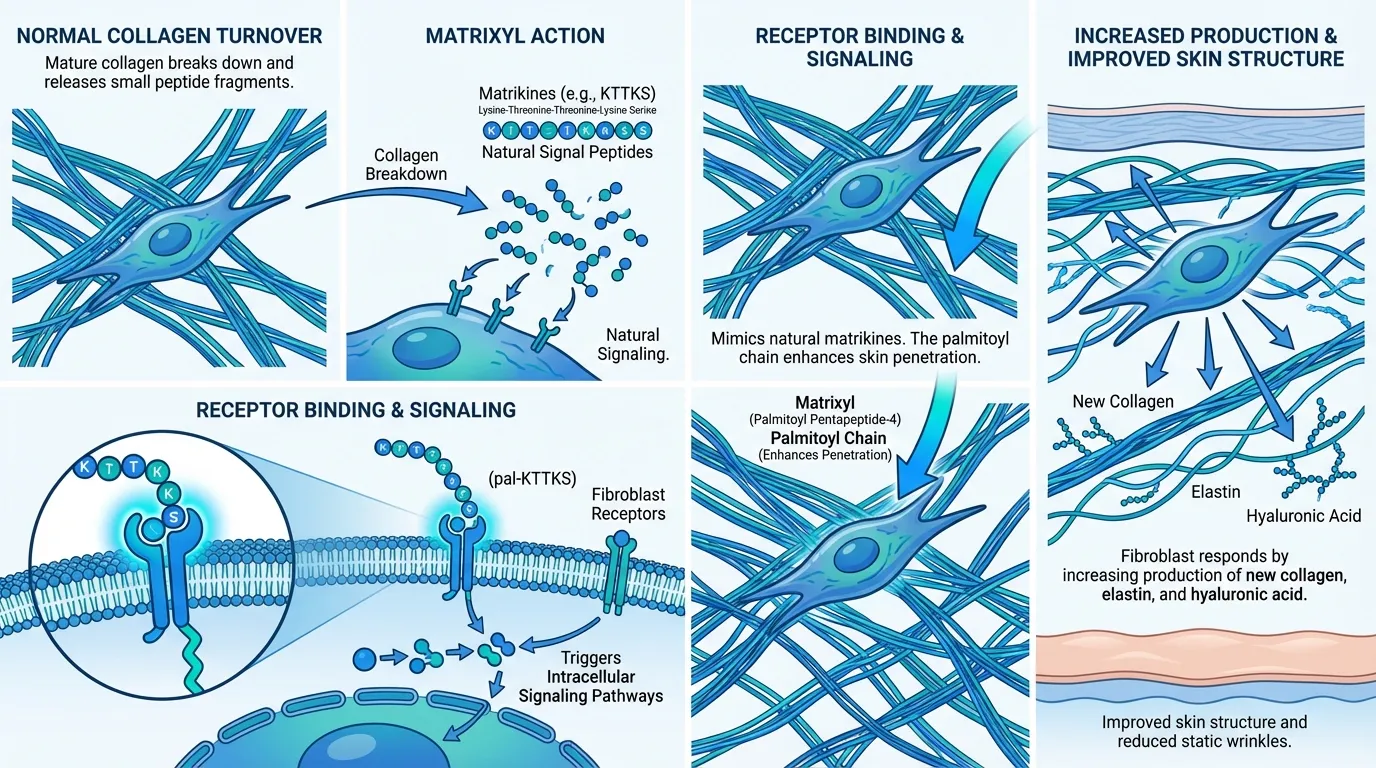
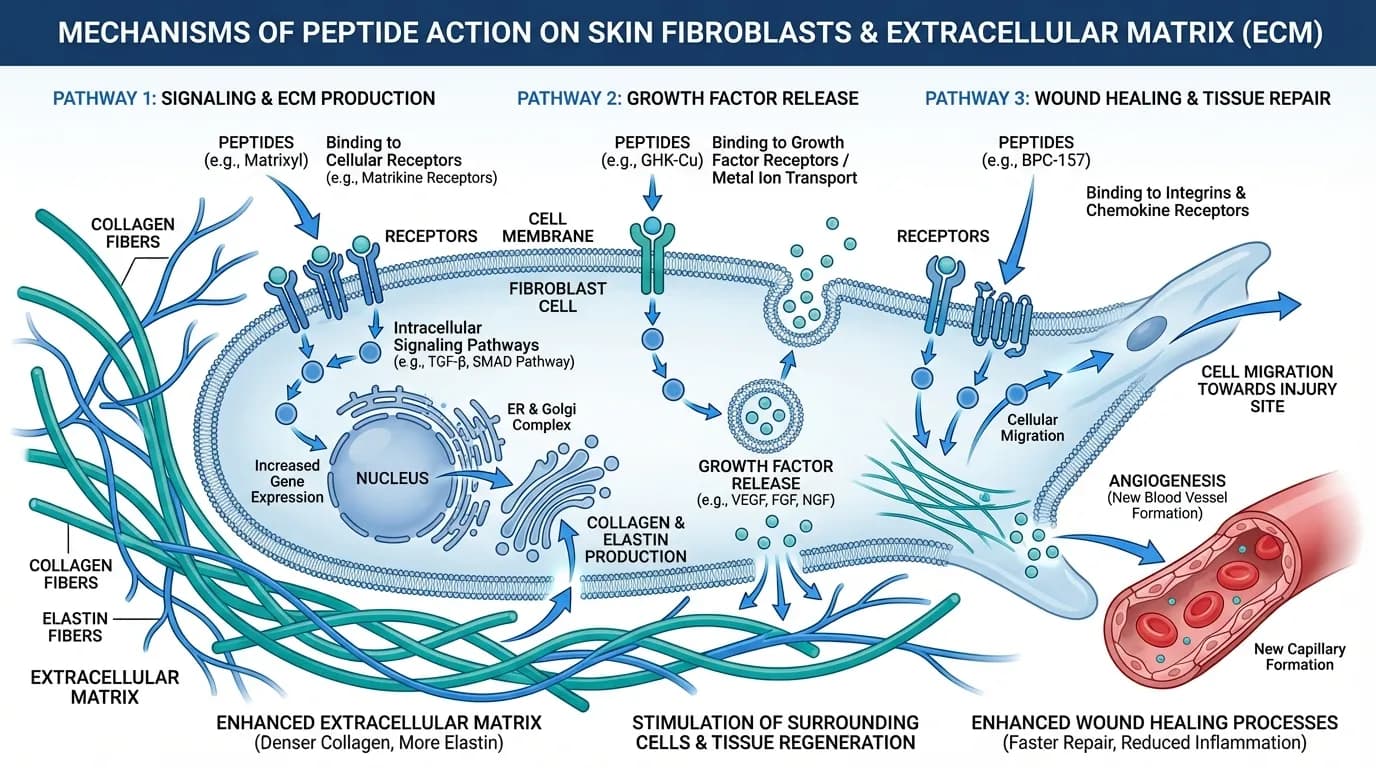
Mechanism: The KTTKS pentapeptide sequence in Matrixyl is derived from the C-terminal propeptide of type I procollagen. When procollagen is processed into mature collagen, these propeptide fragments are released as byproducts. Fibroblasts interpret these fragments as signals that collagen turnover is occurring, triggering increased production of new collagen and other extracellular matrix components. This feedback mechanism is called matrikine signaling.
The palmitoyl (palmitic acid) chain conjugated to the KTTKS sequence enhances lipophilicity, improving penetration through the lipid-rich stratum corneum. This addresses one of the primary limitations of topical peptide delivery.
Clinical Evidence:
Matrixyl has a stronger independent evidence base than the neurotoxin-like peptides:
- Robinson et al. double-blind RCT (93 subjects, 12 weeks): Palmitoyl pentapeptide-4 showed significant improvement in wrinkles and fine lines versus placebo, as measured by both quantitative imaging and expert grader assessment in a split-face design.
- Periorbital study (28 days): 0.005% Matrixyl cream applied twice daily reduced fold depth by 18% and fold thickness by 37%, with 21% improvement in skin firmness.
- Safety data: At 3% concentration, Matrixyl was confirmed non-irritating and non-sensitizing across all skin types.
- Head-to-head comparison: In a randomized clinical trial, GHK-Cu reduced wrinkle volume 31.6% more than Matrixyl 3000, providing context for Matrixyl's relative efficacy.
Matrixyl Variants:
The original Matrixyl (pal-KTTKS) has been followed by several variants:
- Matrixyl 3000 — Contains palmitoyl tripeptide-1 (pal-GHK) and palmitoyl tetrapeptide-7 (pal-GQPR), targeting both collagen synthesis and inflammation
- Matrixyl Synthe'6 — Contains palmitoyl tripeptide-38, targeting six major components of the dermal-epidermal junction
- Matrixyl Morphomics — Contains palmitoyl tripeptide-38, formulated for enhanced dermal delivery
Each variant targets slightly different aspects of extracellular matrix biology, though the original Matrixyl (pal-KTTKS) remains the most extensively studied.
Limitations: Matrixyl targets static wrinkles (collagen loss) rather than dynamic wrinkles (muscle contraction). It will not address deep expression lines the way neurotoxin-like peptides or botulinum toxin might. Most clinical studies, while including placebo controls, have been relatively small and short-duration.
Copper Peptides: Gene Expression Modulators#
GHK-Cu (Copper Tripeptide-1)#
GHK-Cu is the broadest-acting peptide in the anti-wrinkle category, affecting skin biology at the gene expression level rather than targeting a single molecular mechanism.
Mechanism: GHK-Cu (glycyl-L-histidyl-L-lysine:copper(II)) is a naturally occurring tripeptide first identified in human plasma by Loren Pickart in 1973. It modulates the expression of over 4,000 human genes, as demonstrated in a landmark 2015 gene expression study. These include genes governing collagen and elastin synthesis, glycosaminoglycan production, antioxidant defense, inflammatory signaling, and tissue remodeling.
The copper(II) ion is essential for several enzymatic processes relevant to skin health: lysyl oxidase (collagen and elastin cross-linking), superoxide dismutase (antioxidant defense), and cytochrome c oxidase (cellular energy production).
GHK-Cu plasma levels decline with age — from approximately 200 ng/mL at age 20 to 80 ng/mL by age 60 — a decline that correlates with reduced regenerative capacity.
Clinical Evidence:
- Facial study (67-71 women, 12 weeks): GHK-Cu cream improved skin laxity, clarity, and firmness; reduced fine lines, coarse wrinkles, and mottled pigmentation; and increased skin density and thickness in women with photodamage.
- Head-to-head vs Matrixyl 3000: GHK-Cu reduced wrinkle volume 31.6% more than Matrixyl 3000 and 55.8% more than control serum, with wrinkle depth reduced 32.8% versus control.
- Collagen production study: After one month of topical GHK-Cu, collagen production increased in 70% of treated women, compared to 50% with vitamin C and 40% with retinoic acid.
- Gene expression data: Broad Institute analysis of GHK-Cu effects on 4,000+ genes involved in skin biology, providing a mechanistic foundation for its multi-target activity.
Limitations: GHK-Cu was placed in FDA Category 2 (banned from compounding) in 2024, affecting injectable forms. Topical cosmetic formulations remain available. GHK-Cu requires careful formulation due to copper ion reactivity — it is incompatible with strong acids, vitamin C at low pH, and AHAs/BHAs. The extensive gene expression data, while impressive, does not automatically translate to clinical outcomes; modulating a gene is not the same as producing a measurable change in skin appearance.
Comparing the Four Approaches#
Mechanism Comparison#
| Peptide | Class | Target | Wrinkle Type | Evidence |
|---|---|---|---|---|
| Argireline | SNARE inhibitor | SNAP-25 competition | Dynamic | Moderate (industry) |
| SNAP-8 | SNARE inhibitor | SNAP-25 competition | Dynamic | Limited (industry) |
| Leuphasyl | Enkephalin analog | Presynaptic calcium channels | Dynamic | Very limited |
| Matrixyl | Signal peptide | Fibroblast collagen signaling | Static | Moderate (includes RCTs) |
| GHK-Cu | Copper peptide | 4,000+ gene modulation | Both | Moderate to strong |
Efficacy Comparison#
Direct head-to-head comparisons between all of these peptides do not exist in the published literature. However, approximate ranges can be assembled from available data:
- Argireline: ~17-30% wrinkle depth reduction (periorbital, 28-30 days)
- SNAP-8: ~25-35% wrinkle depth reduction (facial, 28 days) — industry data
- Leuphasyl: ~11-24% wrinkle depth reduction (28 days) — manufacturer data
- Matrixyl: ~18% fold depth reduction, 37% fold thickness reduction (periorbital, 28 days)
- GHK-Cu: ~33-56% wrinkle volume reduction versus control (facial, 12 weeks)
These numbers are not directly comparable due to differences in study design, measurement method, treatment duration, and concentration. GHK-Cu shows the largest effects, but its studies were also longer and used a different measurement paradigm (volume versus depth).
Formulation Compatibility#
| Peptide | Stable pH Range | Compatible with Retinol? | Compatible with Vitamin C? | Typical Concentration |
|---|---|---|---|---|
| Argireline | Broad | Yes | Yes | 5-10% |
| SNAP-8 | Broad | Yes | Yes | 3-10% |
| Leuphasyl | Broad | Yes | Yes | 3-5% |
| Matrixyl | Broad | Yes | Yes | 0.001-3% |
| GHK-Cu | 5.0-6.5 | Yes | No (low pH) | 0.01-1% |
One of the practical advantages of the neurotoxin-like peptides and Matrixyl is their broad compatibility with other skincare actives. GHK-Cu's requirement for a narrow pH range and incompatibility with acidic ingredients makes it more challenging to incorporate into multi-active formulations.
Evidence Quality Assessment#
It is important to be transparent about the limitations of the evidence base for cosmeceutical peptides as a category:
Strengths of the field:
- Clear molecular mechanisms supported by in vitro and biochemical data
- Consistent direction of effects across studies (wrinkle reduction, collagen stimulation)
- Good safety profiles with minimal adverse effects
- Growing body of human studies, particularly for Argireline and Matrixyl
Weaknesses of the field:
- Heavy reliance on industry-funded research, particularly for SNAP-8 and Leuphasyl
- Small sample sizes in most clinical studies
- Short study durations (typically 28 days to 12 weeks)
- Limited independent replication of key findings
- Ongoing uncertainty about topical peptide penetration to target sites
- Heterogeneous measurement methods making cross-study comparison difficult
The cosmeceutical peptide field exists in a regulatory space between pharmaceutical-grade clinical trials and basic cosmetic safety testing. The evidence is generally stronger than for most cosmetic claims but weaker than for FDA-approved dermatological treatments.
Combination Strategies#
Because these peptides work through different mechanisms, combining them is a rational approach. Commonly used combinations include:
Argireline + Leuphasyl#
Targets two different steps in neuromuscular signaling — SNARE complex assembly (Argireline) and calcium-dependent vesicle release (Leuphasyl). Manufacturer data suggests additive effects, consistent with the complementary mechanisms.
Argireline or SNAP-8 + Matrixyl#
Addresses both dynamic wrinkles (SNARE inhibition) and static wrinkles (collagen stimulation) simultaneously. This combination has a strong mechanistic rationale, as the two classes target fundamentally different aspects of wrinkle formation.
GHK-Cu + Matrixyl#
Both peptides stimulate collagen production but through different pathways — GHK-Cu through broad gene modulation and copper-dependent enzymatic activity, Matrixyl through matrikine signaling. As discussed in the GHK-Cu vs Matrixyl comparison, these peptides can be used together, though GHK-Cu should be applied first due to its pH sensitivity.
Practical Considerations for Combinations#
- Apply water-based peptide serums before heavier creams or oils
- GHK-Cu products should be applied at a separate time from acidic actives (vitamin C, AHAs)
- Most SNARE-targeting peptides and Matrixyl are compatible and can be layered
- Allow adequate absorption time between layers (1-2 minutes)
Who Should Consider Anti-Wrinkle Peptides#
Anti-wrinkle peptides are best suited for individuals seeking:
- Preventive maintenance — Those in their late 20s to early 40s looking to slow wrinkle development before considering injectable treatments
- Non-invasive alternatives — Those who prefer topical treatments over injections, understanding the trade-off in efficacy
- Complementary care — As part of a broader skincare routine alongside sunscreen, retinoids, and antioxidants
- Post-procedure maintenance — To extend the interval between botulinum toxin or filler treatments
They are less appropriate as standalone treatments for deep-set wrinkles or significant volume loss, where injectable treatments or surgical options have substantially greater efficacy.
Conclusion#
The anti-wrinkle peptide category encompasses distinct classes of molecules with different mechanisms, evidence bases, and practical applications. Argireline remains the most-studied SNARE-targeting peptide for dynamic wrinkles, while SNAP-8 offers a potentially more potent alternative with a thinner evidence base. Leuphasyl provides a complementary neuromuscular mechanism that may enhance the effects of SNARE inhibitors. Matrixyl targets static wrinkles through collagen stimulation with a relatively strong clinical evidence base, and GHK-Cu offers the broadest biological activity across multiple skin aging pathways.
The honest assessment of this field is that the evidence, while promising, remains substantially weaker than for established dermatological treatments. Most studies are industry-funded, short-duration, and small. The fundamental question of whether topical peptides reach their target sites in biologically relevant concentrations has not been definitively resolved for any of these compounds.
That said, the safety profiles are excellent, the mechanistic rationale is sound, and the growing body of clinical data suggests real, if modest, effects. For a comprehensive overview of peptides studied for skin applications, see our 8 Peptides for Skin Health guide, and for a deeper comparison of the collagen-stimulating approaches, see our collagen-boosting peptides review.
Related Peptide Profiles#
Learn more about the peptides discussed in this article:
- Argireline Overview and Research Guide
- Argireline Dosing Protocols
- Argireline Side Effects and Safety
- GHK-Cu Overview and Research Guide
- GHK-Cu Dosing Protocols
- GHK-Cu Side Effects and Safety
- Matrixyl Overview and Research Guide
- Matrixyl Dosing Protocols
- Matrixyl Side Effects and Safety
- SNAP-8 Overview and Research Guide
- SNAP-8 Dosing Protocols
- SNAP-8 Side Effects and Safety

Frequently Asked Questions About Anti-Wrinkle Peptides: SNAP-8, Argireline, Matrixyl, and Leuphasyl Compared
What does this article cover?
Evidence-based guide to cosmeceutical anti-wrinkle peptides including SNAP-8, Argireline, Matrixyl, and GHK-Cu — mechanisms, clinical data, and formulation. This guide is for educational purposes only and does not constitute medical advice.
Which peptides are discussed in this article?
This article covers Argireline, GHK-Cu, Matrixyl, SNAP-8. Key context: Argireline (Hexapeptide SNARE complex inhibitor with the most clinical data among cosmeceutical anti-wrinkle ...); GHK-Cu (Copper peptide with broad gene expression modulation relevant to collagen synthesis and skin remo...); Matrixyl (Collagen-stimulating signal peptide representing the matrikine approach to wrinkle reduction). Each peptide is discussed based on available research evidence.
Who is this guide written for?
This guide is written for researchers and individuals seeking an evidence-based overview of the topic covered in "Anti-Wrinkle Peptides: SNAP-8, Argireline, Matrixyl, and Leuphasyl Compared." It summarizes available research data without making treatment recommendations. Always consult a healthcare provider for medical decisions.
What are the key takeaways from this article?
The main findings covered in this article include: Hexapeptide SNARE complex inhibitor with the most clinical data among cosmeceutical anti-wrinkle .... Copper peptide with broad gene expression modulation relevant to collagen synthesis and skin remo.... Collagen-stimulating signal peptide representing the matrikine approach to wrinkle reduction. These takeaways are based on the research data available at the time of publication.
What is Argireline and why is it significant?
Argireline is a peptide discussed in this article because: Hexapeptide SNARE complex inhibitor with the most clinical data among cosmeceutical anti-wrinkle peptides. For a complete profile of Argireline, see the dedicated peptide page on this site.
Continue reading this research review
Free access to the complete analysis with citations and evidence ratings.
150+ peptide profiles · 30+ comparisons · 18 research tools
Medical Disclaimer
This website is for educational and informational purposes only. The information provided is not intended to diagnose, treat, cure, or prevent any disease. Always consult with a qualified healthcare professional before using any peptide or supplement.
Join 2,000+ researchers getting biweekly updates
Enjoyed this article?
The Research Briefing delivers deep-dives like this biweekly — plus new study breakdowns, safety updates, and tool announcements.
Free forever. No spam. Unsubscribe in one click.
Where to Find These Peptides
Continue Exploring
Peptide Profiles
Keep Reading
Best Peptides for Hair, Skin & Nails: Evidence-Based Guide (2026)
Which peptides actually improve hair growth, skin quality, and nail strength? Evidence-based review of GHK-Cu, copper peptides, Matrixyl, BPC-157, and popular peptide blends.

Collagen-Boosting Peptides for Skin: From GHK-Cu to Matrixyl
Research review of collagen-stimulating peptides for skin rejuvenation including GHK-Cu, Matrixyl, SNAP-8, and BPC-157 wound healing data.

13 Best Anti-Aging Peptides (2026): Ranked by Clinical Evidence
From senolytic FOXO4-DRI to mitochondrial SS-31, we ranked 13 anti-aging peptides by clinical trial evidence across 6 mechanisms. See which have human data vs. animal-only studies.
You Might Also Like
Related content you may find interesting