Healthy Hair, Skin, and Nails Peptide Blend: GHK-Cu, BPC-157, and Collagen Research

Introduction#
Peptide-based approaches to hair, skin, and nail health have attracted significant research interest, driven primarily by GHK-Cu's remarkable gene expression data and the broader understanding of how growth factors, collagen dynamics, and inflammation influence the health of these tissues. While "beauty peptide blends" are marketed commercially, the scientific evidence behind each component varies from extensive molecular data to entirely hypothetical.
This guide examines what the research actually shows for peptides commonly included in hair, skin, and nails formulations, separating validated molecular mechanisms from unsubstantiated claims.
Regulatory Note: GHK-Cu and BPC-157 were placed in FDA Category 2 (banned from compounding) in 2024. No peptide blend is FDA-approved for cosmetic or dermatological indications.
The Biology of Hair, Skin, and Nails#
Shared Structural Dependencies#
Hair, skin, and nails share several biological requirements that peptides may influence:
Collagen and keratin: All three tissues depend on structural protein production. Skin requires collagen types I, III, and V for structural integrity. Hair follicles depend on collagen for dermal papilla function. Nails are primarily keratin but require adequate collagen in the nail bed.
Growth factor signaling: EGF, FGF, VEGF, and TGF-beta pathways are active in all three tissues, regulating cell proliferation, differentiation, and tissue organization.
Blood supply: Hair follicles and nail matrices are metabolically active structures that require adequate vascularization. Impaired blood supply to the scalp or nail bed correlates with poor hair and nail growth.
Inflammatory status: Chronic inflammation damages all three tissues. In hair, inflammation targets follicles (alopecia areata, scarring alopecia). In skin, inflammation drives premature aging and impaired healing. In nails, inflammation causes dystrophy and brittleness.
GHK-Cu: The Central Peptide for Hair, Skin, and Nails#
Gene Expression Data#
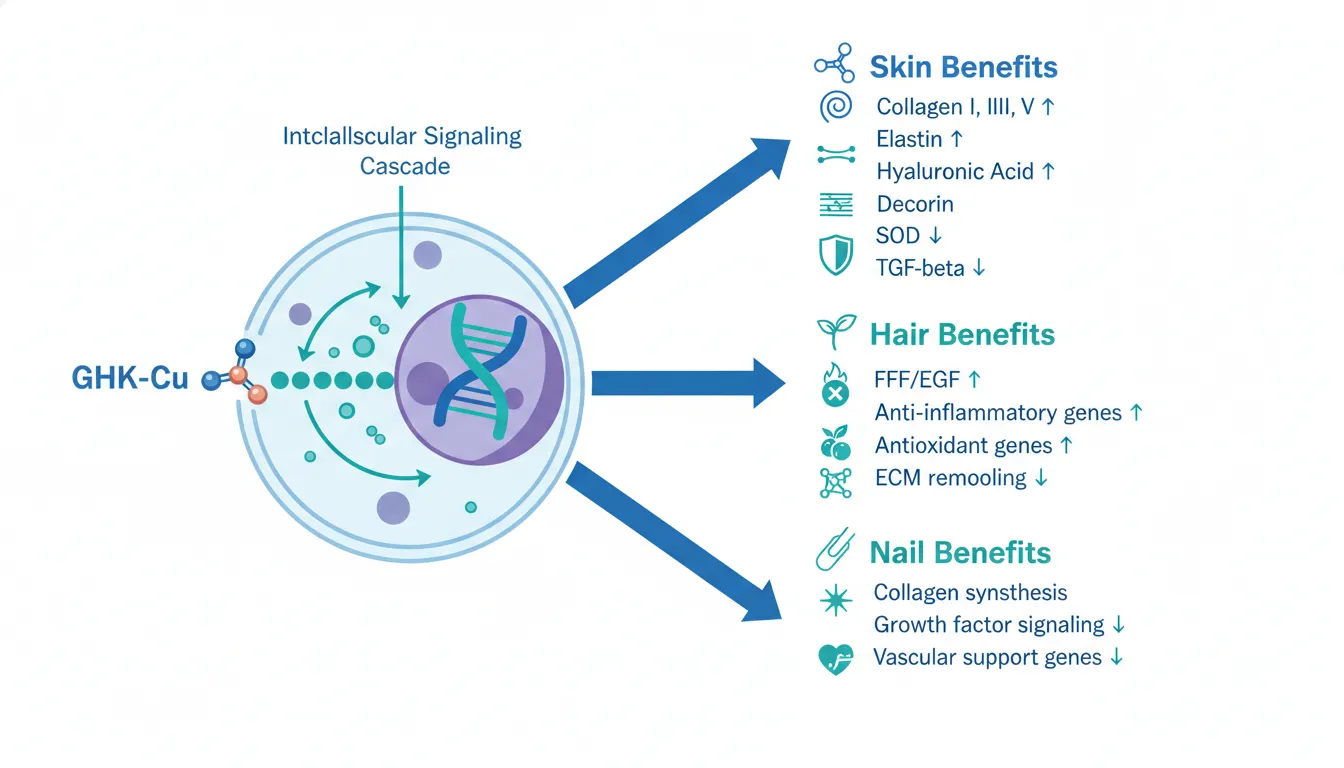
GHK-Cu's relevance to hair, skin, and nails rests on its unprecedented gene expression profile. The 2015 study demonstrating modulation of 4,000+ human genes identified multiple networks directly relevant to these tissues 1:
For skin:
- Collagen types I, III, V upregulation
- Elastin gene activation
- Glycosaminoglycan synthesis (hyaluronic acid)
- Decorin upregulation (collagen fibril organization)
- Superoxide dismutase (antioxidant defense)
- TGF-beta suppression (anti-fibrotic)
For hair:
- Growth factor gene modulation (FGF, EGF families)
- Anti-inflammatory gene activation (relevant to follicular inflammation)
- Antioxidant defense gene upregulation
- ECM remodeling genes supporting dermal papilla function
For nails:
- Collagen synthesis supporting nail bed integrity
- Growth factor signaling relevant to matrix cell proliferation
- Vascular support genes important for nail bed blood supply
Clinical Evidence for GHK-Cu in Skin#
GHK-Cu has the most clinical-adjacent data for skin applications:
- GHK-Cu cream applied to thigh skin for 12 weeks improved collagen production in 70% of women treated, compared to 50% with vitamin C cream and 40% with retinoic acid 2
- Topical application stimulated dermal keratinocyte proliferation in controlled studies
- Gene expression analysis confirmed upregulation of collagen and tissue repair pathways 12
Evidence for GHK-Cu in Hair#
Hair-specific evidence includes:
- Multiple studies demonstrate GHK-Cu's effects on follicle growth phase extension in cultured follicle models and animal studies
- GHK-Cu modulates growth factors (particularly FGF family members) involved in hair follicle cycling
- Microneedling combined with copper peptides has been investigated for androgenetic alopecia
- The age-related decline in plasma GHK-Cu (200 ng/mL at age 20 to 80 ng/mL at age 60) correlates with the onset of age-related hair thinning 1
However, large-scale clinical trials specifically evaluating GHK-Cu for hair restoration are lacking.
Evidence for GHK-Cu in Nails#
Nail-specific evidence is the weakest of the three tissue types. While the collagen-promoting and growth factor effects of GHK-Cu are mechanistically relevant to nail health, no published studies have specifically evaluated GHK-Cu for nail growth, strength, or dystrophy.
Supporting Peptides in Hair, Skin, and Nails Blends#
BPC-157: Vascular and Growth Factor Support#
BPC-157's potential contribution to hair, skin, and nails health centers on vascular support:
- Angiogenesis: VEGFR2 upregulation and NO-mediated vasodilation improve blood supply to metabolically active tissues like hair follicles and nail matrices 34
- Growth factors: EGF, FGF, and VEGF upregulation supports cell proliferation in all three tissue types 5
- Anti-inflammatory effects: Modulation of inflammatory cytokines may protect against follicular inflammation and skin inflammatory aging
However, BPC-157 has no published studies specifically targeting hair growth, nail health, or cosmetic skin outcomes.
TB-500: Cell Migration for Tissue Repair#
Thymosin beta-4 (TB-500's parent compound) has specific hair-relevant data:
- Thymosin beta-4 promotes hair follicle development and cycling in animal models 6
- The peptide stimulates dermal papilla cell migration, which is critical for follicle maintenance and regeneration
- Phase 2 wound healing trials demonstrated accelerated skin repair 7
The hair follicle development data is among the more interesting findings for any peptide in this category, though it applies to thymosin beta-4 rather than the TB-500 fragment specifically.
KPV: Inflammatory Skin Protection#
KPV's role in hair, skin, and nails health is primarily through inflammation management:
- NF-kappaB inhibition reduces MMP expression that degrades skin collagen and elastin 8
- Anti-inflammatory effects may protect hair follicles from inflammation-mediated damage
- Alpha-MSH (KPV's parent peptide) modulates melanocyte activity relevant to skin pigmentation
KPV has no direct evidence for hair growth, nail health, or cosmetic skin improvements.
The Multi-Peptide Approach to Hair, Skin, and Nails#
Theoretical Framework#
| Tissue Target | Primary Need | Peptide Contributor | Mechanism |
|---|---|---|---|
| Skin collagen | Synthesis + preservation | GHK-Cu + KPV | Gene upregulation + MMP suppression |
| Skin elasticity | Elastin production | GHK-Cu | Elastin gene activation |
| Skin hydration | GAG synthesis | GHK-Cu | Hyaluronic acid gene upregulation |
| Hair follicle cycling | Growth factor signaling | GHK-Cu + BPC-157 | FGF/EGF modulation + VEGF |
| Hair follicle blood supply | Angiogenesis | BPC-157 | VEGFR2/NO pathway |
| Hair follicle migration | Cell migration | TB-500 | Actin-mediated dermal papilla cell movement |
| Nail bed vasculature | Blood supply | BPC-157 | Angiogenesis |
| Nail matrix collagen | Structural support | GHK-Cu | Collagen synthesis genes |
| All tissues: inflammation | Anti-inflammatory | KPV + BPC-157 | NF-kappaB inhibition + cytokine modulation |
GHK-Cu Is the Foundation#
In any hair, skin, and nails peptide formulation, GHK-Cu provides the broadest evidence base and the most direct mechanism of action. The other peptides serve supporting roles that may enhance GHK-Cu's effects but do not replace them:
- Without GHK-Cu, the blend lacks the gene-level programming that drives collagen synthesis, elastin production, and ECM remodeling
- Without BPC-157, the blend loses its primary angiogenic component for vascular support
- Without TB-500, the blend loses cell migration capacity (most relevant for hair follicle cycling)
- Without KPV, the blend loses direct NF-kappaB-mediated inflammation control
Evidence Gaps and Honest Assessment#
What Exists#
- GHK-Cu: Extensive gene expression data; some clinical skin data with topical application; hair follicle culture data
- BPC-157: Broad preclinical tissue repair data; very limited human data (n < 15)
- TB-500: Hair follicle development data (parent compound); Phase 2 wound healing trials (parent compound)
- KPV: Preclinical anti-inflammatory data; no human clinical trials
What Does Not Exist#
- No published study has tested any multi-peptide formulation for hair, skin, or nails outcomes
- No clinical trial has compared peptide blends to established treatments (minoxidil, finasteride, retinoids)
- No long-term data on peptide blend use for cosmetic outcomes
- No dose-optimization studies for peptide blends targeting beauty outcomes
- No head-to-head data comparing different blend formulations
Comparison with Established Treatments#
| Approach | Evidence Level | Primary Mechanism | FDA Status |
|---|---|---|---|
| GHK-Cu topical | Gene expression + limited clinical | 4,000+ gene modulation | Category 2 (injectable); cosmetic (topical) |
| Minoxidil (hair) | Phase 3 + decades of clinical use | Vasodilation, follicle stimulation | FDA-approved (OTC) |
| Finasteride (hair) | Phase 3 + decades of clinical use | DHT inhibition | FDA-approved (Rx) |
| Retinoids (skin) | Extensive clinical data | Vitamin A receptor activation | FDA-approved (Rx/OTC) |
| Peptide blends (injectable) | Preclinical individual data only | Multi-pathway theoretical | Not approved |
Researchers should note that established FDA-approved treatments for hair loss and skin aging have extensive clinical validation that no peptide blend currently matches.
Safety Considerations#
Individual Peptide Safety for Cosmetic Use#
GHK-Cu: Long history of topical cosmetic use with a favorable safety profile. Injectable forms banned from compounding (FDA Category 2, 2024).
BPC-157: Limited human safety data. Injectable banned from compounding (FDA Category 2, 2024).
TB-500: Phase 2 wound healing trials report favorable safety (parent compound). Not FDA-approved.
KPV: No human safety data. Not FDA-evaluated.
Multi-Peptide Cosmetic Concerns#
- Multi-peptide injectable blends have no published safety data
- Long-term cosmetic use of peptide blends has not been studied
- Copper interactions from GHK-Cu with other peptides in solution remain uncharacterized
- Commercial blend quality varies; multi-peptide formulations present stability challenges
Key Takeaways for Researchers#
-
GHK-Cu has the strongest mechanistic case for hair, skin, and nails applications, with 4,000+ gene targets mapped and some clinical skin data supporting collagen improvement.
-
Thymosin beta-4 (TB-500's parent) has specific hair follicle data showing promotion of follicle development and cycling, making it the most hair-relevant supporting peptide.
-
BPC-157 provides theoretical vascular support through its angiogenic properties, relevant to all three tissues that depend on adequate blood supply.
-
No peptide blend has clinical evidence for cosmetic hair, skin, or nails outcomes. All multi-peptide claims are extrapolations from individual peptide mechanisms.
-
Established treatments exist for hair loss (minoxidil, finasteride) and skin aging (retinoids) with decades of clinical validation that peptide blends cannot currently match.
-
Topical GHK-Cu is the most accessible component with cosmetic products commercially available, while injectable forms of most peptides in these blends face regulatory restrictions.
References#
Related Peptide Profiles#
Learn more about the peptides discussed in this article:
- GHK-Cu Overview and Research Guide
- GHK-Cu Dosing Protocols
- GHK-Cu Side Effects and Safety
- BPC-157 Overview and Research Guide
- BPC-157 Dosing Protocols
- BPC-157 Side Effects and Safety
- TB-500 Overview and Research Guide
- TB-500 Dosing Protocols
- TB-500 Side Effects and Safety
- KPV Overview and Research Guide
- KPV Dosing Protocols
- KPV Side Effects and Safety
Footnotes#
-
GHK Peptide as a Natural Modulator of Multiple Cellular Pathways in Skin Regeneration. PMID: 26236730. 2015. ↩ ↩2 ↩3
-
Regenerative and Protective Actions of the GHK-Cu Peptide in the Light of New Gene Data. PMID: 29986520. 2018. ↩ ↩2
-
Modulatory effects of BPC 157 on vasomotor tone and the activation of Src-Caveolin-1-endothelial nitric oxide synthase pathway. PMID: 33051481. 2020. ↩
-
BPC 157 Therapy: Targeting Angiogenesis and Nitric Oxide. Pharmaceuticals. PMC: 12567428. 2025. ↩
-
Emerging Use of BPC-157 in Orthopaedic Sports Medicine: A Systematic Review. PMID: 40756949. 2025. ↩
-
Thymosin beta4 promotes angiogenesis, wound healing, and hair follicle development. PMID: 15037013. 2004. ↩
-
The regenerative peptide thymosin beta-4 accelerates the rate of dermal healing in preclinical models and patients. PMID: 23050815. 2012. ↩
-
PepT1-mediated tripeptide KPV uptake reduces intestinal inflammation. PMID: 18061177. 2008. ↩

Frequently Asked Questions About Healthy Hair, Skin, and Nails Peptide Blend: GHK-Cu, BPC-157, and Collagen Research
What does this article cover?
An evidence-based guide to peptide blends targeting hair growth, skin rejuvenation, and nail health, reviewing GHK-Cu's gene modulation data, collagen pathway research, and the evidence for multi-peptide approaches. This guide is for educational purposes only and does not constitute medical advice.
Which peptides are discussed in this article?
This article covers GHK-Cu, BPC-157, TB-500, KPV. Key context: GHK-Cu (Primary component for hair, skin, and nail regeneration via 4,000+ gene modulation and collagen s...); BPC-157 (Supporting component for vascular support and growth factor upregulation in tissue repair); TB-500 (Supporting component for cell migration and wound healing via thymosin beta-4 pathways). Each peptide is discussed based on available research evidence.
Who is this guide written for?
This guide is written for researchers and individuals seeking an evidence-based overview of the topic covered in "Healthy Hair, Skin, and Nails Peptide Blend: GHK-Cu, BPC-157, and Collagen Research." It summarizes available research data without making treatment recommendations. Always consult a healthcare provider for medical decisions.
What are the key takeaways from this article?
The main findings covered in this article include: Primary component for hair, skin, and nail regeneration via 4,000+ gene modulation and collagen s.... Supporting component for vascular support and growth factor upregulation in tissue repair. Supporting component for cell migration and wound healing via thymosin beta-4 pathways. These takeaways are based on the research data available at the time of publication.
What is GHK-Cu and why is it significant?
GHK-Cu is a peptide discussed in this article because: Primary component for hair, skin, and nail regeneration via 4,000+ gene modulation and collagen synthesis. For a complete profile of GHK-Cu, see the dedicated peptide page on this site.
Continue reading this research review
Free access to the complete analysis with citations and evidence ratings.
150+ peptide profiles · 30+ comparisons · 18 research tools
Medical Disclaimer
This website is for educational and informational purposes only. The information provided is not intended to diagnose, treat, cure, or prevent any disease. Always consult with a qualified healthcare professional before using any peptide or supplement.
Join 2,000+ researchers getting biweekly updates
Enjoyed this article?
The Research Briefing delivers deep-dives like this biweekly — plus new study breakdowns, safety updates, and tool announcements.
Free forever. No spam. Unsubscribe in one click.
Where to Find These Peptides
Continue Exploring
Peptide Profiles
Keep Reading
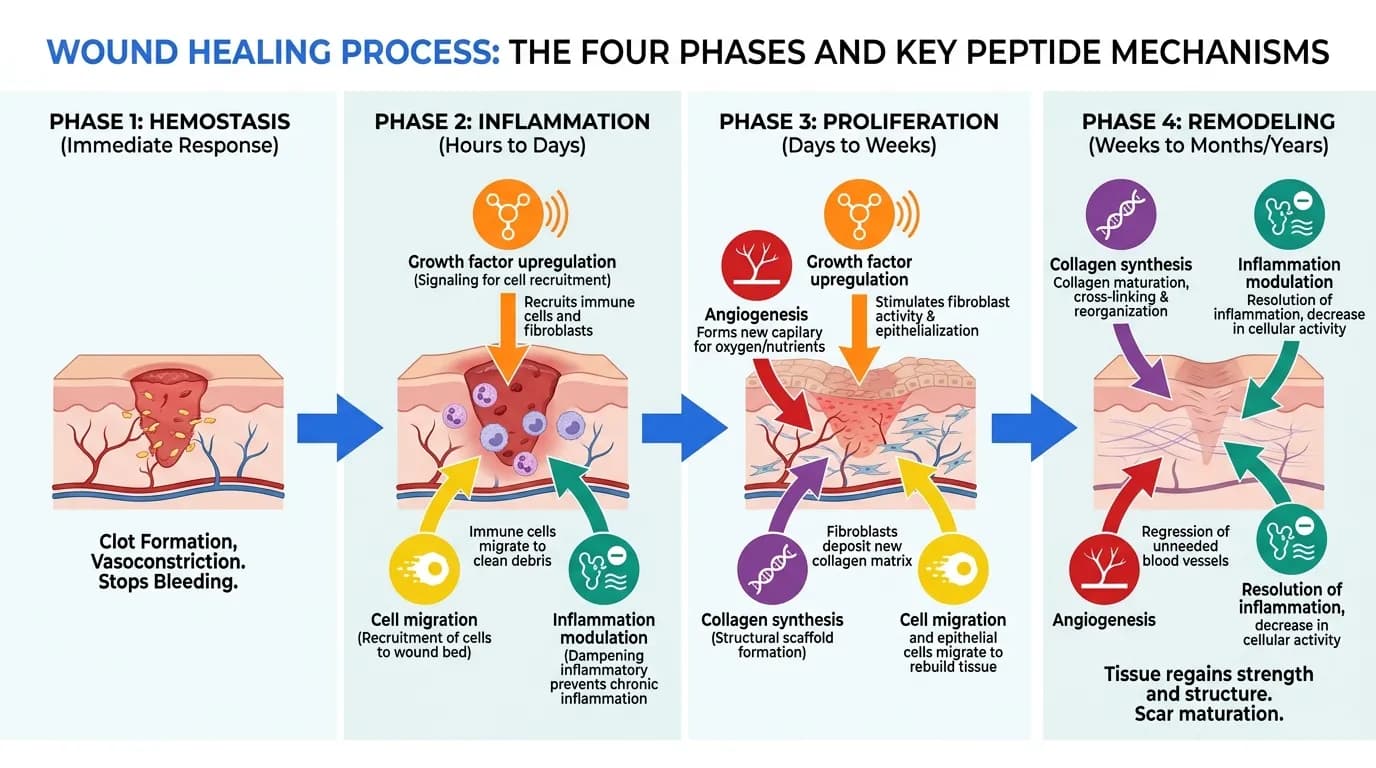
Peptides for Wound Healing & Tissue Repair: What the Research Shows (2026)
Which peptides support wound healing? An educational overview of BPC-157, TB-500, GHK-Cu, KPV, and Thymosin Alpha-1 — mechanisms, evidence status, best-use scenarios, and safety context for tissue repair research.
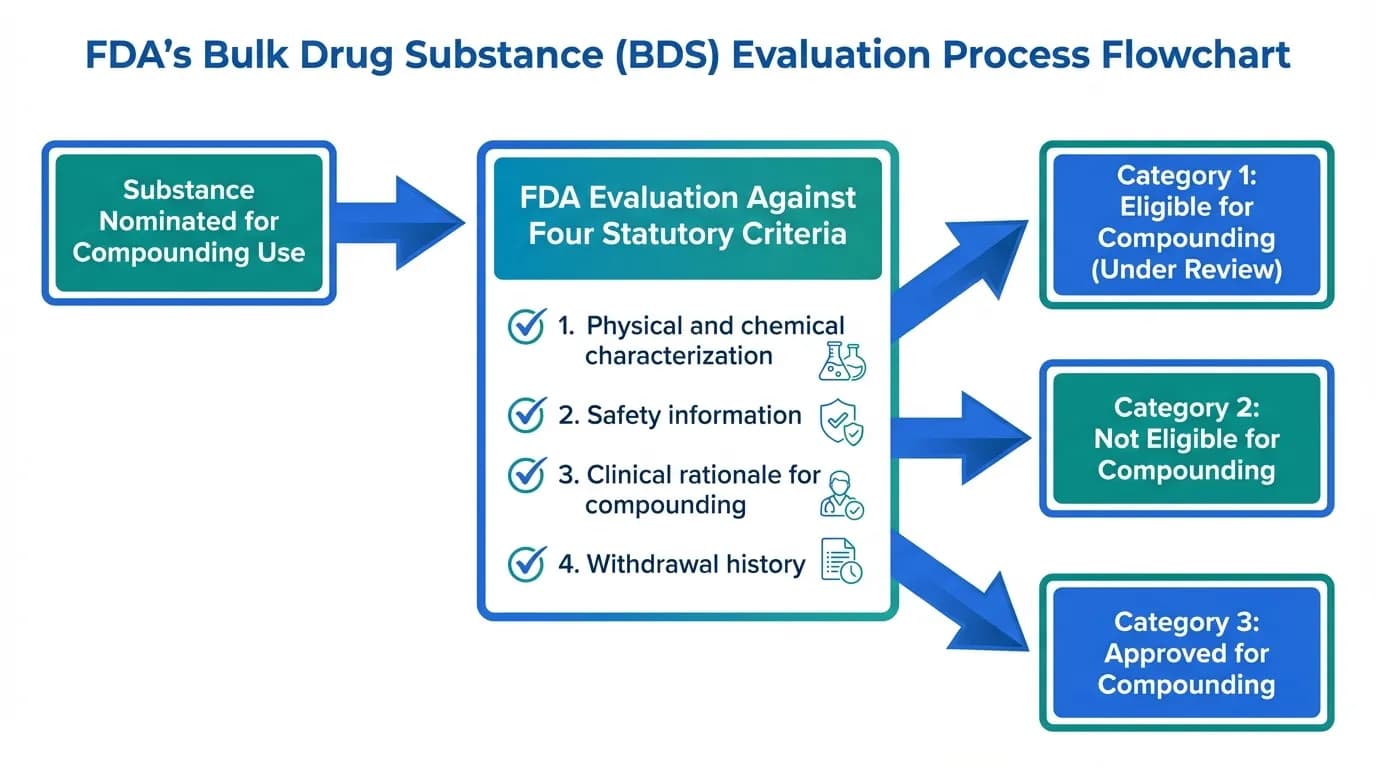
FDA Peptide Categories Explained: Category 1 vs Category 2 (2026)
Understand the FDA peptide classification system. Learn the difference between Category 1, Category 2, and Category 3 peptides and what the 2024-2026 regulatory changes mean for researchers.
Most Popular Therapeutic Peptides in 2026: 15 Ranked by Research Interest
The 15 most popular therapeutic peptides in 2026, ranked by clinical trial activity, search interest, and research community adoption. From semaglutide to BPC-157.
You Might Also Like
Related content you may find interesting