MET-097i vs Semaglutide: Ultra-Long-Acting vs Established GLP-1 Comparison
Evidence-based comparison of MET-097i (ultra-long-acting once-monthly GLP-1 agonist) and semaglutide (established once-weekly/daily GLP-1 agonist) for weight loss and obesity treatment.
Verdict at a Glance
MET-097i represents a potentially disruptive approach to GLP-1 therapy with its ultra-long half-life enabling once-monthly dosing. Phase 2b data shows competitive weight loss (14.1% placebo-subtracted), and the convenience of monthly dosing could significantly improve treatment adherence. However, semaglutide remains the gold standard with proven efficacy, cardiovascular benefit, 7+ years of safety data, multiple formulations, and FDA approval. MET-097i's clinical value will ultimately depend on Phase 3 confirmation and whether the convenience advantage translates to better real-world outcomes. Pfizer's acquisition of Metsera signals strong commercial interest in the once-monthly GLP-1 concept.
| Best for | Pick | Why |
|---|---|---|
| Proven Efficacy and Safety | Semaglutide | FDA-approved since 2017 with over 25,000 clinical trial participants, proven cardiovascular benefit (SELECT trial), and 7+ years of post-marketing surveillance. The most extensively studied GLP-1 agonist available. |
| Dosing Convenience | MET-097i | Once-monthly dosing with potential titration-free administration would reduce injection burden from 52 to 12 injections per year. The ~380-hour half-life is the longest of any GLP-1 agonist in development. |
| Cardiovascular Risk Reduction | Semaglutide | SELECT trial (17,604 patients) demonstrated 20% MACE reduction in overweight/obese adults with established CVD. The first and only anti-obesity drug with proven cardiovascular benefit. |
| Oral Administration Preference | Semaglutide | Rybelsus (oral semaglutide) is the only oral GLP-1 agonist available. MET-097i is injectable only. Patients who prefer oral medication have semaglutide as the sole option. |
| Category | MET-097i | Semaglutide | Advantage |
|---|---|---|---|
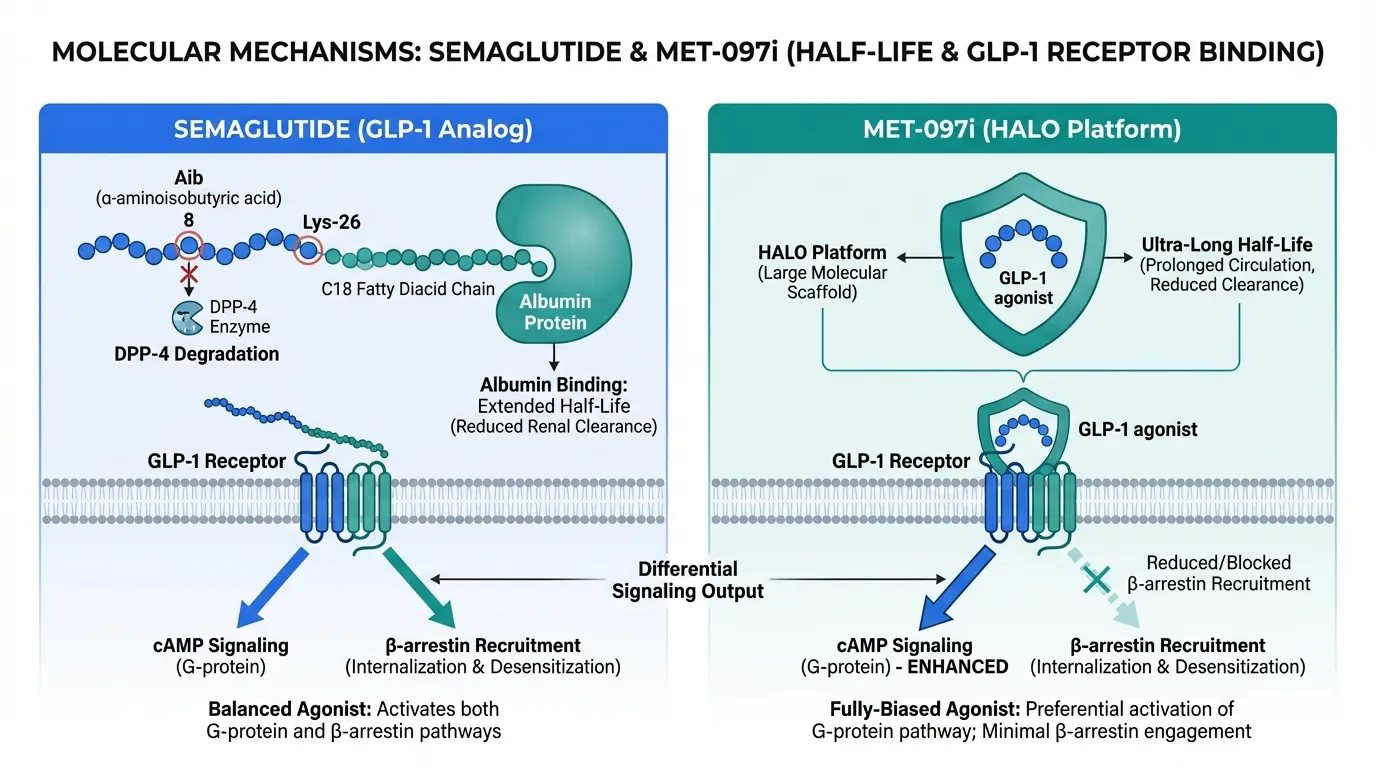
| Mechanism of Action | Fully-biased GLP-1 receptor agonist utilizing HALO platform technology for ultra-long half-life (~380 hours). Designed for once-monthly dosing and potentially titration-free administration. Subcutaneous injectable. | Selective GLP-1 receptor agonist with C18 fatty diacid acylation enabling albumin binding and ~7-day half-life. Available as once-weekly injectable (Ozempic/Wegovy) and once-daily oral tablet (Rybelsus). Proven mechanism with 7+ years of clinical experience. | Comparable |
| Weight Loss Efficacy | Phase 2b VESPER-1 showed up to 14.1% mean placebo-subtracted weight loss after 28 weekly doses. Phase 1/2 showed 7.5% weight reduction at Day 36. Early-stage data suggests competitive weight loss with potential for once-monthly dosing convenience. | STEP 1 Phase 3 demonstrated 14.9% mean weight loss at 68 weeks with 2.4 mg weekly dose. STEP 3 showed 16.0% with intensive lifestyle intervention. 50.5% of patients achieved 15% or more weight loss. Over 5,000 patients across STEP program. | Semaglutide |
| Research Evidence | Phase 1/2 completed (2024). Phase 2b VESPER-1 and VESPER-3 completed (2025). Transitioning to Phase 3. Limited number of trial participants. Developed by Metsera (acquired by Pfizer). | Over 25,000 clinical trial participants across SUSTAIN, PIONEER, STEP, and SELECT programs. FDA-approved for T2D (2017) and obesity (2021). Seven years of post-marketing surveillance. Proven cardiovascular benefit in SELECT trial. | Semaglutide |
| Side Effect Profile | Limited safety data from Phase 1/2 and Phase 2b trials. GI adverse events reported but detailed rates not yet fully published. The ultra-long half-life means adverse effects may persist longer if they occur. | Well-characterized safety profile. Nausea 15-44%, vomiting 5-24%, diarrhea 8-30% (dose-dependent). Manageable with dose escalation. Less than 5% discontinuation for GI events in STEP 1. Thyroid C-cell tumor boxed warning based on rodent data. | Semaglutide |
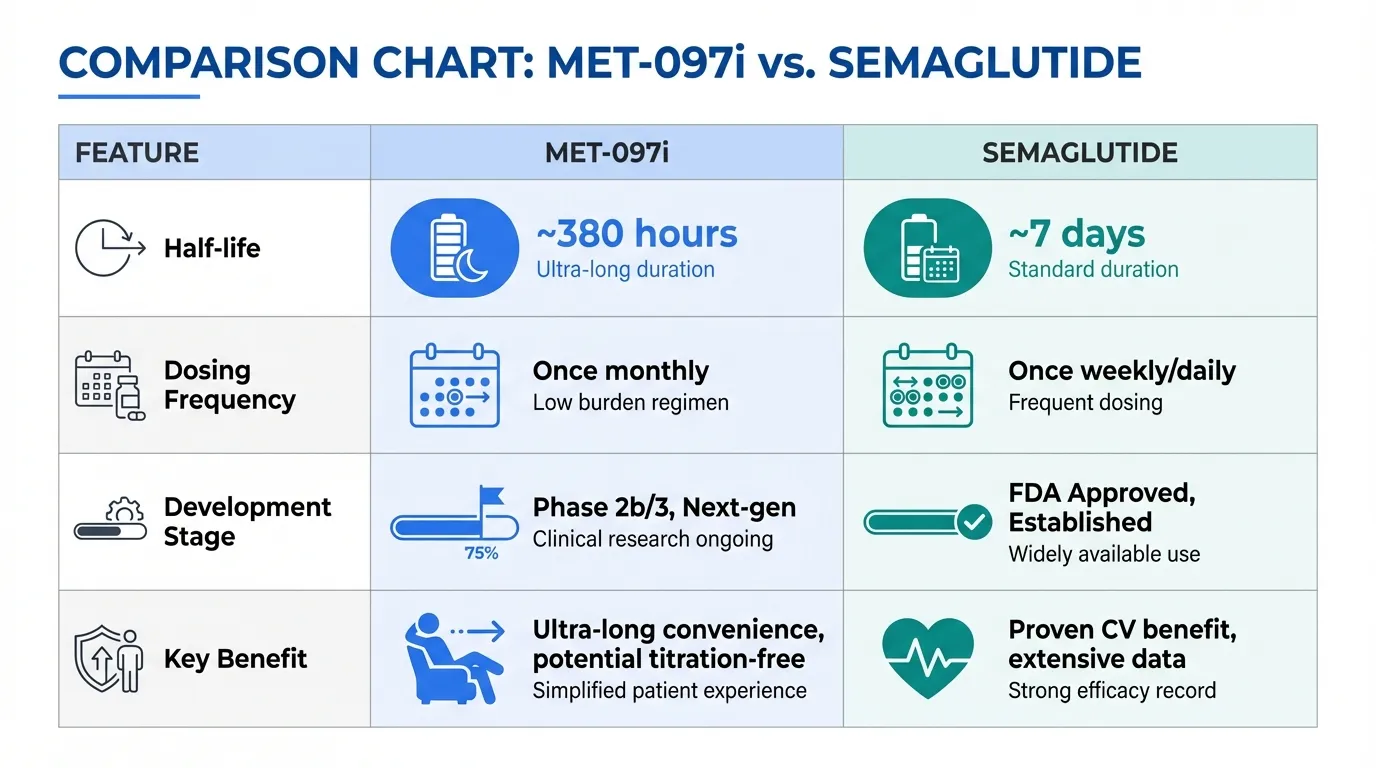
| Dosing Convenience | Designed for once-monthly subcutaneous injection with potential for titration-free dosing. ~380-hour half-life supports extended dosing interval. Could significantly reduce injection burden vs weekly dosing. | Once-weekly injection (Ozempic/Wegovy) or once-daily oral tablet (Rybelsus). Requires 16-week dose escalation for weight management. Well-established dosing protocols. Multiple formulation options. | MET-097i |

Introduction#
MET-097i and semaglutide both target the GLP-1 receptor for obesity treatment but represent different generations of the technology. Semaglutide is the established standard of care with FDA approval, extensive clinical data, and proven cardiovascular benefit. MET-097i is a next-generation ultra-long-acting GLP-1 agonist designed to enable once-monthly dosing, potentially transforming treatment adherence and convenience.
Semaglutide (marketed as Ozempic, Wegovy, and Rybelsus by Novo Nordisk) is a once-weekly injectable and once-daily oral GLP-1 receptor agonist with a half-life of approximately 7 days. Its clinical program spans over 25,000 participants across the SUSTAIN, PIONEER, STEP, and SELECT trial programs.
MET-097i, developed by Metsera (acquired by Pfizer), is a fully-biased GLP-1 receptor agonist utilizing HALO platform technology to achieve an ultra-long half-life of approximately 380 hours. Phase 2b data from the VESPER trials showed competitive weight loss with the potential for once-monthly, titration-free administration.
Mechanism of Action Comparison#
MET-097i#
MET-097i is a GLP-1 receptor agonist designed for ultra-long duration of action using Metsera's HALO platform technology. The approximately 380-hour half-life supports once-monthly dosing, which would be the longest dosing interval of any GLP-1 agonist. MET-097i is described as a "fully-biased" GLP-1 agonist, which may influence signaling pathway selectivity. It is administered by subcutaneous injection.
Semaglutide#
Semaglutide is a synthetic GLP-1(7-37) analog with an Aib substitution at position 8 for DPP-4 resistance and a C18 fatty diacid chain at lysine-26 for albumin binding, giving it a half-life of approximately 7 days. It activates GLP-1 receptors to enhance glucose-dependent insulin secretion, suppress glucagon, delay gastric emptying, and reduce appetite through hypothalamic signaling.
| Feature | MET-097i | Semaglutide |
|---|---|---|
| Target | GLP-1R (fully-biased) | GLP-1R (selective) |
| Half-life | ~380 hours (~16 days) | ~168 hours (7 days) |
| Dosing frequency | Once monthly (target) | Once weekly (injectable) or daily (oral) |
| Platform | HALO technology | Fatty acid acylation |
| Formulations | SC injectable only | SC injectable + oral tablet |
| Developer | Metsera / Pfizer | Novo Nordisk |
Dosing Comparison#
MET-097i Dosing#
MET-097i is being developed for once-monthly subcutaneous injection. In the Phase 2b VESPER-1 trial, dosing was given as 28 weekly doses to characterize dose-response, with the intent to transition to monthly dosing in Phase 3. The ultra-long half-life may eliminate the need for dose titration, which would be a significant convenience advantage over current GLP-1 therapies.
Semaglutide Dosing#
Semaglutide for weight management (Wegovy) requires a 16-week dose escalation from 0.25 mg to the target 2.4 mg weekly dose (0.25, 0.5, 1.0, 1.7, 2.4 mg at 4-week intervals). For T2D (Ozempic), escalation goes from 0.25 mg to 0.5 mg, then optionally to 1 mg and 2 mg. Oral semaglutide (Rybelsus) starts at 3 mg daily, escalating to 7 mg and 14 mg.
Side Effects Comparison#
MET-097i Side Effects#
Phase 2b data from VESPER trials reported GI adverse events consistent with the GLP-1 class, but detailed rates have not been fully published. The ultra-long half-life raises a potential concern: if adverse effects occur, they may take longer to resolve after discontinuation compared to shorter-acting agents.
Semaglutide Side Effects#
Semaglutide has the most extensively characterized safety profile of any GLP-1 agonist. GI events are dose-dependent: nausea (15-44%), vomiting (5-24%), diarrhea (8-30%), and constipation (5-24%). Most events are mild to moderate, occur during escalation, and diminish over time. The 16-week titration protocol for Wegovy effectively manages GI tolerability.
Research Evidence Comparison#
MET-097i Research#
MET-097i's evidence base includes Phase 1/2 data (7.5% weight loss at Day 36) and Phase 2b VESPER-1 data (up to 14.1% placebo-subtracted weight loss after 28 weekly doses). Pfizer's acquisition of Metsera signals strong commercial interest. Transitioning to Phase 3. The evidence level is moderate, typical for Phase 2-stage development.
Semaglutide Research#
Semaglutide has one of the most extensive evidence bases in obesity medicine. Key programs include STEP (14.9% weight loss at 68 weeks in STEP 1), SELECT (20% MACE reduction in 17,604 patients), SUSTAIN (HbA1c reductions up to 2.2%), and PIONEER (oral formulation validation). Over 25,000 clinical trial participants and 7+ years post-marketing data. Evidence level is very high.
Key Differences Summary#
- Dosing frequency: MET-097i targets once-monthly dosing (12 injections/year) versus semaglutide's weekly dosing (52 injections/year) or daily oral dosing.
- Development stage: Semaglutide is FDA-approved with extensive data; MET-097i is Phase 2b transitioning to Phase 3.
- Weight loss: Semaglutide demonstrated 14.9% in STEP 1 (Phase 3); MET-097i showed 14.1% placebo-subtracted in VESPER-1 (Phase 2b).
- Cardiovascular outcomes: Semaglutide has proven 20% MACE reduction (SELECT trial); MET-097i has no cardiovascular data.
- Formulations: Semaglutide offers injectable and oral options; MET-097i is injectable only.
- Titration: MET-097i may enable titration-free dosing; semaglutide requires 16-week escalation.
- Corporate backing: MET-097i acquired by Pfizer; semaglutide marketed by Novo Nordisk.
Conclusion#
MET-097i and semaglutide represent current and future generations of GLP-1 receptor agonist therapy. Semaglutide is the proven gold standard with FDA approval, extensive safety data, cardiovascular benefit, and multiple formulation options. MET-097i offers a potentially transformative advantage in convenience with once-monthly dosing and possible titration-free administration, which could significantly improve treatment adherence.
The clinical question is whether MET-097i's convenience advantage can match semaglutide's efficacy and safety in Phase 3 trials. The Phase 2b data showing competitive weight loss is encouraging, and Pfizer's acquisition of Metsera underscores commercial confidence in the concept. However, the ultra-long half-life introduces questions about adverse event management and the practical implications of extended drug exposure. Phase 3 results will be critical for determining whether monthly GLP-1 dosing delivers on its promise.
Detailed Category Analysis#
Mechanism of Action#
MET-097i: Fully-biased GLP-1 receptor agonist utilizing HALO platform technology for ultra-long half-life (~380 hours). Designed for once-monthly dosing and potentially titration-free administration. Subcutaneous injectable.
Semaglutide: Selective GLP-1 receptor agonist with C18 fatty diacid acylation enabling albumin binding and ~7-day half-life. Available as once-weekly injectable (Ozempic/Wegovy) and once-daily oral tablet (Rybelsus). Proven mechanism with 7+ years of clinical experience.
Advantage: Neither (tie)
Weight Loss Efficacy#
MET-097i: Phase 2b VESPER-1 showed up to 14.1% mean placebo-subtracted weight loss after 28 weekly doses. Phase 1/2 showed 7.5% weight reduction at Day 36. Early-stage data suggests competitive weight loss with potential for once-monthly dosing convenience.
Semaglutide: STEP 1 Phase 3 demonstrated 14.9% mean weight loss at 68 weeks with 2.4 mg weekly dose. STEP 3 showed 16.0% with intensive lifestyle intervention. 50.5% of patients achieved 15% or more weight loss. Over 5,000 patients across STEP program.
Advantage: Semaglutide
Research Evidence#
MET-097i: Phase 1/2 completed (2024). Phase 2b VESPER-1 and VESPER-3 completed (2025). Transitioning to Phase 3. Limited number of trial participants. Developed by Metsera (acquired by Pfizer).
Semaglutide: Over 25,000 clinical trial participants across SUSTAIN, PIONEER, STEP, and SELECT programs. FDA-approved for T2D (2017) and obesity (2021). Seven years of post-marketing surveillance. Proven cardiovascular benefit in SELECT trial.
Advantage: Semaglutide
Side Effect Profile#
MET-097i: Limited safety data from Phase 1/2 and Phase 2b trials. GI adverse events reported but detailed rates not yet fully published. The ultra-long half-life means adverse effects may persist longer if they occur.
Semaglutide: Well-characterized safety profile. Nausea 15-44%, vomiting 5-24%, diarrhea 8-30% (dose-dependent). Manageable with dose escalation. Less than 5% discontinuation for GI events in STEP 1. Thyroid C-cell tumor boxed warning based on rodent data.
Advantage: Semaglutide
Dosing Convenience#
MET-097i: Designed for once-monthly subcutaneous injection with potential for titration-free dosing. ~380-hour half-life supports extended dosing interval. Could significantly reduce injection burden vs weekly dosing.
Semaglutide: Once-weekly injection (Ozempic/Wegovy) or once-daily oral tablet (Rybelsus). Requires 16-week dose escalation for weight management. Well-established dosing protocols. Multiple formulation options.
Advantage: MET-097i
Summary and Verdict#
MET-097i represents a potentially disruptive approach to GLP-1 therapy with its ultra-long half-life enabling once-monthly dosing. Phase 2b data shows competitive weight loss (14.1% placebo-subtracted), and the convenience of monthly dosing could significantly improve treatment adherence. However, semaglutide remains the gold standard with proven efficacy, cardiovascular benefit, 7+ years of safety data, multiple formulations, and FDA approval. MET-097i's clinical value will ultimately depend on Phase 3 confirmation and whether the convenience advantage translates to better real-world outcomes. Pfizer's acquisition of Metsera signals strong commercial interest in the once-monthly GLP-1 concept.
Best For Recommendations#
Proven Efficacy and Safety#
Recommendation: Semaglutide
Reason: FDA-approved since 2017 with over 25,000 clinical trial participants, proven cardiovascular benefit (SELECT trial), and 7+ years of post-marketing surveillance. The most extensively studied GLP-1 agonist available.
Dosing Convenience#
Recommendation: MET-097i
Reason: Once-monthly dosing with potential titration-free administration would reduce injection burden from 52 to 12 injections per year. The ~380-hour half-life is the longest of any GLP-1 agonist in development.
Cardiovascular Risk Reduction#
Recommendation: Semaglutide
Reason: SELECT trial (17,604 patients) demonstrated 20% MACE reduction in overweight/obese adults with established CVD. The first and only anti-obesity drug with proven cardiovascular benefit.
Oral Administration Preference#
Recommendation: Semaglutide
Reason: Rybelsus (oral semaglutide) is the only oral GLP-1 agonist available. MET-097i is injectable only. Patients who prefer oral medication have semaglutide as the sole option.
Further Reading#

Which Is Better For...
Proven Efficacy and Safety
Semaglutide
FDA-approved since 2017 with over 25,000 clinical trial participants, proven cardiovascular benefit (SELECT trial), and 7+ years of post-marketing surveillance. The most extensively studied GLP-1 agonist available.
Dosing Convenience
MET-097i
Once-monthly dosing with potential titration-free administration would reduce injection burden from 52 to 12 injections per year. The ~380-hour half-life is the longest of any GLP-1 agonist in development.
Cardiovascular Risk Reduction
Semaglutide
SELECT trial (17,604 patients) demonstrated 20% MACE reduction in overweight/obese adults with established CVD. The first and only anti-obesity drug with proven cardiovascular benefit.
Oral Administration Preference
Semaglutide
Rybelsus (oral semaglutide) is the only oral GLP-1 agonist available. MET-097i is injectable only. Patients who prefer oral medication have semaglutide as the sole option.
Continue Your Research
Get comparison updates
We publish new head-to-head comparisons regularly. Subscribe to see them first.
Frequently Asked Questions About MET-097i vs Semaglutide: Ultra-Long-Acting vs Established GLP-1 Comparison
Which is better, MET-097i or Semaglutide?
MET-097i represents a potentially disruptive approach to GLP-1 therapy with its ultra-long half-life enabling once-monthly dosing. Phase 2b data shows competitive weight loss (14.1% placebo-subtracted), and the convenience of monthly dosing could significantly improve treatment adherence. However, semaglutide remains the gold standard with proven efficacy, cardiovascular benefit, 7+ years of safety data, multiple formulations, and FDA approval. MET-097i's clinical value will ultimately depend... Individual responses may vary, and this comparison is based on available research data, not a treatment recommendation.
What are the key differences between MET-097i and Semaglutide?
The main differences across comparison categories are: Mechanism of Action: advantage goes to neither (tie); Weight Loss Efficacy: advantage goes to Semaglutide; Research Evidence: advantage goes to Semaglutide. 2 additional categories are analyzed in the full comparison. Each category evaluates a different dimension of the two peptides.
When should I consider Semaglutide over MET-097i?
For the scenario of "Proven Efficacy and Safety," research data suggests Semaglutide may be more relevant. FDA-approved since 2017 with over 25,000 clinical trial participants, proven cardiovascular benefit (SELECT trial), and 7+ years of post-marketing surveillance. The most extensively studied GLP-1 a.... This is based on currently available evidence and individual circumstances may differ.
How do MET-097i and Semaglutide differ in their mechanisms of action?
MET-097i: Fully-biased GLP-1 receptor agonist utilizing HALO platform technology for ultra-long half-life (~380 hours). Designed for once-monthly dosing and potentially titration-free administration. Subcuta.... Semaglutide: Selective GLP-1 receptor agonist with C18 fatty diacid acylation enabling albumin binding and ~7-day half-life. Available as once-weekly injectable (Ozempic/Wegovy) and once-daily oral tablet (Rybe....
Which has fewer side effects, MET-097i or Semaglutide?
In terms of side effects and tolerability, the advantage goes to Semaglutide. MET-097i: Limited safety data from Phase 1/2 and Phase 2b trials. GI adverse events reported but detailed rates not yet fully published. The ultra-long half-.... Semaglutide: Well-characterized safety profile. Nausea 15-44%, vomiting 5-24%, diarrhea 8-30% (dose-dependent). Manageable with dose escalation. Less than 5% di....
Medical Disclaimer
This website is for educational and informational purposes only. The information provided is not intended to diagnose, treat, cure, or prevent any disease. Always consult with a qualified healthcare professional before using any peptide or supplement.